





Analysis
Adjudicating the Environmental Juristocracy | Highlights from the Courts and Constitution Conference 2026
Find out what the panel discussed on the recent interventions from the Court in matters of environmental conversation

In the 7th edition of The Courts and the Constitution Conference, organised by the NALSAR University of Law in partnership with Law and Other Things (LAOT) blog and BML Munjal University, the first panel of Day 2 was themed around Environmental Adjudication of the Court.
Over the years, the issues of environment and animal rights have reached the Court through a steady stream of public interest litigation and on occasion, through the Court’s Suo Moto jurisdiction. Yet, the evolving adjudicatory stance of the Supreme Court has drawn attention from the media, stakeholders, activists and advocates. The Panelists turned to examine how the jurisprudence has evolved and the way forward.
The panel consisted of Senior Advocate Raj Panjwani, Ms. Gauri Maulekhi, Animal Welfare Activist; Mr. Rahul Basu, Research Director, Goa Foundation; and Ms. Kanchi Kohli, Researcher and Educator on Environmental Law. The panel was moderated by Mr. Vivek Mukherjee, Faculty at NALSAR.
Neither heroism, nor judicial restraint
At the outset, Mukherjee directed the conversation at the doctrinal constitution of environmental issues, which inform the decision of the Court. He remarked that the recent perusal of environmental cases in the Supreme Court hint towards a lack of the doctrinal approach, followed by favorability towards an approach that can be best described as economically pragmatic, weighing the cost to the public exchequer.
Mukherjee argued that the deeper problem lies when the Court abandons a doctrinal adjudication in favour of a quasi-judicial one. In this case, the Court no longer resolves environmental disputes as much as it manages them.
In tune with Mukherjee’s remarks, Basu spoke of the various instances of violation the Court fell short of addressing, which led to unchecked environmental impacts that have lasted generations. He primarily spoke of Goa Foundation’s writ petition against illegal mining in Goa, which reached the Supreme Court in 2014. Although the Supreme Court declared 5 years of mining illegal and upheld the principle of intergenerational equity, Basu mentioned that the Court fell short of ensuring that the judgement translates into practice. The mining started again, despite the Court’s order. Basu mentioned that the developers could even obtain a new license. Conclusively, Basu reminded the audience that post facto clearances justified by sunk cost come at a massive environmental cost, compounding silently.
The Law outside Courtrooms
Kohli explained the political economy of the Court’s environmental jurisprudence, stating that the crucial question to ask is whose voice is heard by the Court. Critically, Kohli stated that Courtrooms have become enclosed chambers. Kohli further stated that the fairness of legal adjudication of environmental issues depend fairly on how much the ruling dispensation discusses the question of judicial legitimacy.
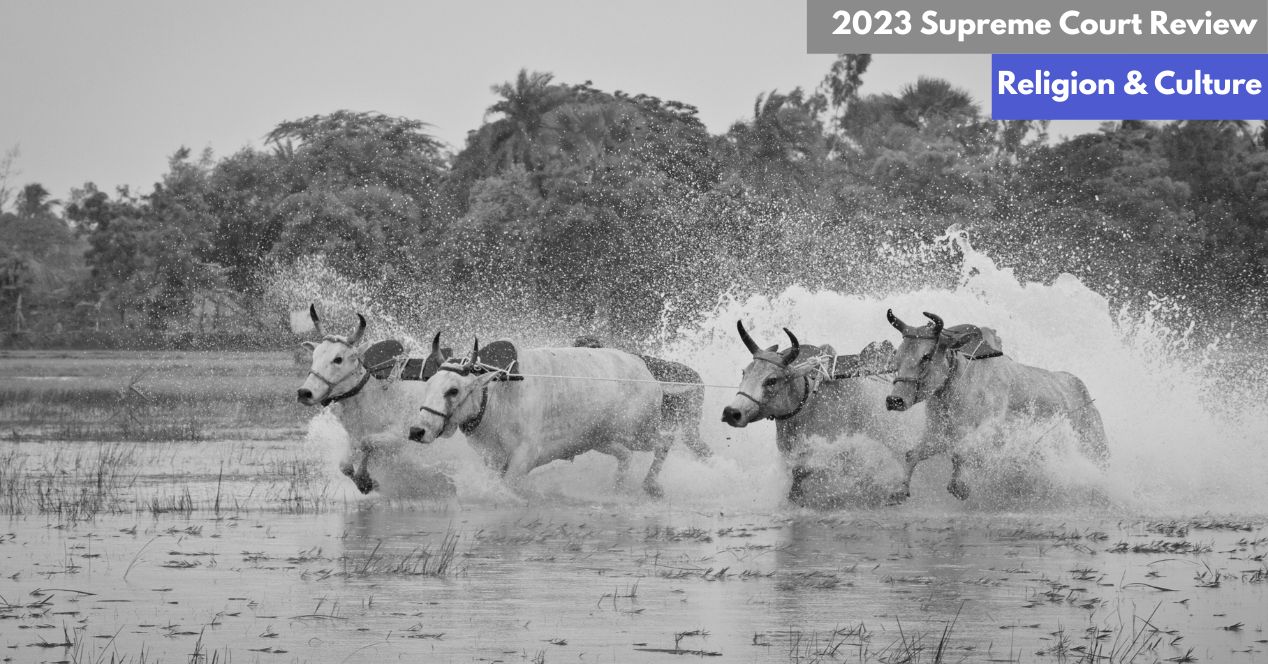
Maulekhi spoke about the conflicting stance of the Courts on environmental issues. Maulekhi said that while the Court strayed from the welfarist approach in matters like Jallikattu, it has, on various occasions, stepped in to protect the rights of animals against big corporations. Maulekhi echoed a hopeful note, saying that the last frontier for protection of animals is the Court – the protector of the most vulnerable.
Lastly, Panjwani took to the podium to speak about the merging approaches of the Supreme Court in the last decade. He stated that transformative and differential outlooks of the Court have merged, creating an unsure stance on emerging environmental jurisprudence.
Panjwani presented the curious case of the Asiatic Lion, elaborating on the efforts of the Supreme Court to aid the Asiatic Lion Reintroduction Project at the Kuno National Park. Panjwani said that despite directions of the Court, the Government had fallen short of acting.
Related articles

75 Years of SC Articles
Giving the green signal: The Supreme Court and the environment
The Court has relied on judicial innovation but the development imperative prevents it from committing to eco-centrism in an era of crisis
Analysis
Supreme Court Review 2025: Lacking a principled stance on environmental rights
In trying to strike balance between environmental rights and the development imperative, the SC delivered a mixed bag of verdicts in 2025
Analysis
Supreme Court Review 2024: Speaking green, acting grey on key environmental issues
While the Court strongly pushed for conservation in crucial environmental cases, it prioritised development projects in others
Analysis
Supreme Court Review 2023: Religion and Culture
The Court’s performance this year was more defined by what it didn’t do than what it did—no hearing for the Hijab Ban and Sabarimala cases