





Analysis
Irretrievable breakdown of marriage and the Supreme Court
A new book traces the origins of “irretrievable breakdown of marriage” as a grounds for divorce and addresses the gaps

…Muslim law regards marriage as a contract and consequently has far clearer rules regarding consent and divorce for both men and women, though the laws are still heavily skewed in favour of men even after the striking down of triple talaq. Talaq-e-hasan and talaq-e-ahsan, which can be issued only by husbands, are not instant but still require no reason or justification for their issuance, while women, who can initiate divorce by a process of khula, have to show they have faced cruelty or mistreatment in order to succeed.
Hindu law, on the other hand, regards marriage as a sacrament, making divorce considerably more difficult for both men and women. Under Section 13 of the HMA, a marriage may be dissolved on grounds of adultery, cruelty, desertion, bigamy, rape, etc. These are often called fault-based cases, where a divorce petition can be moved by either party without the consent of the other. A no-fault divorce can be sought only by mutual consent under Section 13-B, where both parties agree to have the marriage dissolved. In such cases, the parties would ordinarily file a motion for divorce after having lived separately for at least a year, and then have to wait six months before the decree could be passed by the court. The intent was to give them a ‘cooling-off period’ and allow time for reflection. There is no provision for a no-fault divorce that can be granted without mutual consent, that is, if one party simply wants out.
Incorporating irretrievable breakdown as a ground for divorce was considered by the Law Commission in 1974 and again in 1978 in its 71st report. The report noted that neither party needs to be individually at fault here and that the breakdown may be the result of prolonged separation, personality clash or incompatibility. Such marriages are ‘merely a shell out of which the substance is gone’. In these cases, the Commission recommended that the law be amended to provide for it as an additional ground for divorce. This recommendation was reiterated by the Law Commission in its 217th report.
In 2010, the government introduced the Marriage Laws (Amendment) Bill, 2010, which proposed to add IBM as a new ground for divorce in both the HMA and the Special Marriage Act. After receiving suggestions from relevant stakeholders, the Bill was amended and reintroduced as the Marriage Laws (Amendment) Bill, 2013. Under this Bill, the six-month waiting period could be mutually waived by the parties, and IBM was introduced as a separate ground where either spouse could seek a decree after three years of non-cohabitation. Additionally, a woman could oppose the petition on grounds of financial hardship, in which case the court could, considering all the circumstances, either make satisfactory arrangements to eliminate the hardship or dismiss the petition. This Bill was never passed.
In the 2023 case of Shilpa Sailesh v. Varun Sreenivasan, the Supreme Court was faced with two questions: First, whether it could dispense with the waiting period in mutual consent cases, and second, whether it could permit unilateral no-fault divorce or IBM. Under Article 142 of the Constitution, the Supreme Court is empowered to pass any decree necessary for doing complete justice in any cause or matter pending before it. Using this power, the court answered both questions in the affirmative. It recognized that in many cases, the mandatory waiting period only prolongs the misery of the couple and often delays or impedes a settlement.
In a 2026 case, a man sought divorce on the ground that his wife’s persistent refusal to engage in sexual intercourse with him would amount to mental cruelty, which is a valid ground for divorce under the HMA. The court handled the case deftly and admirably, refusing to attribute cruelty or malice to the decision to live separately or withhold sexual intimacy, but allowing divorce under irretrievable breakdown instead. However, it clarified that the power to do this would vest with the Supreme Court alone, as Article 142 does not grant this power to any other court. This power has been used in several other cases as well in the past few years.
One of the concerns that has weighed with both women’s rights experts as well as courts is the disadvantageous position that such divorces could place women in. In Sivasankaran v. Santhimeena, for example, the Supreme Court considered the question of social acceptance and economic security of women if unilateral no-fault divorces were freely granted.
It is a fact that the liberal notion of marriage as a mutually consented-to partnership, however desirable, is not yet the reality in much of the country and its dissolution usually entails enormous social and economic hardship for women and children. While these concerns are valid, the approach of the court to decide these cases under Article 142 restricts the application of IBM, because only the Supreme Court can act under this provision, and treats it as a subject of judicial discretion to be exercised on a case-by-case basis rather than a matter of right. In this way, it avoids the risk of family courts granting such divorces without a necessary examination of the social and financial situation of the parties.
This is a cautious approach, and one that avoids tinkering with personal law, but it is uneven in its impact, leaving the remedy available only to those with the time and resources to pursue their case all the way to the Supreme Court. Also, it is not that one can approach the top court directly in such cases, but only after having exhausted their options at the family court and High Court. To that extent, this approach is inaccessible for most.
What then, is the way forward? Surely it is better to have fewer happy marriages than millions of unhappy ones that exist only on paper. But it is only when divorce is normalized that we can eliminate the social stigma that still comes with it and ensure greater agency for women in matrimonial affairs. Just as the law needs to make getting married easier for people who want it, so it should be for getting divorced. There may be many more women who would want the option of an easier and quicker divorce, provided that their own and their children’s social and economic security is not at risk. Once this is seriously addressed, the law can and should evolve a more mature approach to matrimonial law, one that is based on consent, rather than control.
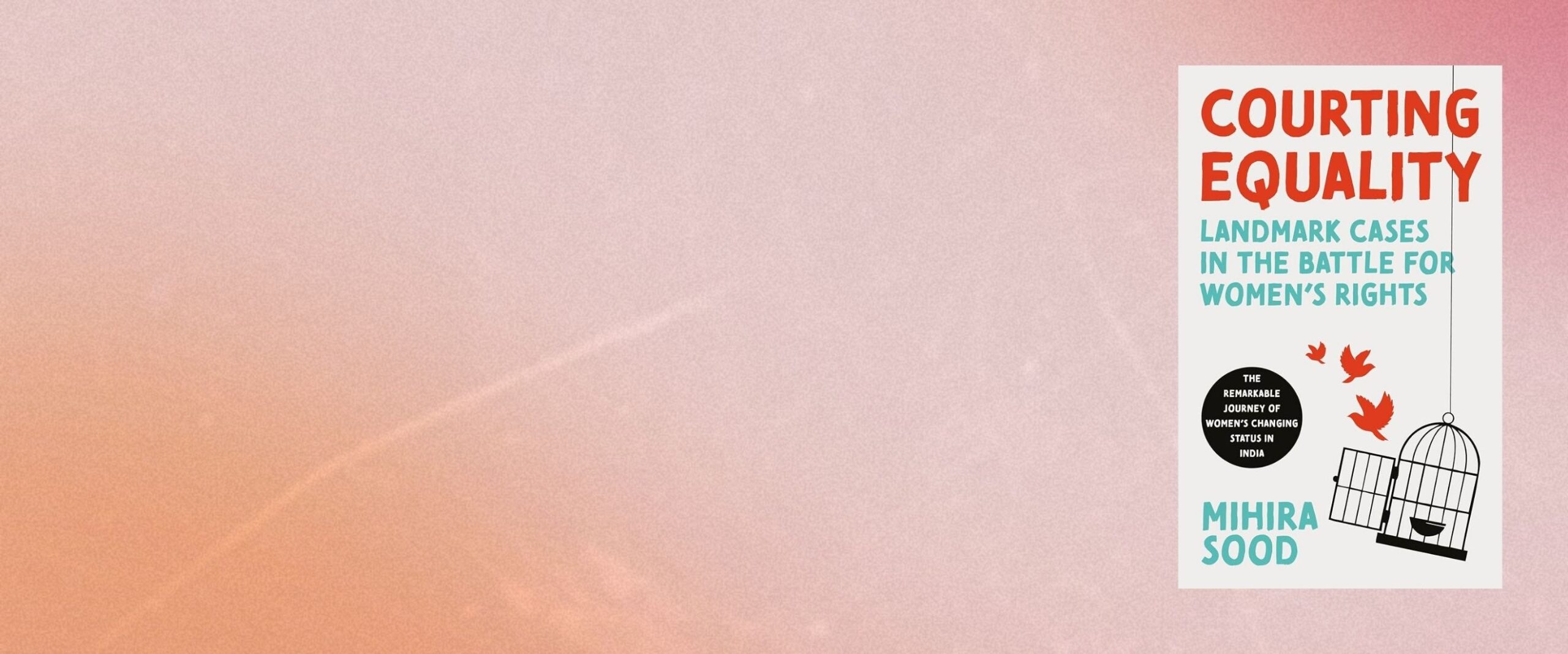
(This is an excerpt from “Courting Equality: Landmark cases in the Battle for Women’s Rights,” published recently by Juggernaut Books)
Related articles


Analysis
The couple behind the Supreme Court’s first PIL
An excerpt from “14 Lawyers: Portraits from the Bar” by Senior Advocate Raju Ramachandran chronicles the legacy of Nirmal & Kapila Hingorani

Analysis
“Let the Union of India…put the bricks back”: Former Attorney General K.K. Venugopal on Babri Demolition
In his autobiography, Senior Advocate K.K. Venugopal describes the Supreme Court proceedings before and after the Babri demolition
Analysis
“The Supreme Court treated the Constitution as lex rather than jus”
In this excerpt from the conclusion of a new book, V. Krishna Ananth argues that the SC has often downplayed the aspirations of the framers
Analysis
How India’s judiciary tried to shape its own independence
Tensions between the Judiciary and the Executive over appointments were brewing even as the Constitution was being drafted