





Analysis
Out of tune: Supreme Court backs off from Dagar-Rahman copyright battle
The SC acted as an ADR forum instead of engaging with issues of originality and authorship in Indian classical music.

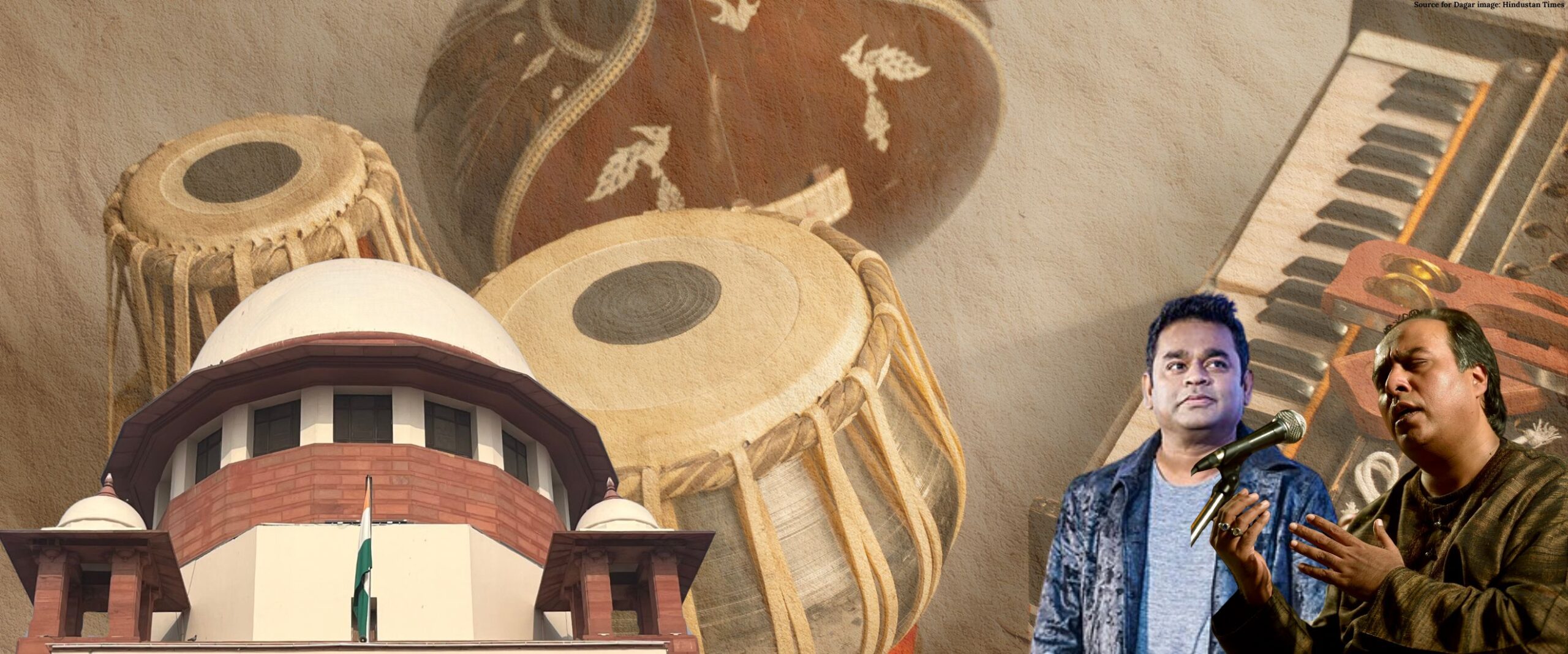
The Supreme Court of India is increasingly becoming a forum for high-profile intellectual property disputes. Over the last year, however, its engagement with the field remained uneven and, at times, notably restrained.
On the one hand, the Court substantively examined the design-copyright interface in Cryogas v Inox India Ltd, and questions of trademark infringement and passing off in Pernod Ricard India v Karanveer Singh. Even so, it has repeatedly declined to settle other significant, long-pending questions of law—refusing to clarify the scope of the Competition Commission’s jurisdiction over patentees’ conduct in CCI v Ericsson, or deciding the design–trademark interface in Crocs Inc v Bata India.
The reluctance also surfaced in a more recent copyright dispute between an Indian classical musician and a composer of film music. Ustad Faiyaz Wasifuddin Dagar and A. R. Rahman are in a face-off over the song ‘Veera Raja Veera’ from the film Ponniyin Selvan: II. The matter raises difficult questions about the standards of proof required—at the interim stage—to establish originality and authorship in Indian classical music.
Yet, the Supreme Court refused to “express any prima facie opinion on merits” and instead merely “persuaded the parties to consider an alternative interim arrangement.” By sidestepping the core issues, the Supreme Court missed an opportunity to correct the law and provide much needed guidance on interim standards.
The background score
Ustad Faiyaz Wasifuddin Dagar is a well-known Indian classical musician and Padma Shri awardee. He belongs to the famous Dagar Gharana, a lineage of musicians known for the distinctive Dagarvani style of Dhrupad singing.
He claimed that his father and uncle (late Ustad N. Zahiruddin Dagar and late Ustad N. Faiyazuddin Dagar, collectively the Junior Dagar Brothers) composed a musical piece titled ‘Shiva Stuti’ in the 1970s. The composition was performed at several international concerts and released as part of the album ‘Shiva Mahadeva by the Dagar Brothers’ by PAN Records. After their deaths, Dagar claimed, the rights in their compositions devolved upon him through a family settlement. He continued to perform the ‘Shiva Stuti’ publicly and teach it to students.
In 2023, Dagar came across the song ‘Veera Raja Veera’. He alleged that its musical composition was similar to the tune of ‘Shiva Stuti’, though the lyrics were different. Interestingly, the song was sung by two of Dagar’s students. They presented ‘Shiva Stuti’ and other traditional compositions to Rahman in a vocal (tarana-style) form for him to choose from for the film. The movie credits initially stated that the composition was “based on a Dagarvani tradition Dhrupad”.
Dagar filed a suit before the Delhi High Court, alleging infringement of copyright and violation of moral rights, particularly the right to attribution of the original composers. Initially, Dagar sought an injunction to restrain Rahman from using the composition in ‘Veera Raja Veera’ and to take down the song. He also sought credit for the Junior Dagar Brothers as the original composers.
However, since the song and film had already been released, the Single Judge refused the injunction. But it granted other reliefs to Dagar. It directed the defendants to deposit Rs. 2 crore with the court registry as a pre-estimated non-exclusive licence fee. The Single Judge also directed the defendants to credit the Junior Dagar Brothers by including the line: “Composition based on Shiva Stuti by Late Ustad N. Faiyazuddin Dagar and Late Ustad Zahiruddin Dagar.”
The Division Bench set aside this order on appeal. The matter eventually reached the Supreme Court through a Special Leave Petition.
Ragas and rights
Copyright law recognises distinct subject matter in which copyright may subsist. These include musical works (the tune or composition), sound recordings (the recorded soundtrack combining music, lyrics and performances) and performers’ rights (singers). For copyright to subsist, the work must be an original work of authorship. Once this is established, the court then considers whether the defendant copied it by creating a substantially similar work.
The threshold for originality is relatively low. Originality exists where a work involves skill, judgement and a minimal degree of creativity (Eastern Book Company v. D. B. Modak, 2007). Originality lies on a spectrum: at one end are works that are copied and at the other end are works that are unique. Most protected works fall somewhere in between.
As for authorship, an author is generally understood to be the “master mind” or the person who controls the creative process. For musical works, the author is the composer.
In this context, Indian classical music consists of common musical elements that define the genre. These common elements or building blocks include ragas that exist in the public domain. Over generations, however, groups of musicians organised into families or lineages known as “gharanas” have rearranged and interpreted these ragas to produce distinctive compositions and styles of singing.
In the present case, the defendant challenged the originality of ‘Shiva Stuti’ which is based on the Adana Raga. Interestingly, if Dagar’s song lacks originality, the same reasoning may apply to Rahman’s composition, particularly if the tunes are similar. And many may indeed conclude that the tunes are strikingly similar—decide for yourself by listening to them here and here.
Single Judge sets the scale
At the interim stage, the Single Judge (SJ) and the Division Bench (DB) came to opposite conclusions on originality and authorship. The SJ followed a sequential approach, first assessing originality and then examining authorship, ultimately holding both in favour of the plaintiff, and also finding infringement.
Although ‘Shiva Stuti’ was based on the Adana Raga, the SJ held that it was not a copy. The Junior Dagar Brothers had selected and arranged the notes, tune and timing to create their own rendition of the raga. The court also recognised that copyright can subsist in Hindustani classical musical works more broadly.
On authorship, Dagar’s evidence was not the strongest. He was unable to produce documents expressly naming the Junior Dagar Brothers as “composers”. Instead, he relied on album covers, international concerts and unsigned musical notes to show that the composition had been created and performed by his father and uncle in the 1970s.
For this, the SJ took into account the realities of the time. Documentation was not the norm. Many Indian musicians did not read or write musical notation and composed orally, with recognition flowing from public performances rather than written records. Since the defendants were unable to identify any alternative author, the court concluded that the plaintiff’s claim was sufficient, at least at the interim stage, to recognise authorship.
Division Bench strikes a false note
By disagreeing with the SJ, the DB risked diluting the interim rights available to classical musicians. The DB held ‘Shiva Stuti’ to be unoriginal not so much because of its similarity to the Adana Raga, but primarily because it had no identifiable author.
This conclusion appears to rest on certain assumptions. First, the absence of direct evidence of authorship. Since Dagar was unable to produce a written record naming the Junior Dagar Brothers as composers, the court refused to ascertain authorship from the circumstances and realities of the time. The court therefore set a very high standard for proving authorship at the interim stage.
The implications of this standard should concern classical musicians and collective artists. At least at the interim stage, courts may no longer examine whether a work reflects skill, judgement or creativity. Instead, the inquiry could collapse into a narrow question of whether or not a clearly identifiable author exists on record.
More concerning, however, is the hasty assumption that much of Indian classical music is effectively ‘authorless’ and therefore ‘unoriginal’. The DB proceeded on the premise that because Indian classical music is generally “ancient traditional heritage”, often created orally, sometimes collectively, and recorded only later, most of it must be unoriginal. Protection extends only to performances in the form of performers’ rights. Such reasoning casts serious doubt on the copyrightability of large swathes of Indian music.
Even where music is created collectively, there may still be an identifiable author who shapes and controls the creative process. While the determination of the “real” author is a matter for trial, the submission of credible evidence of authorship at the interim stage should have been sufficient for the court to proceed to the issue of infringement. This would have allowed the court to focus on assessing whether ‘Shiva Stuti’ and ‘Veera Raja Veera’ are substantially similar, which is ultimately where the real stakes lie.
Further, and rather worryingly, the decision does not sit comfortably with established copyright law. The DB appears to suggest that for a work to qualify as “original” it must “originate from the author.” In the originality assessment, the ‘originate from the author’ test is used in a limited sense to determine whether a work has been copied, i.e., whether it originated from the author as opposed to being derived from another source. The DB misapplies this principle by using it to determine authorship, rather than to assess whether ‘Shiva Stuti’ was a copy of Adana Raga. The inquiry into originality is distinct from the question of authorship, and conflating the two leads to analytical confusion.
And finally, this conclusion is contrary to the scheme of the Copyright Act, 1957. The Act recognises that subject-matter may be protected even where the author is unknown or unidentified—for example, in the case of anonymous works, pseudonymous works and orphan works (Section 31A). Such works are not treated as being in the public domain merely because the author cannot be identified. Instead, anyone seeking to use them must get a licence from the Commercial Court.
The sound of the SC’s silence
As a result of the DB’s decision, Rahman no longer needed to credit the Junior Dagar Brothers. So, Dagar took the dispute to the Supreme Court.
The Supreme Court, on its part, did not play a role beyond brokering a compromise between the parties. It did not address substantive issues such as standards for originality, authorship and the standard of proof at the interim stage.
The intervention offers little to the plaintiff. In the revised credit, ‘Veera Raja Veera’ is characterised as “inspired by”—rather than “based on”—the ‘Dagarvani Tradition Dhrupad’; the Junior Dagar Brothers are recognised merely as having “first recorded” ‘Shiva Stuti’ rather than as its original composers.
It remains to be seen whether the pending civil suit will culminate in a final decision. As is often the case in intellectual property disputes, the matter may settle at the interim stage, further underscoring the Supreme Court’s missed opportunity to provide authoritative guidance.
Aparajita Lath is an intellectual property lawyer based in Bengaluru. She can be reached at aparajita@lathlaw.com.
Related articles
Analysis
Crocs-Bata: Supreme Court misses opportunity to clarify a key question of design and trademark law
In treating ‘trade dress’ and ‘trademark’ as distinct concepts, two benches of the Delhi High Court may have overlooked a doctrinal point

Analysis
Personality rights: The law must not overprotect fame
A look at the spate of image-related cases filed by stars—through the prism of the rights to publicity, expression, privacy and livelihood
Analysis
Touch me not
Another day, another ‘ban’—is the NCERT matter an opportunity for the Court to question alleged executive interference in curriculums?
Analysis
Atomic risk
The Supreme Court heard a petition challenging India's new nuclear energy law just as the world confronted nuclear safety's stakes.