





Analysis
Prohibition of Gambling: Court in Review
A timeline of laws and judgements tracking the evolution of Indian gambling laws since 1867.
1867
The Public Gambling Act
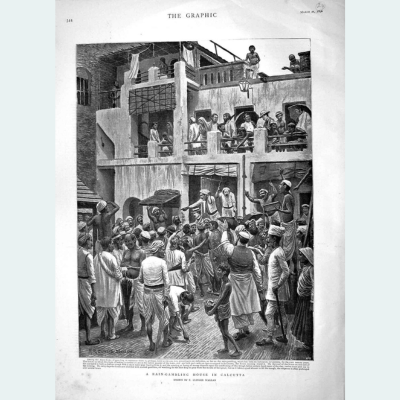
The Public Gambling Act (1867), one of colonial India’s earliest gambling laws, prohibited public gambling by outlawing “common gaming houses”. The scope of the Act was limited to public gambling and did not extend to games of “skill”. Subsequent State Legislations, including the Maharashtra Prevention of Gambling Act, 1887, expanded the definition of “gaming” to include wagering and betting, while carving out statutory exceptions such as betting on horse races.

1925
Shanmuga Mudaliar v Kumaraswami Mudali
The Single-Judge Bench of the Madras High Court held that a chitfund cannot be classified as an illegal lottery. The Court observed that the defining features of gambling are wagering and the assumption of risk arising from uncertainty. The Court held that just because some aspects are decided by chance, such as in chit funds, it cannot be categorised as gambling.

1930
Babasahed Rahimsaheb v Rajaram Raghuram Alpe
The Single-Judge Bench of the Bombay High Court held that gambling requires players themselves to wager an irrecoverable sum that is forfeited upon losing. By contrast, money collected from spectators, which later forms part of the prize pool and remains recoverable, does not constitute wagering.
1955
The Prize Competitions Act
The Prize Competition Act, 1955 came into force on 22 October 1955 regulating prize competitions in the nature of gambling. The Statement of Objects and Reasons noted that “crossword puzzles” and “similar competitions” are in the nature of gambling, even though they purport to be games of skill. The Act sought to curb games of skill which promote the “gambling spirit.”
1957
R. M. D. Chamarbaugwalla v The Union Of India
The Petitioners, challenged Sections 4 and 5 of the Prize Competitions Act, 1955, contending that the law extends beyond gambling competitions to cover substantially skill-based competitions. The five-judge Bench of the Supreme Court distinguished between competitions of skill and those of chance, holding that gambling activities could be prohibited, while skill-based activities could only be regulated. Applying the doctrine of severability, the Court confined the Act’s operation to competitions in the nature of gambling.
1968
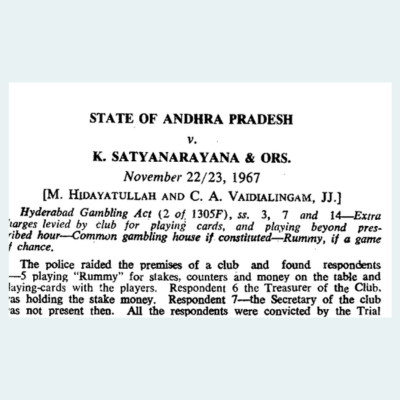
State of Andhra Pradesh v K. Satyanarayanan
The two-judge Bench of the Supreme Court held that rummy is predominantly a game of skill, rather than chance and differentiated between the three-card game, which it described as a game of pure chance. The Supreme Court affirmed this in K.R. Lakshmanan v State of Tamil Nadu (1996).
1995
MJ Sivani v State of Karnataka
The two-judge Bench of the Supreme Court of India held that video games fall under the definition of “gaming” under the Karnataka Police Act, 1963, making them subject to regulation. The Bench further held that video games which are purely games of chance must be prohibited under the Act.

2012
The Director General of Police, State of Tamil Nadu v Mahalakshmi Cultural Association
The two-judge Bench of the Madras High Court held that although rummy is a game of skill, playing it for stakes amounts to gambling. The original respondents challenged the matter in the Supreme Court, where several online rummy companies intervened. In 2015, the Supreme Court permitted the appellants to withdraw the appeal without deciding whether online rummy is a game of skill or chance.

2017
Varun Gumber v Union Territory of Chandigarh
The Single-Judge Bench of the Punjab and Haryana High Court held that fantasy sports platforms such as Dream11 predominantly involve skill and cannot be deemed as gambling. In October 2019, the Supreme Court declined to interfere with the High Court’s decision. The Rajasthan High Court later adopted the same reasoning in Ravindra Singh Chaudhury v Union of India (2020).

2021
Play Games 24 x 7 Private Limited v State of Kerala
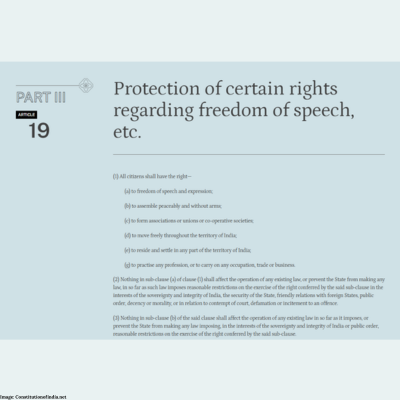
The Single-Judge Bench of the Kerala High Court held that online rummy is a game of skill and whether it is played for stakes does not alter the nature of play.The Court held that offering such games was protected as a business under Article 19(1)(g) for companies offering such games.
2021
Junglee Games India Private Limited v State of Tamil Nadu
The Madras High Court struck down the Tamil Nadu Gaming and Police Laws (Amendment) Act 2021, which imposed a state-wide blanket ban on games of skill such as rummy and poker. The Bench held that the amendment was manifestly arbitrary since the State under Entry 34 of List II of the Seventh Schedule could only legislate on games of chance, constituting gambling.

2023
All India Gaming Federation v State of Karnataka
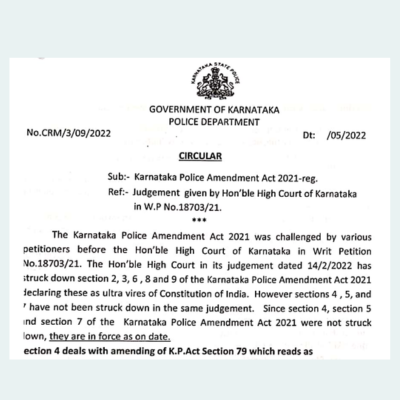
The Division Bench of the Karnataka High Court struck down several provisions of the Karnataka Police Amendment Act, 2021 which criminalised playing or facilitating online games including those involving stakes without distinguishing between games of “skill” and “chance”. The Bench reaffirmed that games of skill do not constitute gambling and the extent of prohibition on online gaming must be restricted to games of chance, and not skill.
2025
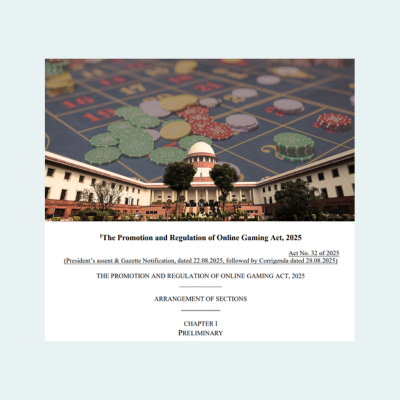
The Promotion and Regulation of Online Gaming Act
Enacted on 22 August 2025, the Promotion and Regulation of Online Gaming Act (PROG Act) established a national framework for regulating the online gaming sector, including e-sports and social gaming. Section 5 prohibited online money games and gaming services without distinguishing between games of skill and games of chance, while prescribing penalties for contraventions.
2026
State of Tamil Nadu v Junglee Games India Private Limited
The Supreme Court set aside the judgements in All India Gaming Federation v State of Karnataka (2023) and Junglee Games India Private Limited v State of Tamil Nadu (2021), holding that even games predominantly involving skill may amount to gambling when played for stakes, bringing them within the scope of Entry 34 of List II of the Seventh Schedule. A day after the verdict, the same bench upheld 28 per cent GST on actionable claims arising from betting and gambling activities in Directorate General of Goods and Services Tax Intelligence (HQs) v Gameskraft Technologies Private Limited. The rulings affirmed that States have the power to regulate or prohibit gambling activities under their legislative competence.

Related articles

Analysis
From Skill to Stakes: How Junglee Games and Gameskraft reshape India’s online gaming laws
As these landmark judgements on betting and gambling redefine gaming laws, a major federal question still hangs in the balance
Analysis
Skill or chance: Will the Supreme Court strike down the Real Money Gaming ban?
By taking the outright ban route, the new Union legislation collapses the tried-and-tested distinction respected by state regulations