





Analysis
Congratulations, Mr. Solicitor General
With his extension, Tushar Mehta is on track to be one of India’s longest serving Solicitor General

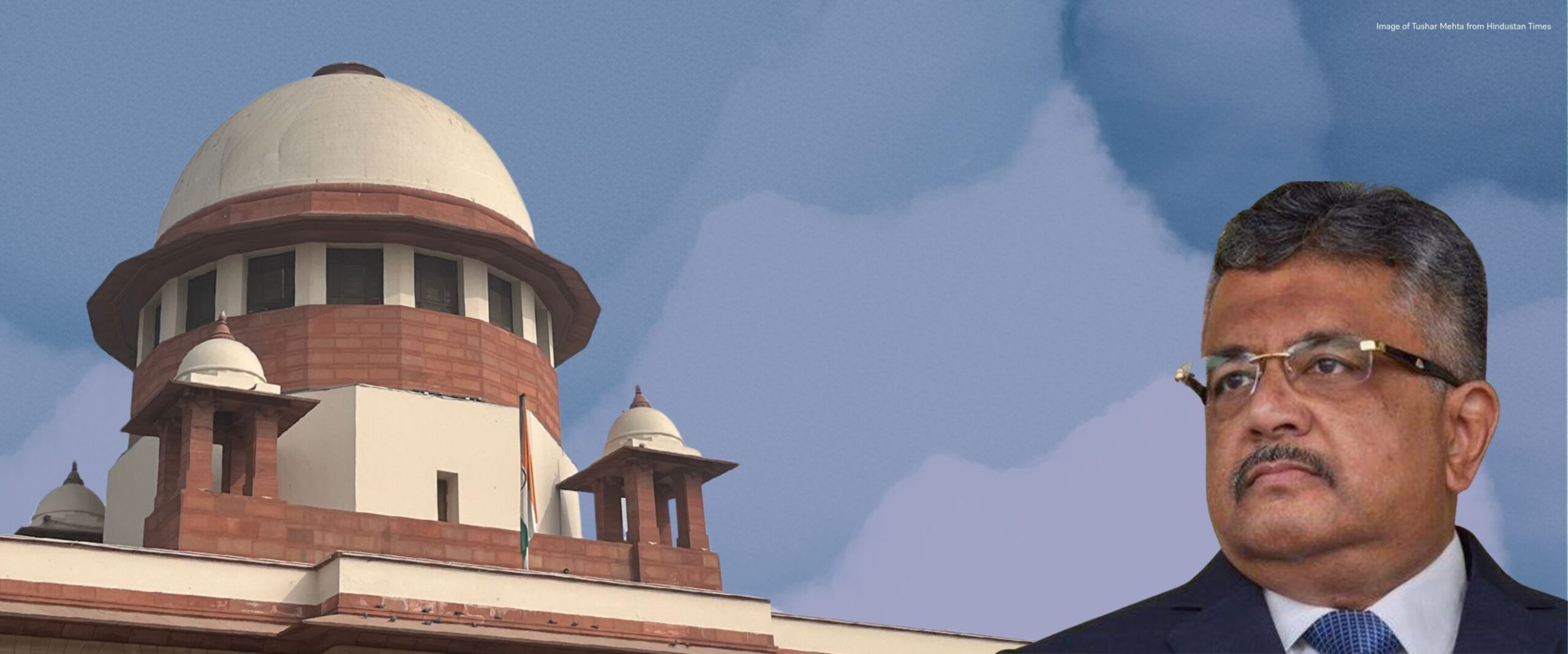
On 20 June, the Department of Personnel and Training (DoPT) extended the term of Solicitor General (SG) Tushar Mehta by three years starting from 1 July. This extension means that Mehta will hold the SG office for at least 11 years —close to surpassing former SG C.K. Daphtary who served as India’s first SG for 12 years (1951-1963).
During his time as the SG, Mehta has emerged as one of the key players for the Union executive. He was ranked 48 on the Indian Express list of most powerful Indians, higher than Minister of Law and Justice, Arjun Ram Meghwal and the AG who was not included in the list. In his recent memoir, former Attorney General K.K. Venugopal described Mehta as “young, forceful and highly effective” with an ability to handle cases “as well as an attorney general would.”
It is no secret that Mehta is one of the most reliable law-officers for the Union. He has secured victories in some important cases, often arguing longer than the AG in Constitution Bench matters. Mehta has appeared for the Union in writ challenges and bail pleas involving opposition ministers. He has appeared across District and High Courts, representing the Enforcement Directorate and the Central Bureau of Investigation. The renewal of Mehta’s term is the continuation of an arrangement that the Union clearly values. A September 2022 directive consolidated the allocation of all Union government cases within the SG’s office. This enables Mehta to assign cases to all government empanelled lawyers, except the AG. Further, it allows Mehta to appear wherever necessary. No Union matter can miss his attention.
Many former law officers have gone on record post-retirement to express what it means to be a government empanelled lawyer. For instance, in Venugopal’s opinion, the AG’s office does not act for the ruling party alone, “but for the country, that is the people of India.” Similarly, M.C. Setalvad, the first and longest serving AG, firmly believed that the office should have no political influence. While the AG is a constitutionally-created position, the SG is not bound by the same expectations. As the SG office becomes as important as the AG office, the norms that apply to this office need greater clarity. Mehta delivers what his client wants and leans into the Union’s broader political strategy. A recent article in ThePrint suggests that Mehta is loyal to his brief, presents the “correct political line” before the court, and has the ability to be the “voice of the government” in the courtroom.
Two years ago, Mehta denied Union support to a law enacted by Parliament during the Indira Gandhi-led Congress government. The law in question was a 1981 amendment which confirmed the minority status of Aligarh Muslim University. At the time, former Chief Justice D.Y. Chandrachud described the stance as “radical” and pointed out that ruling party disagreement with an older amendment must be rectified through the legislature by way of another amendment. He reminded Mehta that “irrespective of which government represents the cause of the Union of India” the Parliament remains ‘eternal’. Mehta was prompt to respond that the Union has chosen not to side with the amendment.
Of late, Mehta’s arguments reflect the Union’s preference for a narrower and more restrictive line of constitutional interpretation. During the Sabarimala Review, he challenged the interpretation of “constitutional morality”, calling it a “judicially evolved, vague and indeterminate concept.” He demanded that “all judgments which use the expression ‘morality’ to mean ‘constitutional morality’ are per incuriam” and required to be declared as such. Going by his definition, these include the decriminalisation of adultery and homosexuality, the 2018 Sabarimala verdict, and recent decisions permitting the withholding of treatment for a patient in permanent vegetative state. By consistently anchoring his arguments in “what the framers intended,” Mehta attempts to persuade Constitution Benches to reject expansive interpretations. In some instances, the Court is convinced by this line of argument—the Court’s advisory opinion on powers of the governor reflects the original intent that Mehta pushed for.
If the Union’s relationship with Mehta sustains, he will break Dapthary’s record if his term is renewed once again in 2029. In his autobiography, Fali S. Nariman recalls how Dapthary ticked him off on accepting the role of the Additional SG in 1972, stating: “with this government, you will find it a thankless job”. In 2026, Mehta may take credit for elevating the SG to be the primary arbiter of constitutional interpretation and the legal enforcer of the political priorities of the Union executive.
This article was first featured in SCO’s Weekly newsletter. Sign up now!
Related articles

Court Data
Sabarimala Reference | Arguments time split
The review petitioners took close to 40 hours to conclude submissions over 16 days of arguments
Analysis
Postman ban
The Delhi High Court's decision on suspension of Telegram services raises questions on intermediary liability
Analysis
The audit from below
On unrelated facts, both Allahabad and Madras High Courts fault the Supreme Court for ignoring consistency.
Analysis
The first half: A Court under strain
As the Court's strength rises to 38, old cases, open questions and new controversies crowd its attention