





Analysis
Eternal vigilance, RTI, and the role of citizens in democracy
Recalling the importance of RTI activism in light of recent comments from the top judiciary

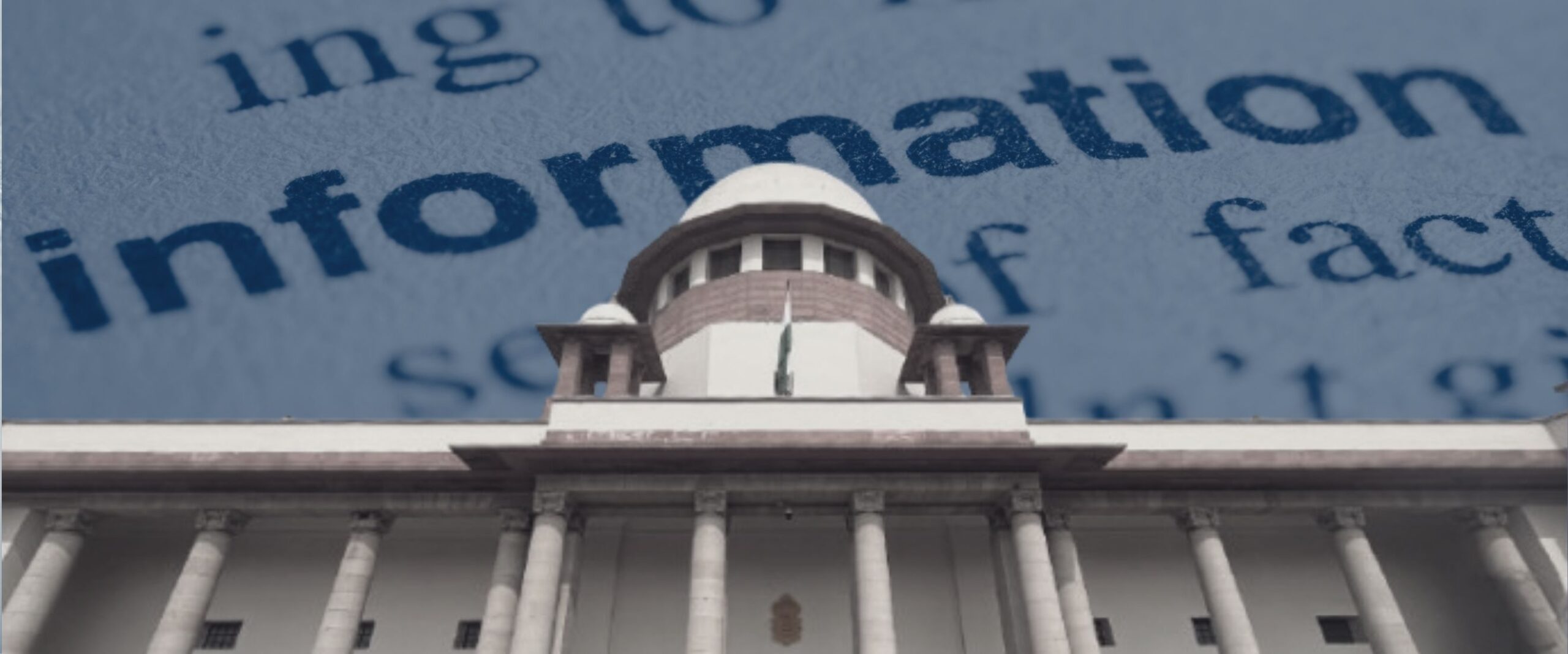
“The condition upon which God hath given liberty to man is eternal vigilance…”
– John Philpot Curran
Over two decades ago, when India adopted the Right to Information (RTI) Act, 2005, it heralded a culture of citizen-led vigilance in democracy, putting an end to the colonial-era legacy of state secrecy. However, recent developments point to a shift in the Supreme Court’s attitude towards public scrutiny of governmental affairs.
Justice Sandeep Mehta’s recent headline-grabbing comment that “RTI activism has become a new business” is one such instance. On 1 June 2026, a Bench of Justices Mehta and Vijay Bishnoi refused anticipatory bail to activist Ramesh Kumar Behl and his aide who were monitoring a road construction project in Punjab. Referring to the appellant as a “nobody” and “so-called RTI activist”, they questioned his authority to oversee the execution of the public work programme. The Bench observed that the Central government had issued the funds for the project and will take care of its construction. Behl and his aide were accused of blocking the road and intimidating workers and the project supervisor. The Punjab and Haryana High Court had earlier recorded a statement by the appellant’s counsel alleging that they were falsely implicated in order to protect the contractors involved in the corruption they exposed.
It is not my intention to condone acts of intimidation of public authorities and the allegations against Behl may well be true. However, for the apex court to suggest that citizen vigilance via the use of RTI or other means is per se disruptive amounts to throwing the baby out with the bathwater.
Corruption in public infrastructure projects
Going by the details reported thus far, it is difficult to ascertain the exact details of the corruption alleged by Behl and whether any steps have been taken to establish their veracity. But it is no secret that public infrastructure projects in India are susceptible to financial misappropriation and contracts are often issued to those favoured by politicians. A peer-reviewed paper published in 2018 in the Journal of Development Economics uses data on 88,000 roads built under the Pradhan Mantri Gram Sadak Yojana (PMGSY) to document the role of political influence in allocation of construction contracts and the likelihood of such projects never being completed. Meanwhile, village-level census data revealed that PMGSY monitoring data on completed roads includes a number of entirely fictitious ones. Not only roads, but all major infrastructure projects, including private building constructions are ripe with illegalities and corrupt practices which compromise their quality. Collapse of bridges, national highways, and commercial buildings due to poor construction cost lives and pose a serious public hazard. The World Economic Forum has noted that corruption is one of the major barriers to economic development and growth in India and recommends closer monitoring of public infrastructure projects by citizens (social auditing) as an important step to ensure transparency and accountability.
Citizen vigilance: the very lifeblood of democracy
Rajasthan was among the first states to implement the state RTI legislation in 2001 prior to the law’s country-wide adoption in 2005. In 1996, the state had already opened up access to panchayat records to ordinary citizens to allow them to monitor expenses incurred on public works. During my doctoral fieldwork, I came across several instances in the State where grassroots activists and ordinary citizens successfully monitored the implementation of public works and infrastructure projects —be it roads, schools, or hospitals—and proactively took steps to report and curb corruption. For instance, it was using RTI data that a woman from Jawaja exposed discrepancy in the distribution of free medication at the government hospital, leading to a public audit and action against the hospital staff found guilty of misusing public funds.
Social audits have emerged as an effective tool against siphoning of state funds. Initially led by organisations like Mazdoor Kisan Shakti Sangathan (MKSS), they were eventually institutionalised via the MNREGA programme and have been adopted by states such as Telangana and Andhra Pradesh as well.
In Delhi, Arvind Kejriwal’s NGO Parivartan used data obtained through the state RTI Act to conduct social audits of the Public Distribution System, road-laying works, and the Delhi electricity board. The importance of social audits was also emphasised by the Supreme Court in 2018 while deciding a PIL matter on whether welfare measures meant for construction workers actually reached them.
RTI activism has led to several meaningful judicial interventions, bringing to light facts that are crucial for dispensing justice. The Court has repeatedly upheld its application, extending its ambit to both financial regulators as well as its own office, balancing the need for transparency and accountability with institutional independence. In 2015, it ruled that the Reserve Bank of India cannot hide all information held under it as a fiduciary as it is accountable to citizens for the management of public money. In 2019, following prolonged activism by Subhash Chandra Agrawal, the Court brought the CJI’s office under the RTI Act, permitting access to information on judicial appointments and declaration of assets on a case by case basis.
RTI action is no easy task
Both the RTI Act, 2005 and the Whistleblower’s Protection Act, 2011 were notably adopted after the tragic death of civil engineer Satyendra Dubey in 2003.
In 2002, Dubey had exposed corruption in implementation of the ‘Golden Quadrilateral Highway Construction Project’, initiated in 2001 by then Prime Minister Atal Bihari Vajpayee. Gunned down in 2003, the 31-year-old’s story raised a country-wide furore, drawing attention to the stakes involved in whistleblowing big money projects. Despite subsequent legal measures to encourage and protect whistleblowers, Dubey’s story rings just as relevant today as anti-corruption activism remains fraught with the risk of retaliation. The Commonwealth Human Rights Initiative documents nearly 500 reported attacks on RTI users since 2005. In such a scenario, the apex Court remains the last bastion of justice available for ordinary citizens to expose corruption.
Numbers counter the rhetoric
On 15 May, when Chief Justice Surya Kant likened unemployed youngsters to cockroaches, he stated that “they go on to become media, social media and RTI activists and start attacking the system.” Accusing RTI activists of being troublemakers and adopting a dismissive attitude towards their efforts to seek accountability is a common defence adopted by public authorities against increased scrutiny.
Instead, as noted in a 2014 report, RTI activism is often a cry for attention to highlight genuine public grievances. Less than 1 per cent of RTI applications filed by citizens were of a vexatious or frivolous nature intended to harass a public authority. What’s more, the high rates of filing may be more indicative of the crumbling RTI infrastructure, defunct State-level Commissions, long pendency of requests and arguably frivolous rejections on technical grounds. At the Supreme Court, a majority of rejected requests fall under the “other” category, providing no reasoning for refusal.
Undermining the spirit of democracy
When the country’s top court discourages RTI activism, it violates the very purpose for which the Court was established: to uphold Constitutional values and the right to information under Article 19(1)(a). In 1973, the Court had observed that “Fundamental Rights themselves have no fixed contents, most of them are empty vessels into which each generation must pour its contents in the light of its experience.” As Dr. Sudarsana Natchiappan notes, the attempt of the Court, therefore, should be to “expand the reach and ambit of fundamental rights by way of judicial interpretation.” To accept unquestioningly the functioning of government and to not ask questions of it or monitor its activities undermines the very spirit of citizen engagement vital for a democracy.
Vidya Venkat is a Research Fellow on the Global Research Network on Parliaments and People, a European Research Council-funded project based at SOAS University of London. Her doctoral thesis on India’s right-to-information movement won the Radcliffe Brown-Sutasoma Award from the Royal Anthropological Institute, UK for outstanding merit. She has previously worked as a journalist and communications consultant in India since 2004.
Related articles

Analysis
RTI See-Saw
DESK BRIEF: On March 4th, a three-judge bench held that citizens could not file RTI requests to obtain copies of pleadings.
Analysis
RTI Judgment: Confusions about Public Interest
Office of the Chief Justice opened up to Right to Information Act, 2005.

Analysis
RTI, privacy, proportionality, empirical evidence…and AI transcripts—key themes from the Electoral Bonds judgement
We highlight four aspects that stood out to us in the Court’s ruling on the unconstitutionality of the Electoral Bonds Scheme

Court Data
500 RTI Rejections at the SC: The ‘Other’ Face of Transparency
Out of the 5,585 RTI applications received in 2020 and 2021, the SC rejected 537 with a majority coming under the 'Other' category.