





Analysis
Gubernatorial Powers, Federalism and Institutional Balance | Highlights from the Courts and Constitution Conference 2026
The panel discussion revolved around the advisory opinion delivered in the aftermath of the Tamil Nadu Governor decision of April 2025

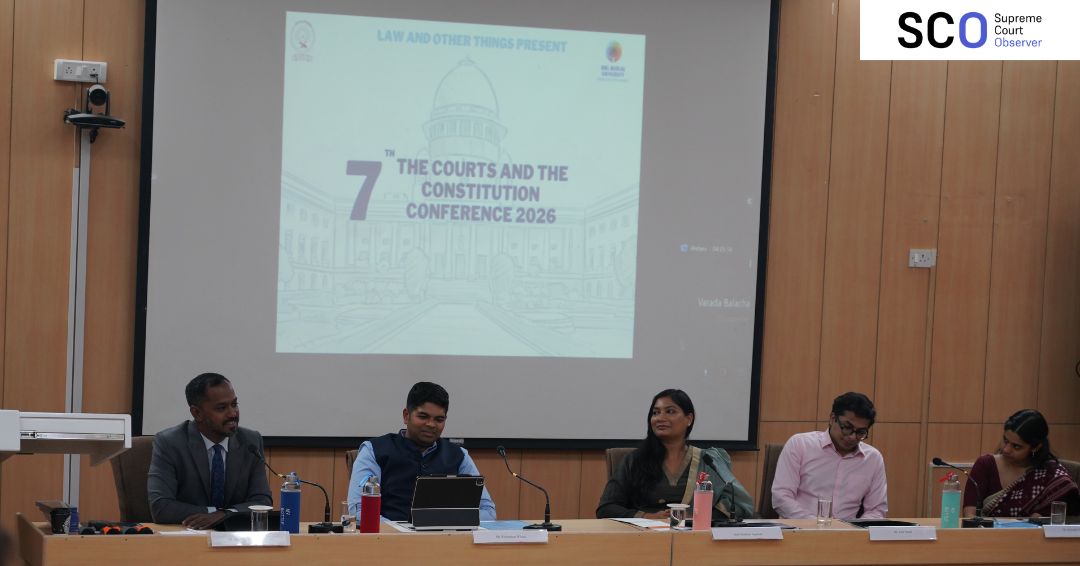
Over 28 and 29 March 2026, the NALSAR University of Law, with the Law and Other Things (LAOT) blog and the BML Munjal University organised the 7th edition of the Courts and Constitution Conference at NALSAR University. The Conference hosted five panels on federalism and governors powers, the Special Intensive Revision (SIR) of electoral rolls, environmental law, policing and state violence, and a memorial panel for late Prof. M.P. Singh.
The Supreme Court Observer participated in the Conference as its media partner. In this report, we bring you key highlights from the panel on “Reworking Constitutional Boundaries: Gubernatorial Power, Federalism, and Institutional Balance.”
Moderated by Prof. Pankhuri Agarwal, BML Munjal University, the panel included Lalit Panda, Vidhi Centre for Legal Policy; Advocate Manuraj Shunmugasundaram, Advocate Richardson Wilson and Advocate Sumedha Ray Sarkar.
The discussion centred on powers of the Governor under Article 200, the Supreme Court’s judgement in Tamil Nadu Governor and the advisory opinion in the Presidential Reference that followed.

Governor office a colonial relic
Setting the stage, Wilson began with the colonial genealogy of the office of the Governor. Describing the post as a “square peg in a round hole”, he argued that it was not designed for a quasi-federal republic as it remained rooted in the unitary hierarchies of the British-era Government of India Acts of 1919 and 1935. He stated that the British wanted the “ultimate say,” and that we have carried that veto-centric shadow into a modern era where it no longer fits. He compared it with the powers of the Governor-General in pre-Independent India who could veto or modify any decisions made by a province.
Refusal to accept data
The next speaker was Sarkar who recalled the Presidential Reference matter in which he appeared. He stated that by refusing to accept state data on gubernatorial inactivity, the Court had attempted to theorise the Constitution without context. This resulted in a “functional reference”, which lacked teeth and substance as it was delivered without consideration of relevant circumstances. While the advisory opinion is not binding, Sarkar warned that it will nevertheless have precedential value. Notably, the panel referred to instances from Punjab, Telangana and Tamil Nadu where bills were withheld for prolonged periods without explanation. A similar petition was filed by the Kerala government as well.
“Constitutional perversion”
Shunmugasundaram contended that Governors in India do not possess any American-style veto. Further, the power to “withhold” assent under Article 200 does not mean that the Governor can review the legal merits of the bill. He stated that elected governments should not “attempt to do the job of a High Court” and described this hindrance as a “constitutional perversion” lacking constitutional mortality.
Overall the panel was in consensus that the Supreme Court should have accounted for the context of the Tamil Nadu Governor matter when delivering its advisory opinion.
Related articles

Analysis
Adjudicating the Environmental Juristocracy | Highlights from the Courts and Constitution Conference 2026
Find out what the panel discussed on the recent interventions from the Court in matters of environmental conversation
Analysis
Prof. MP Singh Memorial Panel | Highlights from the Courts and Constitution Conference 2026
Colleagues and mentees on the panel shared anecdotes and stories about the late jurist
Analysis
Special Intensive Revision of Electoral Rolls | Highlights from the Courts and Constitution Conference 2026
Four panellists closely scrutinised the ECI’s special intensive revision of electoral rolls; here’s what they said
Analysis
The Supreme Court’s retreat from holding Governors accountable
In its advisory opinion on Governors’ assent to state bills, a five-judge Bench of the SC has erased the gains made in TN Governor