





Analysis
Industrial Limitations
In reconsidering the decision in the BWSSB case, the Court considered influence of retrospective interpretations on prospective enactments

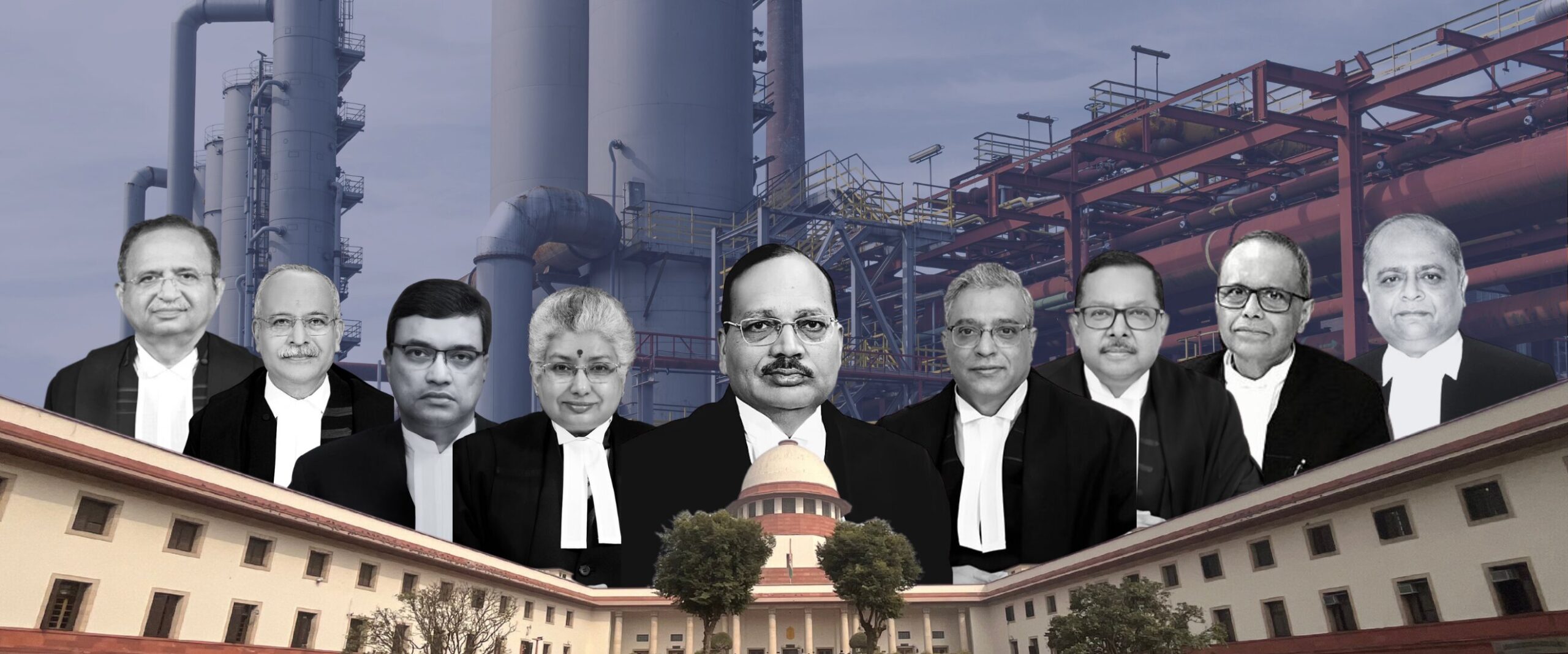
On Thursday, a nine-judge Constitution Bench of the Supreme Court reserved judgement on a question that has perplexed the Indian labour sector for nearly five decades: what constitutes an “industry” under Section 2(j) of the Industrial Disputes Act, 1947? Over three days, my colleague Namrata Banerjee, reported arguments submitted by trade unions and state governments that deliberated on the broad definition of “industry” as was contemplated in—Bangalore Water Supply and Sewerage Board v. R. Rajappa (1978).
Bangalore Water Supply famously prescribed the “triple test” to determine what constitutes an industry. The triple test identified “industries” as units where 1) there is systematic activity; 2) cooperation between employer and employees; 3) there is production and distribution of goods and services to satisfy human wants. Measured against the triple test, traditional non-industries—such as educational institutes, cooperatives, research institutes, clubs, charitable institutions—would be “industries”, arguably rendering their charitable, philanthropic, social or autonomous characters legally irrelevant.
Further, by declaring profit-motive an irrelevant criteria for determination of “industry” and ascribing a strict definition to exemptions such as “sovereign functions”, Bangalore Water Supply aimed to extend the statutory protection of the IDA to all classes of workers, irrespective of their sector. However, in doing so, it had made the definition utterly nebulous and frequently prone to legal challenges.
The confusion was encapsulated in the State of U.P. v Jai Bir Singh–a 2005 case which questioned whether the Social Forestry Department has an industrial character. It was in this case that the Court called for a revisit of the judgement in Bangalore Water Supply and referred it to a larger bench. Jai Bir Singh was merely a thread in a long string of cases which claimed that Bangalore Water Supply did “more harm than good”.
The reference remained pending for two decades. Meanwhile, disputes hinging on the definition continued to pile up on the docket like industrial debris. A nine-judge Bench led by Chief Justice Surya Kant picked it up this week. The Bench must now decide whether the foundation laid in Bangalore Water Supply will continue to stand, or if it must be dismantled—and with it, the host of litigation that has plagued the Court’s docket every time the question of “industry” has resurfaced.
Interestingly, the seven-judge bench in Bangalore Water Supply did not merely interpret the law, it urged Parliament to amend it. A proposed amendment of 1982 adopted the definition, while excluding certain activities. It promised to formulate a “special law” to include those activities which have been excluded. However, the amendment was never notified. Jai Bir Singh suggested that the amendment was never enforced due to demands by stakeholders and the “helplessness” of the legislature and executive.
On Day 1, Additional Solicitor General K.M. Natraj submitted that both the proposed 1982 amendment and the 2020 Labour Codes attempted to restrict the interpretation arrived at in Bangalore Water Supply. He suggested that both legislations were in the nature of a “clarificatory legislation” to inform future interpretation. Justice Joymalya Bagchi was quick to point towards the risk of such an interpretation—prospective legislations cannot have retroactive effects. The contention runs deeper. Can the interpretation of a definition leading back to 1982, which has never been enforced by the executive, be given effect to by the Court?
On this basis, would the revivalist push towards an unenacted legislation – meant to give effect to the 1978 definition – lead to judicial overreach in violation of legislative and executive sovereignty? While rules of interpretation appear attractive in a classroom setting, a restrictive reading may have visible consequences. A narrow definition could exclude workers—in hospitals, educational institutes, clubs and the growing gig economy—from statutory protection.
What remains to be seen is whether the Court’s interpretation of the definition of industry be constrained by a legislature which often defers to put the interest of capital first. We, at the Supreme Court Observer, will be watching closely when the answer arrives.
This article was first featured in SCO’s Weekly newsletter. Sign up now!
Related articles

Analysis
What is the ‘definition of industry’ case about?
In a case that could reshape the country’s labour jurisprudence, a nine-judge Bench will hear arguments on the scope of the term “industry”