




Court Data
January 2026: Pendency increases by 510 cases
Pendency continued to increase in January 2026, in line with a trend that began in July 2025

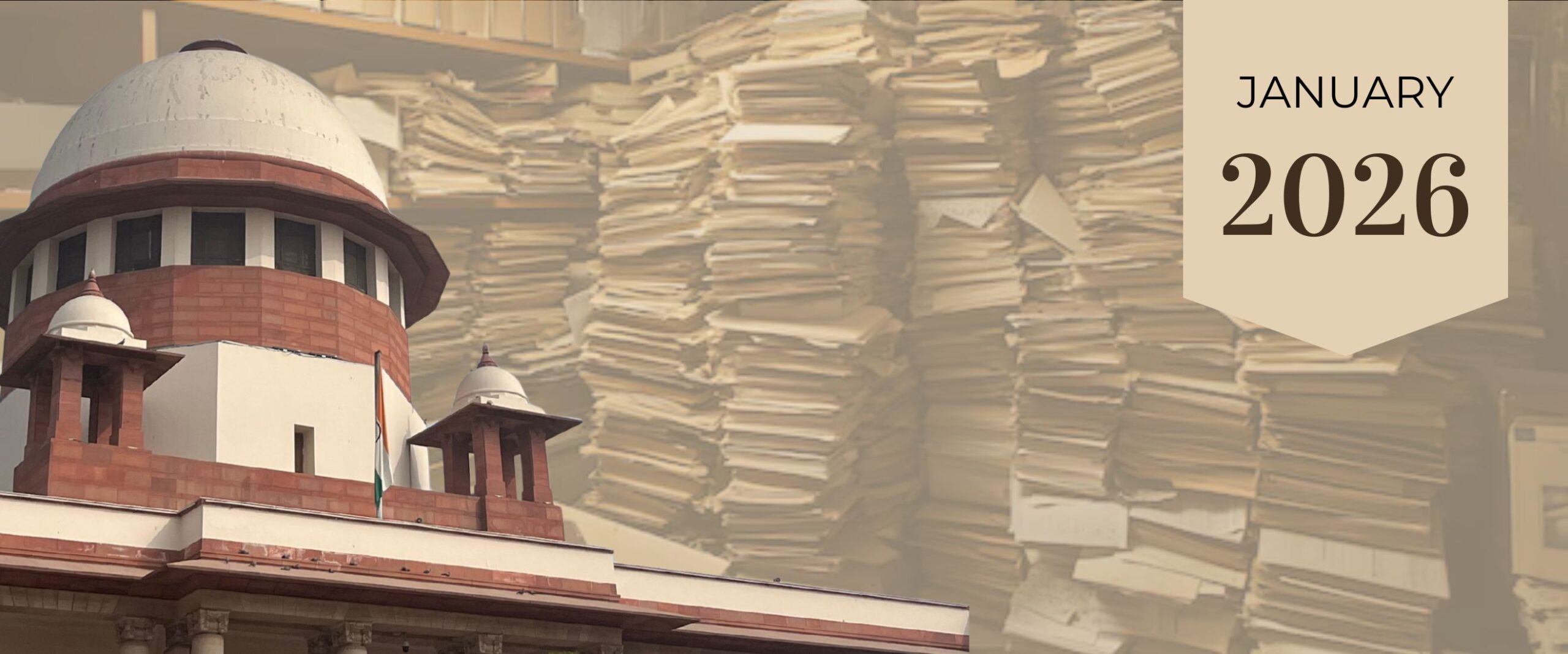
At the end of January 2026, the Supreme Court recorded 92,828 pending cases—an increase of 510 cases from December 2025. This is a record increase of 10,383 cases since January 2025.
Month-wise breakdown of pendency
Figure 1 provides a monthly breakdown of total pending cases in the Supreme Court from July 2025 to January 2026. The Court’s first term starts in July, with the second term starting in January after the winter break. With 18 working days and four holidays, January was a full month for the Court.
In July 2025, the Court returned from the summer break with 87,115 pending cases. By the end of the month, pendency had increased to 88,047 cases. This upward trend continued until the end of the year, with a steep rise in both October and December 2025.
Notably, the Court underwent a change in leadership when Chief Justice B.R. Gavai retired in November 2025. During his six month tenure, pendency reached its highest point for the first time since 1993. His successor, CJI Surya Kant, has identified pendency as a priority and promised to examine underlying factors for the rise.
Pendency in January over the past six years
Figure 2 tracks the total number of pending cases from January 2020 to January 2026.
While a consistent increase in pendency is evident over the years, there was an alarming rise of 10,383 cases in 2025.
This figure is nearly equal to the total rise (of 10,431 cases) over two years between 2020-2022, when the Court functioned at limited capacity during the Covid-19 pandemic. It is higher than the increase of 8299 cases in 2023, which is largely attributed to the then CJI D.Y. Chandrachud’s decision to include all diarised matters in the total count of pending cases. Previously, Miscellaneous Applications, Unregistered Matters, and Defective Caseș were excluded from the count.
2023 and 2024 were notable years for the Court as it limited the rate of increase in pendency. The rise was not steep in January 2025 as CJI Sanjiv Khanna prioritised the listing of miscellaneous matters when he took over in November 2024.
Note: Data up to January 2024 was sourced from the Indian Judiciary Annual Reports released by the Supreme Court, while the January 2025 and 2026 figures were collected from the National Judicial Data Grid (NJDG).
Constitution Bench pendency
Figure 3 illustrates the number of Constitution Bench cases pending in the Supreme Court. Main pending matters are shown on the left, and connected matters (which are cleared once the main matter is decided) are shown on the right.
25 Constitution Bench cases are pending before the Supreme Court as of January 2026. The corresponding figure for January 2025 was 33. While the figures for seven and nine judge benches have remained unchanged since October 2025, the number of five judge benches increased by two in December 2025.
Developments are anticipated on this front as CJI Surya Kant had flagged Constitution Benches as one of his priorities.
6514 cases instituted, 5860 disposed of
Figure 4 shows the number of cases instituted and disposed of in January 2026. Institutions are the number of cases filed in the Court and disposals are the number of cases that the Court has decided, dismissed or disposed of. If institutions are more than disposals, pendency will increase and vice versa.
The rate of disposal was within the 5000 mark in July, August, September and November. In October there was a drop in both institutions and disposals, while in December the gap widened.
In January the Supreme Court disposed of 1155 more cases than it did in December 2025. This has brought the disposal rate back into the 5000 bracket recorded in July, August, September and November last year.
Note: For our pendency, institution and disposal articles, we primarily rely on the data provided on the National Judicial Data Grid (NJDG). We cross-check institution and disposal numbers with the Justice Clock. Typically, on the fifth of each month, the institution and disposal numbers on both portals match. This time, the NJDG recorded two more disposals than the Justice Clock.
Related articles

Court Data
January 2025: Pendency increases by over 2600 compared to last January
However, pendency dropped by 527 cases compared to last month, following the Court’s resumption of regular hearings
Court Data
December 2025: Pendency increases by 1600 cases
The Supreme Court saw an increase of 9000 cases in 2025 as December closed with over 92,000 cases
Court Data
November 2025: Pendency steadily increases by 400 cases
In November 2025, the Court pendency inched closer to 91000, as institutions soared and disposals failed to keep up
Court Data
October 2025: Is the Supreme Court approaching a pendency crisis?
In October 2025, the Court breached the 90,000 mark; the highest it has seen in recent years
Court Data
September 2025: Pendency nears 89,000 mark
With 7,234 new cases filed and 5,596 disposed of, pendency rose to 88,625 in September 2025, the highest this year