


Analysis
‘Out of Sight, Out of Mind’: Jantar Mantar and Democracy
Does the designation of protests to remote and invisible locations amount to regulation or prohibition?

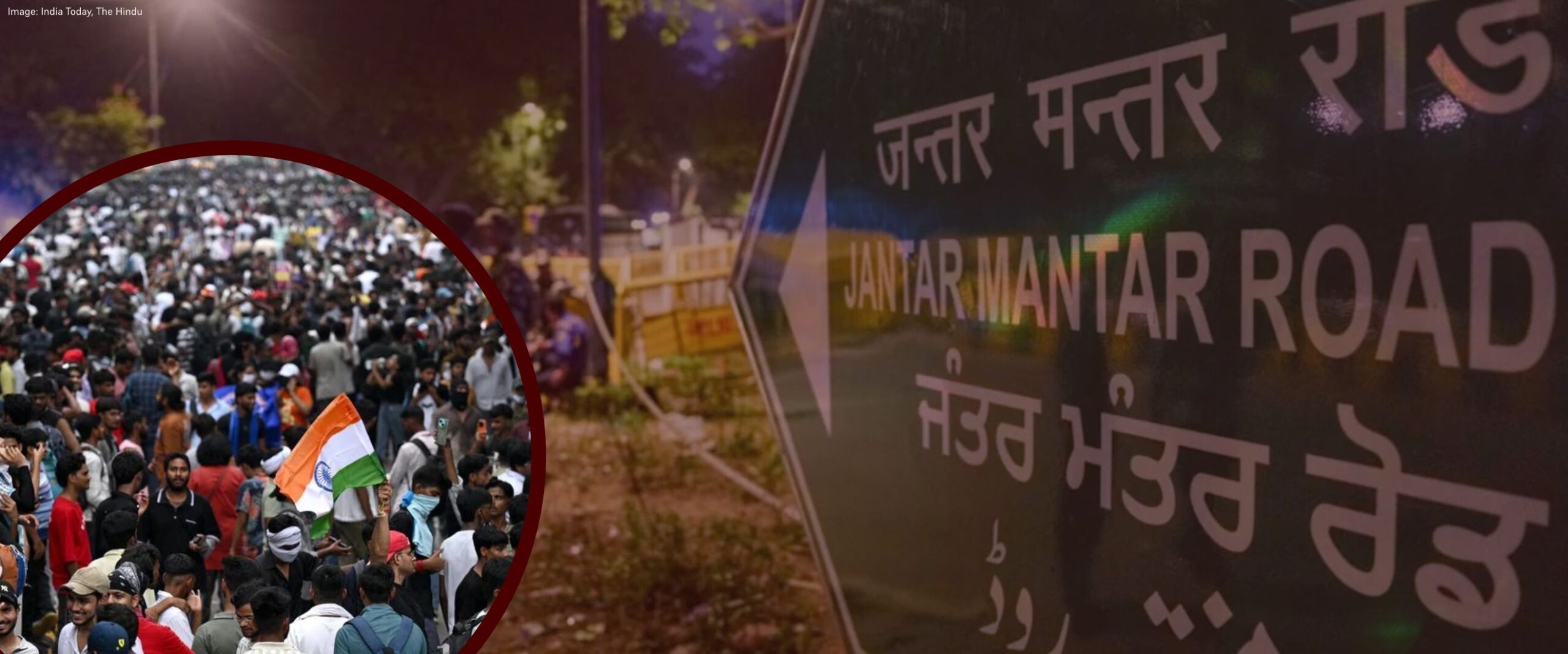
On 11 October, the Delhi Police issued a standing order (no. L&O/48/2026) to denotify Jantar Mantar as a designated protest site. Three alternatives have now replaced it: Ramlila Maidan in the centre of the city, Burari Ground in the north-west, and the CBD Ground in the east.
That governments may regulate protest is not in doubt; Articles 19(2) and 19(3) of the Constitution provide for imposition of reasonable restrictions on the right to peaceful assembly and freedom of speech. The question is whether governments may regulate the right into irrelevance by relocating demonstrations to sites far from public view and institutions of government. Does such restriction remain ‘reasonable’, especially in a nation-state emerging from a Gandhian culture of protest and satyagraha?
Regulation, not erasure
The Supreme Court has already answered this question in 2018. In Mazdoor Kisan Shakti Sangathan (MKSS) v Union of India, it warned against restrictions that render protests invisible. Setting aside a National Green Tribunal order which sought to shift protests to Ramlila Maidan after complaints of noise, filth and traffic from neighbouring residents, the Court reiterated the need to balance Article 19 with Article 21, the right to life. It held that state authorities have a duty to ensure that demonstrations remain within the bounds of Jantar Mantar. Pertinently, the Court then stated that Ramlila Maidan is far from the “concentration of power” and may render protests ineffective.
The decision came soon after Justice K.S. Puttaswamy v Union of India (2017), in which the Supreme Court emphasised proportionality, and held that curtailment of a fundamental right must pursue a legitimate aim, under a law passed by the legislature, by the least intrusive means available. In this context, the denotification of Jantar Mantar is arguably inconsistent with the standards laid down in MKSS and Puttaswamy, as it fails to explain why less restrictive measures such as limits on numbers, amplification, traffic obstruction, or designated protest zones within the same general area would not suffice.
MKSS sits within a longer line of Supreme Court decisions. Ram Manohar Lohia v State of Bihar (1965) separated ‘public order’ from ordinary ‘law and order’, holding that a disturbance affects public order only if it reaches the community at large. Himat Lal K. Shah v Commissioner of Police, Ahmedabad (1972) held that the right to hold meetings on public streets is fundamental but is not a right to meet at any place and time. It accepted prior permission as a valid regulation while striking down a rule that gave the police “unguided discretion” to refuse it. In 2012 and 2016, it recognised peaceful protest as a fundamental right and found police excesses against protesters unjustified. MKSS added the question of location. Amit Sahni v Commissioner of Police (2020) then held that dissent must be expressed in “designated places alone”, and its review in 2021 added that the right to protest cannot be exercised “anytime and everywhere”, though spontaneous protests are tolerated.
There is an important distinction between regulating protests that threaten public order and withdrawing a site from all peaceful protesters in one go. While the former responds to specific risks, the latter affects all classes of citizens irrespective of their conduct, or of the cause or likelihood of resultant disruption.
Judicial intervention has accordingly targeted specific risks, not sites. At Shaheen Bagh and the farmers’ sit-ins on Delhi’s borders, the Court acted on pleas against road blockades (Amit Sahni; Monicca Agarwal v Union of India, 2021), yet affirmed the right to protest and preferred mediation. It said the farmers’ protest should continue “without impediment” and declined to injunct their Republic Day tractor rally. In neither case did the Court suggest that protesters could be denied an accessible site altogether.
Today, the Indian government routinely encourages citizens to exercise freedom of speech under conditions that directly conflict with the tenets laid down in MKSS. Those seeking to voice their concerns are obligated to not make too much noise, occupy too much space, or stand too close to the people they strive to hold accountable. Is a protest still relevant if it can easily be ignored by those it seeks to speak to?
Financial costs and the right to form associations
The denotification further affects the fundamental right to form associations or unions under Article 19(1)(c), since citizens rarely protest alone. The practical exercise of associational freedom is severely impaired when collective gatherings of persons working on or believing in a similar cause become logistically difficult to organise. For well-funded organisations and groups, relocation may be a mere inconvenience. But for unions and associations of informal workers, marginalised communities, and common citizens, relocation away from a relevant, accessible site such as Jantar Mantar operates as a barrier to democratic participation.
Jantar Mantar was hardly an unregulated space. Under Delhi Police Standing Order 10/2018, framed after MKSS, applications went to the DCP, New Delhi District, at least seven days ahead, and the DCP’s decision was final and binding. Protests were limited to 10 am-5 pm and 1,000 people, with no tents or marches, and prohibitory orders, caps and refusals of permission often narrowed the site further. Yet protesters, from farmers to wrestlers, kept returning, because its proximity to Parliament and the ministries gives it visibility that Ramlila Maidan cannot.
Previously, protests have taken place at the Boat Club lawns beside India Gate, where lakhs of farmers camped for a week in 1988. Restrictions followed, and from 1993 Jantar Mantar became the primary permitted site. The Boat Club stayed out of bounds under Section 144 orders, which MKSS described as ‘banning’ rather than ‘regulating’. Even during the Nirbhaya protests of 2012, police barricaded India Gate and pointed citizens to Jantar Mantar and Ramlila Maidan.
While Jantar Mantar is 1.5 kms from the centre of New Delhi, Burari ground is 20 kms away. One might argue that Ramlila Maidan, at a distance of 4 kms, is an alternative. Turns out, it is available for only 3 days for the rest of 2026, as it has been booked in advance for festivities and other events. Further, the ground costs ₹1.8 lakhs a day. Should the right to a peaceful protest be conditioned by season, advance planning of months, and payment of a fee?
The constitutional problem, therefore, is not relocation. It is relocation which operates as a de facto prohibition, by means of distance, expense, procedural uncertainty (by way of arbitrary denials of permission), or otherwise just general loss of visibility.Even as the State seeks to protect residents from disruptions, it cannot kill off the basic purpose of a protest, which is to indeed disrupt normal life in some form, so as to make itself heard.
Who has the power to designate a protest site or denotify it?
The Standing Order’s own justification bears this out. The police rely on a committee constituted by the Home Ministry, and on Supreme Court proceedings in which Ramlila Maidan was suggested as an alternative protest venue. An invitation to consider an additional site is not a direction to denotify the existing one. What is left behind is a semblance of a right.
The scale and shape of arbitrariness has taken different avatars across states. Opposition MPs marching to the Election Commission on 6 October 2026 were detained under Section 163 prohibitory orders, whereas in August 2023 the Supreme Court declined to stay rallies by the Vishwa Hindu Parishad and the Bajrang Dal across the Delhi NCR after the Nuh violence, asking only for CCTV coverage and adequate policing. When the Karnataka Rakshana Vedike’s signboard rally turned to vandalism in December 2023, its president and dozens of members were arrested. Each outcome was case-by-case discretion of the kind Himat Lal condemned.
Protest sites of affected communities have fared worse. In July 2026, police cleared the ‘Chita Andolan’ camp against the Ken-Betwa link project at Kupi, Chhatarpur, after more than two weeks, citing rising river levels; protesters alleged detentions, which the police denied. In Hasdeo Arand, activists report that over 100 villagers resisting tree-felling were detained in August 2024, which the police deny.
Processions and mass events show the opposite failing. In Bangalore this month, police permission was granted for marches by the Rashtriya Swayamsevak Sangh at over 100 locations right after detaining citizens for holding placards on electoral discrepancy at a “conditionally” permitted Tiranga march. Gatherings that did need management went unmanaged: 11 died outside the Chinnaswamy Stadium in June 2025 (a commission found organisers and senior police officers negligent), 41 at the Karur rally in September 2025 (after which the Madras High Court ordered an SOP for political rallies) and 19 at a Kolkata Durga Puja pandal on 17 October 2026. Regulation that is quick to restrict protest but slow to manage crowds is misdirected.
Dissent should not be treated as a civic nuisance to be delegated to the edges of a city. Demonstrations are ways citizens remind the State that public power truly belongs to ‘We, the People’. And when democracy requires them to speak truth to power, the Constitution would not permit the State to respond to such voices by simply shifting them out of reach. The Supreme Court, which has issued notice to the Centre and the Delhi Police on a challenge to the denotification, will now decide whether it does.
The authors are practising advocates. Views are personal.