


Analysis
SC weighs penalties for Yamuna water pollution
The latest order contains concrete measures to identify degrees of differentiated responsibility

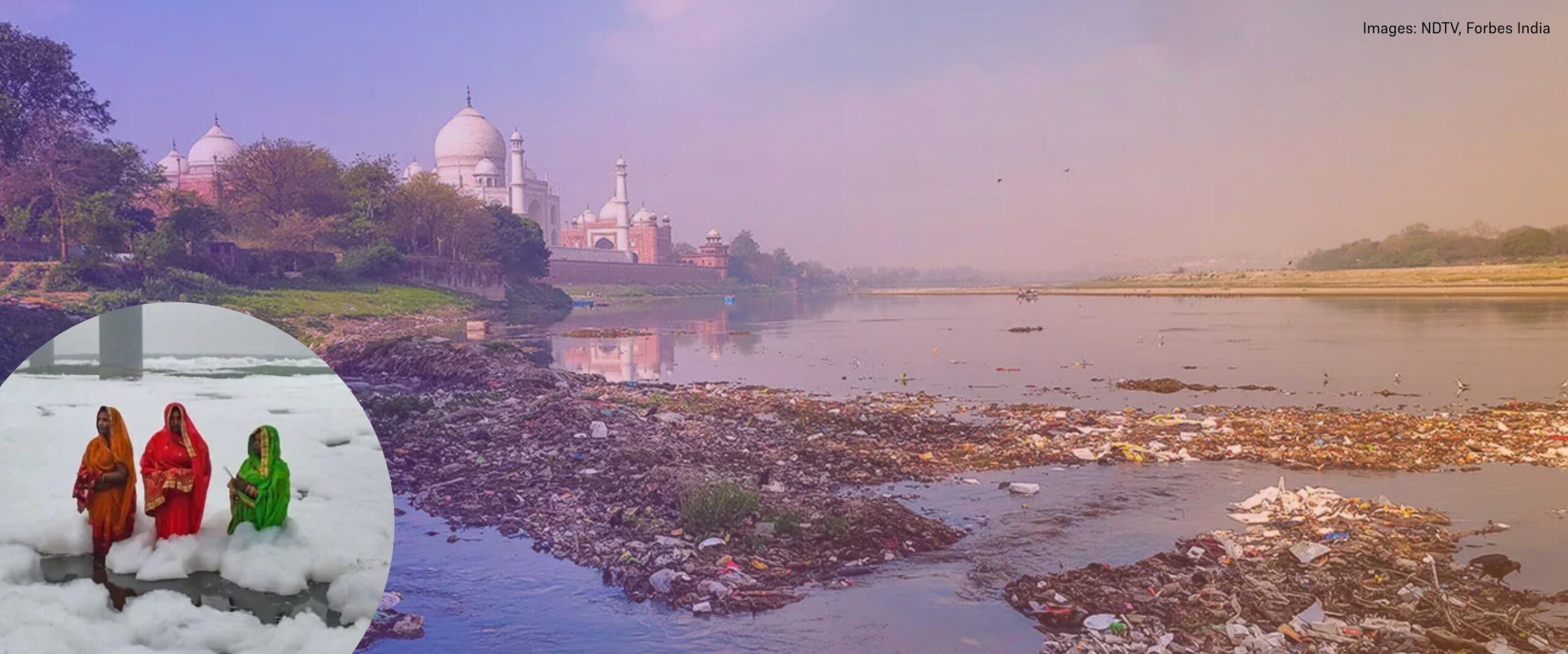
On 4 November 2026, the Supreme Court warned states and Union Territories (UTs) along the river Yamuna that they could face penalties for deterioration of its water quality. A Bench of Justices Manoj Misra and Manmohan directed the Central Pollution Control Board (CPCB) to recommend a formula for calculating the compensation payable by the authorities.
As the Court applies the international principle of differentiated responsibilities to tackle challenges of liability and evidence, this dispute is testing the limits of its expertise.
A journey riddled with barriers
The dispute dates back to a 2018 petition filed by environmentalist Abhisht Kusum Gupta regarding untreated sewage disposal in the river. In 2022, the National Green Tribunal (NGT) directed the NOIDA Authority and Delhi Jal Board to deposit ₹100 crore and ₹50 crore, respectively, as interim compensation for the pollution. This order was stayed by the Supreme Court which then expanded the scope of the matter to the entire Yamuna basin.
The first challenge arose in 2025, when the Court took up a compliance report on a proposed sewage treatment plant (STP) in Uttar Pradesh. Although land had been transferred to the state on 13 February 2026 for the purpose of setting up the STP dispute over road access remained, making it difficult for the U.P. Jal Nigam to construct the land. As wastewater from the region flows through Delhi before joining the Kondli-NOIDA drain, the Court must ascertain liability for pollution caused.
On 21 May 2026, the Court constituted a committee headed by the Union Home Secretary, with representatives of the concerned states and UTs, to prepare a comprehensive action plan. The Court appointed Senior Advocate K. Parameshwar as amicus curiae to assist it.
The resulting Yamuna Action Plan, submitted in October, envisaged 125 new STPs with an aggregate capacity of 4,401.30 million litres per day (MLD), augmentation of the 20 existing ones, 12 new common effluent treatment plants (CETPs) in Haryana and several waste-management projects. It identified 520 drains discharging about 9600 MLD of wastewater into the Yamuna and its tributaries.
However, inconsistencies soon arose. While the plan states that only 25 per cent of Delhi STPs fall below prescribed standards, the CPCB found that none of 37 plants met the standard. Further, the plan rests on a presumption that there were no encroachments in Delhi’s Zone O, but an annexure prepared by the Delhi government marked all 35 water bodies and wetlands in the zone as encroached.
Different responsibilities
Principle 7 of the 1992 Rio Declaration recognises collective responsibility of concerned parties but provides that their specific obligations towards environmental protection may differ according to their contribution to the problem and ability to respond. This principle of common but differentiated responsibilities was developed in the context of cooperation between sovereign nations. Applying it to the Yamuna, the Bench reasoned that respective state governments sharing the river must protect it as a common resource, while bearing obligations proportionate to their role in causing the pollution and their ability to control it.
The Court drew support from the River Ganga (Rejuvenation, Protection and Management) Authorities Order, 2016 which states that the Ganga is to be managed as a single system and expressly includes the Yamuna as a tributary of the Ganga.
According to the Bench, water leaving a state should be no worse in quality than when it entered.
Measures to establish differentiated liability
Under the proposed system, the CPCB must be provided water quality measurements at points where the Yamuna and major drains enter and exit states, UTs, and districts by the State Pollution Control Board/ Pollution Control Committees. The parameters include biochemical oxygen demand (BOD), chemical oxygen demand (COD), faecal coliform and total suspended solids (TSS). BOD measures the oxygen used by microorganisms to decompose organic matter. High BOD levels usually indicate significant organic pollution which leaves less oxygen available for aquatic life.
Independent verification through simultaneous sampling by institutions like the Indian Institutes of Technology has been suggested.
However, further investigation may be required before the cause of pollution can be established. The Court, for instance, asked CPCB to prepare a detailed report on incidents of pollution, such as dying aquatic life, white foam, algal blooms, or increases in BOD, COD, or TSS levels (Para 17). The report must specify the cause of such an incident or spike, as well as remedial measures to be undertaken. If a State/UT is found liable, a penalty will be imposed and the amount may be recovered (after holding an inquiry) from the polluter and/or the officials who were remiss in performing their duties.
On 22 August 2026, the Court had set aside the liability of the Art of Living foundation on the grounds that there was lack of evidence to prove the causal link between the activity (the World Culture Festival, 2016) and degradation of the river. The 4 November order, however, incorporates concrete measures to facilitate identification of such causal links. It mandates identification of officials responsible for each treatment plant and major drain, and filing of monthly compliance affidavits before the Court. Senior nodal officers must be nominated by states/UTs within two weeks and urban local bodies are directed to register septage tankers and fit them with GPS tracking systems.
Protection and rehabilitation of floodplains
The Order goes a step further to address encroachment on the Yamuna floodplain by proposing protection of Delhi’s Zone O as a green zone. It also examines whether similar protection could be extended along other stretches of the river.
Finding that sewage infrastructure is difficult to provide due to illegal colonies and settlements along drains and the riverbed, it considered removing structures in accordance with laws on rehabilitation of occupants.
The next test
The Bench has acknowledged the limits of judicial expertise in city planning and river management. It proposes giving administrators flexibility in implementation while attaching consequences to poor environmental outcomes.
This balance will be tested when the case returns to the Court on 13 January 2027. By then, the CPCB’s proposed penalty formula and progress on monitoring infrastructure should provide a clearer picture of how the Court’s approach would work.
Related articles

Analysis
Proving the polluter: What the Yamuna floodplain verdict demands of environmental liability
The Supreme Court holds that the polluter pays principle presupposes a proven polluter and a documented ecological baseline.


Analysis
Should the National Green Tribunal have Suo Moto Powers?
The NGT's use of suo moto powers has been heavily debated: are the powers inherent to its functioning or should they be explicit in the Act?
Analysis
2026 Supreme Court mid-year review: Environmental and animal rights
The Supreme Court restructured decade-old litigations and delivered a range of firm environmental rulings in the first-half

Analysis
Supreme Court Review 2025: Lacking a principled stance on environmental rights
In trying to strike balance between environmental rights and the development imperative, the SC delivered a mixed bag of verdicts in 2025