





Analysis
SC disimisses Congress leader Meenakshi Natarajan’s challenge against the rejection of her Rajya Sabha nomination
The Bench held Article 329 bars judicial intervention during elections, leaving Natarajan to pursue an election petition before High Court

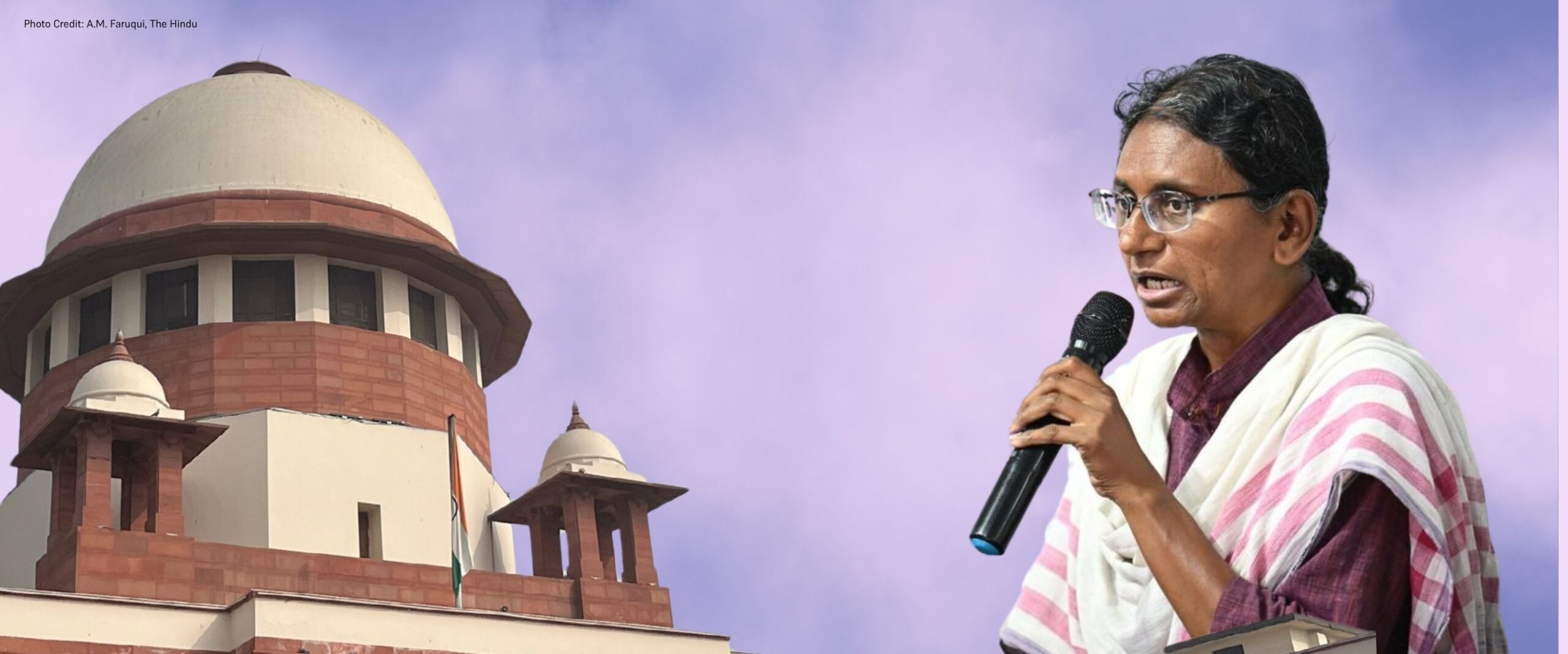
Today, a partial working day Bench of Justices P.K. Mishra and A.S. Chandurkar dismissed Congress leader Meenakshi Natarajan’s petition challenging the rejection of her nomination for the Rajya Sabha election from Madhya Pradesh. The Bench held that it had no jurisdiction under Article 32 to hear a challenge to rejection of nomination papers during the election process. The Bench held that Article 329(b), which bars judicial interference in election disputes except through an election petition, does not permit courts to distinguish between cases involving “glaring” illegality and other election disputes.
Natarajan had challenged the Returning Officer’s (RO) order dated 9 June rejecting her nomination on the ground that she had failed to disclose a pending court case in Form 26, the affidavit required under Rule 4A of the Conduct of Elections Rules, 1961 (Election Rules). The RO recorded that cognisance had been taken in the complaint against her, summons had been issued and that she had filed a written statement before the Magistrate, indicating knowledge of the proceedings.
Senior Advocate A.M. Singhvi, appearing for Natarajan, contended that the rejection was contrary to Section 33A of the Representation of the People Act, 1951 (RPA), which governs disclosure of criminal antecedents by candidates.
Singhvi: Section 33A requires framing of charges
Singhvi argued that the provision requires disclosure only in cases involving offences punishable with imprisonment of two years or more and where charges have been framed by a court of competent jurisdiction. According to him, the present case had not crossed that threshold. He submitted that the proceedings arose from a private complaint in Hyderabad and there was neither a charge-sheet nor an order framing charges. Referring to Section 223 of the Bharatiya Nagarik Suraksha Sanhita, 2023 (BNSS), which deals with procedure in complaint cases before Magistrates, Singhvi submitted that Parliament had consciously introduced safeguards before cognisance.
His principal submission, however, was that even assuming cognisance had been taken, Section 33A requires framing of charges. When Justice Mishra observed that summons are ordinarily issued when a court is prima facie satisfied, Singhvi responded that only notice had been issued in the proceedings.
Singhvi: Complaint names petitioner only for inaction
Taking the Court through the complaint, Singhvi submitted that Natarajan was not the principal accused and had been named only because she was the AICC in-charge for Telangana. He pointed out that the complainant had alleged sexual harassment and intimidation against another Congress leader and that the only allegation against Natarajan was her failure to act on representations made to the party. According to Singhvi, the alleged incident dated back to 2022, whereas Natarajan assumed charge as AICC in-charge for Telangana only in 2025.
He argued that the complaint itself showed that Natarajan was mentioned only in connection with party affairs and that a candidate could effectively be prevented from contesting elections merely for not taking internal disciplinary action. Questioning the RO’s conclusion that cognizance had been taken, Singhvi submitted: “Only notice issued, where is the cognisance?”
He maintained that no criminal proceeding had reached the stage as contemplated under Section 33A.
Bench questions scope of judicial interference during elections
A substantial part of the hearing concerned Article 329(b) of the Constitution and the extent to which courts can intervene during an ongoing election process. Justice Mishra asked, “We have been saying, however wrong, once nomination is rejected, the remedy is elsewhere. Show us any judgment where we have interfered.”
Singhvi argued that the rule against judicial interference was not absolute and relied on Mohinder Singh Gill v Chief Election Commissioner (1977) and Election Commission of India v Ashok Kumar (2000). He contended that these decisions recognised an exception where judicial intervention facilitates rather than obstructs the electoral process. “This is not a vanilla formula that once the (sic.) election is in process my Lords will say come later. Exception is the most important,” he submitted. He argued that if an arbitrary rejection leaves only one candidate in the fray, courts can step in to preserve the level playing field that underlies free and fair elections.
Referring to Indira Nehru Gandhi v Raj Narain (1975), Singhvi submitted that an uneven electoral field strikes at the basic structure of the Constitution. Justice Mishra asked, “If we allow your nomination, there will be splitting of the jurisdiction created in Article 329. How do we differentiate these two powers?” Singhvi responded that courts could interfere only in cases of patent illegality. Drawing an analogy, he submitted, “Suppose tomorrow the RO writes 2+2=6, will you still say wait for an election petition?”
Rohatgi and Naidu: Election petition is the only remedy
Senior Advocate Mukul Rohatgi, appearing for the rival candidate, argued that the right to contest elections is a statutory right and not a fundamental right. Relying on Jyoti Basu v Debi Ghosal (1982), he submitted that a petition under Article 32, which is for the enforcement of fundamental rights, was not maintainable. He further placed reliance on N.P. Ponnuswami v Returning Officer (1952), to argue that once the election process begins, judicial review under Articles 32 and 226 stands excluded.
Senior Advocate D.S. Naidu, appearing for the Election Commission of India (ECI), relied on Section 100(1)(c) of the RPA, which treats improper rejection of a nomination as a ground for challenging an election through an election petition. He argued that Parliament had already provided a statutory remedy and Article 324, which vests the ECI with superintendence and control over elections, could not be used to bypass that framework.
Naidu rejected the criticism regarding declaration of the results during the pendency of the proceedings, placing reliance on Section 53(3) of the RPA. He submitted that once the number of validly nominated candidates was less than the available seats, the RO was bound to declare them elected.
The respondents further relied on Rule 4A of the Elections Rules and Clause 5 of Form 26 to contend that candidates are required to disclose all pending criminal cases irrespective of the stage of proceedings. In rejoinder, Singhvi disputed this interpretation, arguing that Form 26 could not override Section 33A.
Court refuses to carve out exception under Article 329(b)
In its order, the Court recorded the petitioner’s submission that the rejection of the nomination was ex facie illegal because neither cognisance nor charges had been framed and therefore there was no violation of Section 33A.
Rejecting the petitioner’s plea for an exception in cases of manifest illegality, the Court observed that recognising such a distinction would require courts to divide election disputes into two classes: those warranting immediate intervention and those relegated to election petitions. “Such a distinction finds no place in Article 329(b) of the Constitution,” the Court held. The Bench observed that reading such an exception into the constitutional scheme would amount to creating a category not envisaged by the Constitution and “ought not to be encouraged”, and dismissed the petition.
The Court clarified that its observations on the basis of rejection of Natarajan’s nomination were made only for deciding maintainability and would not affect her right to file an election petition before the High Court.
Related articles

Analysis
Five election-related cases in the Court’s docket in the run-up to the 2024 polls
The what, when and why of the top court’s decisions in these key cases could have significant ramifications on India’s electoral landscape

Analysis
Trusting the Election Commission
In a hearing on electoral roll revision, the SC reiterated its inclination to trust the ECI, but not before offering friendly advice
Channel
The Supreme Court’s Election Duty
The election season saw the top court in the hot seat as it dealt with multiple petitions demanding its active involvement during elections