





Analysis
Through courtrooms and constituencies
An urgent pre-counting hearing was the TMC’s final attempt at challenging the poll procedure in West Bengal.

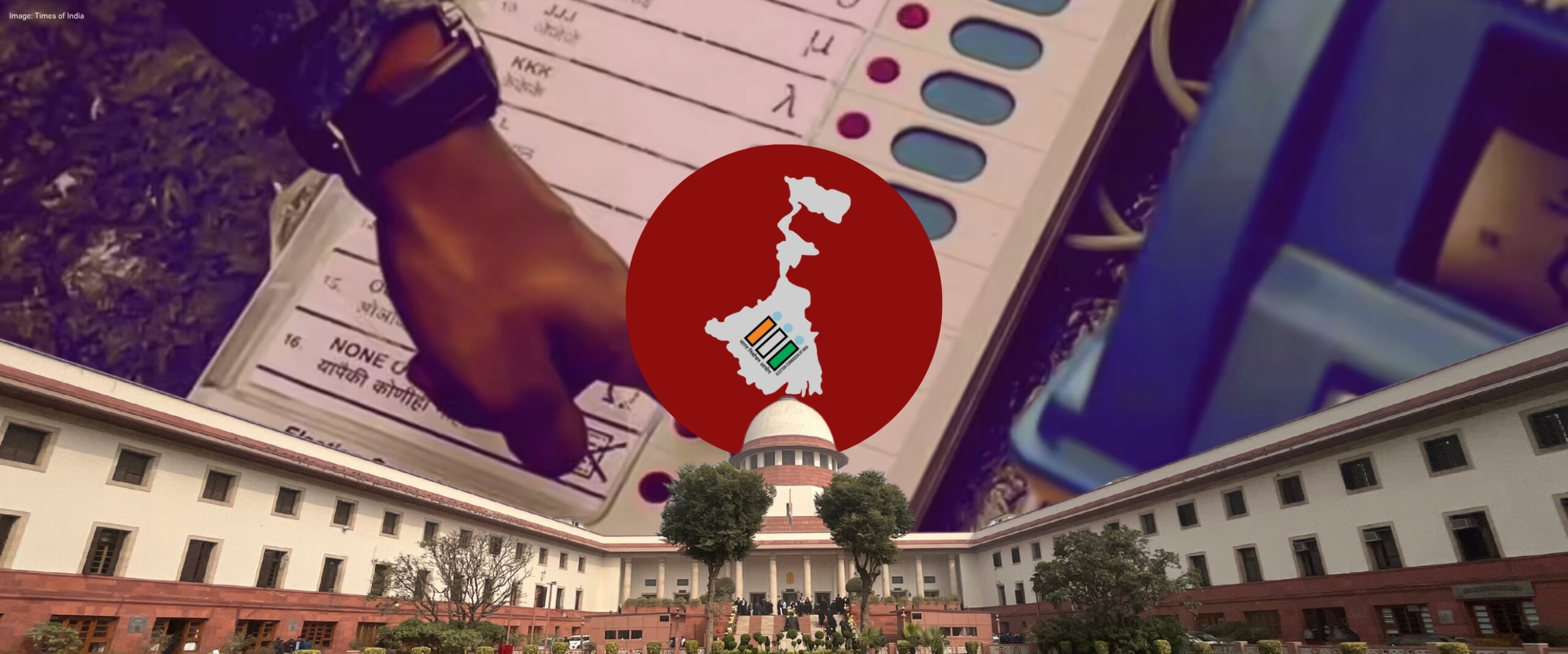
Today, the Supreme Court listed an urgent weekend hearing for the first time in two years. A Bench of Justices P.S. Narasimha and Joymalya Bagchi convened to hear a plea filed by the All India Trinamool Congress (TMC) against exclusion of State employees from supervisory duty over vote counting scheduled for Monday. After a 20 minute hearing, the Court refused to intervene.
A weekend hearing was last held on 27 January 2024, when the Court took suo moto cognizance of a public clash in the Calcutta High Court. A five-judge bench was constituted after Justice Abhijit Gangopadhyay issued an unusually sharp order, accusing Justice Soumen Sen of political bias and misconduct. Then, the Court intervened to contain an institutional breakdown. This time, it was called to step in during an election hot with distrust and allegations galore.
On 13 April, the Election Commission of India (ECI) directed for at least one supervisor or assistant at each counting table to be a Central Government or Central PSU employee. On 30 April, the Calcutta High Court upheld the ECI’s circular, stating that appointments can be made from either Central or State pools. Today Senior Advocate Kapil Sibal pointed out delays in communication of the circular, lack of disclosed basis for apprehensions of irregularities, and failure to follow the circular’s own scheme, which envisaged State nominees. However, Justice Bagchi reiterated that when appointments are permitted from either category, there is no bar on choosing entirely from one pool. Justice Narasimha questioned the distinction, noting that all such personnel are government employees. Appearing for the ECI, Senior Advocate D.S. Naidu said the apprehensions were misplaced and stressed that returning officers retain control. Recording an assurance that the circular would be followed in “letter and spirit”, the Court declined to pass further orders.
What was the backdrop to today’s hearing? The story begins with the rolls. On 4 February, the Court issued notice on West Bengal Chief Minister Mamata Banerjee’s challenge to the Special Intensive Revision (SIR). The scale of the exercise had become hard to ignore with around 1.36 crore voters placed in the “logical discrepancy” list and nearly 32 lakhs marked as unmapped. Many of these cases turned on small variations in spelling—Dutta and Datta, Roy and Ray—differences that are routine in Bengali households but triggered notices that put voters at risk of exclusion. Appearing in person that day, Banerjee said the exercise was operating as one of deletion, not inclusion.
The Court has struggled to keep pace with the scale. In February, it extended timelines for adjudication, recorded an increasingly evident “trust deficit”, and brought in judicial officers to handle verification. By March, more than 47 lakh objections had been disposed of. Then, on 1 April, judicial officers were prevented from working in Malda district. Taking suo motu cognisance, the Court transferred investigation of the incident to the National Investigation Agency. It declined interim voting rights for those excluded, but ensured restoration of names before polling in cases of successful appeal. Unfortunately, this order had a limited impact.
The context is as significant as the order. Turnout has been striking, with over 92.47 per cent recorded over both phases, well above the 84.72 per cent recorded in 2011. While the electorate has shown up in numbers, the TMC alleged unauthorised access of strong rooms and the ECI had to order for repolls to be held today, following reports of electoral malpractice. What remains is the question that has been hanging over this election from the start: will the legal battle survive the election result?
This article was first featured in SCO’s Weekly newsletter. Sign up now!
Related articles

Analysis
Beyond ‘Special’: How the 2025 Bihar SIR marks a break from the past
As the SC considers its verdict in the roll revision case following 29 hearing days, it must confront the history of electoral safeguards
Analysis
Trusting the Election Commission
In a hearing on electoral roll revision, the SC reiterated its inclination to trust the ECI, but not before offering friendly advice
Analysis
“The Supreme Court is watching” CJI warns Presiding Officer allegedly caught vote tampering in Chandigarh mayoral elections
CJI Chandrachud directed all records related to the Chandigarh mayoral election to be submitted for scrutiny
Analysis
Five election-related cases in the Court’s docket in the run-up to the 2024 polls
The what, when and why of the top court’s decisions in these key cases could have significant ramifications on India’s electoral landscape