


Analysis
CEC powers: 10 key objections and the ECI’s responses
A rundown of the ECI's counter affidavit in the challenge against the powers of the CEC

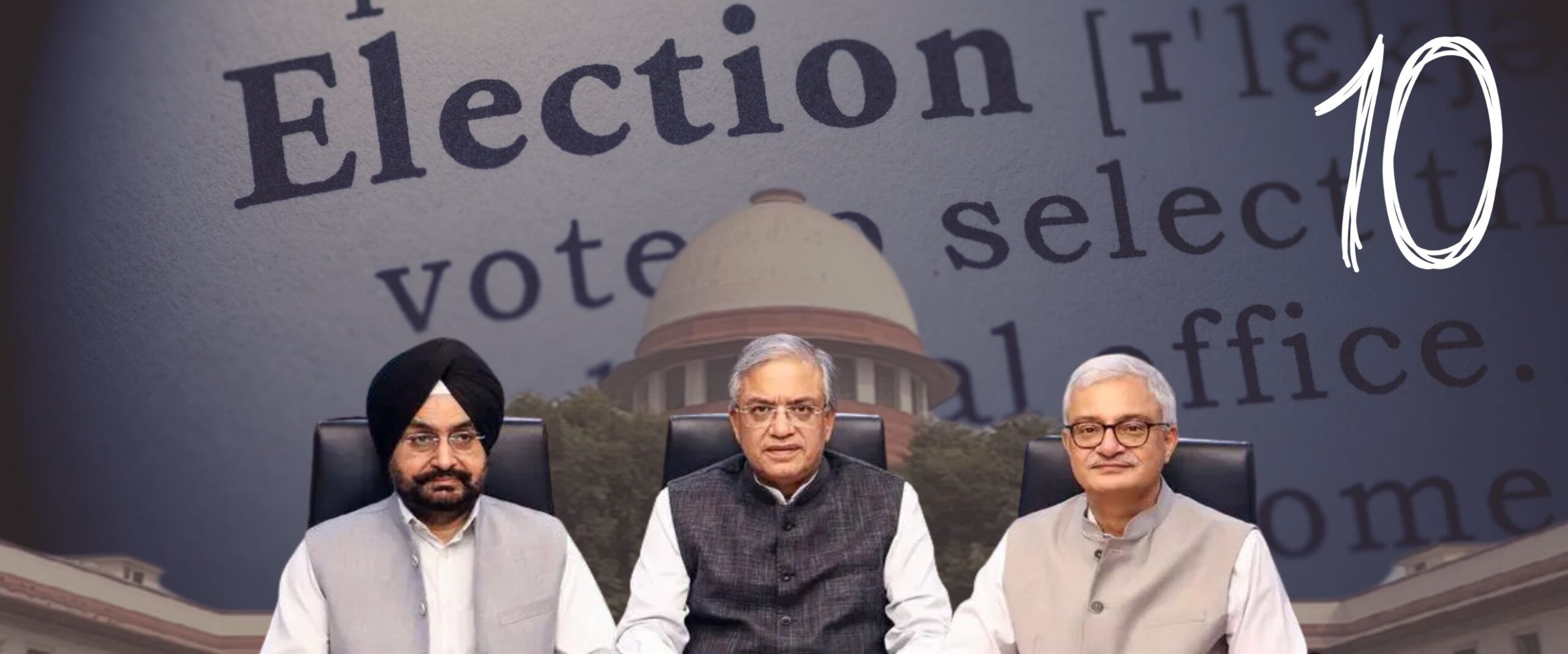
On 26 October, the Election Commission of India (ECI) filed a counter affidavit defending its functioning. This was in response to allegations that Chief Election Commissioner (CEC) Gyanesh Kumar had exercised unilateral powers without the complete participation of other members. The ECI filed the response in Rakesh Kumar Singh alias Rakesh Singh v Union of India, W.P. (C) No. 1246 of 2026.
The petition challenging the functioning of the ECI was filed after reports revealed objections recorded by Election Commissioners Sukhbir Singh Sandhu and Vivek Joshi to decisions taken in the ECI’s name. On 5 October, a Bench of Chief Justice Surya Kant and Justices Joymalya Bagchi and V. Mohana issued notice on the challenges. It declined to grant the interim request to suspend Kumar.
Deputy Election Commissioner Bhanu Prakash Yeturu filed the affidavit on behalf of the ECI. He states that all three Commissioners unanimously approved its filing. Citing the Dussehra vacation and paucity of time, the respondents sought permission to submit a comprehensive paragraph-wise response if the Court requires it.
Below are 10 issues arising from Singh’s petition and the ECI’s counter-affidavit. The objections and reliefs sought are set out alongside the Commission’s explanations.
1. Collective approval for SIR decisions
Provisions: Article 324 vests the Election Commission with control over the preparation of electoral rolls and the conduct of elections. Section 18 of the Chief Election Commissioner and other Election Commissioners (Appointment, Conditions of Service and Term of Office) Act, 2023 requires decisions to be made unanimously as far as possible, with differences resolved by majority.
Objection: Singh argues that the reported objections of two Commissioners call into question whether the Special Intensive Revision (SIR) of electoral rolls was authorised collectively. Relying on T.N. Seshan v Union of India (1995), he submits that the CEC’s chairmanship requires the other Commissioners’ participation in decisions. His prayer seeks to invalidate the SIR and electoral roll changes made under it, while preserving changes lawfully undertaken.
ECI’s response: The Commission says it unanimously approved the three SIR orders, dated 24 June 2025, 27 October 2025 and 14 May 2026, in compliance with Article 324 and Section 18. It describes suggestions, queries and differing views expressed during deliberations as inputs considered before the Commission reaches a decision.
According to the affidavit, files requiring the Commission’s approval move first to one Election Commissioner, then the other and finally the CEC. The Secretariat records approved decisions on the files and obtains their signatures before communicating and implementing them.
2. Communications issued in the Commission’s name
Provisions: Section 19A of the Representation of the People Act, 1951 permits Deputy Election Commissioners and the Secretary to perform Commission functions, subject to its directions. Sections 18 and 21 of the 2023 Act govern decision-making and preserve earlier actions consistent with the new law.
Objection: The petition recounts complaints about letters and orders issued without Commission approval. It also cites Joshi’s reported 16 April statement that, for over a year, he had received neither agendas before meetings nor minutes afterwards, and that he objected to officers’ foreign travel without approval. Singh seeks regular circulation of agendas and minutes and a record of authorisation for acts issued in the Commission’s name.
ECI’s response: The affidavit relies on delegation orders of 12 January 1996 and 9 December 1997. It says the Commission retains constitutional, quasi-judicial and other important functions, while delegating specified powers to the CEC and officers.
An officer issuing a communication must ensure that it falls within the officer’s delegated authority or obtain the competent authority’s approval. Decisions requiring the Commission’s consideration may be taken in meetings or recorded on files. In urgent situations, members’ approvals may be obtained electronically and subsequently recorded. The ECI says it will take action to fix responsibility if it becomes aware of an unauthorised communication.
3. Changes to internal work allocation
Provision: Section 18(1) of the 2023 Act requires unanimity to regulate the procedure for transacting business and allocate it among the Commissioners.
Objection: Singh alleges that an internal work-allocation order removed a layer of oversight over the ECI’s information technology establishment without the two Election Commissioners’ knowledge. He seeks to quash the order to the extent it was issued without a Commission decision under Section 18.
ECI’s response: An officer of Additional Secretary rank, on deputation to the Commission, issued the order on 28 July 2026. Sandhu and Joshi separately wrote to the Cabinet Secretary the following day about the order and the officer’s conduct.
The affidavit says the two Commissioners issued a joint direction on 30 July, after which the Commission never implemented the 28 July order. Work allocation continued under the earlier arrangement of 23 September 2025.
4. Changes to online Form 6
Provision: Form 6, used to seek inclusion in electoral rolls, is prescribed under the Registration of Electors Rules, 1960.
Objection: According to the petition, Joshi objected on 16 May to requiring applicants to state whether they, their parents or grandparents appeared in the last SIR roll without amending the Rules. Sandhu concurred on 19 May. Singh alleges that the mandatory field nevertheless appeared in July and records Sandhu’s subsequent description of the change as “unauthorised and illegal”. He seeks to have the alteration quashed.
ECI’s response: The Commission denies amending Form 6 and acknowledges that the power to amend it rests with Parliament. It describes the SIR declaration as a separate document required alongside the statutory form during the revision exercise.
The affidavit nevertheless acknowledges concerns about the way the declaration appeared online. Officers had combined it with the Form 6 page so that applicants could use a single one-time password and electronic signature. The Commission says this presentation could be understood as an amendment to Form 6.
Following the Electoral Rolls Division’s decision on 21 October, the online application will have two parts: the prescribed Form 6 and the SIR declaration, corresponding to the arrangement for physical applications.
5. Linking applicants to previous electoral rolls
Provision: Section 21(3) of the Representation of the People Act, 1950 empowers the ECI to direct a special revision of electoral rolls for recorded reasons.
Objection: Singh argues that an additional mandatory field affecting voter registration requires lawful authority even when introduced electronically. He seeks protection against an otherwise eligible applicant being denied inclusion solely for failing to supply the disputed information.
ECI’s response: The Commission describes this linking process, called “mapping”, as an alternative that reduces the documents an applicant must produce. Applicants who supply the relevant earlier-roll details can avoid further documentation during the claims and objections stage. Others may establish eligibility through the prescribed documents, with notice and an opportunity to respond where required.
The ECI relies on the Court’s 27 May 2026 judgement in Association for Democratic Reforms v Election Commission of India which upheld the Bihar SIR documentation framework and recognised a degree of residual authority to devise requirements suited to a special revision.
The affidavit cites a unanimous 26 September decision requiring Booth Level Officers to collect documents at the homes of people issued notices for being unmapped or for discrepancies. Hearings are to be exceptional and preferably online. After SIR is completed, applications are to use the statutory forms without the additional declaration.
6. Electoral Registration Officers’ control over the database
Provisions: Sections 13B, 22 and 23 of the 1950 Act govern Electoral Registration Officers (EROs) and their functions concerning electoral rolls. Section 24 provides for appeals.
Objection: The petition cites Joshi’s reported concern about centralisation of the electoral roll database and his proposal to audit access credentials. It records Sandhu’s 14 August objection that statutory officers lacked proper, complete access. Singh argues that software permissions cannot curtail powers conferred on Electoral Registration Officers by law and seeks restoration of lawful access.
ECI’s response: The Commission says the ERO retains authority over inclusion, correction and deletion. Entries can be changed only through an ERO’s order. The ECINet team must enable officers to exercise their statutory functions and discretion through the portal.
The affidavit records unanimous decisions on 26 and 30 September to establish a committee to check ECINet’s compliance with the applicable laws. Constituted on 14 October, it is headed by a Senior Deputy Election Commissioner and includes election officials and two independent experts from IIT Bombay and the Indian Institute of Science, Bengaluru. Its recommendations were pending when the affidavit was filed.
The ECI says the Committee of Officers will discuss future initiatives on IT modules and portals before seeking the Commission’s approval. Further changes will be made where field officers require functional flexibility.
7. Restoration of 97 Goa electors
Issue: Whether electoral-roll software prevented eligible people from being restored to the rolls after their cases had been examined.
Objection: The newspaper investigation annexed to Singh’s petition describes 97 Goa electors whom local officers found eligible but whose restoration was allegedly blocked because ECINet lacked a rollback facility.
ECI’s response: The affidavit says Booth Level Officers were directed to visit the affected households and collect forms. It states that 88 people submitted Form 6 and their applications were accepted; six were outside the country, and three held Portuguese passports or were foreigners. The Goa Status report annexed to the affidavit does not specify the total number of names restored in the electoral rolls out of the 88.
8. Authority to file appeals in West Bengal
Issue: The authorisation for appeals against judicial officers’ orders permitting inclusion in the electoral rolls during the West Bengal SIR.
Objection: The petition recounts Sandhu’s reported 12 August query about who authorised appeals against voters’ inclusion and under what authority. Singh seeks to quash the authorisation to the extent the records establish that appeals were filed in the ECI’s name without the required Commission decision.
ECI’s response: The affidavit relies on the Court’s orders of 1 April and 6 April in Mostari Banu v Election Commission of India. Those orders contemplate appeals by both excluded electors and ECI authorities aggrieved by the inclusion of names.
The Commission cites a 22 October communication from the West Bengal Chief Electoral Officer’s office stating that its officers filed the appeals in their capacity as authorities under the Representation of the People Act. The affidavit expressly states that the Commission did not hear these matters, arguing that the officers had authority under the Court’s orders.
It further says that the electors concerned already had favourable judicial orders and remained on the rolls, making them eligible to vote in the recent Assembly elections.
9. Production of records and an independent inquiry
Issue: Whether the reported objections warrant judicial examination of the Commission’s original records.
Petitioner’s case: Singh acknowledges that the material obtained through investigative reporting requires verification. He asks the Court to obtain agendas, minutes, approvals, file notings, delegation orders, IT-access records, server logs and database-change histories. The petition presents the reported objections as grounds for obtaining this evidence and preserving them during the pendency of the proceedings. The legality of the disputed acts may be tested against it.
If those records disclose decisions that materially affected electoral rolls, Form 6, database access or appeals taken without Commission approval, Singh seeks a judicial inquiry commission or a Special Investigation Team headed by a retired Supreme Court judge and assisted by technical and electoral experts.
ECI’s response: The Commission argues that the petition rests entirely on a single newspaper report and that the petitioner made no attempt to ascertain the facts from the respondents or submit a representation to them.
It submits that a newspaper report does not establish the facts it narrates and says it neither released nor authorised the release of internal files or notes to a news agency. On that basis, it asks the Court to examine the petition’s conclusions with circumspection and challenges its maintainability.
10. Restraining the CEC from functioning
Provisions: Article 324(5) protects the CEC’s tenure by requiring removal in the same manner and on the same grounds as a Supreme Court judge. Section 18 of the 2023 Act provides for unanimous or majority decision-making within the Commission.
Relief sought: Singh frames quo warranto as a challenge to Kumar’s claimed authority to exercise powers vested collectively in the Commission. The petition acknowledges that the writ ordinarily examines lawful title to public office, and argues that Kumar’s alleged assumption of the Commission’s collective authority raises a question of title to that power.
As interim relief, he asks that Kumar cease functioning as CEC and that Sandhu and Joshi conduct business unanimously during that period. He further seeks a direction that any appointment to the resulting vacancy follow a recommendation by a committee including the Chief Justice of India.
ECI’s response: The affidavit argues that quo warranto is misconceived because the petition accepts that Kumar was duly appointed. It invokes Article 324(5), which protects the CEC from removal except in the same manner and on the same grounds as a Supreme Court judge.
The Commission argues that restraining one member would frustrate the three-member decision-making structure through which a majority can resolve disagreements. It asks the Court to dismiss the petitions summarily.
Related articles


Analysis
“Ancient republics” and the Bihar SIR
An anatomy of mass exclusion through swadeshi jurisprudence and the Special Intensive Revision (SIR) of electoral rolls
Analysis
Sequel Season
Recent challenges to the ECI’s exercise of plenary powers has left onlookers anticipating a legal sequel
Analysis
Dissent over SIR: Making sense of Supreme Court hearings
The extraordinary Sunday sitting raised expectations, but its directions will count only if the following proceedings produce safeguards
Analysis
What are the sub judice cases that form part of INDIA Bloc’s memorandum to CJI Surya Kant?
CJI Surya Kant declined to meet INDIA bloc leaders as matters concerning alleged electoral irregularities are pending before the SC