





Analysis
Collegium’s familiarisation policy: an incomplete reform
Recent appointments reveal that transfer of judges prior to their elevation as Chief Justice must factor time for state government consultat

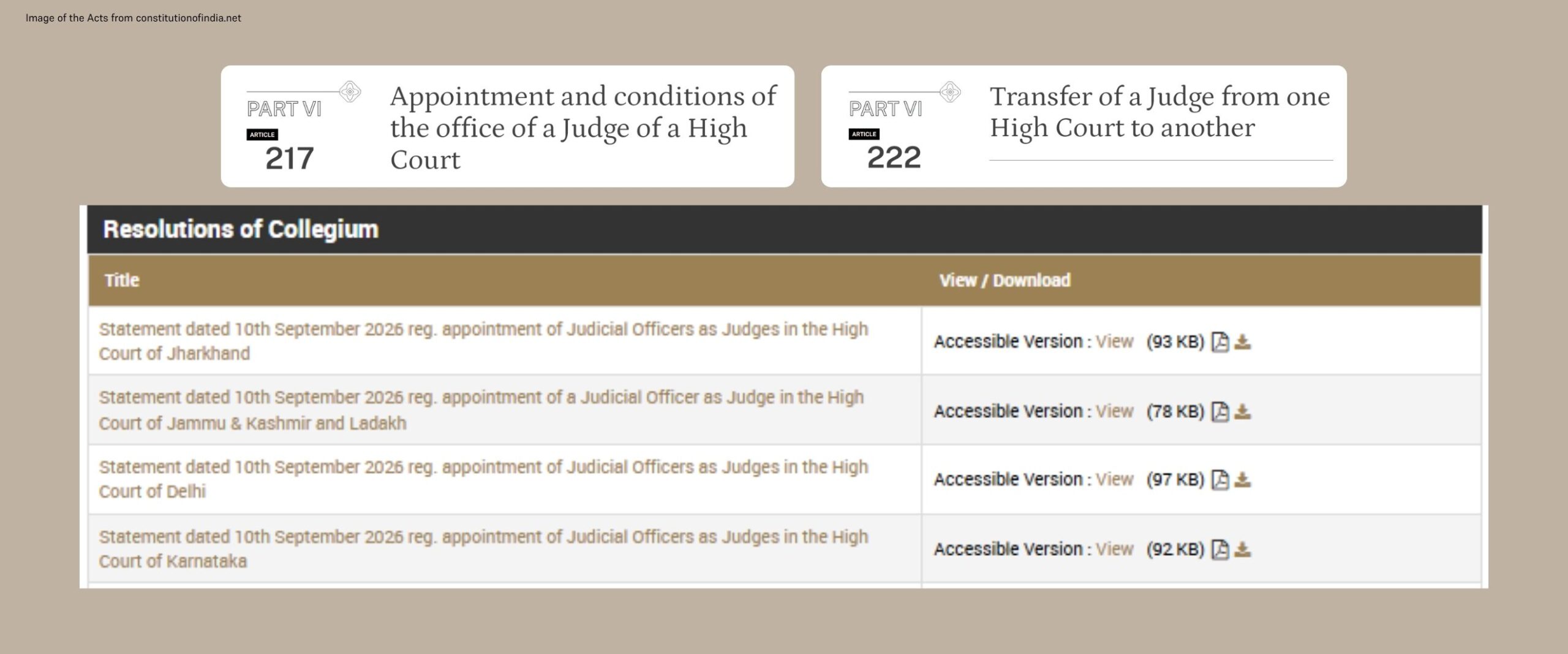
In February 2026, the Supreme Court Collegium took a policy decision to transfer prospective chief justices two months before their date of appointment. This was done to facilitate familiarisation of judges with the affairs of their destination court.
On 5 September 2026, the Union government notified the appointment of new CJs at eight different High Courts. Seven of these judges had never served at the courts they were selected to lead. Justice Ashwani Kumar Mishra happens to be the sole exception, but his elevation has produced a separate controversy as the Punjab government’s opinion was not taken into account.
These developments bring two aspects of judicial succession into focus: advance familiarisation and consultation with State governments. Each serves a distinct purpose: the former seeks to improve administrative efficiency, while the latter is meant to secure federal legitimacy. The success of the Collegium policy depends on a timetable that allows them to operate in a synchronised manner.
The February policy
The Memorandum of Procedure for appointment of judges already recommended that the process be concluded at least one month before an anticipated vacancy. The February 2026 Collegium resolution noted that a Judge may be transferred two months in advance before the vacancy arises, although the words “may” and “preferably” make it a stated preference rather than an inflexible rule.
This preference was applied by the same resolution in its recommendation of Justice Lisa Gill’s transfer from the Punjab and Haryana High Court to the Andhra Pradesh High Court and her subsequent elevation as CJ. The Union notified her transfer on 6 March; she joined the Andhra Pradesh High Court on 13 March and took oath as CJ on 25 April. Her stint as a puisne judge was shorter than two months, but it demonstrated how an advance transfer and elevation could be staged.
No room for familiarisation
Only for Justices Mohapatra and Agrawal did the Collegium make separate recommendations for transfer and elevation. However, in both cases, it failed to specify when the transfer was to take effect and ultimately, both transfers were not notified by the Union. Instead, notifications were issued for their respective elevation on 5 September, with both judges identified as per their source court. Neither institution published reasons for this departure.
The official vacancy position on 1 August helps explain the absence of advance transfers. Seven destination Courts were already led by Acting Chief Justices. Chhattisgarh was the only Court with an incumbent, who retired on 4 September. By the time the Collegium selected the appointees, the vacancies had already arisen, making an advance transfer impossible in seven cases and leaving less than a month for familiarisation in the eighth instance.
A familiarised successor, a disputed consultation
Justice Mishra spent more than 13 months at the Punjab and Haryana High Court, including three months as the Acting Chief Justice (ACJ). Yet, his transfer predates the Collegium’s familiarisation policy and was never stated to have been designed for eventual elevation.
Familiarity could only prepare him to lead the Court. His elevation as CJ required a fresh constitutional process under Article 217 which mandates consultation with the Chief Justice of India and the Governor. Since the Punjab and Haryana High Court is a common High Court, Article 231 extends the consultation to the Governors of both States.
The MoP adds a mandatory executive step: after receiving the CJI’s recommendation for appointment of a High Court Chief Justice, the Union Law Minister is to obtain the concerned State government’s views and then submit the proposal to the Prime Minister, who advises the President on the appointment. While the State has to be consulted, neither Article 217 nor the MoP mandate its consent or concurrence as a condition of appointment.
Justice Mishra’s appointment was notified on 5 September. The Punjab Cabinet objected the next day, invoked the absence of its “consent”, and asked for the appointment and oath to be held back. Justice Mishra’s oath-taking was nonetheless conducted on 7 September.
While both Governors and the Haryana government had responded to the Ministry’s request for their views, the Punjab government did not respond for 24 days. The MoP provides no deadline for submission of responses and no express rule for treating silence as consent. A six-week rule exists in its separate section on appointment of High Court judges, but this is not expressly extended to CJs. The controversy gives rise to two questions: Did Punjab receive a meaningful opportunity to respond, and how long should the Union wait before proceeding with an appointment?
Two tracks, one calendar
An advance transfer occurs under Article 222, while elevation follows under Article 217. Operationally, both form one succession process, but their interdependence creates a sequencing risk. If the consultation required for elevation is delayed by any one of the constitutional functionaries, it may unwittingly lengthen the period available for familiarisation. If a judge is transferred for the publicly stated purpose of being elevated as a CJ, a subsequent request for the State government’s views may appear to address a settled choice. During this interval, the judge retains full judicial authority and may issue binding orders affecting the same State government that is participating in the pending appointment process. Even if the judge and the government act independently, an adverse order may be interpreted as endangering the elevation, and a favourable order as courting the State government’s support.
A workable policy therefore needs one calendar for both tracks. The Collegium must identify the proposed successor more than two months ahead if it is to honour the recommended familiarisation period. The transfer recommendation and consultation process can begin together and the transfer can take effect after the State has been consulted or after a defined, reasonable response period expires.
The record should make clear that advance service prepares the judge for possible succession without finalising their subsequent elevation. Where the Collegium or Union departs from this sequence, the relevant institution should publish a dated account of each stage: the transfer and elevation recommendations; the request for and receipt of the State government’s views; the transfer notification and the judge’s joining; and the notification of their elevation as CJ. Reasons for the departure should accompany that account, allowing the exception to be assessed.
The September round of appointments exposes an incomplete Collegium reform. Until an architecture is supplied for distinct stages of transfer, consultation and elevation, the February policy will remain a stated preference whose operation depends on ad hoc timing.
Related articles

Analysis
Bench or bias?
From recusal pleas to judicial appointments, litigants and governments have reasons to care who sits on the bench.
Analysis
ACJ Sharma controversy: Collegium recommends a new Rajasthan High Court CJ
While the SC Collegium acted swiftly to contain the protests; the resolutions left the question of accountability open.
Analysis
Raising a complaint
Justice Sandeep Mehta’s leaked letters present a unique opportunity for the Supreme Court to reassure public faith in itself
Analysis
Chief-in-waiting: New door opened by Collegium in its Justice Bagchi recommendation
If ‘in-line-to-be-CJI’ is now a relevant consideration for SC elevation, we examine how the Collegium might have picked Justice Bagchi