





Analysis
Reserved for later
Amidst uproar over women’s reservation in Parliament, two Supreme Court orders signal winds of change

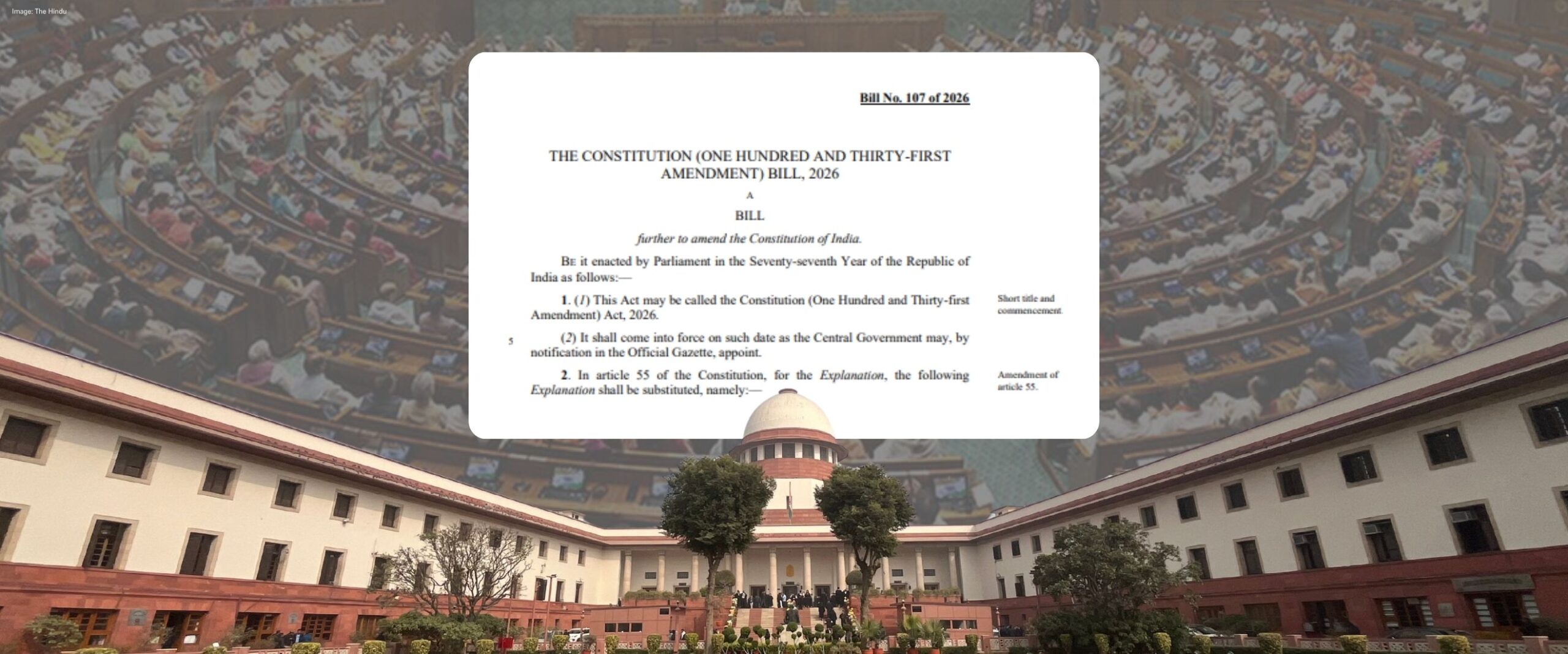
“The daughters of India cannot be asked to wait,” declared Prime Minister Narendra Modi as the Union government hyped the Constitution (131st Amendment) Bill as an effort to fast track enforcement of 33 per cent reservation for women in Parliament. On Friday, the bill failed to muster the 2/3rd majority required, as opposition members fought to delink reservation from delimitation. Despite the Union’s Thursday announcement of the coming into force of the reservation law—Nari Shakti Vandan Adhiniyam, 2023—things have returned to square one, with the 33 per cent quota contingent on the 2027 census.
While Parliament deliberated on women’s rights and the politics of delimitation, the Supreme Court saw some developments in this regard when it came to the bar.
In Vivya Nagpal v Union of India, the Supreme Court directed the earmarking of four Executive Committee posts for women in the Supreme Court Advocates-On-Record Association (SCAORA). On 8 December 2025, the Court had exercised its powers under Article 142 to direct 30 per cent reservation for women in elections at the State Bar Councils. What stands out in these orders is the seeming absence of contention. Reservation in SCAORA was finalised after both sides “graciously and fairly agreed” to the Court’s suggestion. The 8 December Order expressed appreciation for “the pragmatic, progressive, and cooperative approach” of the BCI.
But was this truly such a cooperative process?
“Talk of reservation has been going on for quite some time,” said AOR Jasmine Damkewala, pointing to CJI Surya Kant’s support for women’s representation. Initially, a lot of people viewed the demand as “anti-men” she said, noting that “today, the current environment is very positive.” Senior Advocate Shobha Gupta disagreed. She told me that “the first step had to be taken by the Court only because it wasn’t happening through the Bar associations themselves!” Gupta gave the example of how the Supreme Court had to direct reservations in the Supreme Court Bar Association (SCBA) after a proposal failed in the General Body Meeting. “Then it happened at the Bar Council of Delhi, then at the High Court Bar Associations,” she said, iterating that “extraordinary measures” are only required when matters do not “happen organically”. The only shift Gupta identifies is a shift among women themselves. “We have gone from asking our due, to claiming our due,” she said.
AOR Vivya Nagpal expressed a similar understanding. “SCAORA was very non-committal,” she said, “That’s the sole reason I had to file this petition.” Referring to a comment by Justice Bagchi at Monday’s hearing, Nagpal quotes, “the light is darkest below the lamp.” Describing change as “subtle and slow”, she said, “I strongly believe at least 60 per cent of my colleagues, both men and women, are in support of this move.”
Gupta is convinced that the 8 December Order will bring a major change.“At the time we had only five women out of 450 Bar Council members,” she said, “now we will have 150.” Recounting efforts to campaign for a woman friend who contested in the SCBA elections, Gupta said that when they approached members after 4 pm, they were “warned in a way” and told that “this is not an advisable time.” She described “practical predicaments” that discourage women from contesting, such as not having time to maintain a public appearance to garner votes. For her, reservations is as much about encouraging women’s participation in elections as it is about ensuring that they are taken seriously by all voters. “Now there are 88 women candidates for the Delhi Bar Council elections and 57 in Rajasthan,” she says, “I can’t imagine the number of women coming forth for elections we never considered before!”
All three practitioners suggest that reservations have to be a time-bound measure. “The minute we realise it is no longer required, it should stop” says Damkewala. Gupta says the measures will remain both necessary and welcome until “we get accustomed and habituated to taking instructions from women, and until it happens so frequently that it is no longer an exception.”
Related articles

Analysis
The Women’s Reservation Bill has a long history of arguments and stakes
DESK BRIEF: After two years of silence from the government in a PIL, Parliament abruptly passed the bill in a special session

Court Data
Only 107 of 788 Sitting High Court Judges are Women
With hardly any senior women judges in India's High Courts, gender diversity at the Supreme Court will take a hit.
Court Data
4% of Supreme Court Judges of All Time are Women
In the 50s, 60s, 70s, and most of the 80s, the Supreme Court had no women Judges. Since 1989, it has had 11.

Court Data
Number of all women Benches in the history of the Supreme Court
Until date, only two all women benches in the Supreme Court.