





Analysis
Supreme Court Review 2025: Walking the tightrope of jail and bail
The Court served up a mixed bag of bail orders—some baffling for their onerousness and others providing relief before the start of trial

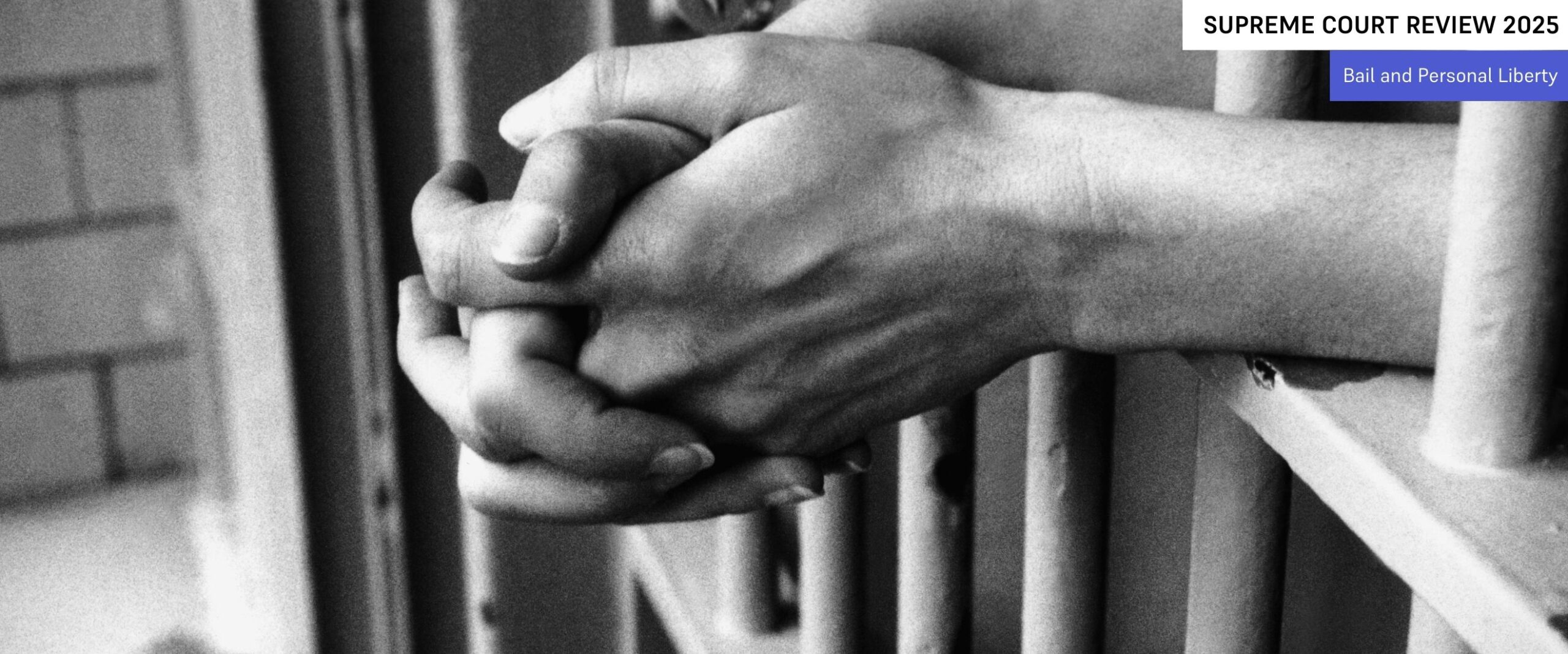
In 2025, the Supreme Court’s engagement with bail unfolded in fragments rather than through a single doctrinal shift. The Court continued to acknowledge delay, prolonged incarceration and procedural unfairness, but increasingly responded through interim relief, conditional release and scrutiny of bail reasoning instead of following through more wholly on its declarations on personal liberty.
The way this approach played out in cases under special criminal statutes like the UAPA and PMLA led to uneven outcomes despite similar claims of prolonged custody. Across these decisions, bail emerged not as a settled principle but as a tightly controlled judicial outcome, shaped case by case in a polyvocal court.
An SIT for a Facebook post
The approach was visible early in the year in Ali Khan Mahmudabad v State of Haryana. Mahmudabad, an associate professor at Ashoka University, was arrested in connection with two social media posts relating to Operation Sindoor. The FIRs invoked offences alleging threats to public order and national security.
By an order dated 21 May, a Bench of Justices Surya Kant and N. K. Singh declined to stay the investigation. At the same time, the Court directed the constitution of a Special Investigation Team headed by an Inspector General-rank officer from, noting the need for “proper appreciation” of the expressions used in the posts.
The Court granted interim bail. However, it imposed strict conditions, restraining Mahmudabad from writing or speaking on the subject matter of the FIRs, from expressing any opinion on the terrorist attack on Indian soil or the Armed Forces’ response, and directing him to surrender his passport and cooperate fully with the SIT. The order made clear that if further incriminating material emerged, the investigating agency could seek modification. The Court thus secured temporary liberty while postponing any assessment of the legality of the speech itself.
Bail under anti-conversion laws
A similar restraint marked the Court’s approach in cases arising under state anti-conversion laws. In Aman Siddiqui alias Aman Chaudhary v State of Uttarakhand, decided on 19 May, the Court granted bail to an accused booked under Sections 3 and 5 of the Uttarakhand Freedom of Religion Act, 2018, read with provisions of the Bharatiya Nyaya Sanhita, 2023. Siddiqui had been arrested following objections to his inter-faith marriage, despite the consent of both families.
Setting aside the Uttarakhand High Court’s refusal of bail, a Bench of Justices B.V. Nagarathna and S.C. Sharma held that the state could have no objection to two consenting adults residing together. Noting that Siddiqui had spent nearly six months in custody and that the chargesheet had been filed, the Court directed his release on bail.
The Court returned to this theme of procedural overreach in: Aftab v State of Uttar Pradesh, decided on 25 June. Although Aftab had been granted bail by the Supreme Court on 29 April, he remained in custody for nearly a month after authorities declined to release him on the ground that a sub-clause of the Uttar Pradesh Prohibition of Unlawful Conversion of Religion Act, 2021 was not expressly mentioned in the bail order.
A Bench of Justices K.V. Viswanathan and N.K. Singh observed that it was “a travesty of justice” that liberty was denied merely because “a sub-section number was not mentioned”. Holding that the continued detention rested on “hyper-technical and irrelevant” grounds, the Court awarded 5 lakh compensation for the 28 days Aftab spent in custody despite a subsisting bail order.
However, the larger challenge to the constitutionality of anti-conversion laws remains pending still in Citizens for Justice and Peace v State of Uttar Pradesh. There, the Court is examining whether anti-conversion laws restrict the rights to choice, privacy, personal liberty, marriage and dignity under Article 21 and whether they violate freedom of religion and conscience under Article 25.
Bail in a crypto scam
On 18 February, in Subhelal v State of Chhattisgarh, the Supreme Court granted regular bail to an accused in a cryptocurrency investment fraud case involving alleged losses of about Rs. 4 crore. The appellant had been in custody since December 2023 for offences under Sections 420, 201 and 120B of the Indian Penal Code, 1860 (IPC).
A Bench of Justices J.B. Pardiwala and R. Mahadevan noted that the chargesheet had been filed and that trial progress was slow, with only one witness examined out of 189 cited. Referring to Section 437(6) of the Code of Criminal Procedure, 1973 (CrPC), the Court held that prolonged custody in a Magistrate-triable case weighed in favour of bail. Bail was granted subject to conditions, including a deposit of Rs. 35 lakh.
Setting aside High Court orders
In Victim ‘X’ v State of Bihar, decided on 21 July, the Supreme Court cancelled bail granted under the SC/ST (Prevention of Atrocities) Act, 1989, noting that the High Court had failed to hear the victim and had not adequately considered the accused’s position of influence, who was a woman in charge of a Bihar shelter home. She had been accused of trafficking its residents and facilitating commercial sexual exploitation
Soon after, in Netsity Systems v State (NCT of Delhi) on 25 September, the Court set aside a Delhi High Court bail order that had ignored prior judicial findings recording dishonest conduct. The Court held that overlooking such findings at the bail stage distorted the record and undermined the integrity of the process.
Directions for anticipatory bail applications
In Anna Waman Bhalerao v State of Maharashtra, decided on 12 September, the Supreme Court dismissed appeals against rejection of anticipatory bail in a case alleging forged mutation entries and illegal land transfers. At the same time, a Bench of Justices J.B. Pardiwala and R. Mahadevan issued detailed directions on the expeditious disposal of bail and anticipatory bail applications.
The Court expressed concern that the appellants’ anticipatory bail pleas had remained pending for years with repeated interim protection. It observed that matters affecting personal liberty ought not to be kept pending indefinitely, warning against allowing a “sword of Damocles” to hang over applicants through repeated interim orders.
Parity not a substitute for role assessment
The limits of parity came into focus in Sagar v State of Uttar Pradesh, decided on 28 November. The Allahabad High Court had granted bail solely on the ground that a co-accused had been released earlier. On appeal, a Bench of Justices Sanjay Karol and N.K. Singh set aside the order, holding that parity cannot be applied mechanically. The Bench observed that Courts must examine the specific role attributed to the accused and determine whether he stands on the same footing as the co-accused.
Anticipatory bail under the SC/ST Act
On 1 September, in Kiran v Rajkumar Jivraj Jain, the Supreme Court revisited the statutory bar on anticipatory bail under Section 18 of the SC/ST (Prevention of Atrocities) Act, 1989. The case involved allegations of assault and public humiliation using the caste slur “Mangatyano”.
A three-judge Bench comprising then Chief Justice B.R. Gavai and Justices K.V. Chandran and N.V. Anjaria held that once a prima facie offence under Section 3 of the SC/ST Act is disclosed on a plain reading of the FIR, the statutory bar is attracted. The Court noted that the alleged abuse carried a clear caste reference and was intended to humiliate the complainant because he belonged to a Scheduled Caste community. The Court further clarified that anticipatory bail may be granted only where no offence under the SC/ST Act is made out at first blush, without entering the evidentiary realm.
Wangchuk’s detention in Jodhpur
Sonam Wangchuk, activist and educator, was placed under preventive detention in late September 2025 following protests in Leh demanding constitutional safeguards for Ladakh. The protests on 24 September turned violent, after which the administration invoked the National Security Act, 1980. Wangchuk was detained by the authorities and shifted to Jodhpur Central Jail, far from Ladakh.
His wife, Dr. Gitanjali J. Angmo, approached the Supreme Court challenging the legality of the detention. The petition questioned the grounds of detention and the use of preventive custody for protest-related activity. The Court issued notice to the Union, allowed amendments to the petition challenging the detention grounds and adjourned the matter for further consideration. As of the end of 2025, Wangchuk remains in custody and the challenge to his detention is pending before the Court.
The Khalid case
Perhaps the most closely watched bail proceedings unfolded in Umar Khalid v State (NCT of Delhi). Arrested in September 2020 in connection with the alleged larger conspiracy behind the 2020 Delhi riots, Khalid had spent over five years in custody by the time his bail plea reached the Supreme Court.
During hearings spanning October to December, the Delhi Police argued that the riots were not spontaneous but pre-planned. They relied on speeches, protected witness statements, call detail records, location data and WhatsApp communications to contend that Khalid played a coordinating role in organising road blockades and protests. He submitted that the material attracted the statutory bar under Section 43D(5) of the Unlawful Activities (Prevention) Act, 1967, which makes bail impermissible where the court is satisfied that the allegations disclose a prima facie case.
On the other hand, counsel for Khalid and other accused argued that prolonged incarceration without trial could not continue indefinitely. They pointed out that there was no recovery of funds, weapons or incriminating material, and that mere membership of WhatsApp groups, without active participation, could not establish conspiracy. On 10 December, after concluding hearings, the Court reserved judgement.
Related articles

Analysis
2025 Supreme Court Half-Yearly Review: Bail
The Court in the first half of 2025 displayed a patchwork of standards on bail and personal liberty

Analysis
Bail Under UAPA: Court in Review
Section 43D(5) of the Unlawful Activities (Prevention) Act, 1967 lays down stringent provisions for the grant of bail.
Analysis
Article 21 remains a divided promise in the Supreme Court’s bail jurisprudence
The selective reading of liberty in UAPA and PMLA cases hinges on the accused’s identity. A ‘Khalid Test’ could offer a course correction