





Analysis
Why the challenge to the Election Commissioners law must be heard by five judges
Whether the selection committee may have an executive majority is yet to be judicially settled.

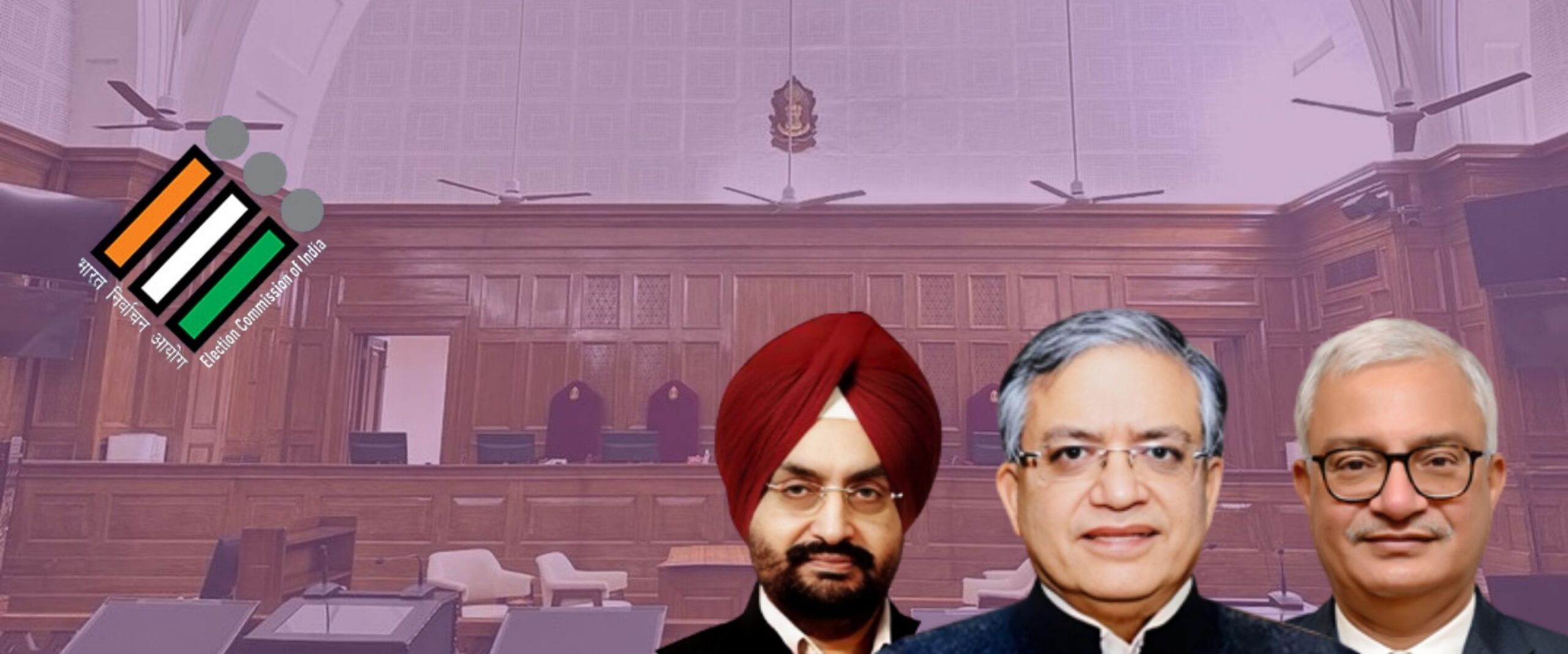
On 23 September 2026, Justice Dipankar Datta and Justice S.C. Sharma delivered separate opinions in the challenge to the 2023 law on appointing Election Commissioners. They differed on whether a Bench of two judges could decide that challenge.
Justice Datta held that the case required only the application of settled principles and could be decided by two judges. Justice Sharma held that it raised a substantial question of constitutional interpretation, which Article 145(3) reserves for at least five judges. Their joint order placed the matter before the Chief Justice of India (CJI) for the constitution of a larger Bench.
The split verdict and the ultimate reference has drawn criticism. The concern over the delay that attends Constitution Bench references is well founded. The criticism, however, treats as settled a question which the Supreme Court has never decided.
Both judges accepted two propositions drawn from Anoop Baranwal v Union of India (2023). The committee of the Prime Minister, the Leader of the Opposition and the CJI was an interim arrangement. It ended when Parliament legislated. The Constitution Bench’s declaration on the ECI’s independence continues to bind every court under Article 141.
What the 2023 judgement settled
Justice K.M. Joseph, writing the majority opinion in Anoop Baranwal, held that the power to appoint ECI members must “not be lodged exclusively with the Executive”. This suggests that appointments must be insulated from exclusive executive control. He added that a law made by Parliament could not perpetuate “appointment at the absolute and sole discretion of the Executive”.
These passages tell Parliament that its law must depart from sole executive discretion. The Bench was neither scrutinising a statute nor had an occasion to limit how far a law must depart from the Constitution Bench judgement. Section 7 of the 2023 Act gives the government two votes on the selection committee and the Leader of the Opposition one. Executive control has thus moved from a monopoly to a majority. The opinion splits on this characterisation. A rule against monopoly can govern a majority only if a court decides that the two are equivalent.
While the inclusion of the Prime Minister’s nominee makes the equivalence obvious, the hearings demonstrated that the matter is less plain. The petitioners argued that Article 324 bars executive dominance in the selection process. The Union responded that Parliament was free to choose a design and that the law would only fail a constitutional test if there was actual proof that the ECI’s independence was under threat. Determining the correct position would require interpretation. Petitioners may prevail given the ECI’s role in elections.
Justice Datta’s method
Justice Datta’s opinion formed a prima facie view that Section 7 leaves the LoP with little real say in the selection process. This reading is persuasive. He relied on the “perception test” and on collective responsibility under Article 75(3). He also suggested the need for an “independent counterweight” in the form of a neutral selector. The “perception test” can be traced back to Anoop Baranwal which warned against “even a perception” that a “yes man” would decide democracy’s fate. The aspects of collective responsibility and an independent counterweight do not appear in Anoop Baranwal.
Justice Datta acknowledged that Anoop Baranwal’s reasoning for a neutral appointment mechanism was transient and not a “not a binding norm that Parliament was constitutionally obliged to follow.” If the question regarding a neutral selector was left pending in 2023, then the Bench that decides it today would be tackling the issue for the first time. Therefore, his conclusion that the challenge could be decided on the basis of settled principles of law is difficult to reconcile with his own method.
What Ganga Singh decided
State of Jammu and Kashmir v Thakur Ganga Singh (1959) held that a question of interpretation arises when the parties place different constructions on a provision. The respondents raised a preliminary objection under the then Article 132(2). At the time, Article 132(1) provided an appeal to the Supreme Court where the High Court certified that a case involved a substantial question of law concerning constitutional interpretation. If the High Court refused that certificate, Article 132(2), since repealed, allowed the Supreme Court itself to grant special leave on the same constitutional ground. The question in Ganga Singh was therefore whether that narrower requirement under Article 132 had been satisfied. The respondents argued that a series of the Court’s decisions had already settled the meaning of Article 14, and that no such question could arise.
The Court agreed with the respondents, and explained that interpretation is the method by which the true sense of a provision is understood. There is no question of constitutional interpretation if parties agree with a construction and raise no question about it. The Court added that a substantial question of law cannot arise where the law has been finally and authoritatively decided. Both sides in Ganga Singh accepted the settled doctrine of classification under Article 14, and they disputed only whether a motor vehicles rule satisfied it. The Court therefore accepted the preliminary objection and dismissed the appeal with costs.
The parties before Justices Datta and Sharma shared no such common ground. The Union argued that the Constitution Bench had directed interim measures under its powers under Article 142. This could not constrain Parliament’s choice of a framework. Attorney General R. Venkataramani questioned whether a law could be struck down without material showing an actual threat to the Commission’s independence. The petitioners answered that Article 324 forbids executive dominance of the selection process.
Ganga Singh’s holding on law that is finally and authoritatively decided, gives no ground for resisting the reference. The 2023 Bench left the majority question undecided, as its text shows.
The history of the case points in the same direction. On 23 October 2018, a two-judge Bench referred Anoop Baranwal’s petition to five judges. Its Order recorded that the issue had “not been debated and answered” by the Court earlier. The question then was what Article 324(2) requires while Parliament remains silent. The question now is what it requires of Parliament when it legislates, and that question is equally one of interpretation.
Have benches of two judges decided such questions earlier?
Readers may recall two celebrated rulings in which Benches of only two judges decided important constitutional questions. A closer look at both shows why two judges were sufficient there, and why five are needed in the present case.
The first is NALSA v Union of India (2014), in which the Court recognised the right of transgender persons to choose their gender identity. The Union government did not oppose the petitions in that case. It told the Court that the hardships of the transgender community deserved serious attention. Since nobody before the Bench disagreed about what the Constitution meant, there was no dispute over its interpretation for a larger Bench to settle.
The second is Shreya Singhal v Union of India (2015), in which the Court struck down Section 66A of the Information Technology Act, 2000. The Union did oppose the petitions and argued that Section 66A fitted within the grounds listed in Article 19(2), on which the Constitution permits speech to be restricted. The two judges therefore had to apply tests which larger Benches had already laid down.
The ECI Appointments case stands on a different footing from both rulings. The Union and the petitioners disagree about what Article 324 itself requires of Parliament. No larger Bench has answered that question yet.
Institutional Delay
None of this lessens the force of the concern about delay. The Union raised the plea for a reference after the petitioners had concluded their arguments. The petitioners called it a ploy to delay a challenge pending since 2024. Their grievance is legitimate. Article 145(3), however, prescribes the minimum strength of the Bench in mandatory terms. A belated plea cannot alter what the Constitution requires. The remedy for delay lies in prompt listing. The joint order urges the CJI to set up a permanent Constitution Bench.
Justice Sharma reached the correct forum on reasoning that was thinner than his conclusion. He leaned partly on the novelty of the statute, although the firmer ground was the gap between monopoly and majority. The five judges must now decide whether Article 324 prohibits an executive majority on the selection committee. They must also decide whether the appearance of independence is an enforceable constitutional standard. Justice Datta may yet be vindicated on the merits of the challenge, even though the reference to five judges was the correct course.
Related articles

Analysis
Split verdict, common order
All eyes are on the ECI but an aberration at the Supreme Court draws attention to larger bench references

Analysis
Trusting the Election Commission
In a hearing on electoral roll revision, the SC reiterated its inclination to trust the ECI, but not before offering friendly advice

Analysis
Election Commission: 4 Must Reads
We have curated a set of must-reads that examine the practices of the Election Commission in recent times and its interaction with the SC.