





Analysis
2025 Winter Session Review
This winter, the Supreme Court witnessed Presidential Reference opinion, two Constitution Bench decisions and retirement of Justice Gavai

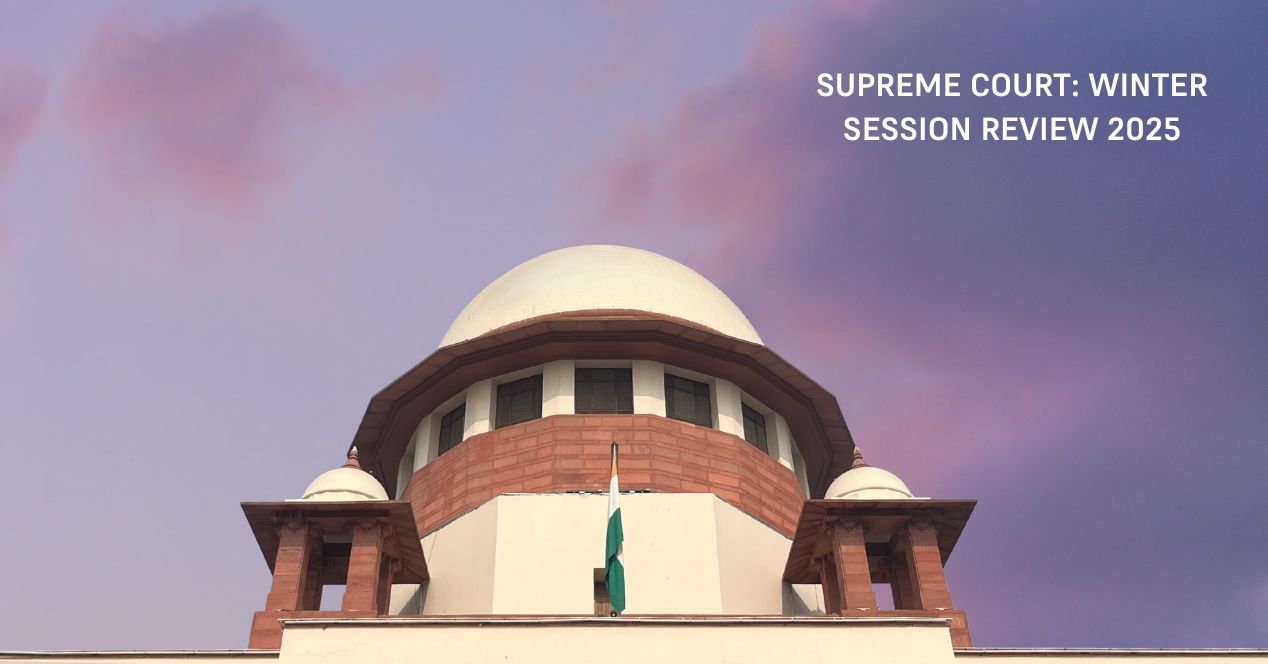
Right at the start of the winter session, the Supreme Court was bustling with activities — on both legal and administrative fronts. Having concluded hearings, the Court delivered an opinion on Presidential Reference while also deciding two Constitution Bench matters.
In the last week of November, the Court bid farewell to the outgoing Chief Justice B.R. Gavai. Justice Surya Kant assumed leadership as the 53rd Chief Justice of India, at a time when the Court’s pendency soared past the 90,000 mark.
Note: The Supreme Court does not have an official session calendar. For analytical clarity, we at the Supreme Court Observer have divided it into four sessions: Spring (January to March), Summer (April to June), Monsoon (July to September), and Winter (October to December).
Quick facts
Working Days: The Supreme Court worked 50 days between 1 October and 31 December. In this period, the Court observed a two-week holiday for Dussehra and Diwali, followed by a 10-day break for Christmas and New Year. For the first time, the Court witnessed vacation benches during the winter break, with CJI Surya Kant sitting twice to hear urgent matters.
Quorum: Currently, the Court has a working strength of 33 judges with one vacancy remaining at the end of the year.
Appointments and retirement
Between October to December, the Supreme Court witnessed the retirement of the former CJI Gavai, who was succeeded by CJI Surya Kant. No recommendations have been made so far by CJI Surya Kant-led Collegium for the single vacancy arising on Justice Gavai’s retirement.
At the end of CJI Gavai’s tenure, we covered his last day in the Court and compiled a list of his 10 most notable judgements. We provided an overview of his tenure in numbers and considered pendency under his leadership.
The Court saw no appointments this winter session. The elevation of Justice V.M Pancholi by the Justice Gavai-led Collegium was the last appointment of 2025.
Constitution Bench decisions
- Presidential Reference on the powers of the Governors and the President – Opinion dated 20 November 2025
- Direct recruitment of District Judges under the Bar Quota—five-judge bench—Judgement dated 9 October 2025
- Reservation for Civil Judges for the post of Principal District Judge – five-judge bench – Judgement dated 19 November 2025
Constitution Bench Hearings
None
Pendancy
- 27 five-judge bench matters with 186 tagged matters
- 6 seven-judge bench matters with 35 tagged matters
- 4 nine-judge bench matters with 50 tagged matters
Total Pendency: 92321
(Data collected from the National Judicial Data Grid on 5 January 2026)
Constitution Bench Decisions
Opinion on Presidential Reference
On 20 November 2025, a five-judge Bench led by former CJI Gavai clarified the scope of powers of Governors and the President with regard to assent, withholding and reservation of State bills.
Following the Court’s decision to impose guardrails on the discretion exercised by the Constitutional functionaries under Article 200 and 201 respectively, the President of India sought clarification under Article 143 of the Constitution. In the unsigned unanimous opinion of the five judges, the Court opined that discharge of functions by Governors and the President is non-justiciable and that the Court’s judicial timelines cannot be binding on them.
Merit, not exclusion
On 9 October 2025, a five-judge Bench held that a judicial officer, with at least seven years of practice as an advocate, can be appointed as a District Judge under the bar quota. Setting aside the ruling in Dheeraj Mor v Union of India (2020), the Court noted that under Article 233(2), there is no bar on judicial officers being appointed as District Judges. Further, the Court noted that excluding in-service candidates from appointment “prohibits otherwise meritorious candidates from the zone of consideration.”
The inter-se seniority question
On 19 November 2025, a five-judge Bench settled principles governing the determination of seniority among cadres of the Higher Judicial Services (HJS). The Court held that a legitimate expectation of reservation among the cadres of the HJS cannot be the basis to allow artificial classification. The Court acknowledged the need to “strike a balance between” merit and seniority. It suggested that a uniform framework based on merit-cum-seniority be framed for promotion within the HJS.
Division Bench decisions
Winter’s Green Verdicts
The Court has meted out myriad judgements on the environment in the past three months.
On 8 October 2025, the Court ordered the Jharkhand government to declare 314.86 square kilometres within the Saranda forest a wildlife sanctuary. While the Court extended protection to ongoing mining projects within the region, it directed the authorities not to grant any fresh mining leases.
On 18 November, the Court reversed the verdict in Vanashakti v Union of India in a 2:1 split, stating that ex post facto clearances are not illegal under environmental laws. The majority decision further suggested that declaring ex post facto clearances illegal would hurt larger public interest. However, Justice Bhuyan, in his minority decision, called the judgement “a step in retrogression.”
On 20 November, a three-judge Bench, led by Justice B.R. Gavai settled the definition of the Aravali Hills and Ranges. The definition excluded ranges that were less than 100 metres in height. The decision was stayed by a bench, led by CJI Surya Kant, on 29 December 2025, where the Court formed an expert panel to examine the question of height and permissible mining in Aravalis.
Close-watch on governance
The Supreme Court closely watched matters concerning Other Backward Caste reservations in Maharashtra, vacancies in Central Election Commission (CEC), and the Speaker’s powers under Section 3(2) of the Judge’s (Inquiry) Act, 1968.
On 25 November, the Court heard arguments on the validity of 27 per cent OBC reservations in local body elections in Maharashtra. While the Court allowed reservations based on the Banthia Committee report, it directed the State to strictly comply with the 50 per cent reservation ceiling.
On 16 December, the Court heard the challenge to the Speaker’s power to constitute an Inquiry Committee for impeachment proceedings under Section 3(2) of the Judges Act, 1968. The Court took note of Justice Yashwant Varma’s allegation that the Speaker acted “unilaterally”, which without the directions of the Chairperson, could not have been admitted. On 8 January 2026, the Bench reserved judgement in the matter.
In December, the Court heard petitions on vacancies at the Central and State Information Commission. The petitioners argued that the Union Government has taken no steps to fill vacancies for the last 10 months. The Court directed States to submit affidavits on the issue and comply with the directions on filling vacancies at the earliest.
Strengthening the Transgender Persons Act, 2019
On 17 October 2025, the Supreme Court issued concrete directions in affirmation of equal opportunity guidelines to materialise the rights of transgender persons as envisioned in National Legal Services Authority (NALSA) v Union of India (2014). Directing the award of compensation to a transwoman petitioner, who was discriminated against based on her gender, the Court took note of gaps in existing legislation. It directed the formation of a committee to eradicate “omissive discrimination” against the transgender community.
Determining criminality
On 11 November, the Court, in a curative petition, acquitted the last accused in the Nithari Killings case (2006), observing that the case was marred with evidentiary deficiencies, making identification of the actual perpetrator beyond reasonable doubt difficult. It remarked, “presumption of innocence is endured until guilt is proven through admissible and reliable evidence.”
On 29 December, the Supreme Court stayed the Delhi High Court’s suspension of the life sentence awarded to Kuldeep Sengar, a former MLA. Accused in the 2017 Unnao Rape case, Sengar was charged with offences under the Indian Penal Code and Protection of Children from Sexual Offences Act, 2012. The Court deliberated on whether an MLA comes under the definition of “public servant” to determine the application of Section 5 of the POCSO Act.
Continued hearings
On 10 December, after 11 days of arguments, a Bench of Justices Aravind Kumar and N.V. Anjaria reserved judgement on a batch of bail applications in the 2020 Delhi Riots case. The judgement was pronounced on 5 January, directing the release of five of the accused while denying bail to Umar Khalid and Sharjeel Imam.
Between October and December, the Court heard 10 days of arguments in the challenge to the Special Intensive Revision (SIR) in Bihar.
In the same period, it heard submissions from concerned authorities and experts on the air pollution crisis in Delhi.
Court news
On 19 December, Manohar Lal Sharma, a renowned public interest litigator, passed away. Sharma’s frequent petitions, in various high profile cases such as pegasus, abrogation of Article 370, Rafael deal, among others, had become an entry point for constitutional inquiry.
In the final week of 2025, the Supreme Court Registry issued a Standard Operating Procedure (SOP), mandating a cap on the length of written submissions to five pages. The SOP further required lawyers to submit a note, disclosing an estimate of the time to be taken by advocates on arguments.
Year-end reviews
Reflecting on 2025 in the Supreme Court, we published our year-end review series, covering myriad topics including Constitution Bench judgements and Top 10 judgements of 2025. The series also compiled landmark judgements on matters of governance and democracy, freedom of speech, bail, appointment of judges and environmental law.
SCO.LR
SCO.LR is a compilation of judgements delivered by the Supreme Court each week. With the completion of 2025, we marked one year of the initiative with a grand total of 250 cases in our docket!
Find all judgements of the winter session here – October, November, and December.
Check out our SCO.LR page for more!
Related articles
Analysis
2024 Winter Session Review
This winter session, the Supreme Court delivered seven Constitution Bench decisions and saw the retirement of Chief Justice D.Y. Chandrachud
Analysis
2025 Monsoon Session Review
This monsoon session, the Court heard two Constitution Bench cases, saw two new appointments and delivered key judgements
Analysis
2025 Spring Session Review
Fresh faces, familiar fault lines, and a scandal – this Spring, the top court found itself standing at the crossroads of promise and peril
Analysis
2025 Summer Session Review of the Supreme Court of India
With Justice BR Gavai taking over as Chief Justice of India and three new appointments, the top court has new faces on the bench this summer