





Analysis
Bulldozer demolitions | A guideline without a forum
The Court’s decision to relegate bulldozer contempt pleas to the High Courts reopens a question about the reach of its own directions

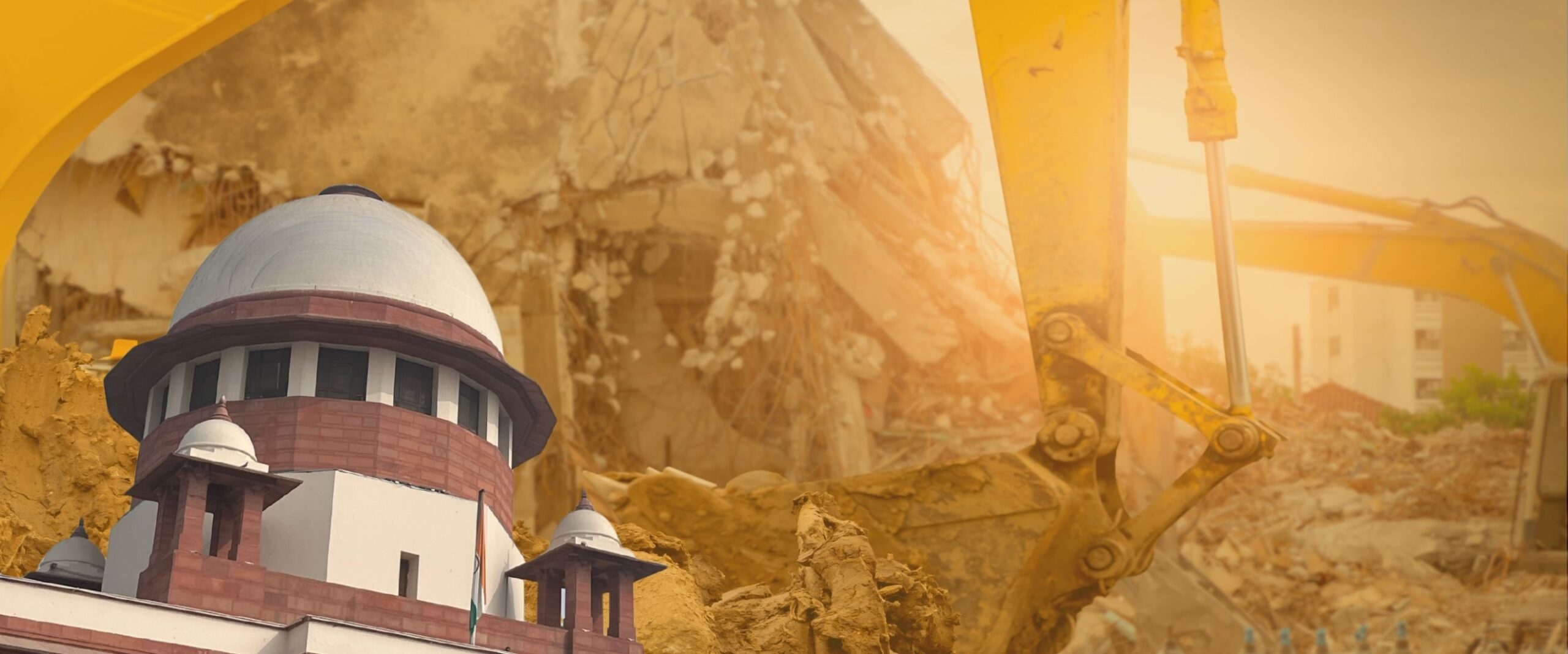
On 16 July, the Supreme Court declined to hear a batch of contempt petitions which alleged that state authorities had flouted the Court’s November 2024 directions against arbitrary demolition.
The Bench of Chief Justice Surya Kant, Justices Joymalya Bagchi and V. Mohana remitted the pleas back to the jurisdictional High Courts, directing them to decide the pleas within four months. Interim protection already granted will continue. Parties may seek to modify it before the High Courts. The Bench recorded no opinion on the merits.
The judgement in In Re: Directions in the Matter of Demolition of Structures (2024) laid down pan-India guidelines on bulldozer demolitions. The Court’s July Order reopens a question that outlives this dispute. What is a guideline judgement worth, once the Court that wrote it steps back from enforcing it?
The judgement that grew teeth
Justices B.R. Gavai and K.V. Viswanathan in November 2024 held that the executive cannot raze a home merely because its owner stands accused or convicted. They reasoned that such demolition offends the rule of law and the separation of powers.
The Bench exercised the Court’s inherent jurisdiction under Article 142 to lay down a national code. It held that no demolition can take place without a prior show-cause notice. The owner gets 15 days to reply. A personal hearing must follow. A reasoned order must be issued. Fifteen more days must pass before any bulldozer moves. The whole exercise must be videographed.
Officials who breached the directions would face contempt. They would also restore the demolished property at their own cost. A digital portal would record every notice and order. Enforcement was written into the text.
So the petitioners did the obvious thing. When demolitions continued, they returned to the Supreme Court on contempt.
“Judgement cannot be read as a statute”
The 16 July order closed that route. Justice Bagchi supplied the defining line: “Judgment cannot be read as a statute. Directions [are] hedged with a caveat,” he observed. The directions restated existing statutory rights, he added, and had to be read with paragraph 94, which houses the exceptions.
The November judgement had exempted encroachments on public land, such as roads, footpaths and water bodies. It had exempted demolitions ordered by a court. The CJI noted that once an authority invokes those exceptions, the dispute turns factual. Was the land public or private? Did the structure exceed its sanction? Was notice served, and a hearing given? Was this an anti-encroachment measure, or selective punishment? Contempt cannot resolve such questions. It asks only whether a clear order was wilfully disobeyed.
Justice Mohana put the practical worry plainly. “All over India, whatever happens, can everybody come directly to the Supreme Court?” she asked. One case illustrated the tangle. Senior Advocate S. Muralidhar’s client had gone first to the Madhya Pradesh High Court, which refused to entertain the plea. It closed the matter on the footing that the Collector had no notice of the Supreme Court’s judgement. The Bench set that order aside and remanded it.
The Court’s logic is not weak
The order is defensible on its own terms. The High Courts are better equipped to assess evidence as they sit closer to the ground, especially in contempt demands where there needs to be a proof of deliberate defiance. Further, High Courts can quash an illegal demolition and direct compensation and summon officials under Article 226. It also divides the work across the High Courts instead of centralising the challenge at one forum in Delhi.
High Courts are constitutional courts, bound by Article 141 to apply the law the Supreme Court declares. In D.K. Basu v State of West Bengal (1997), the Court let breaches of its national arrest safeguards be pursued as contempt in the High Court holding territorial jurisdiction. The bulldozer judgement built no such local mechanism. Justice Bagchi noted the absence. On this reading, relegation supplies what the judgement left out, and keeps the national rule while sending only the facts downstream.
The petitioners’ accounts show what is lost. Senior Advocate Huzefa Ahmadi appeared in a case that concerned a Somnath mosque, razed after a politician’s letter asked how the state could host Asia’s largest mosque. Senior Advocate Sanjay Hegde appeared for a man whose fruit juice stall was bulldozed while a television anchor live-telecast the scene. Senior Advocate C.U. Singh pointed to Maharashtra demolitions that followed politicians’ public calls for “bulldozer action”. A fact-finding detour returns these petitioners to the very forums that did not halt the bulldozer.
The cost the order does not price
Demolition is irreversible. A house reduced to rubble is not rebuilt by a favourable order four months later. That four-month window is a request, not a hard bar. Those affected are usually poor, and often from minority communities. They must now gather evidence, brief counsel afresh and wait. The asymmetry is stark. The State acts in the morning. The remedy takes a season. There is a signal cost too. Singh warned that a Court which will not defend its judgement blunts its deterrent force.
The longer pattern
This is the recurring fate of the guideline judgement. The bulldozer judgement, unlike D.K. Basu, named no local forum to police it. That gap is what the July order now tries to close.
A guideline is only as strong as the forum that polices it. When that forum is the Supreme Court, a breach carries a national signal. When enforcement devolves to twenty-five High Courts, the signal fragments. A direction meant to bind uniformly begins to vary by bench and by state. That is the structural price of relegation.
The evidence arrived within days. On 20 July, a Division Bench of the Allahabad High Court split on bulldozer action. Justice Atul Sreedharan favoured a two-year bar on razing an accused’s home after an FIR. Justice Siddharth Nandan disagreed. The question now goes to a third judge. One High Court, two views, on the very safeguards the Supreme Court had just entrusted to it.
Whose contempt is it?
A quieter puzzle sits underneath. A court usually enforces contempt of its own orders. High Courts draw that power from Article 215, the Supreme Court from Article 129. In the bulldozer case, the alleged disobedience concerns the Supreme Court’s own directions, yet the High Courts will judge it.
A question still hangs. Are the High Courts punishing defiance of the Supreme Court’s order, enforcing the law it declared under Article 141, or trying contempt of the transferred proceedings? The label is not academic. It governs the standard of proof, the reach of interim relief and the remedy. Moreover, has the Court built a federal enforcement machine, or dispersed the duty to secure obedience? The High Court rulings will answer it.
What to watch
The order leaves a test for the High Courts. Will they treat the 2024 directions as binding norms, or as soft guidance to weigh against local facts? Justice Bagchi’s own words cut both ways. The judgement, he recalled, “came as the conscience of the court was shocked”. Yet bulldozers are needed, he said, when the rule of law is “throttled by comfortable corruption between authorities and illegal encroachers”. Enforcement, he warned, must not slide into the “characterisation of individuals”. Lawful demolition and its abuse can wear the same uniform.
Three markers will tell the story:
- Whether the High Courts keep to the four-month timetable;
- Whether they enforce the personal liability the 2024 judgement imposed;
- Whether the portal of notices, ordered to bring transparency, actually runs.
If those hold, relegation is delegation. If they slip, a landmark becomes a promise without a forum.The Court has not disowned its own judgement. It has asked others to keep it. Whether a guideline can survive that hand-off is the question this order leaves behind.
Related articles

Analysis
Bulldozer demolitions remind of a “lawless, ruthless state of affairs”, declares Supreme Court, as it issues pan-India guidelines
The Court directed that demolitions, if at all, must be preceded by due process, and violation of the guidelines would amount to contempt
Analysis
Supreme Court reserves judgement in ‘Bulldozer Action’ case; stay on demolitions remains
As the Court discussed suggestions for ‘pan-India’ guidelines, it stopped the UN Special Rapporteur on Housing from intervening
Analysis
SC hearings on ‘Bulldozer Justice’: What has happened so far?
Before the top court takes up the matter again on 1 October, a brief run-through on what the courts have said about illegal demolitions

Analysis
Has the Supreme Court been trigger-happy with Article 142?
The power of the top court to ‘do complete justice’ is back in the limelight after its recent judgement on the Tamil Nadu Governor