





Analysis
Five more chairs
With its first set of recommendations, the Collegium has an opportunity to address the religious diversity question in its next cycle

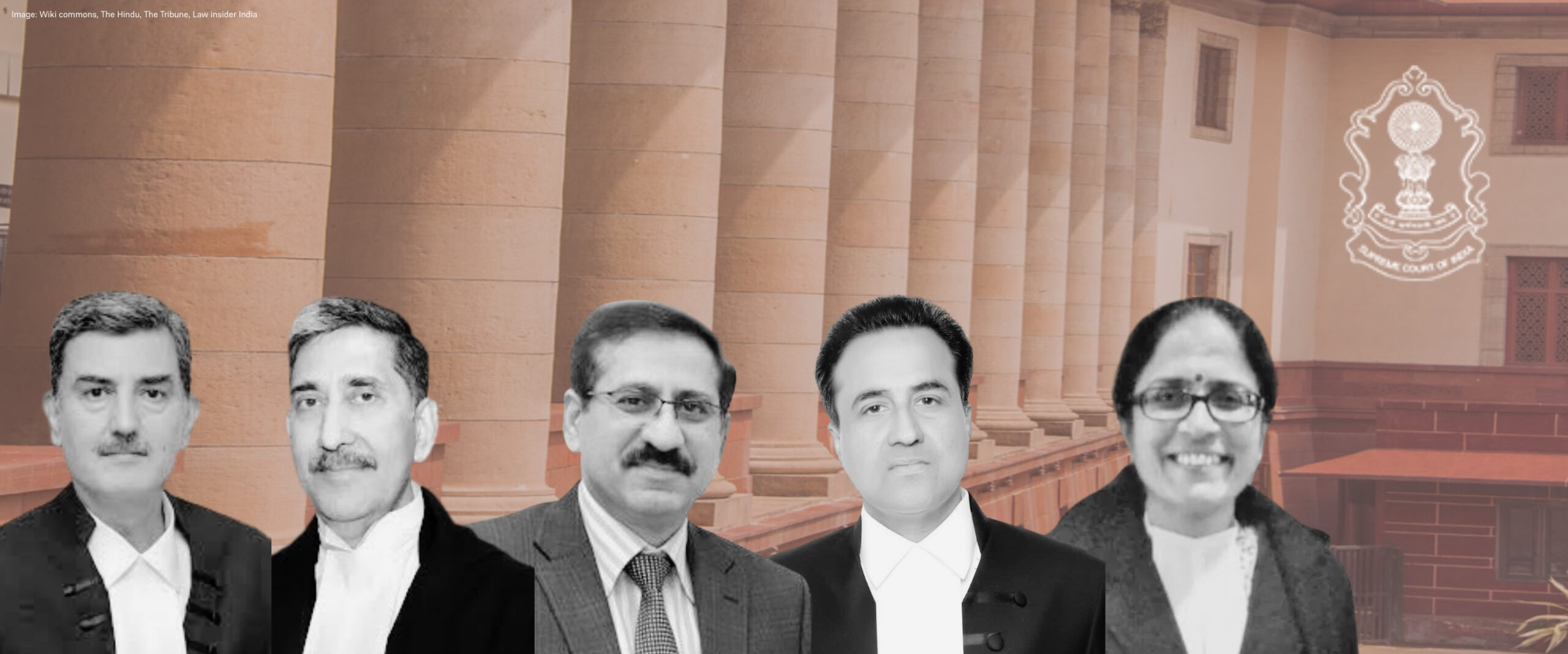
In the late hours of 27 May, the Supreme Court website published a Collegium resolution recommending four High Court Chief Justices and a woman senior advocate from the Bar, V. Mohana, for elevation. Her recommendation addresses a growing demand for gender representation in a top court that currently has only one woman judge, Justice B.V. Nagarathna. Mohana is only the second woman in history to be elevated directly from the Bar, following Justice Indu Malhotra’s appointment in 2018.
The Chief Justices include Chief Justices Sheel Nagu (Punjab and Haryana), Shree Chandrashekhar (Bombay), Sanjeev Sachdeva (Madhya Pradesh), and Arun Palli (Jammu & Kashmir and Ladakh). The resolution disproves the theory that the imminent retirement of some High Court Chief Justices might have influenced the Ordinance route.
The single-page resolution offered very little commentary, strictly limiting its text to the five names and their parent High Courts. As this marked the first set of recommendations from the Collegium led by Chief Justice Surya Kant, we had anticipated a return to the practice of publishing detailed background rationales and exact seniority rankings. Instead, the non-transparent approach introduced under CJI B.R. Gavai continues.
While detailed resolutions open the Collegium to greater public scrutiny, they allow us to understand the Collegium’s underlying intent, which may—in some instances—validate its choices. A nuanced explanation from the Collegium is vital to dispel misgivings, if any.
Geographically, the choices maintain the traditional regional balance across Madhya Pradesh, Delhi, and Punjab and Haryana High Courts. Justice Nagu’s recommendations will effectively fill the vacancy left by Madhya Pradesh’s Justice J.K. Maheshwari, retiring in June 2026. Similarly, Justice Sachdeva’s appointment increases the Delhi High Court’s representation to two judges, an equilibrium the Court has maintained, and admitted in a Collegium resolution. Justice Palli’s elevation restores the Punjab and Haryana representation following Justice Rajesh Bindal’s retirement in April 2026.
Justice Palli supersedes a senior judge from his own parent court—Justice G.S. Sandhwalia. The Collegium has deviated from the seniority principle in the past. It is a common practice as seniority is not the only factor. Interestingly, past Collegium data reveals that the Union government sat on Justice Sandhawalia’s appointment as Chief Justice of the Madhya Pradesh High Court for two months. The Collegium later transferred him to the Himachal Pradesh High Court, where he is now expected to serve as Chief Justice until October 2027.
Similarly, Justice Shree Chandrashekar’s recommendation restores Jharkhand’s presence in the top court, for the first time in a decade. Justice Chandrashekar supersedes Justice Aparesh Kumar Singh, currently Chief Justice of Telangana—also hailing from Jharkhand.
The final recommendation is of Mohana, a Senior Advocate from humble beginnings and a first-generation lawyer. She happens to be trained under Justice Indu Malhotra. If approved by the Union Government, she will serve until June 2031, a relatively long tenure at a time when concerns about gender representation remain acute.
With two more retirements looming and a single vacancy, we expect more recommendations from the Collegium soon. Notably, this current round of recommendations included no religious minorities. Justice Ahsanuddin Amanullah remains the sole Muslim judge on the Bench, joined by Justice A.G. Masih as the sole Christian judge. While the Collegium missed an opportunity to elevate Justice Sandhwalia, a Sikh judge, the next three upcoming vacancies provide an opportunity to address these fresh sets of diversity questions.
This article was first featured in SCO’s Weekly newsletter. Sign up now!