


Analysis
Justice S.C. Sharma: Notable judgements
In three years at the Supreme Court, Justice Sharma participated in seven Constitution Bench decisions, authoring two separate opinions.

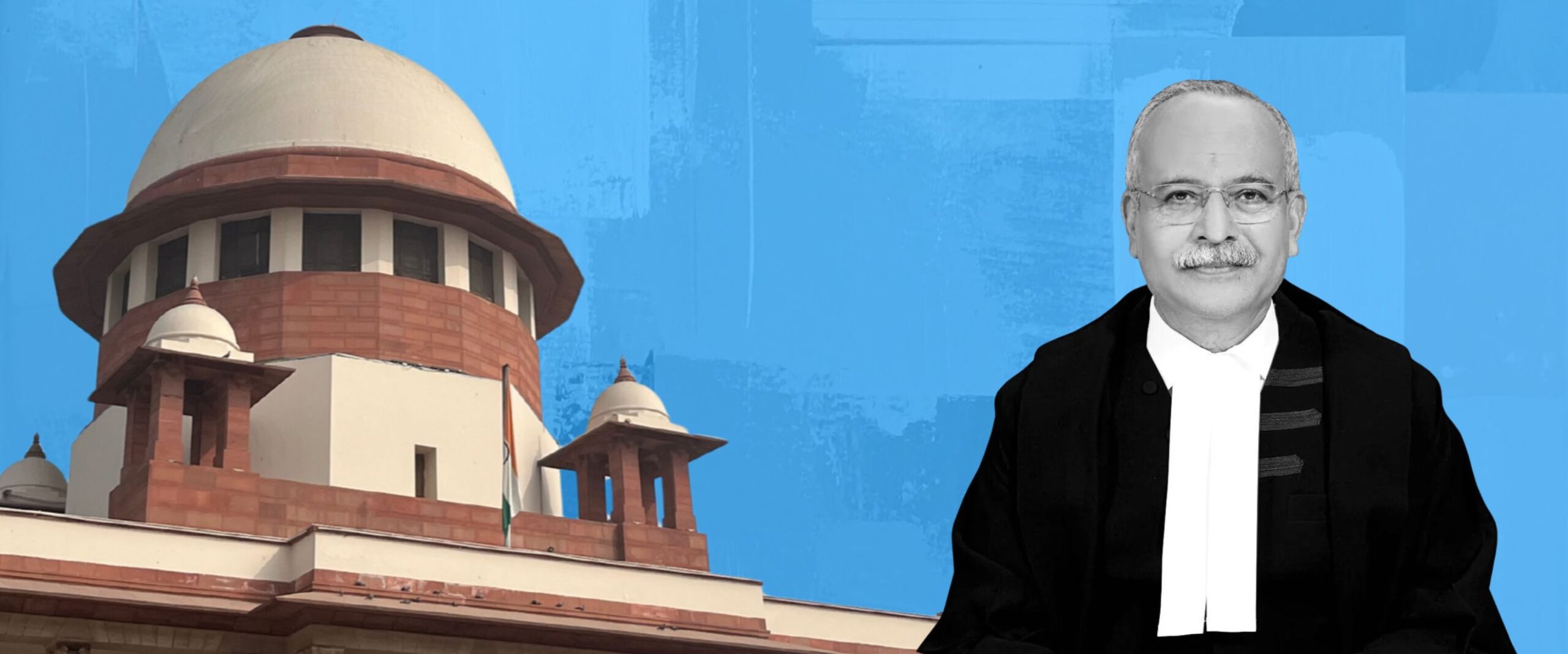
On 29 November 2026, Justice S.C. Sharma will retire after a tenure of three years and 20 days as a Judge of the Supreme Court. Justice Sharma was elevated in November 2023 from his position as Chief Justice of the Delhi High Court. He had previously served as Chief Justice of the Telangana High Court and Acting Chief Justice of the Karnataka High Court between 2021-22.
In commemoration of his tenure, we revisit the significant judgements that form part of his judicial legacy.
Constitution Benches
In 2024, Justice Sharma was a part of three nine-judge Constitution Benches. In Mineral Area Development Authority v Steel Authority of India, Justice Sharma was part of the 8:1 majority which held that royalty paid by mining leaseholders does not constitute a tax and upheld the states’ legislative competence to tax mineral rights.
In State of Uttar Pradesh v Lalta Prasad Vaish, he concurred with the eight-judge majority in holding that the states’ power to regulate “intoxicating liquors” under Entry 8 of the State List extended to industrial alcohol.
On 5 November, in Property Owners Association v State of Maharashtra, Justice Sharma concurred with the then Chief Justice D.Y. Chandrachud’s majority opinion, which held that not all privately owned property constitutes “material resources of the community” under Article 39(b). The Bench unanimously held that Article 31C, to the extent that it was upheld in Kesavananda Bharati v State of Kerala (1973), remained in force.
Justice Sharma authored separate opinions in two Constitution Bench decisions that year. On 1 August, in State of Punjab v Davinder Singh, he concurred with the majority on the permissibility of sub-classification within the Scheduled Castes for the purpose of reservations. In his concurring opinion, he considered the identification of a creamy layer within the SC/ST community a constitutional imperative.
In Aligarh Muslim University v Naresh Agarwal, Justice Sharma was one of three judges on a Bench of seven to write a dissenting opinion. He disagreed with the majority’s interpretation of what constitutes the establishment of a minority educational institution under Article 30. Questioning the validity of the reference by a two-judge Bench in 1981, Justice Sharma held that the correctness of the 1967 decision in S. Azeez Basha v Union of India cannot be doubted..
On 9 October 2025, Justice Sharma was part of the unanimous five-judge decision in Rejanish K.V. v K. Deepa, which overruled Dheeraj Mor v High Court of Delhi (2020) to allow serving judicial officers to compete for direct recruitment as District Judges. The Bench clarified the requirement of seven years’ experience, counting both practice at the Bar and judicial service and 35 years of age.
On 20 August 2026, in State of Uttar Pradesh v Jai Bir Singh, Justice Sharma concurred with the majority opinion authored by Chief Justice Surya Kant. The nine-judge Bench retained the applicability of the triple test formulated in Bangalore Water Supply and Sewerage Board v A. Rajappa (1978) to pending disputes under the Industrial Disputes Act, 1947, leaving the interpretation of the Industrial Relations Code, 2020 open for independent consideration.
Election laws and Judges Inquiry Act
On 23 September 2026, Justices Dipankar Datta and Sharma delivered separate opinions in Jaya Thakur v Union of India on the Union’s plea to refer the challenge to the Election Commissioners Act, 2023 to a larger bench. Departing from Justice Datta’s opinion, Justice Sharma noted that the matter involved substantial questions of law not previously interpreted by the Court, which warranted a reference.
The petitioners argued that the 2023 Act legislatively overrules the five-judge Bench decision in Anoop Baranwal v Union of India (2023), which had prescribed a selection committee comprising the Prime Minister, Leader of the Opposition and Chief Justice of India (CJI) until Parliament enacted a law governing appointments to the Election Commission of India (ECI). Section 7 of the 2023 Act replaced the CJI with a Union Cabinet Minister nominated by the Prime Minister, inviting concerns that the committee was executive-heavy.
Despite their disagreement, the judges, by an unanimous Order, directed that the matter be placed before the CJI for reference to a five-judge bench.
Earlier in January 2026, against the backdrop of Justice Yashwant Varma’s cash-in-house controversy, Justices Datta and Sharma had examined the statutory procedure for the removal of judges in X v Speaker of the House of the People. Justice Varma had challenged the setting up of the three-member inquiry committee by the Speaker of Lok Sabha after the Deputy Chairman of the Rajya Sabha rejected the motion for removal. Dismissing the challenge, the Bench rejected Justice Varma’s argument that no inquiry committee can be constituted unless the motion has been admitted in both Houses under Section 3(2) of the Judges (Inquiry) Act, 1968.
Criminal Procedure and Arbitration
In June 2026, in Dr. Rakesh Kumar Gupta v State of Uttar Pradesh, Justices Datta and Sharma considered the jurisdiction of a referee judge under Section 392 of the Code of Criminal Procedure, 1973. The Bench held that a referee judge cannot independently re-open, re-evaluate or overturn concurrent findings of fact or guilt reached both judges. Setting aside the referee judge’s findings concerning the two accused, the Bench referred the correctness of Sajjan Singh v State of Madhya Pradesh (1998), which permitted a referee judge to independently examine the entire case, to a larger Bench.
On 16 November 2026, in Rajasthan Rajya Vidyut Utpadan Nigam v Parsa Kente Collieries, Justices Sharma and N. K. Singh clarified that the Supreme Court’s jurisdiction under Article 136 in arbitration proceedings is discretionary and exceptional, and that interference must remain confined to the grounds stipulated under Section 34 of the Arbitration and Conciliation Act, 1996.
Admissibility of evidence
On 14 July 2025, a Bench of Justices B.V. Nagarathna and Sharma, in Vibhor Garg v Neha, held that secretly recorded conversations between spouses were admissible as evidence in matrimonial proceedings. Setting aside the Punjab and Haryana High Court’s decision, the Bench clarified that the privilege accorded to marital communications under Section 122 of the Indian Evidence Act, 1872 does not extend to proceedings between spouses.
On 19 May 2026, in State of Tamil Nadu v Ponnusamy, Justices M.M. Sundresh and Sharma held that a broad re-enactment by an accused does not per se amount to testimonial compulsion under Article 20(3).
Property and land rights
On 5 February 2026, in Dorairaj v Doraisamy, Justices Sanjay Karol and Sharma held that where the existence of ancestral, income-yielding property is established, acquisitions made by or in the name of the Karta are ordinarily presumed to be joint family properties. The burden of proving self-acquisition rests on the coparcener asserting it.
On 18 November 2026, in Bibol Toppo v State of Odisha, Justices Datta and Sharma set aside notifications for the acquisition of 273 hectares of land for mining in Odisha’s Sundargarh district. Reversing the Orissa High Court’s interpretation of Section 41(3) of the Land Acquisition, Rehabilitation and Resettlement (LARR) Act, 2013, the Bench held that the requirement of prior consent from Gram Sabhas or Panchayats for land acquisition in Scheduled Areas had a sound constitutional and statutory basis and could not be construed as merely directory.
Related articles

Analysis
Justice Sanjay Karol’s notable judgements
From proportionality in criminal sentencing to nationwide directives, Justice Karol leaves a legacy of firm and precise adjudication
Analysis
Justice J.K. Maheshwari: Notable judgements
As precise as his prose, Justice Maheshwari’s rulings were marked by clarity on rules of interpretation
Analysis
Justice Pankaj Mithal’s Notable Judgements
From Waqf to Sub-classification of Scheduled Caste Persons, Justice Mithal has been a part of it all

Analysis
Justice Sudhanshu Dhulia’s notable judgements
Highlights include a dissent in a long-pending case, a stirring verdict on language recognition and a reiteration of evidence law principles