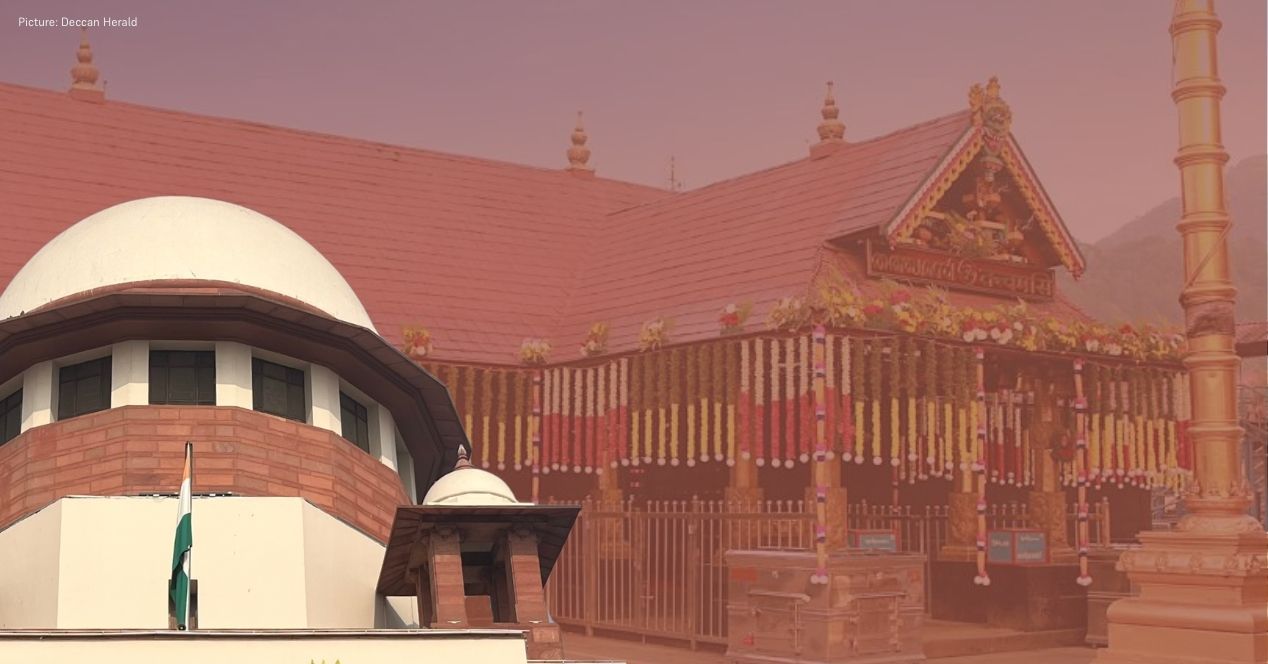


Sabarimala Reference | Day 1: Union challenges essential religious practices test
Sabarimala ReviewJudges: Surya Kant CJI, B.V. Nagarathna J, M.M. Sundresh J, Ahsanuddin Amanullah J, Aravind Kumar J, A.G. Masih J, P.B. Varale J, R. Mahadevan J, Joymalya Bagchi J
Eight years after the Supreme Court’s 2018 ruling allowing entry of women of all ages into the Sabarimala temple, a nine-judge Constitution Bench returned to the underlying constitutional questions on religious freedom. The Bench, led by Chief Justice Surya Kant, is examining the scope of Articles 25 and 26. These provisions deal with freedom of religion and management of religious affairs.
Solicitor General Tushar Mehta appeared for the Union government and urged the Court to move away from the essential religious practices test. In 2018, a 4:1 majority held that the custom of barring entry of women in the Sabarimala temple violated Article 25(1) and Section 3 of the Kerala Hindu Places of Worship (Authorisation of Entry) Rules, 1965. Mehta suggested that the Court return to a position where the content of the religion is determined by the religion itself, as held in Commissioner, Hindu Religious Endowments, Madras v Sri Lakshmindra Thirtha Swamiar of Sri Shirur Mutt (1954). He relied on Constituent Assembly Debates and referred to Article 25(2)(b) to argue that provisions designed to address caste-based exclusion cannot be extended to gender.
Background
On 28 September 2018, in Indian Young Lawyers Association v State of Kerala, a Constitution Bench of Chief Justice Dipak Misra, Justices R. F. Nariman, A. M. Khanwilkar, D. Y. Chandrachud and Indu Malhotra, in a 4:1 majority, held that the Sabarimala Temple’s exclusionary custom prohibiting the entry of women is unconstitutional. The custom barred women between the ages of 10 and 50 years old from entering the temple. The Judgment held that the said custom, and Rule 3(b) of the Kerala Hindu Places of Public Worship (Authorisation of Entry) Rules, 1965 — which allowed religious denominations to exclude women from public places of worship based on custom, violated the fundamental right to freedom of religion of female worshippers under Article 25 of the Constitution. The Bench held that the devotees of Lord Ayyappa were not a separate religious denomination and that the custom was not an essential religious practice (ERP).
More than 50 review petitions were subsequently filed by various individuals and organisations including Kantaru Rajeevaru, the Chief Priest of the Sabarimala Ayyappa Temple, the National Ayyappa Devotees (Women’s) Association, the Nair Service Society and the All Kerala Brahmin’s Association.
After CJI Misra retired, the review petition was heard on 13 November 2018 by a Bench of CJI Ranjan Gogoi, and Justices Khanwilkar, Nariman, Chandrachud and Malhotra. On 14 November 2019, the review bench by a narrow 3:2 majority decided to keep the review petitions pending and referred certain overarching constitutional questions to a larger bench. The review will be decided after the questions are clarified. The majority found that the Sabarimala judgement will have a bearing on other freedom of religion cases. Justices Nariman and Chandrachud dissented, holding that this speculation went beyond the narrow scope of a review petition. They dismissed challenges against the review.
On 13 January 2020, a nine-judge Bench led by CJI S.A. Bobde and Justices, R. Banumathi, Ashok Bhushan, Nageswara Rao, Mohan M. Shantanagoudar, S. Abdul Nazeer, R. Subhash Reddy, B.R. Gavai and Surya Kant began hearing the reference. Parties raised concerns that a review bench cannot refer questions of law to a larger bench.
On 10 February 2020, the nine-judge Bench upheld the referral order issued in the November 14 judgement. It held that the Court had the power to refer a point of law to a larger bench in a review petition, however, it did not publish any reasons for this finding at the time. On 11 May 2020, the Supreme Court published a detailed judgement substantiating the maintainability of the reference.
On 16 February 2026, a Bench of CJI Surya Kant with Justices Joymalya Bagchi and Vipul Pancholi listed the case for arguments on 7 April 2026.
Key Issues
- What is the scope and extent of judicial review with regard to a religious practice as referred to in Article 25 of the Constitution of India?
- What is the scope and extent of the word ‘morality’ under Articles 25 and 26 of the Constitution of India and whether it is meant to include Constitutional morality?
- What is the scope and ambit of right to freedom of religion under Article 25 of the Constitution of India?
- Whether the rights of a religious denomination under Article 26 of the Constitution of India are subject to other provisions of Part III of the Constitution of India apart from public order, morality and health?
- What is the meaning of expression “Sections of Hindus” occurring in Article 25 (2) (b) of the Constitution of India?
- What is the inter-play between the rights of persons under Article 25 of the Constitution of India and rights of religious denomination under Article 26 of the Constitution of India?
Judicial method at the centre
Mehta began by referring to Indian Young Lawyers Association v State of Kerala (2018) and Adi Saiva Sivachariyargal N.Sangam v State of Tamil Nadu (2015). He clarified that the Union government was not taking an extreme position. From Shirur Mutt to Sabarimala, he said, two aspects were unnoticed: the Constituent Assembly Debates and the “enormity and width of religion in this country.” He added that Hinduism, Buddhism and Islam reflect an internal plurality with several sub-denominations.
“Section thereof” and denominational protection
Mehta submitted that the phrase “any section thereof” under Article 26 extends constitutional protection to sub-groups within a religion. This aspect was not noticed in the 2018 decision. He contended that religious denominations cannot be defined and referred to the “18 schools” in Buddhism to illustrate. He urged the Court to interpret Articles 25 and 26 in light of the Preamble, particularly “liberty of thought, expression, belief, faith and worship,” to focus on faith as the basis of protection.
ERP doctrine under challenge
Mehta contended that it is impossible to decide essential religious practices for the Courts, unless it reaches a “level of spiritual supremacy”.
Justice R. Mahadevan asked whether Mehta’s argument would mean that Courts cannot determine religious practices. The Solicitor clarified that the courts cannot deliberate upon whether it is essential—it does not bar a court from examining the existence of a practice. Mehta placed primary reliance on Shirur Mutt to argue that the Constitution leaves the determination of religion to the religion itself. He pointed out that the case arose from both a suit and a writ petition challenging the Hindu Religious Endowments Act, 1863 and a scheme framed under it, where the Court recognised the Mutt as a religious denomination entitled to protection under Article 26(b).
Reading from the judgement, he stressed that what constitutes religion must be ascertained from the doctrines of that religion. He referred to the Court’s observations that offerings to idols, performance of rituals and recitation of sacred texts remain religious practices even if they involve expenditure or organisational elements. He then referred to Ratilal Panachand Gandhi v State of Bombay (1954), decided two days later by a substantially similar Bench, to submit that the same understanding continues. According to him, Ratilal confirmed that denominations have the right to manage their religious affairs, and that this cannot be interfered with by courts.
After setting out the position in Shirur Mutt, Mehta turned to Durgah Committee v Syed Hussain Ali (1961) and said that this is where the Court moved away from that approach. He submitted that Durgah Committee introduced the essential religious practices test and allowed courts to examine whether a practice is integral to religion. He argued that this has no basis in the text of Articles 25 and 26, which do not use the word “essential,”and that Shirur Mutt itself does not permit such an inquiry. By allowing courts to exclude practices as superstition, he said, Durgah Committee takes the Court into questions of faith.
Mehta then relied on Sri Venkataramana Devaru v State of Mysore (1957) to explain how Articles 25 and 26 operate together. He pointed out that the case concerned a denominational temple founded by Gowda Saraswat Brahmins, where the issue was whether the right under Article 26(b) could be restricted to allow entry of Scheduled Castes under Article 25(2)(b). He submitted that the Court treated the temple as a public institution and permitted entry of all classes of Hindus under Article 25(2)(b), while preserving denominational control over certain rituals on specific occasions. On this basis, he argued that Devaru does not place Article 26(b) under Article 25(2)(b) generally, but allows a limited reconciliation in the context of temple entry.
Constituent Assembly Debates: caste context, not gender
Turning to the Constituent Assembly Debates, Mehta relied on drafts by K.M. Munshi and Dr. B.R. Ambedkar to explain the framing of Article 25. Referring to Munshi’s Note and Draft Articles, he submitted that the guarantee of freedom of conscience and the right to “profess” and “practice” religion was made subject to public order, health and morality. He pointed out that Munshi clarified that “economic, financial or political activities”associated with religious worship would fall outside the scope of protection. Mehta relied on this to argue that the constitutional scheme distinguishes between matters of religion and secular activities connected to it. He noted that Munshi’s draft contained a specific prohibition on conversion by coercion, undue influence or material inducement, and submitted that this reflects the framers’ concern with regulating abuse rather than defining religion through judicial standards.
Building on this, Mehta argued that the phrase “all persons are equally entitled” in Article 25 emerged in the context of communal tensions, not gender equality, and that issues of gender are addressed under Articles 14 and 15.
He referred to debates of 27 and 31 March 1947, where Rajkumari Amrit Kaur and Hansa Mehta cautioned that religion could be used to justify oppressive practices. Justice Nagarathna remarked that, “we call them the founding mothers of the Constitution.”
Mehta pointed to the shift from “religious worship” to “religious practice” and the insertion of Article 25(2)(b). Referring to discussions of 1 May 1947, he submitted that the provision was introduced to throw open Hindu religious institutions to all classes of Hindus, targeting caste exclusion. He reiterated, “It has nothing to do with gender.”
Article 17: “Untouchability” cannot be extended to women
Mehta objected to the reliance on Article 17 in one of the opinions in Sabarimala. He pointed out that Article 17 abolishes “untouchability” and prohibits its practice in any form, and is historically rooted in caste-based exclusion. He submitted that extending Article 17 to the exclusion of women would distort its meaning and constitutional purpose.
He asked whether such an interpretation would mean that the Court was treating women as untouchable, arguing that the provision was never intended to apply outside the context of caste. Justice Nagarathna responded by pointing to the historical specificity of Article 17. She said that untouchability has a distinct social context in India and added that, “Article 17 cannot apply for three days and on the fourth day there is no untouchability,” indicating that the concept cannot be stretched to cover temporary or biological conditions such as menstruation. However, Mehta reiterated that the constitutional route for addressing exclusion in religious institutions lies in Article 25(2)(b), which was specifically introduced to open Hindu religious institutions to all classes of Hindus. He maintained that this provision targeted caste-based exclusion and cannot be extended to gender.
Denomination despite open access
Mehta challenged the finding in the 2018 judgement that Sabarimala is not a religious denomination. He drew a parallel to Article 26, which protects the right of a “religious denomination or any section thereof” to manage its own affairs in matters of religion.
He submitted that the reasoning in 2018 was flawed in treating the presence of devotees from different religions as a ground to deny denominational status. According to him, openness of access does not take away the character of a denomination. He said, “I can give 50 examples where all communities go,” and cited places such as Nizamuddin Dargah and Shirdi to show that participation by persons of different faiths does not dilute the identity of the institution.
He argued that denominational character depends on the existence of a distinct set of beliefs, practices or followers, and not on exclusivity of entry. By overlooking the phrase “any section thereof” in Article 26, he submitted that the 2018 Judgement narrowed the scope of denominational protection.
The Court will continue to hear the arguments tomorrow.