




Court Data
Regional Representation in the Supreme Court as of October 2026
Seven out of 25 High Courts in the country are currently not represented in the Supreme Court

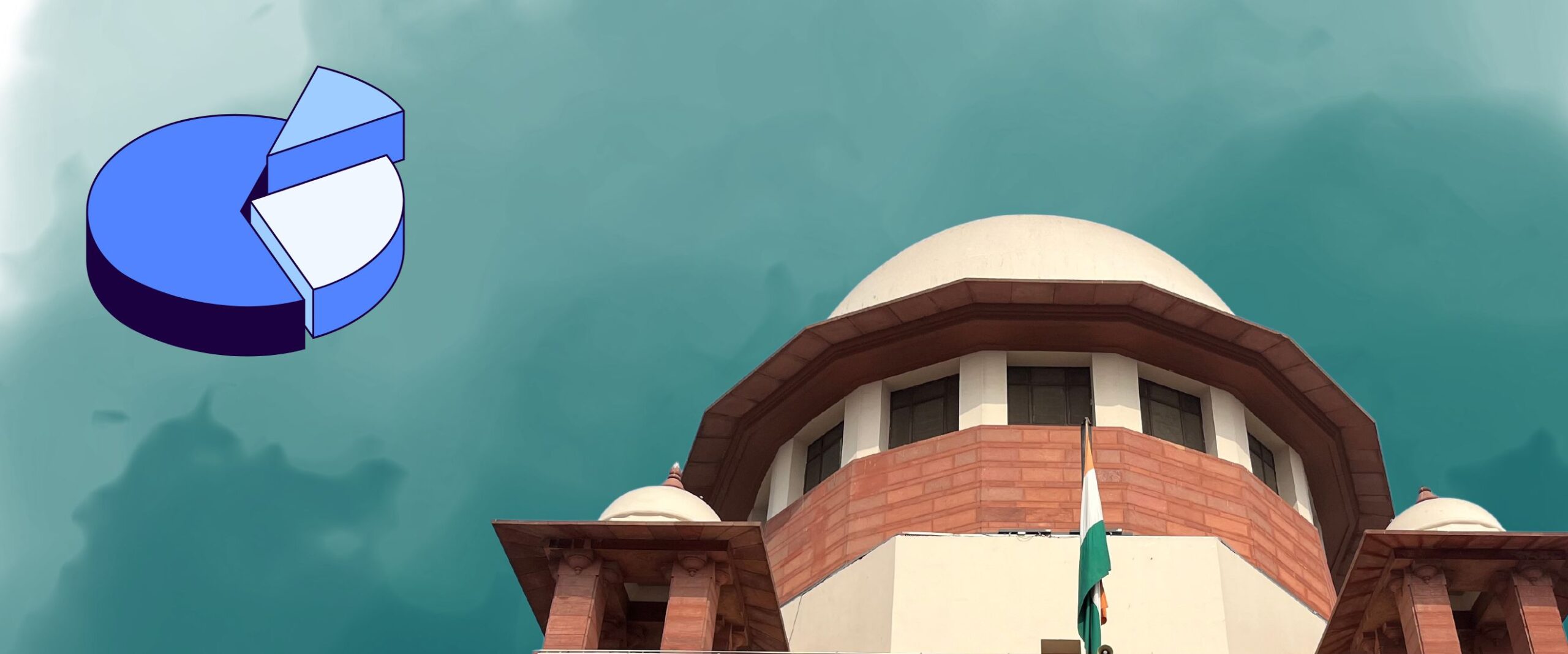
On 6 October, Justices Sunita Agarwal, Devendra Kumar Upadhyaya and Aparesh Kumar Singh took oath as the Judges of the Supreme Court, increasing the sitting strength of the Court to 37 out of its sanctioned strength of 38 judges. The Collegium led by Chief Justice Surya Kant recommended the three names in a single statement that mentions no detail further than their parent High Courts.
Despite the lack of specific information on recommendations, the Collegium has previously recorded criteria for consideration such as merit, integrity, competence and regional representation from High Courts across the country while making recommendations. While the Collegium is not bound by aspects of seniority or regional representation, these patterns are often (but not always) spotted in recommendations.
Since the Supreme Court (Number of Judges) Amendment Ordinance, 2026 enhanced the sanctioned strength of the top court from 34 to 38, three retirements followed. With the Court nearly at full strength, it is a good time to review which High Courts are represented on the Bench and which are not.
Figure 1 lists all High Courts and depicts the current representation from each High Court in the Supreme Court.
Currently, the Allahabad High Court tops the most represented High Court with four Judges at the Supreme Court namely Justices Vikram Nath, Manoj Misra, Sunita Agarwal and D.K. Upadhyaya.
The High Courts of Gujarat, Madhya Pradesh and Punjab and Haryana are each represented by three Judges—Justices J.B. Pardiwala, N.V. Anjaria and V.M. Pancholi hail from Gujarat; Justices S.C. Sharma, Alok Aradhe and Sheel Nagu represent Madhya Pradesh while Punjab and Haryana are represented by Chief Justice Surya Kant and Justices A.G. Masih and Arun Palli.
The elevations to the top court from the Bar sits at three with Justices P.S. Narasimha, K.V. Viswanathan and V. Mohana directly elevated. This is followed by eight different High Courts which are represented by two Judges at the top court.
These include Bombay (Justices P.B. Varale and A.S. Chandurkar); Calcutta (Justices Dipankar Datta and Joymalya Bagchi); Delhi (Justices Manmohan and Sanjeev Sachdeva); Jharkhand (Justices Shree Chandrashekhar and Aparesh Kumar Singh); Karnataka (Justices B.V. Nagarathna and Aravind Kumar); Madras (Justices M.M. Sundresh and R. Mahadevan) and Rajasthan (Justices Sandeep Mehta and Vijay Bishnoi).
The High Courts of Chhattisgarh (Justice P.K. Mishra), Gauhati (Justice Ujjal Bhuyan), Manipur (Justice N.K. Singh), Kerala (Justice K.V. Chandran) and Patna (Justice Ahasanuddin Amanullah), Andhra Pradesh (Justice S.V. Bhatti) and Telangana (Justice P.V. Sanjay Kumar) have one representative each in the top court.
No representation from seven High Courts
Currently, seven out of the 25 High Courts remain without representation. These include High Courts of Jammu and Kashmir, Meghalaya, Orissa, Himachal Pradesh, Sikkim, Tripura and Uttarakhand. Justice Sanjay Karol who retired in August 2026 hailed from the Himachal Pradesh High Court. The Collegium has previously taken retirements into account to restore representation in the Supreme Court. For instance, Justice K.V. Chandran was recommended two days after the retirement of Justice C.T. Ravikumar. Both hailed from Kerala.
No recent Collegium statements have recommended judges from these High Courts. Recently, two appointments came from the Jharkhand High Court—which was never represented in the Supreme Court. This suggests that the under-representation from these Benches will change soon.
With one vacancy and the upcoming retirement of Justice S.C. Sharma in November, the Supreme Court will have two vacancies and an opportunity to recommend the elevation of judges native to these under-represented High Courts.
Related articles

Court Data
14 Out of 25 High Courts are Represented at the Supreme Court
With no fixed rules about it, and the recent appointment of nine new judges, regional representation in the Supreme Court has changed.
Court Data
72% of all High Courts are represented in the Supreme Court
Seven out of 25 High Courts lack representation in the top court. This includes four north-eastern states, J&K, Orissa and Jharkhand
Court Data
9 out of 25 High Courts are Not Represented at the SC
Regional diversity is one of the factors the Collegium considers in recommending judges to the Supreme Court.
Court Data
Six out of 25 High Courts are not represented at the Supreme Court | May 2025
The Collegium has made no recommendations from these High Courts since January 2018