


Analysis
Bangladesh: A year of unprecedented constitutional upheaval
The referendum on the July Charter and a Supreme Court decision on caretaker governments raise questions of legality and legitimacy
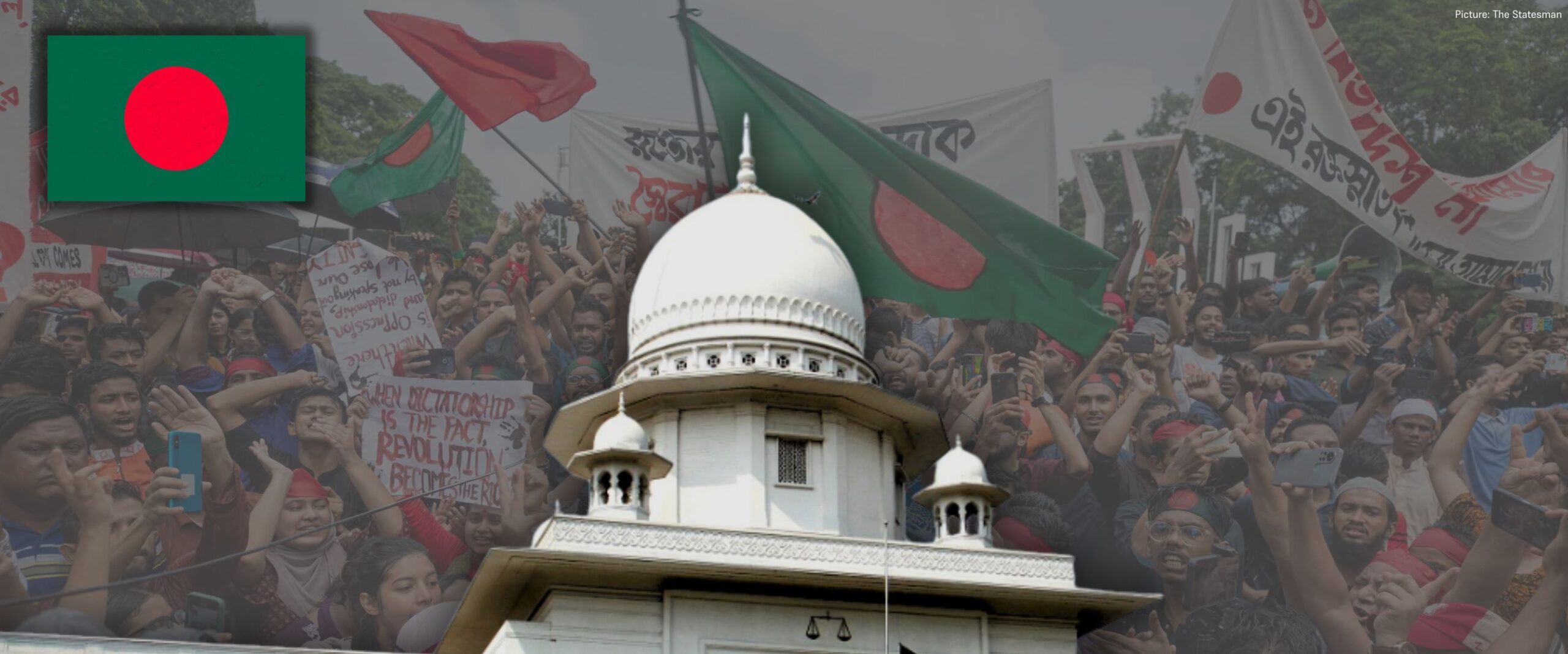
To borrow a phrase from comparative constitution expert Tom Ginsburg, the fall of Sheikh Hasina’s government on 5 August 2024 forged a “dramatic break” in the legal and constitutional continuity in Bangladesh. This rupture was the inevitable result of a student-led uprising in July, which was brutally suppressed by State authorities. According to UN estimates, around 1400 people, including 180 children, were killed over the course of three weeks.
The ousted Awami League government was the longest-serving in Bangladesh’s history, remaining in power from 2009 to 2024. This long stay did not rest on democratic foundations. General elections during this period were widely regarded as uncompetitive: major opposition parties, including the Bangladesh National Party (BNP), boycotted elections in 2014 and 2024, while their campaigns were heavily constrained by State forces in 2018.
Hasina had engineered her long stay in power by removing the non-party caretaker government (NPCTG) system through the Fifteenth Amendment to the Constitution in 2011. This abolition was justified by the government on the basis of the Supreme Court’s 2011 decision in the Thirteenth Amendment case, which declared NPCTG unconstitutional for violating the Constitution’s basic structure—specifically, the principle of democracy.
Demand for a new Constitution
Following the unusual change of regime, an interim government was sworn in on 8 August. Although the concept of an interim government now lay outside the constitutional text, it was widely accepted as legitimate. The Supreme Court reportedly endorsed its formation in an advisory opinion under Article 106 of the Constitution.
The opinion was issued without a full hearing and appears to have been delivered on an expedited basis, after an online hearing with only the Attorney General. It was handed down hours before the interim government was sworn in and has not been made public.
In December 2024, a lawyer challenged the President’s authority to seek such an opinion, arguing that because the interim government was not contemplated by the Constitution, no valid constitutional reference could be made. In January 2025, the High Court Division of the Supreme Court dismissed the petition summarily, referring to the 2024 “mass uprising” as part of the nation’s history. The Appellate Division of the Supreme Court subsequently declined leave to appeal (4 Dec 2025), holding that the President was entitled to seek an advisory opinion on a question of public importance in circumstances of an “extraordinary constitutional vacuum.” This decision in Muhammad Mohsen Rashid v Ministry of Law, Justice and Parliamentary Affairs (CPLA 781/2025) has since been treated as conferring an additional layer of legal legitimacy on the interim government.
Against this backdrop, the leaders of the uprising articulated a demand for a “new Constitution”, principally to guard against the return of authoritarianism. The core argument was that the founding Constitution facilitated autocratic rule by concentrating power in the office of the Prime Minister. Article 55(2), for instance, provides that the “executive power of the Republic shall, in accordance with this Constitution, be exercised by or on the authority of the Prime Minister.” Such an allocation of authority is unusual within a Westminster-style parliamentary system, particularly given the absence of intra-party accountability. The Constitution also stops short of making the Prime Minister individually accountable to Parliament, instead providing in Article 55(3) that the Cabinet is “collectively responsible to Parliament.”
Along with other reform bodies, a Constitution Reform Commission (CRC) was formed in October 2024. The CRC submitted its report in January 2025, and general elections for the 13th Parliament were subsequently called for 12 February 2026.
The declaration of a general election has been the single most significant development in Bangladeshi politics, particularly amid concerns that the interim government might defer elections for three to five years. Shortly after the announcement in December 2025, it was confirmed that the Awami League would not be allowed to participate. This exclusion was effected through the use of anti-terrorism legislation, with the interim government asserting that the party’s involvement in the July 2024 massacre brought it within the scope of a terrorist organisation. This justification obscures what appears to be a colourable exercise of legal power.
Question around the referendum
The CRC report recommends sweeping changes to the Constitution and political system. Among other changes, it advocates incorporating “equality, human dignity, social justice, pluralism, and democracy” as fundamental State principles in place of four founding principles of “democracy, secularism, nationalism, and socialism”. It recommends bicameral parliament, a constitutional council for key appointments, limiting the term of the head of the government and restoration of the interim government system.
These reforms, collectively referred to as the ‘July Charter’, are to be put to a public referendum on the same day as the general election. The decision to hold a referendum followed the inability of political parties to reach a concrete consensus on the reforms. To confer high-level legitimacy to the proposals, the July Charter was signed off and adopted through an Ordinance. The terms of the referendum bind the future parliament to implement the reforms.
The present Constitution does not have a clause dealing with referendums. The mechanism—mandatory for some, but not all, constitutional amendments—was removed by the Fifteenth Amendment in 2011.
Further, there are serious questions around the structure and clarity of the questions put to the electorate. Voters will be asked to approve the July Charter through four bundled sub-questions, without the option of voting separately on each component. These sub-questions range from the establishment of an election-time caretaker government, the Election Commission, and other constitutional bodies in line with the July Charter, to the introduction of a bicameral parliament with an upper house elected through proportional representation.
This bundled approach raises legitimacy concerns, given the absence of political consensus. The BNP, for instance, has formally opposed proportional representation while supporting bicameralism, whereas the Jamaat-e-Islami (JeI) has endorsed the proposal in full. The National Citizens Party (NCP)—formed by leaders of the uprising and now in an electoral alliance with JeI—has not signed the Charter.
The remaining sub-questions seek to bind winning parties to implement some thirty agreed reforms, as well as “other reforms” described in the July Charter, a formulation that is notably ambiguous and risks imposing obligations even in the absence of consensus.
A second concern is that the referendum was legitimised through a Presidential Order rather than an Ordinance. The Order appends a draft bill for enactment by a future parliament—an unusual form of legal innovation. The present Constitution contains no provision authorising an order of this kind. While the President may “make rules” or issue orders in limited contexts—such as for the allocation and transaction of government business under Article 55(6), or for appointments to the subordinate judiciary under Article 115—no comparable power exists in connection with referendums. Notably, the Order claims authority from “the sovereign popular will, expressed by the people through the successful student mass uprising in July–August 2024.”
Restoration of the caretaker government
In a verdict delivered on 20 November 2025 (Dr. Badiul Alam Majumdar v Abdul Mannan Khan), the Appellate Division of the Supreme Court overturned its 2011 decision striking down the Thirteenth Amendment, which had introduced the caretaker system. It was the first time a constitutional amendment previously invalidated by the Appellate Division was reinstated by the Court.
The Court clarified that the ruling would take effect from the fourteenth parliamentary elections, not the 2026 elections. This prospective operation is defensible from the point of view of political reality, given that an apolitical interim government—akin to a constitutional caretaker government in spirit—had already been installed following the uprising.
The restoration of the NPCTG nevertheless raises concerns for judicial independence. Under the original framework, the last-retired Chief Justice served as Chief Adviser of the caretaker government. The 2011 Judgement striking down the system had held that such post-retirement executive involvement compromised judicial independence. With the NPCTG now restored in full, it will fall to a future parliament to revisit and reform these provisions. The July Charter’s own proposals on caretaker arrangements will also require legislative consideration.
These developments intersect with two recent Ordinances that have reshaped judicial appointments and administration. The Appointment of Judges to the Supreme Court Ordinance, 2025 replaced the earlier system—under which judges were appointed by the President in consultation with the Chief Justice, with the Prime Minister exercising decisive influence—with a Supreme Judicial Appointments Council tasked with assisting the Chief Justice and recommending candidates based on defined criteria.
A second Ordinance established a separate Supreme Court Secretariat. This reform implements directions issued by the Appellate Division as early as 1999 in the Masdar Hossain case, which called for institutional separation to ensure judicial control over postings, promotions, leave, and discipline in the subordinate judiciary under Article 116. Successive governments had avoided compliance. Until December 2025, these functions remained with the Law Ministry.
Looking ahead
At the end of 2025, the greatest challenge facing Bangladeshi constitutionalism was the attainment of political stability and the absence of consensus among political parties on foundational constitutional questions. The July Charter sets out 84 reform proposals, of which the 24 signatory parties reached consensus on only around 30.
While most parties supported the introduction of a bicameral legislature, there was no agreement on the method of election to the upper house, nor on separating party leadership from the office of the Prime Minister. More than 50 proposals attracted formal notes of dissent. The BNP has alleged that several proposals to which it dissented were nonetheless included in the referendum question.
A further challenge concerns the absence of political pluralism. The ban on the Awami League has highlighted persistent problems of stability and the legitimacy of the proposed reforms. This period of uncertainty has deepened societal divisions and crystallised doubts about the willingness to conduct free and fair elections.
The future of constitutionalism in Bangladesh will ultimately depend on the country’s capacity to establish and sustain a genuinely competitive electoral system, alongside the effective functioning of democratic institutions. Much will therefore turn on post-2026 election politics—including the outcome of the election and referendum—and on how the elected government and other political actors translate the mandate of the July Charter into constitutional reform.
While the higher judiciary remains important, this next phase is likely to be driven primarily by executive and legislative authority. The strength of checks on the executive and legislature will therefore depend on the judiciary’s ability to exercise its role with independence and authority — an ability that, in turn, partly rests on the willingness of the future government to sustain the reforms achieved in judicial appointments and administration.
Dr. Ridwanul Hoque is former Professor of Law, Dhaka University. His areas of interest are comparative constitutionalism, judicial activism and politics, migration law, human rights of vulnerable groups, and law and society. He is the author of Judicial Activism in Bangladesh: A Golden Mean Approach (2011) and co-editor of the volumes Constitutional Foundings in South Asia (2021) and A History of the Constitution of Bangladesh: The Founding, Development, and Way Ahead (2022).
Related articles
Analysis
Bhutan: Constitutional guarantees come up against resource constraints
Declining press freedom and two recent incidents highlight how institutional capacity continues to lag behind constitutional aspiration
75 Years of SC Articles
Justice In Circles
How architecture, history, and tradition inform the duality of Indian courts
75 Years of SC Articles
The First Eight
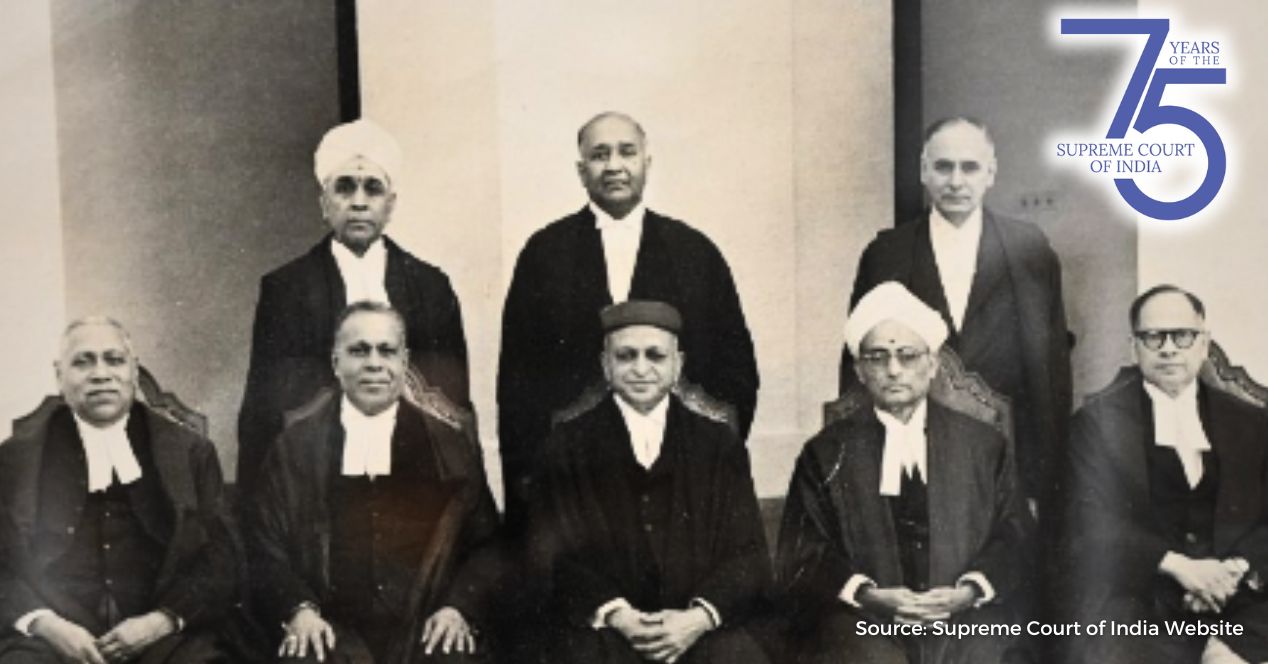
As part of our special series on the Supreme Court’s 75th anniversary, we take a brief look at the lives and times of the first eight judges
75 Years of SC Articles
Advocates on 75 Years of the Supreme Court of India
Over the years, the Court has seen several changes and its lawyers have adapted to them. What do they have to say about it?