


Ujjal Bhuyan
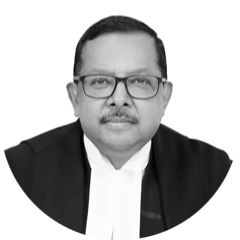
Ujjal Bhuyan
Sitting Judge of the Supreme Court of India
Assumed Office14th Jul, 2023
Retires On1st Aug, 2029
Previously
Chief Justice of the Telangana High CourtJune 28th, 2022 - July 12th, 2023
Permanent Judge of the Telangana High CourtOctober 22nd, 2021 - June 27th, 2022
Permanent Judge of the Bombay High CourtOctober 3rd, 2019 - October 21st, 2021
Permanent Judge of the Gauhati High CourtMarch 20th, 2013 - October 2nd, 2019
Additional Judge of the Gauhati High Court October 17th, 2011 - March 19th, 2013
Senior AdvocateSeptember 6th 2010 - October 16th, 2011
Profile
Early Life and Education
Justice Ujjal Bhuyan was born in Gauhati on 2 August 1964. He studied at Don Bosco High School, Gauhati, before graduating with a degree in Arts from Kirori Mal College, Delhi. He pursued law at the Government Law College, Gauhati, and subsequently obtained his LL.M. degree from Gauhati University.
He is the son of Senior Advocate Suchendra Nath Bhuyan, who served as the Advocate General of Assam.
Career as an Advocate
In March 1991, Justice Bhuyan enrolled with the Bar Council of Assam, Nagaland, Meghalaya, Manipur, Tripura, Mizoram and Arunachal Pradesh. He specialised in Revenue, Labour and Taxation matters.
From 1995 to 2011, he was the Standing Counsel for the Income Tax Department. He served as the Additional Government Advocate for Meghalaya for four years, and in March 2010, was appointed Standing Counsel of the Gauhati High Court.
He was designated a Senior Advocate by the Gauhati High Court in September 2010. In July 2011, he became the Additional Advocate General of Assam. By then, he had practiced in the Gauhati High Court for two decades.
Career as a Judge
On 17 October 2011, Justice Bhuyan was appointed as an Additional Judge of the Gauhati High Court and became a Permanent Judge on 20 March 2013.
In 2019, he was transferred to the Bombay High Court, where he served until 2021. The same year, on 22 October 2021, he was transferred as a Judge of the Telangana High Court. On 28 June 2022, he was sworn in as Chief Justice of the Telangana High Court.
In March 2023, he made headlines when he announced plans to constitute larger benches with more women judges in the Telangana High Court.
On 5 July 2023, the Collegium recommended him for elevation to the Supreme Court for his expertise in taxation law. His appointment was notified by the Department of Justice on 12 July 2023. He took oath as a Judge of the Supreme Court on 14 July 2023.
In March 2025, while addressing law students at Bharatiya Vidyapeeth New Law College, Pune, Justice Bhuyan condemned extra-legal demolition drives, calling bulldozer actions “like running a bulldozer over the Constitution.” He warned such measures negate the rule of law and violate Article 21, stressing that innocent family members are also displaced. He urged students to adopt a critical mindset, noting that while the Supreme Court is final, “if there were a court above it, many of its judgements would have been reconsidered.”
Justice Bhuyan has authored 140 judgements and has been a part of 313 benches.
Out of his judgements, Justice Bhuyan has authored 38 per cent judgements in criminal matters, 24 per cent judgements in matters of direct taxation, 14 per cent in customs, 12 per cent in exercise and 12 per cent judgements in other matters.
Notable Judgements
In V. Vasanta Mogli v State of Telangana (2023) as Chief Justice of the Telangana High Court, Justice Bhuyan authored the judgement striking down the colonial-era Telangana Eunuchs Act, 1919. The Act permitted warrantless arrests of transgender persons and mandated their registration. He held that the Act was “manifestly arbitrary” and violated Articles 14 and 21, as it offended the rights to privacy and dignity of transgender persons.
In the Delhi Excise Liquor Policy case (2024), a Division Bench of Justices Surya Kant and Bhuyan granted bail to former Delhi Chief Minister Arvind Kejriwal. Justice Bhuyan, in a separate opinion, questioned the Central Bureau of Investigation’s belated decision to arrest him nearly two years after registering a case. He observed that the arrest appeared to frustrate the bail granted to Kejriwal in the same case investigated by the Enforcement Directorate.
In Re: Right to Privacy of Adolescents (2025), Justice Bhuyan was part of the Bench that overturned a Calcutta High Court acquittal which had indulged in “victim-shaming” in a POCSO case. The Court restored the conviction but set aside the sentence, noting systemic failures. It directed the West Bengal Government to provide shelter and education for the victim and her child. The Bench asked the Union to implement reforms for institutional accountability in POCSO cases.
In Ramu Appa Mahapatar v State of Maharashtra (2025), the Court acquitted a murder accused, emphasising that extra-judicial confession is a weak form of evidence and must be corroborated. The judgement, authored by Justice Bhuyan, found that the accused was in a confused state when he confessed. It reiterated that in cases based solely on circumstantial evidence, all links in the chain must conclusively point to the accused’s guilt.
In Bijender Singh v Union of India (2025) the Court held that if a disease is not detected at the time of enrolment in the Armed Forces, it must be presumed to have arisen during service. Justice Bhuyan clarified that when a person is invalided out on medical grounds, their disability is presumed to be at least 20 percent. He directed that the petitioner be granted disability pension at the rate applicable to 50 percent disability.
In Somdatt Builders NCC-NEC v National Highways Authority of India (2025), a Bench of Justices A.S. Oka and Bhuyan held that courts cannot interpret contractual terms while hearing an appeal under Section 37 of the Arbitration Act, 1996. They set aside a Delhi High Court Division Bench ruling that had overturned an arbitral award by re-examining the merits of the contract, reiterating that the scope of Section 37 is limited.
In Confederation of Real Estate Developers of India v Vanashakti (2025), Justice Bhuyan authored a dissenting judgement in the three-judge Bench decision to declare post-facto environmental clearances valid. This decision overruled Vanashakti v Union of India (2025), where it was held that post facto environmental clearances are fundamentally at odds with the principles of environmental protection. In his dissent, Justice Bhuyan noted that by filing a review of the Vanashakti judgement, the review petitioners “have shown scant regard for the rule of law”.
In Wikimedia Foundation Inc v ANI Media Private Limited (2025), the Bench of Justices Oka and Bhuyan held that directions for takedown of online content must only be granted when it poses real and substantial risks. The Bench held that directions issued must comply with the twin test of necessity and proportionality.
In Syed Iftikhar Andrabi v National Investigation Agency, Jammu (2026), the Bench of Justices Nagarathna and Bhuyan, while granting bail to an accused charged with provisions under the Unlawful Activities (Prevention) Act, 1967 noted that speedy trial is an essential facet of Article 21 and the fundamental right of the accused to speedy trial is not eclipsed by nature of offence. Authoring the judgement, Justice Bhuyan expressed “strong reservations” against the judgement in Gulfisha Fatima v State (Govt. Of Nct Of Delhi), where Justices Aravind Kumar and N.V. Anjaria held that prolonged incarceration cannot override the statutory bar on bail under Section 43(D)(5) of UAPA.