Sabarimala Reference | Day 4: “PILs cannot become a route to question faith,” Singhvi argues
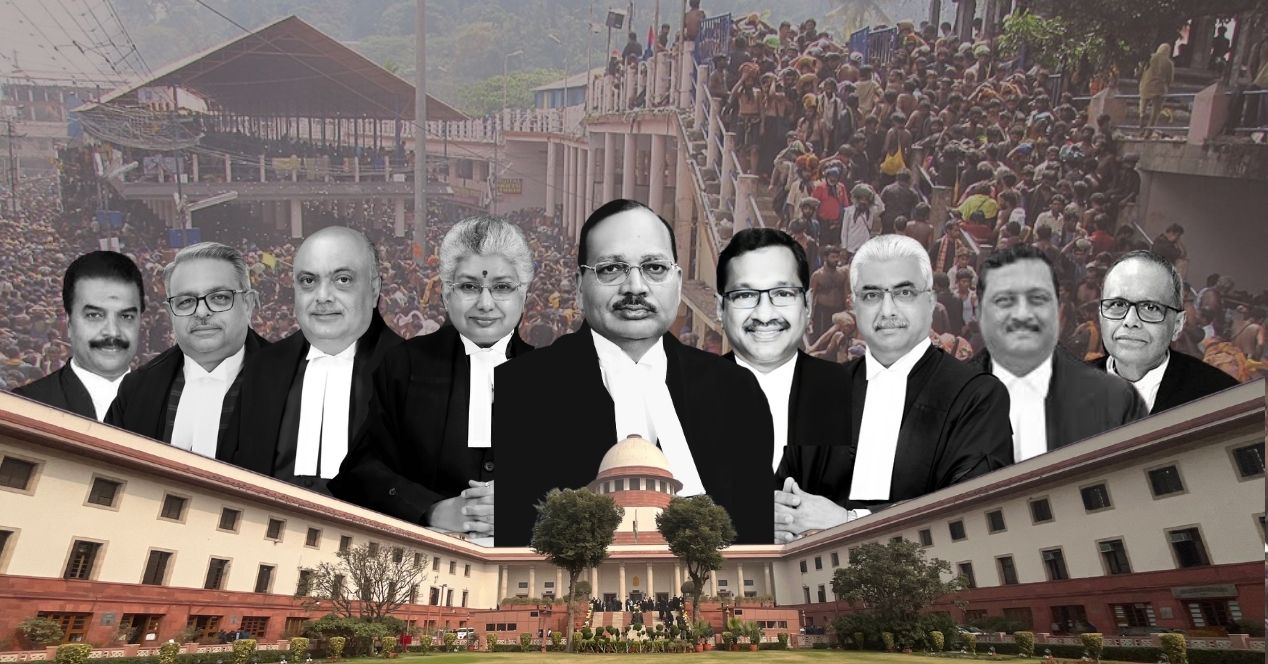
Sabarimala ReviewJudges: Surya Kant CJI, B.V. Nagarathna J, M.M. Sundresh J, Ahsanuddin Amanullah J, Aravind Kumar J, A.G. Masih J, P.B. Varale J, R. Mahadevan J, Joymalya Bagchi J
Today, Senior Advocate Dr. Abhishek Manu Singhvi, appearing for the Travancore Devaswom Board, questioned the essential religious practices doctrine before a nine-judge Bench led by Chief Justice Surya Kant hearing the Sabarimala reference.
Singhvi argued that courts cannot test religious beliefs on external standards, as the Bench raised concerns over the maintainability of Public Interest Litigations (PILs) challenging long-standing practices.
Background
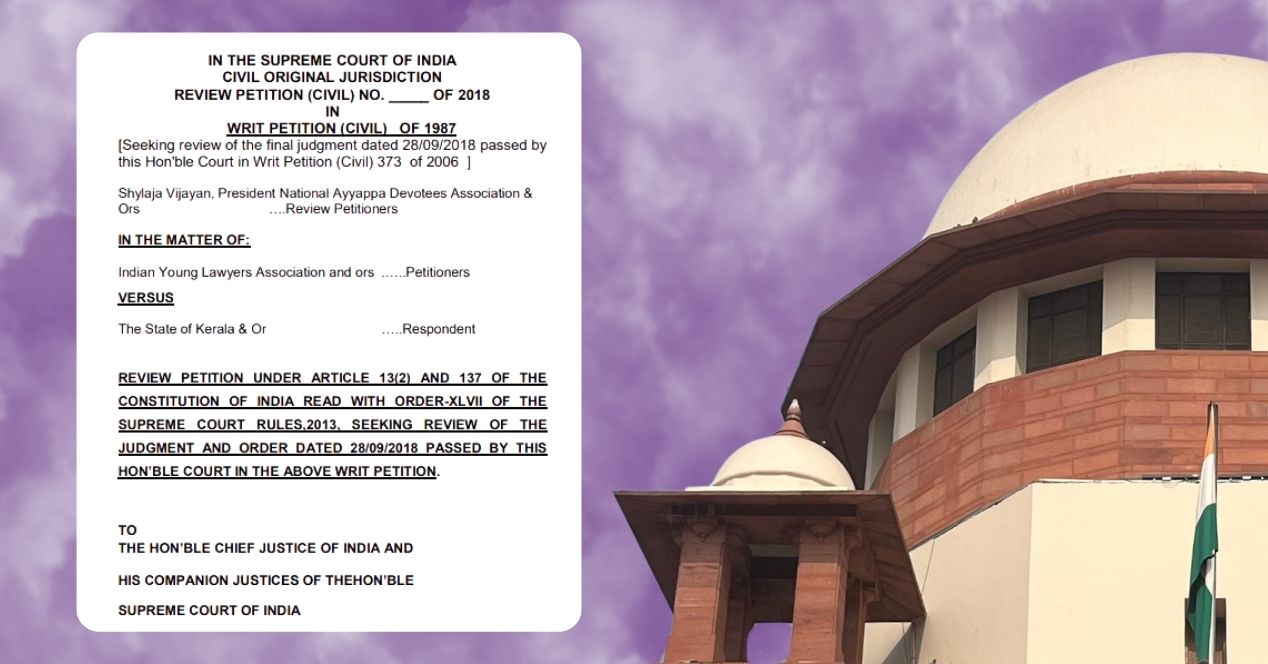
On 28 September 2018, in Indian Young Lawyers Association v State of Kerala, a Constitution Bench of Chief Justice Dipak Misra, Justices R. F. Nariman, A. M. Khanwilkar, D. Y. Chandrachud and Indu Malhotra, in a 4:1 majority, held that the Sabarimala Temple’s exclusionary custom prohibiting the entry of women is unconstitutional. The custom barred women between the ages of 10 and 50 years old from entering the temple. The Judgment held that the said custom, and Rule 3(b) of the Kerala Hindu Places of Public Worship (Authorisation of Entry) Rules, 1965 — which allowed religious denominations to exclude women from public places of worship based on custom, violated the fundamental right to freedom of religion of female worshippers under Article 25 of the Constitution. The Bench held that the devotees of Lord Ayyappa were not a separate religious denomination and that the custom was not an essential religious practice (ERP).
More than 50 review petitions were subsequently filed by various individuals and organisations including Kantaru Rajeevaru, the Chief Priest of the Sabarimala Ayyappa Temple, the National Ayyappa Devotees (Women’s) Association, the Nair Service Society and the All Kerala Brahmin’s Association.
After CJI Misra retired, the review petition was heard on 13 November 2018 by a Bench of CJI Ranjan Gogoi, and Justices Khanwilkar, Nariman, Chandrachud and Malhotra. On 14 November 2019, the review bench by a narrow 3:2 majority decided to keep the review petitions pending and referred certain overarching constitutional questions to a larger bench. The review will be decided after the questions are clarified. The majority found that the Sabarimala judgement will have a bearing on other freedom of religion cases. Justices Nariman and Chandrachud dissented, holding that this speculation went beyond the narrow scope of a review petition. They dismissed challenges against the review.
On 13 January 2020, a nine-judge Bench led by CJI S.A. Bobde and Justices, R. Banumathi, Ashok Bhushan, Nageswara Rao, Mohan M. Shantanagoudar, S. Abdul Nazeer, R. Subhash Reddy, B.R. Gavai and Surya Kant began hearing the reference. Parties raised concerns that a review bench cannot refer questions of law to a larger bench.
On 10 February 2020, the nine-judge Bench upheld the referral order issued in the November 14 judgement. It held that the Court had the power to refer a point of law to a larger bench in a review petition, however, it did not publish any reasons for this finding at the time. On 11 May 2020, the Supreme Court published a detailed judgement substantiating the maintainability of the reference.
On 16 February 2026, a Bench of CJI Surya Kant with Justices Joymalya Bagchi and Vipul Pancholi listed the case for arguments on 7 April 2026.
Key Issues
- What is the scope and extent of judicial review with regard to a religious practice as referred to in Article 25 of the Constitution of India?
- What is the scope and extent of the word ‘morality’ under Articles 25 and 26 of the Constitution of India and whether it is meant to include Constitutional morality?
- What is the scope and ambit of right to freedom of religion under Article 25 of the Constitution of India?
- Whether the rights of a religious denomination under Article 26 of the Constitution of India are subject to other provisions of Part III of the Constitution of India apart from public order, morality and health?
- What is the meaning of expression “Sections of Hindus” occurring in Article 25 (2) (b) of the Constitution of India?
- What is the inter-play between the rights of persons under Article 25 of the Constitution of India and rights of religious denomination under Article 26 of the Constitution of India?
What is religion and who decides it?
Singhvi argued that while the freedom of religion under Article 25 protects both individual and collective dimensions of religion, individual claims cannot be expanded in a way that undermines the denomination’s collective belief system. The inquiry into what constitutes religion, he said, must be undertaken from the standpoint of the adherents themselves.
Justice B.V. Nagarathna observed that religion concerns the relationship between man and God. Singhvi accepted this broadly but noted that such a formulation may not hold across all traditions, pointing to atheistic strands such as Charvaka. Justice Nagarathna pressed that commonality in belief must relate to something identifiable. Singhvi maintained that the Court’s role is limited to recognising whether the belief exists within the community, not evaluating it.
Essential religious practices test is doctrinally flawed
Turning to the essential religious practices (ERP) doctrine, Singhvi submitted that its origins in Durgah Committee v Syed Hussain Ali (1961) rest on “loose language” that has since been elevated into a rigid test. He framed his objection directly, “The false premise… is that the Court will see whether this is an essential part of the religion or not.”
According to him, the Court is only entitled to determine whether a practice is religious at all. Even that inquiry must be conducted subjectively, consistent with Commissioner, Hindu Religious Endowments, Madras v Sri Lakshmindra Thirtha Swamiar of Sri Shirur Mutt (1954). Once a practice is shown to be part of the religion, he argued, courts cannot proceed to test its importance or rationality. Justice Nagarathna asked whether the ERP test was evolved precisely to identify the scope of protection under Article 25. Singhvi responded that the language of “essentiality” has misdirected the inquiry and led courts into theological adjudication.
Articles 25 and 26: Harmonisation and constitutional design
Singhvi submitted that Article 25 is expressly subject to “other provisions of this Part”, including Articles 14, 15 whereas Article 26 is not. Article 26 deals with the freedom to manage religious affairs, and is subject to public order, morality and health. Relying on Constituent Assembly Debates, he submitted that this distinction was consciously drawn by the framers.
Justice M.M. Sundresh questioned how denominational rights can be insulated when denominations are formed by individuals protected under Article 25. Singhvi responded that while Article 25 forms the basis of Article 26, the two operate in distinct spheres and must be harmonised without collapsing one into the other. He clarified that Article 25(2)(b) will prevail over Article 26(b) on questions of entry into temples of a public character. However, once entry is secured, denominational autonomy under Article 26 governs matters of worship and internal management. Singhvi departed from Senior Advocate C.S. Vaidyanathan’s position on Article 25(2)(b), arguing that while it enables entry into temples, it does not extend to regulating denominational practices once entry is secured.
Justice Joymalya Bagchi observed that the phrase “subject to” must be given meaning. Singhvi accepted that conflicts may arise but maintained that courts must resolve them contextually.
Religious and secular spheres: limits of regulation
Singhvi then addressed what the State can regulate under Article 25. Relying on Shirur Mutt, he said that Article 25(2)(a) allows regulation only of economic, commercial or political activities connected with religion, and not religious practices themselves. He submitted that once a practice is found to be religious, the State cannot step in simply because it appears irrational or unnecessary. The only limits are those already in the Constitution, namely public order, morality and health.
Justice Bagchi pointed to the difficulty in cases where religious and non-religious elements are mixed. He asked how the Court should deal with activities that have both aspects. Singhvi accepted that such situations exist and said they form a narrow set of difficult cases. He explained that the Court must first decide whether the activity is religious, and that this must be seen from the perspective of the religion itself.
Constitutional morality cannot become an independent test
Singhvi then turned to constitutional morality, continuing a line of argument also made earlier by the Union. He said that constitutional morality is not part of the text of Article 25 and cannot be treated as a separate ground to test religious practices. “Constitutional morality was never contemplated as an additional ground of derogation,” he submitted. He explained that Article 25 already has its own limits along with specific provisions like Article 25(2)(a) and 25(2)(b). According to him, bringing in constitutional morality as an extra standard would disturb this structure and allow courts to judge religion on a vague and open-ended basis.
Justice Nagarathna stepped in to clarify the position. She said that a law can be struck down only if it violates Part III of the Constitution or if there is no legislative competence. Singhvi agreed with this, saying courts cannot add new grounds beyond what the Constitution already provides.
Justice Ahsanuddin Amanullah asked whether constitutional morality could still be used in a flexible way, since it is a concept that may evolve over time. He suggested that it may not have to be rejected completely and cannot be given a straightjacket formula. Singhvi responded by drawing a clear line. He said that constitutional morality may have some role in areas where the Constitution is silent, such as conventions. But it cannot be used as a test to judge religious practices under Article 25. That, he said, would mean applying an external standard to religion which the Constitution itself does not permit. CJI Surya Kant added that using constitutional morality in this context could lead to “non-manageable standards.” Singhvi agreed, saying it would make the test too subjective, depending on how each judge understands morality.
PILs and the difficulty of judging faith
The hearing then turned to the maintainability of PILs challenging religious practices, particularly at the instance of non-adherents. Justice Nagarathna indicated that such petitions could be rejected at the threshold as those of an “interloper,” noting that the aggrieved party had not approached the Court. Justice Sundresh posed a fundamental question: whether a court can decide on the validity of a religious practice “without hearing millions” who follow it. CJI Surya Kant observed that the “most difficult task” for a constitutional court is to declare that a belief held by large numbers is wrong or erroneous.
In response, Singhvi clarified that he was not advocating a complete bar on PILs. He accepted that in extreme situations, such as practices implicating serious threats to public order, health or morality, the Court may justifiably intervene, even without waiting for a petition. When Justice Bagchi posed a hypothetical question involving a sect advocating mass self-harm, Singhvi accepted that such an “extreme case” may warrant intervention. However, he maintained that such cases must remain exceptional. For ordinary religious practices, he submitted that PIL jurisdiction must be exercised with far greater restraint. He argued that the threshold in such cases should be “ten times higher” than in ordinary PILs, as otherwise third parties would be able to invoke Article 32 to reshape religious practices without being adherents themselves.
Sabarimala: the relevance of the deity’s character
In the final part of his submissions, Singhvi connected the doctrinal framework to the facts of the Sabarimala dispute. He submitted that the issue cannot be decided in abstract constitutional terms without reference to the specific religious character of the temple. He explained that the Sabarimala temple is unique in worshipping Lord Ayyappa in the form of a naisthika brahmachari, an eternal celibate who has renounced the grihastha ashram. According to him, this characteristic is foundational to the identity of the deity and informs the practices associated with the temple, including the requirement of a 41-day vratam observed by devotees.
Singhvi argued that the restriction on entry of women between the ages of 10 and 50 is not a blanket exclusion based on gender. Women outside this age group are permitted entry. The classification, he submitted, must be examined in light of whether it bears a rational nexus to the object sought to be achieved. According to him, the object is the preservation of the deity’s character as a naisthika brahmachari. The restriction, he argued, is linked to that identity and must be assessed in that specific context rather than as a general rule applicable across all temples. He further submitted that women are not denied the opportunity to worship Lord Ayyappa altogether, as they may visit several other temples dedicated to the deity. The constitutional analysis, he said, must therefore account for the distinct nature of the Sabarimala temple and the form of worship it embodies.
The Bench will continue hearing the matter tomorrow.