

Sabarimala Reference | Day 5: Essential Religious Practice doctrine “unstable” and “unworkable”, argue review petitioners
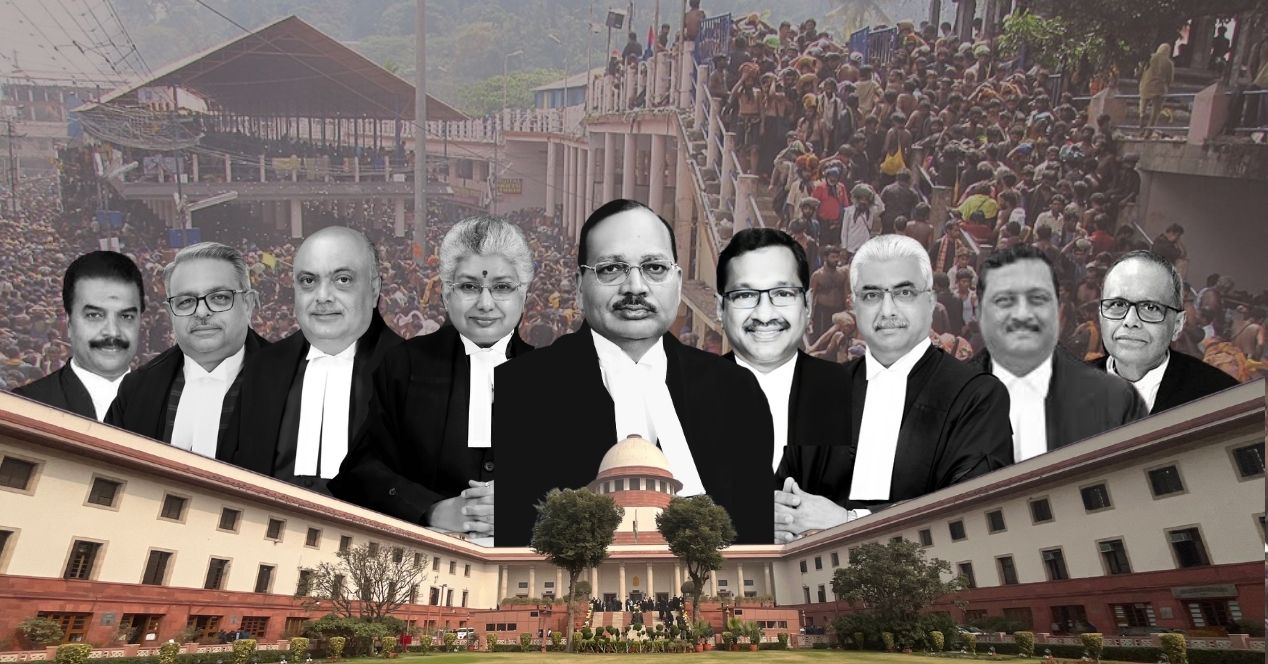
Sabarimala ReviewJudges: Surya Kant CJI, B.V. Nagarathna J, M.M. Sundresh J, Ahsanuddin Amanullah J, Aravind Kumar J, A.G. Masih J, P.B. Varale J, R. Mahadevan J, Joymalya Bagchi J
Today, a nine-judge Bench of the Supreme Court led by Chief Justice Surya Kant continued hearing arguments from parties seeking a review of the 2018 Sabarimala Judgement. The Court considered whether it can go beyond religion into questions of conscience, and whether the essential religious practices (ERP) doctrine can still govern claims under Articles 25 and 26.
Background
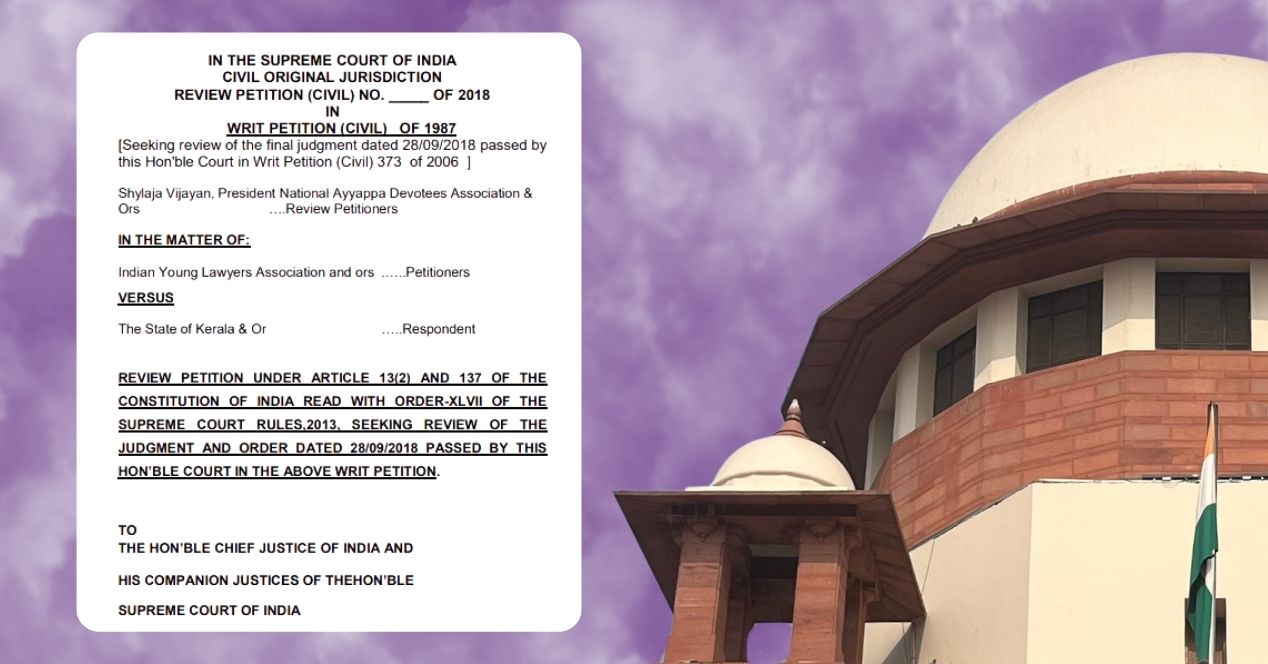
On 28 September 2018, in Indian Young Lawyers Association v State of Kerala, a Constitution Bench of Chief Justice Dipak Misra, Justices R. F. Nariman, A. M. Khanwilkar, D. Y. Chandrachud and Indu Malhotra, in a 4:1 majority, held that the Sabarimala Temple’s exclusionary custom prohibiting the entry of women is unconstitutional. The custom barred women between the ages of 10 and 50 years old from entering the temple. The Judgment held that the said custom, and Rule 3(b) of the Kerala Hindu Places of Public Worship (Authorisation of Entry) Rules, 1965 — which allowed religious denominations to exclude women from public places of worship based on custom, violated the fundamental right to freedom of religion of female worshippers under Article 25 of the Constitution. The Bench held that the devotees of Lord Ayyappa were not a separate religious denomination and that the custom was not an essential religious practice (ERP).
More than 50 review petitions were subsequently filed by various individuals and organisations including Kantaru Rajeevaru, the Chief Priest of the Sabarimala Ayyappa Temple, the National Ayyappa Devotees (Women’s) Association, the Nair Service Society and the All Kerala Brahmin’s Association.
After CJI Misra retired, the review petition was heard on 13 November 2018 by a Bench of CJI Ranjan Gogoi, and Justices Khanwilkar, Nariman, Chandrachud and Malhotra. On 14 November 2019, the review bench by a narrow 3:2 majority decided to keep the review petitions pending and referred certain overarching constitutional questions to a larger bench. The review will be decided after the questions are clarified. The majority found that the Sabarimala judgement will have a bearing on other freedom of religion cases. Justices Nariman and Chandrachud dissented, holding that this speculation went beyond the narrow scope of a review petition. They dismissed challenges against the review.
On 13 January 2020, a nine-judge Bench led by CJI S.A. Bobde and Justices, R. Banumathi, Ashok Bhushan, Nageswara Rao, Mohan M. Shantanagoudar, S. Abdul Nazeer, R. Subhash Reddy, B.R. Gavai and Surya Kant began hearing the reference. Parties raised concerns that a review bench cannot refer questions of law to a larger bench.
On 10 February 2020, the nine-judge Bench upheld the referral order issued in the November 14 judgement. It held that the Court had the power to refer a point of law to a larger bench in a review petition, however, it did not publish any reasons for this finding at the time. On 11 May 2020, the Supreme Court published a detailed judgement substantiating the maintainability of the reference.
On 16 February 2026, a Bench of CJI Surya Kant with Justices Joymalya Bagchi and Vipul Pancholi listed the case for arguments on 7 April 2026.
Key Issues
- What is the scope and extent of judicial review with regard to a religious practice as referred to in Article 25 of the Constitution of India?
- What is the scope and extent of the word ‘morality’ under Articles 25 and 26 of the Constitution of India and whether it is meant to include Constitutional morality?
- What is the scope and ambit of right to freedom of religion under Article 25 of the Constitution of India?
- Whether the rights of a religious denomination under Article 26 of the Constitution of India are subject to other provisions of Part III of the Constitution of India apart from public order, morality and health?
- What is the meaning of expression “Sections of Hindus” occurring in Article 25 (2) (b) of the Constitution of India?
- What is the inter-play between the rights of persons under Article 25 of the Constitution of India and rights of religious denomination under Article 26 of the Constitution of India?
Venkatesh: Core constitutional terms are inherently indeterminate
Appearing for the Atmatam Trust, Senior Advocate M.R. Venkatesh submitted that expressions such as “religious practice”, “Hindu religious institutions” and “religious denominations” under Articles 25 and 26 are “indeterminate” and “probably incapable of being defined”.
He argued that the expression “denomination” sits uneasily in the Indian context, considering it has a foreign lineage and has its roots in Latin and Christian ecclesiastical structures. Meanwhile, he submitted, “religious practice” and “Hindu religious institutions” under Articles 25(2)(a) and 25(2)(b) are uniquely Indian provisions. They lack any clear international parallel and were crafted to address specific social conditions. After explaining the source of these expressions, Venkatesh moved to the structural difficulty it creates: if denominational status under Article 26 becomes the gateway to constitutional protection, it excludes temples which do not fall into that classification. He warned that the current approach risks reducing such institutions into open public spaces “equated to a car, railway station or a bus stand,” where unrestricted entry dilutes their religious character.
He stated that questions such as “how free is free”, what constitutes “practice”, and what is meant by “freedom of conscience”, lie at the heart of Articles 25 and 26.
Venkatesh: Secular regulation cannot be used to enter the core of religion
Turning to Article 25(2)(a), Venkatesh submitted that any intervention that enters the core religious practice is unacceptable and would fall foul of Article 13(2) i.e. inconsistent with fundamental rights. State involvement through a law may be permissible if it is of a secular character and has an incidental application on religion.
He claimed that this framework has been inverted by courts who have “boxed religious practices into a corner” and interpret religious law in association with secular practices. Illustrating this, he pointed to charity. While charity may be secular, once embedded within religion, “a religious charity would fall within the ambit of religion and should not be interfered with.” He argued that Article 25(2)(a) does not regulate religion itself and only permits regulation of economic, political, or financial activities associated with it.
Venkatesh: Entry is universal but management remains with the denomination
On the scope of Article 25(2)(b), Venkatesh submitted that “throwing open to all classes” must include “every caste and every community,” ensuring access across social divisions. However, he submitted, there is a clear distinction between entry and control. For instance, he compared that while members of the public may enter to watch the court proceedings, the Registrar maintains and runs the affairs. He argued that the same principle applies to temples, adding that denominational autonomy in matters of management is “non-negotiable” under Article 26(b).
He elaborated on “sections of Hindus,” submitting that it must be understood broadly. Referring to the Sabarimala pilgrimage, he stated that caste and class distinctions dissolve, and submitted, “There is only one thing that sustains us, that is Lord Ayyappa’s section,” indicating a unified devotional identity.
Continuing on the concept of “sampradaya”, he submitted that it must be understood as lineage and tradition, and must receive constitutional protection as it forms the basis of religious continuity.
Venkatesh: Practices relating to women reflect discipline, not discrimination
Venkatesh argued that temple entry under the Kerala Devaswom Rules has historically been regulated across multiple categories: non-Hindus, persons under ritual pollution, those suffering from contagious diseases, persons of unsound mind and others. He contended that such restrictions form a part of a broader framework of ritual discipline. He added that women across South India voluntarily refrain from entering temples during menstruation as part of religious discipline. This, he argued, cannot be evaluated through empirical standards, stating that such practices operate within faith. “When science ends, belief begins,” he submitted.
Dhavan: Court must lay down principles for all religions
Senior Advocate Rajeev Dhavan began his arguments by reminding that the Court is not concerned with Hindu practices alone “but is laying down the law for everybody, every belief and every matter of conscience,”. He warned that an outcome hinged on the Hindu law framework will not be applicable to practices observed in tribal religions, and practices like witchcraft.
Dhavan: Sabarimala exposed doctrinal conflict on essential practices and morality
Dhavan argued that the five-judge Constitution Bench in Sabarimala in 2018, did not arrive at a single, coherent standard on essential religious practices and morality. This divergence had made the present reference necessary. While the majority held that the exclusion of women was not an essential practice, Justice Nariman proceeded on the footing that it was essential and Justice Indu Malhotra adopted a distinct approach grounded in pluralism and deference to religious belief.
He argued that the inconsistency was even sharper on the question of morality under Article 25. “There is a clear difference of opinion,” he submitted, stating that the nine-judge Bench was required to settle what standard actually governs claims of religious freedom.
Dhavan: Essential practices doctrine has become unworkable
Dhavan submitted that the evolution of the ERP doctrine has made it conceptually unstable and difficult to apply. He argued that has moved from identifying essential practices, to “integral” practices, and eventually to a narrower test of whether the removal of a practice would fundamentally alter the religion itself. This, he stated, has placed courts in the position of evaluating the core of religious belief without a principled framework. “I am dead against it,” he said.
Dhavan: Conscience, belief and limits of religious protection
Turning to Article 25(1), Dhavan said that “freedom of conscience” is a wide guarantee. It includes the right to believe, question and dissent, so long as it is exercised with restraint. At this point, Justice Ahsanuddin Amanullah asked whether a constitutional court must “rise above” personal faith and move into the broader domain of conscience while deciding such cases. Dhavan responded that conscience, though broad, operates within constitutional limits, including respect for others. He added that certain guarantees such as Articles 14 and 17, stand on a different footing and cannot be overridden by claims of religion.
On belief, he said even practices described as “superstitious” must be protected so long as they remain within the domain of faith. On the issue of temple entry, he rejected the idea that devotees can simply go elsewhere. “It is not entry simpliciter… it is a right to worship,” he said, stressing that the right includes meaningful participation.
As he argued for a broader reading of religious institutions under Article 26, Justice B.V. Nagarathna noted that this could leave non-denominational temples without protection—a concern shared by Venkatesh. Dhavan responded that the solution lies in reading denomination broadly so that all such institutions are covered.
Giri: Essential practices should not be entirely discarded
Senior Advocate V.V. Giri submitted that the ERP doctrine should be applied with restraint and cannot be abandoned altogether. “The essential characteristics of the deity are a part of the temple,” he said, adding that a devotee “does not go there to challenge the character of the deity,” but to affirm belief. He submitted that in the context of idol worship, once a deity is consecrated, it acquires a distinct character, and the preservation of that character forms part of the religious practice itself. The mode and manner of worship, he argued, are therefore not incidental, but integral to the identity of the temple.
Justice Nagarathna pointed out that such an approach could effectively insulate practices from scrutiny, since anything claimed to be tied to the character of the deity may be placed beyond review. The concern, she indicated, was whether this would make it difficult for courts to test exclusionary practices under the essential religious practices framework. Justice Amanullah then observed that belief is not confined to inner conviction alone and extends to its outward manifestation. Once a practice takes external form, he indicated, it may still fall within the scope of judicial review, particularly where constitutional guarantees are implicated.
The Court will continue hearing the matter on 21 April.