


Menstrual Health as a Facet of Right to Life
Dr. Jaya Thakur v Government of India
Case Summary
The Supreme Court held that menstrual health is an aspect of right to life and the right to free and compulsory education under Article 21 and 21A respectively.
Dr. Jaya Thakur filed a writ petition under Article 32 requesting the Court to direct all states and union territories to provide free...
Case Details
Judgement Date: 30 January 2026
Citations: 2026 INSC 97 | 2026 SCO.LR (2)[1][4]
Bench: J.B. Pardiwala J, R. Mahadevan J
Keyphrases: Article 32—Menstruation as barrier to education—Drop-out and absenteeism—Lack of affirmative action—Menstrual hygiene and health—Substantive equality—Menstrual hygiene as right under Article 21 and 21A—Prayer granted.
Mind Map: View Mind Map
Judgement
J.B. PARDIWALA & R. MAHADEVAN, JJ.:
“A period should end a sentence – not a girl’s education.”
1. We are tempted to preface our judgment with the words of Melissa Berton, an American educator, social activist, and producer. The statement articulated above resonate with an undiminishing force in the present petition as well. The issues that have unfolded before us echo the very same judicial disquiet. Even with the passage of time, the challenges that beset a girl child’s education persist in much the same form.
I. THE CONTEXT
2. The petitioner, who is a social worker, has filed the present petition under Article 32 of the Constitution in public interest seeking appropriate directions to the respondents – the Union of India, the States and Union Territories respectively to ensure providing of (i) free sanitary pads to every female child studying between classes 6 & 12; and (ii) a separate toilet for females in all government aided and residential schools. Apart from this, certain other consequential reliefs have also been sought for in public interest including the maintenance of toilets and the spread of awareness programmes. The prayer in the petition reads thus:-
“a. issue a writ order or directions in the nature of Mandamus to the Respondents to provide the free sanitary pads to girl child who are studying from 6th to 12th class and;
b. issue a writ order or directions in the nature of Mandamus to the Respondents to provide the separate girl toilet in all Government, Aided and residential schools;
c. issue a writ order or directions in the nature of Mandamus to the Respondents to provide one cleaner in all Government, Aided and residential schools to clean the toilets and;
d. issue a writ order or directions in the nature of Mandamus to the Respondents to provide three-stage awareness programme i.e. Firstly, the spreading of awareness about menstrual health and unboxing the taboos that surround it; Secondly, providing adequate sanitation facilities and subsidized or free sanitary products to women and young students, especially in disadvantaged areas; Thirdly, to ensure an efficient and sanitary manner of menstrual waste disposal and;
e. pass such other or further order/s as this Hon’ble Court may deem it fit in the facts and circumstances of this case.”
II. THE BASICS
3. Menstruation refers to the regular discharge of blood and mucosal tissue from the inner lining of the uterus through the cervix, which passes out of the body through the vagina at approximately monthly intervals. It occurs when the egg released during ovulation is not fertilized, leading to the breakdown and shedding of the uterine lining. Menarche (the first menstrual period) occurs after the onset of pubertal growth. The average age of a female at the time of menarche is between 8 and 15 years, and it usually occurs at intervals of about 28 days.
4. The Ministry of Drinking Water and Sanitation in the National Guidelines for Menstrual Hygiene Management defines menstrual hygiene management (hereinafter referred to as “MHM”) as, “(i) articulation, awareness, information and confidence to manage menstruation with safety and dignity using safe hygienic materials together with (ii) adequate water and agents and spaces for washing and bathing with soap and (iii) disposal of used menstrual absorbents with privacy and dignity.” Further, water, sanitation and hygiene (hereinafter referred to as “WASH”) facilities include clean water, sex-separated washrooms, handwashing facilities and MHM.1
5. According to the 2012 Joint Monitoring Programme of the World Health Organization, MHM is defined as thus;
“Women and adolescent girls are using a clean menstrual management material to absorb or collect menstrual blood, that can be changed in privacy as often as necessary, using soap and water for washing the body as required, and having access to safe and convenient facilities to dispose of used menstrual management materials. They understand the basic facts linked to the menstrual cycle and how to manage it with dignity and without discomfort or fear.”
6. In the aforesaid context, we may discuss what menstrual poverty or period poverty means. Menstrual poverty, also known as period poverty, refers to the financial burden and obstacles that women face in affording menstrual hygiene, or sanitary products because they are unable to maintain such expenditure. It extends beyond the lack of sanitary products and includes inadequate WASH facilities.
7. The present writ petition seeks to address this issue of lack of menstrual hygiene management in schools across the country. The problem identified is two-fold, first, absenteeism; and secondly, completely dropping out of school due to lack of MHM measures.2
8. In such circumstances referred to above, the petitioner is here before this Court with the present writ petition.
III. SUBMISSIONS ON BEHALF OF THE PARTIES
i. Submissions on behalf of the Union of India – Respondent Nos. 1 to 3 respectively
9. We have perused the affidavit filed by the Union of India and the concerned Ministries in pursuance of the order dated 24.07.2023 passed by this Court. The respondent nos. 1 to 3 respectively admitted that menstruation and menstrual practices are clouded by taboos and socio-cultural restrictions for women as well as adolescent girls. It was acknowledged that there is a limited access to sanitary products and lack of safe sanitary facilities. It was recognized that unhealthy practices like using old clothes, ash, straw as menstrual absorbent which not only affect menstrual hygiene but also have long-lasting implication on the reproductive health.
10. In pursuance of order dated 06.11.2023, the Union of India through the respondent nos. 1 to 3 respectively, has placed the Menstrual Hygiene Policy for School Going Girls. It is stated that the said policy has been approved by the Ministry of Health & Family Welfare. The policy aims to mainstream menstrual hygiene within the Government and Government-aided schools to bolster change in knowledge, attitudes, and behaviour among schoolgirls.
11. The policy intends to provide access to safe and low-cost menstrual hygiene products, environmentally safe disposal methods for menstrual waste, promote clean and gendersegregated sanitation facilities, and incorporate menstrual hygiene education into school curriculum to raise awareness and reduce stigma.
12. In the aforesaid context, the respondent nos. 1 to 3 have undertaken a number of policy initiatives and programmes which are summarized hereinbelow:-
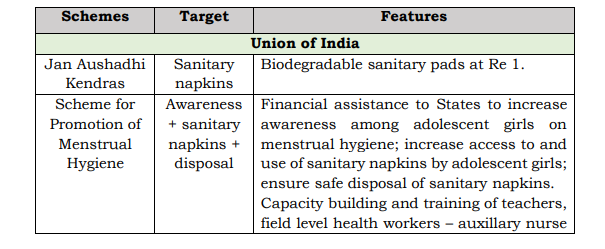
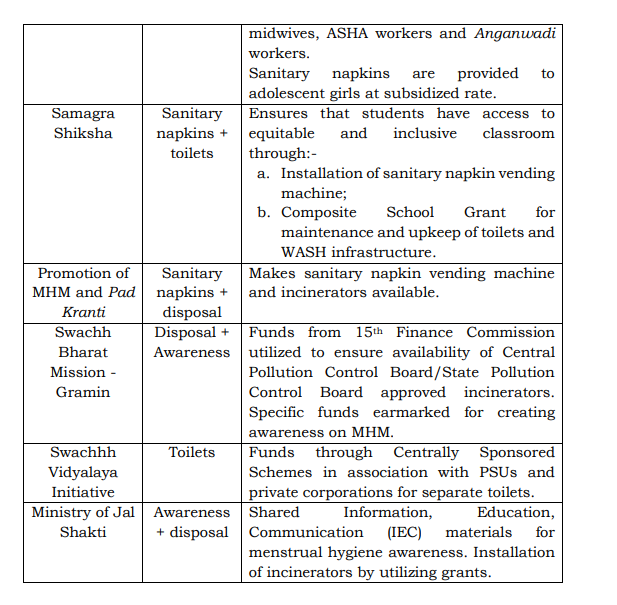
ii. Submissions on behalf of the States – Respondent Nos. 4 to 39 respectively
13. The following States have undertaken a number of policy initiatives and programmes which are summarized hereinbelow:-

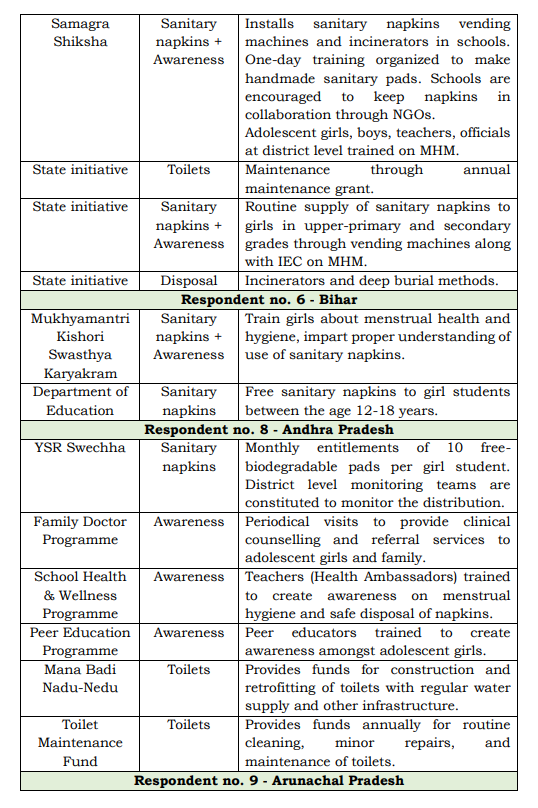
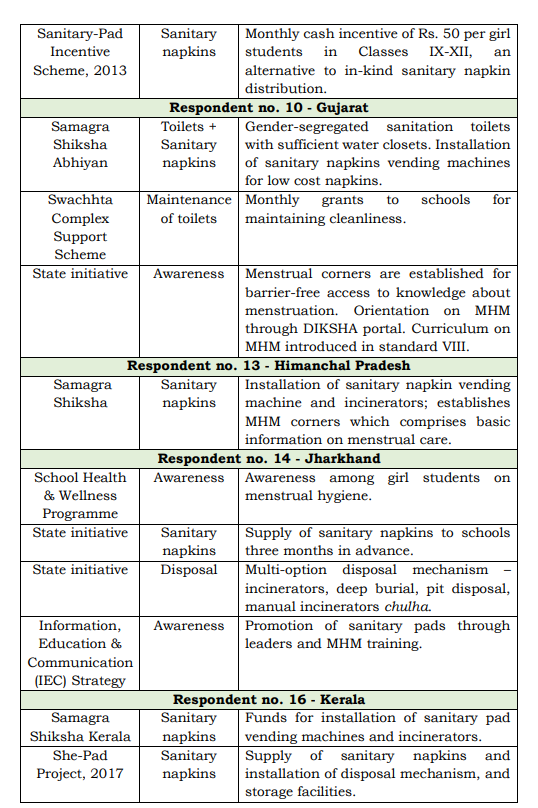
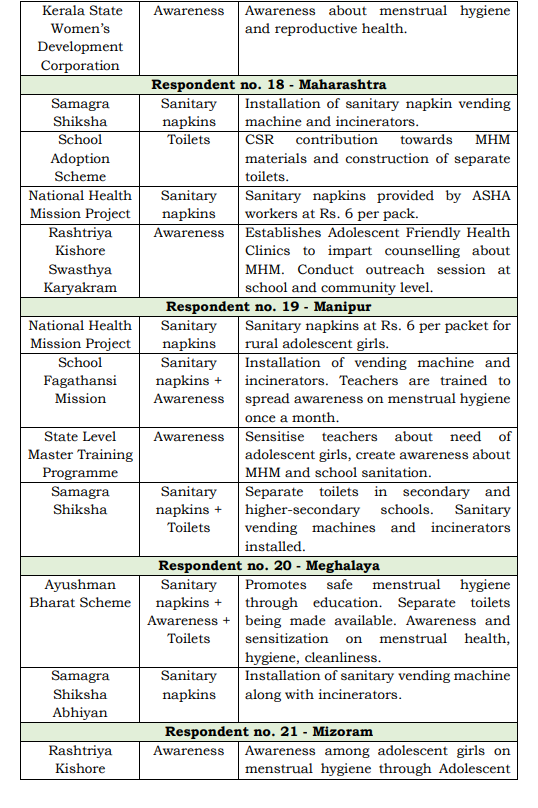
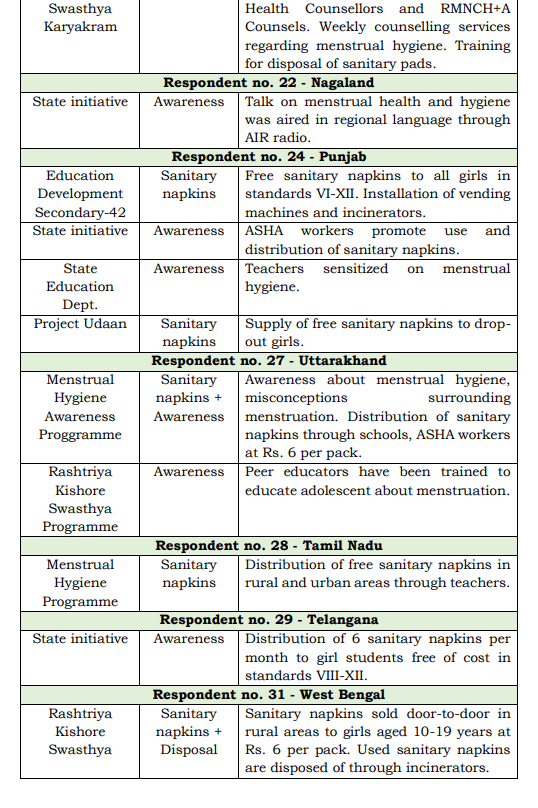
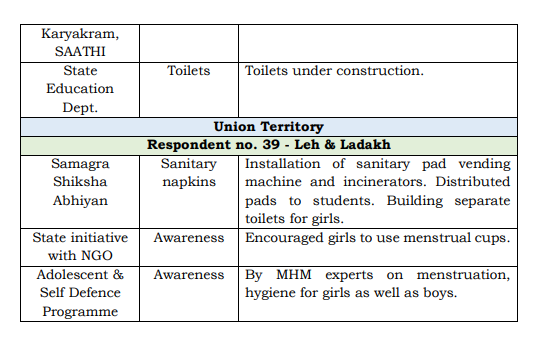
14. At the same time, the States of Uttar Pradesh, Chhattisgarh, Goa, Haryana, Karnataka, Madhya Pradesh, Odisha, Rajasthan, Sikkim, Tripura, respectively, and the Union Territories of Delhi, Lakshadweep, Daman & Diu, Dadra & Nagar Haveli, Andaman & Nicobar Islands, Puducherry, Chandigarh, and Jammu & Kashmir respectively have found it convenient to not file their affidavits.
15. Undoubtedly, there is no dearth of policies, schemes, programmes aimed at addressing the issue. However, what seems to be lacking is effective and consistent implementation.
IV. ISSUES FOR CONSIDERATION
16. Having heard the learned counsel appearing for the parties and having gone through the materials placed on record, the following questions fall for our consideration:-
a. Whether unavailability of gender-segregated toilets and nonaccess to menstrual absorbents could be said to be in violation of the right to equality for adolescent girl students under Article 14 of the Constitution?
b. Whether the right to dignified menstrual health could be said to be part of Article 21 of the Constitution?
c. Whether unavailability of gender-segregated toilets and nonaccess to menstrual absorbents could be said to be in violation of the right of participation and equality of opportunity as constitutional guarantees enshrined under Article 14 of the Constitution?
d. Whether unavailability of gender-segregated toilets and nonaccess to menstrual absorbents could be said to be in violation of the right to education under Article 21A, and the right to free and compulsory education under the Right of Children to Free and Compulsory Education Act, 2009?
V. ANALYSIS
A. The right to access education: A fundamental human right
17. Education is a fundamental human right, as it ensures full and holistic development of a human being. It is a stepping stone towards realizing other human rights. Education is an integral part of dignity of a child. It is a right, not a charitable concession. It promotes the physical and cognitive development of a child. It also contributes to the realization of the full potential of an individual. Most importantly, it shapes a person’s sense of identity and affiliation.
18. A child’s identity, knowledge, values, and skills are largely formed through social relationships. In other words, active participation in community life strengthens their ability to relate to others, promotes inclusivity and harmonious social relations, and facilitates learning through experiences and interactions. To put it briefly, to be educated is to be empowered.
19. It is apposite to understand that the right to education does not exist in a vacuum. Education has a direct impact on an individual’s civil and political rights, cultural rights, and physical and emotional well-being. It influences a person’s ability to make healthier life choices, more particularly, to access and navigate the healthcare system, and to seek timely medical assistance. The right assumes importance in the case of girls, who occupy a comparatively disadvantaged position within familial and societal structures. Undeniably, the way our society perceives women directly translates into prejudice against the girl child, and this perpetuates an endless cycle of discrimination.
20. In the aforesaid context, absence of education limits a girl child’s opportunities for participation and representation in society, restricts her from challenging social hierarchies, and impedes her growth and development. A girl child is often burdened with the weight of social prejudice, stereotypes, and structural oppression that are foisted upon her from an early age. Education serves as a counterweight to these factors by equipping her with knowledge and awareness. In its absence, inequality is not merely sustained but normalized.
i. Education – an essential human right in the International Human Rights Law framework
21. Article 26 of the Universal Declaration of Human Rights (UDHR) recognizes education as a universally protected fundamental human right. It stipulates that everyone has the right to education, and elementary education shall be compulsory. Further, Article 13 of the International Covenant on Economic, Social and Cultural Rights (ICESCR) also recognizes the right to education for everyone. The General Comment on Article 13 of the ICESCR states that the article envisages non-discrimination and equal treatment in imparting education.3To this end, the ICESCR states that State Parties must include policies, programmes, and other practices to identify and take measures to redress any de facto discrimination.
22. Similarly, the Constitution of the United Nations Educational, Scientific and Cultural Organization (UNESCO) states that the purpose of the Organization is to further respect for human rights and promote equality of educational opportunity. It calls upon the member States to formulate policies aimed at ensuring equality of opportunity and equality of treatment in education. It encourages making primary education free and compulsory, the availability and accessibility of secondary education to all, and the promotion of educational opportunities for persons who have either not received primary education or have been unable to complete it.
23. The UNESCO highlights that the primary purpose of education is to enrich and empower an individual. Education helps shape a person’s understanding of the world, values, and identity. The Organization underscored that education provides for the development of knowledge and skills that helps one negotiate life and achieve goals. It is crucial to interact and shape the world around them. It was referred to as a ‘multiplier right’, meaning that it opens the gate to the enjoyment of other rights.4
24. The Convention on the Elimination of All Forms of Discrimination against Women (CEDAW) mandates that State Parties take appropriate measures to eliminate discrimination against women in the field of education. It requires that equality must be ensured in access to pre-school, general, technical, professional and higher technical education. The Convention further obligates the State Parties to take effective steps to reduce female student drop-out rates, and actively work towards improving access to educational information necessary to safeguard the health and well-being of families.
25. Similarly, Article 28 of the Convention on the Rights of the Child (CRC) stipulates that State Parties recognize the right of every child to education. To give meaning to this right, the State Parties are obligated to encourage regular attendance at schools and to reduce drop-out rates. The Convention further mandates that the administration of the school must be in a manner that is consistent with the dignity of the child. In this regard, the State Parties affirm that education must be directed towards the holistic development of the child’s personality, more particularly, mental and physical abilities.
26. The Committee on the Rights of the Child states that discrimination in education violates the human dignity of a child and undermines the capability of a child to benefit from educational opportunities. It states that discriminatory practices include circumstances that limit a girl child’s participation in educational opportunities. It emphasizes that such practices impair a child’s growth to its fullest potential.5
27. What flows from the aforesaid discussion is that while interpreting domestic laws it is important to keep in mind the commitments under various international treaties and interpret laws in a manner consistent with the international human rights standards. Article 51 of the Constitution envisages that the State shall give due regard to international law and treaty obligations.
28. This Court has, time and again, affirmed India’s obligation with regard to international laws and conventions.6 We shall discuss the application of the aforementioned treaties and conventions insofar as the Right of Children to Free and Compulsory Education Act, 2009 (for short, “the RTE Act”), is concerned in the latter part of this judgment.
ii. Judicial recognition of education as a human right
29. It is necessary for us to look into as to how the courts across the world have recognized the right to education as a basic human right. In Brown v. Board of Education of Topeka Shawnee County Kan Briggs, reported in 1954 SCC OnLine US SC 44, the Supreme Court of the United States was considering whether segregation of children in schools solely based on race meant depriving the minority group of equal educational opportunities. In this context, the Court highlighted the importance of education. The relevant observations read thus:-
“13. Today, education is perhaps the most important function of state and local governments. Compulsory school attendance laws and the great expenditures for education both demonstrate our recognition of the importance of education to our democratic society. It is required in the performance of our most basic public responsibilities, even service in the armed forces. It is the very foundation of good citizenship. Today it is a principal instrument in awakening the child to cultural values, in preparing him for later professional training, and in helping him to adjust normally to his environment. In these days, it is doubtful that any child may reasonably be expected to succeed in life if he is denied the opportunity of an education. Such an opportunity, where the state has undertaken to provide it, is a right which must be made available to all on equal terms.”
(Emphasis supplied)
30. In Plyler v. J R Doe Texas, reported in 1982 SCC OnLine US SC 118, the issue before the Supreme Court of the United States was whether free public education could be denied to undocumented school-age children. Although access to education was not a constitutional guarantee yet the Court held that the State cannot prevent children from attending public schools unless a substantial state interest is involved. While underscoring the importance of education, it observed that “children denied an education are placed at a permanent and insurmountable competitive disadvantage, for an uneducated child is denied even the opportunity to achieve”. The relevant observations read thus:-
“26. Public education is not a “right” granted to individuals by the Constitution. San Antonio Independent School Dist. v. Rodriguez, 411 U.S. 1, 35, 93 S.Ct. 1278, 1298, 36 L.Ed.2d 16 (1973). But neither is it merely some governmental “benefit” indistinguishable from other forms of social welfare legislation. Both the importance of education in maintaining our basic institutions, and the lasting impact of its deprivation on the life of the child, mark the distinction. The “American people have always regarded education and [the] acquisition of knowledge as matters of supreme importance.” Meyer v. Nebraska, 262 U.S. 390, 400, 43 S.Ct. 625, 627, 67 L.Ed. 1042 (1923). We have recognized “the public schools as a most vital civic institution for the preservation of a democratic system of government,” Abington School District v. Schempp, 374 U.S. 203, 230, 83 S.Ct. 1560, 1575, 10 L.Ed.2d 844 (1963) (BRENNAN, J., concurring), and as the primary vehicle for transmitting “the values on which our society rests.” Ambach v. Norwick, 441 U.S. 68, 76, 99 S.Ct. 1589, 1594, 60 L.Ed.2d 49 (1979). “[A]s . . . pointed out early in our history, . . . some degree of education is necessary to prepare citizens to participate effectively and intelligently in our open political system if we are to preserve freedom and independence.” Wisconsin v. Yoder, 406 U.S. 205, 221, 92 S.Ct. 1526, 1536, 32 L.Ed.2d 15 (1972). And these historic “perceptions of the public schools as inculcating fundamental values necessary to the maintenance of a democratic political system have been confirmed by the observations of social scientists.” Ambach v. Norwick, supra, 411 U.S., at 77, 99 S.Ct., at 1594. In addition, education provides the basic tools by which individuals might lead economically productive lives to the benefit of us all. In sum, education has a fundamental role in maintaining the fabric of our society. We cannot ignore the significant social costs borne by our Nation when select groups are denied the means to absorb the values and skills upon which our social order rests.
27. In addition to the pivotal role of education in sustaining our political and cultural heritage, denial of education to some isolated group of children poses an affront to one of the goals of the Equal Protection Clause : the abolition of governmental barriers presenting unreasonable obstacles to advancement on the basis of individual merit. Paradoxically, by depriving the children of any disfavored group of an education, we foreclose the means by which that group might raise the level of esteem in which it is held by the majority. But more directly, “education prepares individuals to be self-reliant and self-sufficient participants in society.” Wisconsin v. Yoder, supra, 406 U.S., at 221, 92 S.Ct., at 1536. Illiteracy is an enduring disability. The inability to read and write will handicap the individual deprived of a basic education each and every day of his life. The inestimable toll of that deprivation on the social economic, intellectual, and psychological well-being of the individual, and the obstacle it poses to individual achievement, make it most difficult to reconcile the cost or the principle of a status-based denial of basic education with the framework of equality embodied in the Equal Protection Clause. [ Because the State does not afford noncitizens the right to vote, and may bar noncitizens from participating in activities at the heart of its political community, appellants argue that denial of a basic education to these children is of less significance than the denial to some other group. Whatever the current status of these children, the courts below concluded that many will remain here permanently and that some indeterminate number will eventually become citizens. The fact that many will not is not decisive, even with respect to the importance of education to participation in core political institutions. “[T]he benefits of education are not reserved to those whose productive utilization of them is a certainty . . . .” 458 F.Supp., at 581, n. 14. In addition, although a noncitizen “may be barred from full involvement in the political arena, he may play a role perhaps even a leadership role—in other areas of import to the community.” Nyquist v. Mauclet, 432 U.S. 1, 12, 97 S.Ct. 2120, 2126, 53 L.Ed.2d 63 (1977).
Moreover, the significance of education to our society is not limited to its political and cultural fruits. The public schools are an important socializing institution, imparting those shared values through which social order and stability are maintained.][…]
xxx
41. Justice MARSHALL, concurring.
42. While I join the Court’s opinion, I do so without in any way retreating from my opinion in San Antonio Independent School District v. Rodriguez, 411 U.S. 1, 70-133, 93 S.Ct. 1278, 1315-1348, 36 L.Ed.2d 16 (1973) (dissenting opinion). I continue to believe that an individual’s interest in education is fundamental, and that this view is amply supported “by the unique status accorded public education by our society, and by the close relationship between education and some of our most basic constitutional values.” Id., at 111, 93 S.Ct., at 1336. Furthermore, I believe that the facts of these cases demonstrate the wisdom of rejecting a rigidified approach to equal protection analysis, and of employing an approach that allows for varying levels of scrutiny depending upon “the constitutional and societal importance of the interest adversely affected and the recognized invidiousness of the basis upon which the particular classification is drawn.” Id., at 99, 93 S.Ct., at 1330. See also Dandridge v. Williams, 397 U.S. 471, 519-521, 90 S.Ct. 1153, 1178-1180, 25 L.Ed.2d 491 (1970) (MARSHALL, J., dissenting). It continues to be my view that a class-based denial of public education is utterly incompatible with the Equal Protection Clause of the Fourteenth Amendment.”
(Emphasis supplied)
31. In Bandhua Mukti Morcha v. Union of India, reported in (1984) 3 SCC 161, a three Judge Bench of this Court held that the right to live with dignity under Article 21 is inspired by the Directive Principles of State Policy which includes, inter alia, educational facilities.
32. We may also refer to the decision in Mohini Jain (Miss) v. State of Karnataka, reported in (1992) 3 SCC 666, wherein this Court held that the right to education forms part of the broader framework of the right to life and human dignity under Article 21 of the Constitution. As the right to life includes the right to live with dignity, such dignity cannot be realized without access to education. While recognizing that denial of education directly impacts the exercise of fundamental rights, the Court observed that social justice cannot be achieved in the absence of education. It observed that education is foundational to the realization of other fundamental rights. The relevant observations read thus:-
“8. The Preamble promises to secure justice “social, economic and political” for the citizens. A peculiar feature of the Indian Constitution is that it combines social and economic rights along with political and justiciable legal rights. The Preamble embodies the goal which the State has to achieve in order to establish social justice and to make the masses free in the positive sense. The securing of social justice has been specifically enjoined an object of the State under Article 38 of the Constitution. Can the objective which has been so prominently pronounced in the Preamble and Article 38 of the Constitution be achieved without providing education to the large majority of citizens who are illiterate. The objectives flowing from the Preamble cannot be achieved and shall remain on paper unless the people in this country are educated. The three-pronged justice promised by the Preamble is only an illusion to the teaming millions who are illiterate. It is only education which equips a citizen to participate in achieving the objectives enshrined in the Preamble. The Preamble further assures the dignity of the individual. The Constitution seeks to achieve this object by guaranteeing fundamental rights to each individual which he can enforce through court of law if necessary. The Directive Principles in Part IV of the Constitution are also with the same objective. The dignity of man is inviolable. It is the duty of the State to respect and protect the same. It is primarily education which brings forth the dignity of a man. The framers of the Constitution were aware that more than seventy per cent of the people, to whom they were giving the Constitution of India, were illiterate. They were also hopeful that within a period of ten years illiteracy would be wiped out from the country. It was with that hope that Articles 41 and 45 were brought in Chapter IV of the Constitution. An individual cannot be assured of human dignity unless his personality is developed and the only way to do that is to educate him. This is why the Universal Declaration of Human Rights, 1948 emphasises:“Education shall be directed to the full development of the human personality …”. Article 41 in Chapter IV of the Constitution recognises an individual’s right “to education”. It says that “the State shall, within the limits of its economic capacity and development, make effective provision for securing the right … to education …”. Although a citizen cannot enforce the Directive Principles contained in Chapter IV of the Constitution but these were not intended to be mere pious declarations. We may quote the words of Dr Ambedkar in that respect:
“In enacting this Part of the Constitution, the Assembly is giving certain directions to the future legislature and the future executive to show in what manner they are to exercise the legislative and the executive power they will have. Surely it is not the intention to introduce in this Part these principles as mere pious declarations. It is the intention of the Assembly that in future both the legislature and the executive should not merely pay lip service to these principles but that they should be made the basis of all legislative and executive action that they may be taking hereafter in the matter of the governance of the country.”
(C.A.D. Vol. VII, p. 476)”
(Emphasis supplied)
33. A Constitution Bench in Unni Krishnan, J.P. v. State of A.P., reported in (1993) 1 SCC 645, affirmed the abovementioned observations in Mohini Jain (supra) to the extent that the right to education has always been regarded as fundamentally important to human life. The Court observed that the country would be unable to achieve the objectives set forth in the Preamble without education. The relevant observations read thus:-
“Article 21 and Right to Education:
166. In Bandhua Mukti Morcha [(1984) 3 SCC 161 : 1984 SCC (L&S) 389] this Court held that the right to life guaranteed by Article 21 does take in “educational facilities”. (The relevant portion has been quoted hereinbefore.) Having regard to the fundamental significance of education to the life of an individual and the nation, and adopting the reasoning and logic adopted in the earlier decisions of this Court referred to hereinbefore, we hold, agreeing with the statement in Bandhua Mukti Morcha [(1984) 3 SCC 161 : 1984 SCC (L&S) 389] that right to education is implicit in and flows from the right to life guaranteed by Article 21. That the right to education p has been treated as one of transcendental importance in the life of an individual has been recognised not only in this country since thousands of years, but all over the world. In Mohini Jain [Mohini Jain v. State of Karnataka, (1992) 3 SCC 666] the importance of education has been duly and rightly stressed. The relevant observations have already been set out in para 7 hereinbefore. In particular, we agree with the observation that without education being provided to the citizens of this country, the objectives set forth in the Preamble to the Constitution cannot be achieved. The Constitution would fail. We do not think that the importance of education could have been better emphasised than in the above words.[…]”
(Emphasis supplied)
34. Although the 11 judge Bench in T.M.A Pai Foundation v. State of Karnataka, reported in (2002) 8 SCC 481, overruled the decision in Unni Krishnan (supra) insofar as the framing of the scheme qua grant of admission and the fixation of the fee, yet the observation that primary education is a fundamental right was affirmed.
35. We may also look into the decision in the case of Minister of Health v. Treatment Action Campaign, reported in 2002 SCC OnLine ZACC 17, wherein the Constitutional Court of South Africa recognized the concept of “minimum core” developed by the ICESR. The minimum core concept ensures that certain essential levels of each right, such as access to basic education, primary healthcare, food, shelter, and dignity, must be guaranteed immediately. The ICESR recognizes that although realization of rights may be subject to resources, yet it obligates State Parties to secure the minimum essential content of the rights.
36. In R.D. Upadhyay v. State of A.P., reported in (2007) 15 SCC 337, a fervent appeal was made to this Court to issue directions for the development of children of those mothers who were either undertrial prisoners or convicts. In such circumstances, this Court directed that adequate arrangements shall be made available in all jails to impart education to children of female prisoners. What has been conveyed by this Court in so many words is the understanding of education as a continuing and non-derogable right that cannot be denied even within the confines of a prison.
37. The Constitutional Court of South Africa in Governing Body of the Juma Musjid Primary School v. Ahmed Asruff Essay N.O., reported in 2011 SCC OnLine ZACC 13, underscored the importance of education in an appeal assailing an order authorizing the eviction of a public school from a private property. To put it in simple words, the Court was addressing a conflict between the right to education and the right to property. While holding that the government has a positive obligation to provide access to schools in fulfilling the right to basic education, the other non-State actors have a negative obligation not to infringe that right under the Constitution. The Court held that any limitation on the right to education must be reasonable and justifiable. The relevant observations read thus:-
“42. The significance of education, in particular basic education [ As enshrined in section 29(1) of the Constitution.] for individual and societal development in our democratic dispensation in the light of the legacy of apartheid, [ As pointed out by Berger in ‘The Rights to Education under the South African Constitution’ (Apr 2003) vol 103, No 3 Columbia Law Review, 616, the separatist national education policy under apartheid, manifested in the Bantu Education Act 47 of 1953, was an integral part of apartheid’s segregationist objective.] cannot be overlooked. The inadequacy of schooling facilities, particularly for many blacks [ Blacks here also denoting Indians and Coloureds.] was entrenched by the formal institution of apartheid, after 1948, when segregation even in education and schools in South Africa was codified. Today, the lasting effects of the educational segregation of apartheid are discernible in the systemic problems of inadequate facilities and the discrepancy in the level of basic education for the majority of learners.
43. Indeed, basic education is an important socioeconomic right directed, among other things, at promoting and developing a child’s personality, talents and mental and physical abilities to his or her fullest potential. [ See also Article 29(1) of the Child Rights Convention, which provides—“States Parties agree that the education of the child shall be directed to:(a) The development of the child’s personality, talents and mental and physical abilities to their fullest potential;(b) The development of respect for human rights and fundamental freedoms, and for the principles enshrined in the Charter of the United Nations;(c) The development of respect for the child’s parents, his or her own cultural identity, language and values, for the national values of the country in which the child is living, the country from which he or she may originate, and for civilizations different from his or her own;(d) The preparation of the child for responsible life in a free society, in the spirit of understanding, peace, tolerance, equality of sexes, and friendship among all peoples, ethnic, national and religious groups and persons of indigenous origin;(e) The development of respect for the natural environment.”] Basic education also provides a foundation for a child’s lifetime learning and work opportunities. To this end, access to school — an important component of the right to a basic education guaranteed to everyone by section 29(1)(a) of the Constitution — is a necessary condition for the achievement of this right.”
(Emphasis supplied)
38. In the aforesaid context, if a State Party under the ICESR fails to discharge this minimum core obligation, it is considered to be in breach of the Covenant. Moreover, States could justify nonfulfilment of the obligations only by exhibiting that it made everypossible effort to utilize all resources at its disposal to fulfil these obligations. Thus, failure to meet the minimum core threshold deprives the right of its substantive meaning and reduces the right to dead letters.
39. What appears from the aforesaid discussion is that the right to education is not confined to the physical existence or formal availability of schools. It extends to the ability of a child to participate in education in a meaningful, continuous, and nondiscriminatory manner. In other words, mere enrolment does not fulfil the right if structural or practical barriers prevent regular participation, engagement, or progression within the educational system.
40. To enable a child’s participation in school by way of affirmative measures reflects commitment to the substantive approach to equality, which goes beyond formal access to schooling. Such affirmative measures mandate State action to ensure all children are placed equally to avail educational opportunities.
B. Substantive approach to right to equality in education under Article 14 of the Constitution
41. The exercise of the right to education requires the removal of impediments that obstruct its enjoyment. In the present case, these impediments include the lack of MHM measures, such as non-access to toilets, non-availability of menstrual absorbents, and absence of a safe disposal mechanism. These barriers disproportionately affect the right to education of adolescent female students. As a result, the State is under an obligation to address them through appropriate measures.
42. There is no doubt that the right to education loses its spirit if such conditions exist that exclude menstruating girl children from the educational process. As stated aforesaid, addressing the impediments through affirmative actions would be consistent with the substantive approach to equality embodied in Article 14 of the Constitution. In order to place a menstruating girl child on an equal footing with others, mere equal treatment would not suffice.
43. We shall now look into and discuss the substantive approach to the right to equality under Article 14 of the Constitution. Article 14, in its traditional understanding, envisaged formal equality and guaranteed that likes would be treated alike. Under this formal conception of equality, although equality before the law and equal protection of the laws were guaranteed to all, yet inequality in the realization of other rights continued to persist.
44. The principle of substantive equality recognizes that once two individuals are placed in unequal positions because of social, economic, or cultural factors, mere equal “treatment” becomes inadequate. If two individuals are treated alike, without regard to their religion, race, caste, sex, or similar characteristics, the right to equality cannot be given its true effect. In other words, it cannot be given its true effect in the absence of taking into consideration the position of the individual, which may be profoundly shaped by historical and structural disadvantages. Equal treatment afforded in isolation, or rather without accounting for such disadvantage, may perpetuate inequality.
45. Equality is not an abstract concept. It is embedded in social reality and must be responsive to those who are disadvantaged and marginalized. Equality entails not merely formal conferral of rights, but also the adoption of measures necessary to translate those rights into equality.6 Substantive equality is brought into action through policies aiming to redress these systemic, direct or indirect disadvantages, by addressing the structural and contextual barriers that impede genuine equality. To put it briefly, it seeks to reduce the gap between disadvantages and the effective realization of rights.
46. There is no gainsaying that equality cannot be restricted to a mere duty of restraint on the State. Substantive equality can be meaningfully realized only when it is supported by positive overt actions aimed at remedying existing structural disadvantages. In other words, such positive duties require the State to take proactive measures to address patterns of discrimination and exclusion. In the absence of the aforementioned affirmative obligations, structural inequalities are merely preserved, and the promise of equality will be reduced to a paper provision
47. In such circumstances referred to above, differential treatment may be indispensable to achieve equality in practice. As has been aptly observed by Amartya Sen, “Equal consideration for all may demand very unequal treatment in favour of the disadvantaged.”7 As a result, unequal treatment may be constitutionally permissible when it is directed towards securing equal outcomes.8 In other words, substantive equality focuses on the extent to which an individual is able to meaningfully exercise choices, rather than merely possessing a formal right to do so. It recognizes that access to opportunities shall not be constrained by social, economic, or physical factors.
i. Menstruation as a barrier to the right to access education
48. In a research9 conducted on whether schools across the territory of India are menstrual-hygiene friendly, the researchers found that more than half of the girls did not have information about menstruation prior to menarche. The research revealed that the lack of sanitation facilities in schools hindered the ability of girls to manage menstruation healthily, safely, and with dignity.
49. Similarly, the Clean India: Clean Schools Handbook reported that although the number of schools providing drinking water and toilets have increased yet poor maintenance has left them inaccessible. The inaccessibility was attributed to factors such as absence of dedicated funds for operation and maintenance, weak management, poor quality of construction, and the lack of availability of water within toilets.
50. We are disheartened to note that the availability of water for cleaning and flushing of toilets still remains a major concern. The Handbook further reported that MHM is absent in a majority of schools, including the lack of gender-specific infrastructure, access to sanitary napkins, and a disposal mechanism.
51. In another research10 conducted to study school absenteeism during menstruation amongst adolescent school girls in North India, the researchers found that nearly one-third of girls were absent from school due to issues related to menstrual health, restrictive societal norms, and inadequate menstrual hygiene management. Out of approximately 500 students, 29.2% of the participants were reported to be absent from school during menstruation.
52. In the aforesaid study, among the reported reasons for absence, dysmenorrhea11 was the most prevalent, followed by restrictions at home, fear of staining clothes and difficulty in changing sanitary pads at school. The findings of the study revealed that students in government schools were more likely to be absent as compared to those in private schools. Notably, girls using hygienic methods reported lower absenteeism as compared to others. To address the aforesaid issues, the researchers recommended integrating comprehensive menstrual health education into school curricula and improving access to hygienic menstrual products.
53. Accessibility of MHM measures provides the same opportunities for all students in school, while recognizing unequal distribution of resources with the objective to attain equal access to human rights. In other words, it levels the playing field by addressing unequal starting points.
54. The right to education as a human right does not merely demand parity between genders but further requires equality of opportunity in the enjoyment of that right for all. Inaccessibility of MHM measures perpetuates a systemic exclusion and discrimination that impacts the admission or continuation of girl children in school.
55. The observations of this Court in Joseph Shine v. Union of India, reported in (2019) 3 SCC 39, succinctly capture the understanding of the substantive approach to equality. It held that substantive equality is aimed at eliminating all sorts of discrimination that undermine social, economic, and political participation in society. It was further held that Article 15(3) of the Constitution is intended to bring out substantive equality by remedying the disadvantage. It reads thus:-
“171. Section 497 amounts to a denial of substantive equality. The decisions in Sowmithri [Sowmithri Vishnu v. Union of India, 1985 Supp SCC 137 : 1985 SCC (Cri) 325] and Revathi [V. Revathi v. Union of India, (1988) 2 SCC 72 : 1988 SCC (Cri) 308] espoused a formal notion of equality, which is contrary to the constitutional vision of a just social order. Justness postulates equality. In consonance with constitutional morality, substantive equality is “directed at eliminating individual, institutional and systemic discrimination against disadvantaged groups which effectively undermines their full and equal social, economic, political and cultural participation in society” [ S. Martin and K. Mahoney (Eds.), Kathy Lahey, Feminist Theories of (In)equality, in Equality and Judicial Neutrality (1987).] . To move away from a formalistic notion of equality which disregards social realities, the Court must take into account the impact of the rule or provision in the lives of citizens.
172. The primary enquiry to be undertaken by the Court towards the realisation of substantive equality is to determine whether the provision contributes to the subordination of a disadvantaged group of individuals. [ Nivedita Menon (Ed.), Ratna Kapur and Benda Cossman “On Women, Equality and the Constitution : Through the Looking Glass of Feminism in Gender and Politics in India” (1993).] The disadvantage must be addressed not by treating a woman as “weak” but by construing her entitlement to an equal citizenship. The former legitimises patronising attitudes towards women. The latter links true equality to the realisation of dignity. The focus of such an approach is not simply on equal treatment under the law, but rather on the real impact of the legislation. [ Maureen Maloney, “An Analysis of Direct Taxes in India : A Feminist Perspective”, Journal of the Indian Law Institute (1988).] Thus, Section 497 has to be examined in the light of existing social structures which enforce the position of a woman as an unequal participant in a marriage.”
(Emphasis supplied)
56. By yet another Constitution Bench of this Court in Janhit Abhiyan v. Union of India (EWS Reservation), reported in (2023) 5 SCC 1, it was held that when substantive equality is asserted as a constitutional mandate, the State is tasked to place the concerned individuals on an equal footing. This Court, in so many words, held that substantive equality can take various forms, as per the requirements of the disadvantaged person or group. It was also observed that social justice cannot be achieved without substantive equality which means taking affirmative actions. The relevant observations read thus:-
“87. Indian constitutional jurisprudence has consistently held the guarantee of equality to be substantive and not a mere formalistic requirement. Equality is at the nucleus of the unified goals of social and economic justice. In Minerva Mills [Minerva Mills Ltd. v. Union of India, (1980) 3 SCC 625] it was observed : (SCC p. 709, para 111)
“111. … the equality clause in the Constitution does not speak of mere formal equality before the law but embodies the concept of real and substantive equality which strikes at inequalities arising on account of vast social and economic differentials and is consequently an essential ingredient of social and economic justice. The dynamic principle of egalitarianism fertilises the concept of social and economic justice; it is one of its essential elements and there can be no real social and economic justice where there is a breach of the egalitarian principle.”
(emphasis supplied)
88. Thus, equality is a feature fundamental to our Constitution but, in true sense of terms, equality envisaged by our Constitution as a component of social, economic and political justice is real and substantive equality, which is to organically and dynamically operate against all forms of inequalities. This process of striking at inequalities, by its very nature, calls for reasonable classifications so that equals are treated equally while unequals are treated differently and as per their requirements.
xxx
99. Thus, it could reasonably be summarised that for the socio-economic structure which the law in our democracy seeks to build up, the requirements of real and substantive equality call for affirmative actions; and reservation is recognised as one such affirmative action, which is permissible under the Constitution; and its operation is defined by a large number of decisions of this Court, running up to the detailed expositions in Jaishri Patil [Jaishri Laxmanrao Patil v. State of Maharashtra, (2021) 8 SCC 1] .”
(Emphasis supplied)
57. We may refer with profit the decision in Gaurav Kumar v. Union of India, reported in (2025) 1 SCC 641, wherein one of us, J.B. Pardiwala, J., was a part of the Bench, this Court reiterated that the substantive approach to equality aims to eliminate individual, institutional, and systemic discrimination against the disadvantaged. To put it briefly, substantive equality can be achieved through affirmative actions aimed towards eliminating discriminatory factors.
58. Recently, in Jane Kaushik v. Union of India, reported in (2026) 1 SCC 336, this Bench held that redressal of a disadvantage cannot be devoid of an understanding of the other impediments that an individual may face on account of other identity markers that may cause such an individual to be stigmatized and marginalized. The principle of reasonable accommodation was put into application as a means for achieving substantive equality.
a. Intersectionality of disability, gender, and access to education
59. The responsibility of the State is further heightened in the case of a child with disability, as the intersection of disability with gender compounds the disadvantage faced during menstruation. In case of children with disabilities, accessibility of washrooms is even more essential for inclusion and for enabling meaningful participation in school. Needless to say, the absence of such accessibility results in exclusion from education and reinforces the social and economic marginalization.
60. In Rajiv Raturi v. Union of India, reported in (2024) 16 SCC 654, wherein one of us, J. B. Pardiwala, J., was a part of the Bench, held that the right to accessibility is an integral part of the existing human right framework, more particularly, of Articles 14, 19, and 21 respectively. It was observed that accessibility enables the exercise of other rights, one of which forms part of the right to live a meaningful life under Article 21. The Court further held that to enable such a right the State is required to implement accessibility measures proactively. The relevant observations read thus:-
“22. Accessibility is not merely a convenience, but a fundamental requirement for enabling individuals, particularly those with disabilities, to exercise their rights fully and equally. Without accessibility, individuals are effectively excluded from many aspects of society, whether that be education, employment, healthcare, or participation in cultural and civic activities. Accessibility ensures that persons with disabilities are not marginalised but are instead able to enjoy the same opportunities as everyone else, making it an integral part of ensuring equality, freedom, and human dignity. By embedding accessibility as a human right within existing legal frameworks, it becomes clear that it is an essential prerequisite for the exercise of other rights.
xxx
26. Similarly, A.K. Sikri, J. in the 2017 judgment [Rajive Raturi v. Union of India, (2018) 2 SCC 413 : (2018) 1 SCC (L&S) 404] grounded the right to accessibility in the fundamental rights chapter of the Constitution, emphasizing that access to public spaces and services is an essential aspect of the right to life and dignity. This Court observed: (SCC p. 426, para 12)
“12. The vitality of the issue of “accessibility” vis-àvis visually disabled person’s right to life can be gauged clearly by the [Supreme] Court’s judgment in State of H.P. v. Umed Ram Sharma [State of H.P. v. Umed Ram Sharma, (1986) 2 SCC 68] where the right to life under Article 21 has been held broad enough to incorporate the right to accessibility.”
27. The inclusion of accessibility within the fundamental rights framework ensures that PWDs are entitled to full participation in society under Articles 14, 19 and 21 of the Constitution. Article 14 upholds equal access to spaces, services, and information; Article 19 guarantees the freedom to move and express oneself; and Article 21 ensures the right to live with dignity. Together, these provisions guarantee not only formal equality but also substantive equality, which requires the State to take positive steps to ensure that individuals can enjoy their rights fully, irrespective of disabilities. This Court in a plethora of judgments has repeatedly recognised that the right to dignity and the right to a meaningful life under Article 21 necessitate conditions that enable PWDs to enjoy the same freedoms and choices as others. [ See Jeeja Ghosh v. Union of India, (2016) 7 SCC 761 : (2016) 3 SCC (Civ) 551 : 2016 INSC 412; Rajive Raturi v. Union of India, (2018) 2 SCC 413 : (2018) 1 SCC (L&S) 404 : 2017 INSC 1243; Ravinder Kumar Dhariwal v. Union of India, (2023) 2 SCC 209 : (2023) 1 SCC (L&S) 181 : 2021 INSC 916; Vikash Kumar v. UPSC, (2021) 5 SCC 370 : (2021) 2 SCC (L&S) 1 : 2021 INSC 78.] Thus, the right to accessibility is foundational, enabling PWDs to exercise and benefit from other rights enshrined in Part III of the Constitution.”
(Emphasis supplied)
61. We would like to refer to the observations of this Court in Om Rathod v. Director General of Health Services, reported in 2024 SCC OnLine SC 3130, to further elaborate upon the principles of law on substantive equality in disability rights. It was observed that Section 3 of the Rights of Persons with Disabilities Act, 2016, casts a positive obligation on the State as well as private entities to ensure that no person with disability faces discrimination. The Court held that reasonable accommodation is a facet of substantive equality and failure to reasonably accommodate constitutes discrimination. The relevant observations read thus:-
“29. The principle of reasonable accommodation is not only statutorily prescribed but also rooted in the fundamental rights guaranteed to persons with disabilities under Part III of the Constitution. Reasonable accommodation is a fundamental right. It is a gateway right for persons with disabilities to enjoy all the other rights enshrined in the Constitution and the law. Without the gateway right of reasonable accommodation, a person with disability is forced to navigate in a world which excludes them by design. It strikes a fatal blow to their ability to make life choices and pursue opportunities. From mundane tasks of daily life to actions undertaken to realise personal and professional aspirations – all are throttled when reasonable accommodations are denied. Reasonable accommodation is a facet of substantive equality and its failure constitutes discrimination.[…]”
30. Section 3 of the RPWD Act affords persons with disabilities a right to equality and non-discrimination. In Vikash Kumar (supra) this Court held that Section 3 casts an affirmative obligation on the Government and private entities to take steps to ensure reasonable accommodation and utilize the capacity of persons with disabilities by providing an appropriate environment. There is a positive obligation to realise the inclusive premise in the concept of reasonable accommodation. This includes the duty to create an environment conducive for the development of persons with disabilities. This Court has held that:
“… The accommodation which the law mandates is ‘reasonable’ because it has to be tailored to the requirements of each condition of disability. The expectations which every disabled person has are unique to the nature of the disability and the character of the impediments which are encountered as its consequence. …
48. Failure to meet the individual needs of every disabled person will breach the norm of reasonable accommodation. Flexibility in answering individual needs and requirements is essential to reasonable accommodation. The principle of reasonable accommodation must also account for the fact that disability based discrimination is intersectional in nature. The intersectional features arise in particular contexts due to the presence of multiple disabilities and multiple consequences arising from disability. Disability therefore cannot be truly understood by regarding it as unidimensional.” (emphasis supplied)”
(Emphasis supplied)
62. Although accessibility and reasonable accommodation are distinct concepts, as already recognized in Rajive Raturi v. Union of India, reported in (2024) 16 SCC 654, yet the foundation for both is a substantive approach to equality and removal of barriers that impede the effective realization of rights. To put this in context, a commitment to accessibility would reflect in making the washrooms at school accessible for children with disabilities. However, this is not enough, reasonably accommodating a girl child with disability would also mean making menstrual absorbents available and educating all the students about menstruation and MHM measures.
63. Thus, we have no hesitation in saying that inaccessibility means not only depriving a girl child with disability of education but also violating her right to equality, freedom, and dignity. To reasonably accommodate means actively creating a conducive environment for children with disabilities.
64. What can be discerned from the above discussion is that the steps towards substantive equality are, first, the identification and recognition of disadvantage; and secondly, actions taken towards redressing that disadvantage. This Court is mindful that constitutional guarantees do not attain their true meaning by mere textual inclusion in statute books but through their realization in reality.
65. For a menstruating girl child who cannot afford menstrual absorbents, the disadvantage is two-fold. First, vis-à-vis menstruating girl children who can afford menstrual absorbents. Secondly, vis-à-vis male counterparts or nonmenstruating counterparts. Further, when the menstruating girl child is also a child with disability, she is not merely facing disadvantages arising from menstrual poverty, but is additionally subjected to other disadvantageous consequences flowing from the intersection of gender and disability.
66. The aforesaid disadvantages can be redressed by ensuring access to clean gender-segregated washrooms, sanitary napkins, or other suitable menstrual absorbents, hygienic and safe disposal mechanisms; and spreading awareness and imparting education on menstruation and MHM measures.
67. The right to education is a universally recognized human right, which, in circumstances referred to above, stands compromised and undermined for girl children. Menstrual poverty hinders menstruating girls from exercising their right to education with dignity equal to that of their male counterparts, or students who can afford sanitary products. There is no gainsaying that impairment of primary or secondary education has grave and lasting consequences, not only for individual development but also for long-term social and economic participation.
68. Many girls choose to absent themselves during menstruation due to lack of access to, or inability to afford, menstrual hygiene products, unavailability of gender-segregated washrooms, and absence of disposal mechanisms. This establishes a clear causal relationship between menstrual poverty and girls’ lower attendance in school. The absence of such measures lead many girls to absent themselves, or rather drop-out of school, leaving a lasting adverse impact on their education.
C. The right to dignified menstrual health a part of Article 21
i. The right to human dignity as a concomitant of the right to life
69. The right to life under Article 21 means a life with dignity. This Court, in a catena of decisions, has consistently recognized that dignity is an essential and inseparable facet of the right to life and liberty. The right to life means more than mere survival. Every human possesses inherent dignity by virtue of being human, which enables the individual to make self-determining choices. This Court has recognized dignity to be intrinsic and inalienable continuing beyond biological existence.12
70. When we recognize dignity as forming a significant part of human existence, we acknowledge the value of life. Dignity makes life livable. There is no gainsaying to the fact that the right to a dignified existence secures decisional autonomy, enabling an individual to transform life from mere subsistence into a meaningful endeavour. Dignity inheres in every stage and every aspect of human existence. As a result, the Constitution protects an individual’s expectation that dignity will be preserved and respected throughout their life.
71. In this regard, we shall refer to the decision in K.S. Puttaswamy (Privacy-9 J.) v. Union of India, reported in (2017) 10 SCC 1, wherein this Court categorically held that dignity is an integral part of the Constitution, and its reflections are found in Articles 14, 19, and 21, respectively. This Court noted that dignity can neither be given nor taken away. It held that there is a positive obligation on the State to not only protect one’s dignity but also take steps to facilitate it. It was observed that dignity ties all the fundamental rights together. The relevant observations read thus:-
“Jurisprudence on dignity 108. Over the last four decades, our constitutional jurisprudence has recognised the inseparable relationship between protection of life and liberty with dignity. Dignity as a constitutional value finds expression in the Preamble. The constitutional vision seeks the realisation of justice (social, economic and political); liberty (of thought, expression, belief, faith and worship); equality (as a guarantee against arbitrary treatment of individuals) and fraternity (which assures a life of dignity to every individual). These constitutional precepts exist in unity to facilitate a humane and compassionate society. The individual is the focal point of the Constitution because it is in the realisation of individual rights that the collective wellbeing of the community is determined. Human dignity is an integral part of the Constitution. Reflections of dignity are found in the guarantee against arbitrariness (Article 14), the lamps of freedom (Article 19) and in the right to life and personal liberty (Article 21).
xxx
113. Human dignity was construed in M. Nagaraj v. Union of India [M. Nagaraj v. Union of India, (2006) 8 SCC 212 : (2007) 1 SCC (L&S) 1013] by a Constitution Bench of this Court to be intrinsic to and inseparable from human existence. Dignity, the Court held, is not something which is conferred and which can be taken away, because it is inalienable : (SCC pp. 243 & 247-48, paras 26 & 42)
“26. … The rights, liberties and freedoms of the individual are not only to be protected against the State, they should be facilitated by it. … It is the duty of the State not only to protect the human dignity but to facilitate it by taking positive steps in that direction. No exact definition of human dignity exists. It refers to the intrinsic value of every human being, which is to be respected. It cannot be taken away. It cannot give (sic be given). It simply is. Every human being has dignity by virtue of his existence. …
***
42. India is constituted into a sovereign, democratic republic to secure to all its citizens, fraternity assuring the dignity of the individual and the unity of the nation. The sovereign, democratic republic exists to promote fraternity and the dignity of the individual citizen and to secure to the citizens certain rights. This is because the objectives of the State can be realised only in and through the individuals. Therefore, rights conferred on citizens and non-citizens are not merely individual or personal rights. They have a large social and political content, because the objectives of the Constitution cannot be otherwise realised.”
(emphasis supplied)
119. To live is to live with dignity. The draftsmen of the Constitution defined their vision of the society in which constitutional values would be attained by emphasising, among other freedoms, liberty and dignity. So fundamental is dignity that it permeates the core of the rights guaranteed to the individual by Part III. Dignity is the core which unites the fundamental rights because the fundamental rights seek to achieve for each individual the dignity of existence. Privacy with its attendant values assures dignity to the individual and it is only when life can be enjoyed with dignity can liberty be of true substance. Privacy ensures the fulfilment of dignity and is a core value which the protection of life and liberty is intended to achieve.”
(Emphasis supplied)
72. In Common Cause v. Union of India, reported in (2018) 5 SCC 1, Chandrachud, J., opined that the Constitution protects the legitimate expectation of a person to live a life with dignity. The relevant observations read thus:-
“437. Under our Constitution, the inherent value which sanctifies life is the dignity of existence. Recognising human dignity is intrinsic to preserving the sanctity of life. Life is truly sanctified when it is lived with dignity. There exists a close relationship between dignity and the quality of life. For, it is only when life can be lived with a true sense of quality that the dignity of human existence is fully realised. Hence, there should be no antagonism between the sanctity of human life on the one hand and the dignity and quality of life on the other hand. Quality of life ensures dignity of living and dignity is but a process in realising the sanctity of life.
438. Human dignity is an essential element of a meaningful existence. A life of dignity comprehends all stages of living including the final stage which leads to the end of life. Liberty and autonomy are essential attributes of a life of substance. It is liberty which enables an individual to decide upon those matters which are central to the pursuit of a meaningful existence. The expectation that the individual should not be deprived of his or her dignity in the final stage of life gives expression to the central expectation of a fading life : control over pain and suffering and the ability to determine the treatment which the individual should receive. When society assures to each individual a protection against being subjected to degrading treatment in the process of dying, it seeks to assure basic human dignity. Dignity ensures the sanctity of life. The recognition afforded to the autonomy of the individual in matters relating to endof-life decisions is ultimately a step towards ensuring that life does not despair of dignity as it ebbs away.
xxx
518. Constitutional recognition of the dignity of existence as an inseparable element of the right to life necessarily means that dignity attaches throughout the life of the individual. Every individual has a constitutionally protected expectation that the dignity which attaches to life must subsist even in the culminating phase of human existence. Dignity of life must encompass dignity in the stages of living which lead up to the end of life. Dignity in the process of dying is as much a part of the right to life under Article 21. To deprive an individual of dignity towards the end of life is to deprive the individual of a meaningful existence. Hence, the Constitution protects the legitimate expectation of every person to lead a life of dignity until death occurs;”
(Emphasis supplied)
73. Recently, in Gaurav Kumar v. Union of India, reported in (2025) 1 SCC 641, wherein one of us, J.B. Pardiwala, J., was a part of the Bench, this Court elucidated the importance of dignity in achieving substantive equality. This Court held that dignity encompasses the right of the individual to develop their potential to the fullest. The relevant observations read thus:-
“99. Dignity is crucial to substantive equality. The dignity of an individual encompasses the right of the individual to develop their potential to the fullest. [K.S. Puttaswamy (Privacy-9 J.) v. Union of India, (2017) 10 SCC 1, para 525] The right to pursue a profession of one’s choice and earn livelihood is integral to the dignity of an individual. Charging exorbitant enrolment fees and miscellaneous fees as a precondition for enrolment creates a barrier to entry into the legal profession. The levy of exorbitant fees as a precondition to enrolment serves to denigrate the dignity of those who face social and economic barriers in the advancement of their legal careers. [ See Neil Aurelio Nunes (OBC Reservation) v. Union of India, (2022) 4 SCC 1, para 35] This effectively perpetuates systemic discrimination against persons from marginalised and economically weaker sections by undermining their equal participation in the legal profession. Therefore, the current enrolment fee structure charged by SBCs is contrary to the principle of substantive equality.”
(Emphasis supplied)
74. In our considered view, MHM measures are inseparable from the right to live with dignity under Article 21. We say so because dignity cannot be reduced to an abstract ideal, it must find expression in conditions that enable individuals to live without humiliation, exclusion, or avoidable suffering. For menstruating girl children, the inaccessibility of MHM measures subjects them to stigma, stereotyping, and humiliation.
75. The absence of safe and hygienic menstrual management measures undermines dignified existence by compelling the adolescent female students to either resort to absenteeism or adopt unsafe practices, or both, which violates the bodily autonomy of the menstruating girl children.
ii. The right to privacy and decisional autonomy
76. Dignity cannot be assured without privacy. Privacy is one of the rights that are inherent in a human being by virtue of mere existence. Being a natural right, it inures every individual irrespective of their caste, class, gender, or any other similar differentiating ground. Privacy enables each individual to make choices and take decisions in respect of intimate and personal matters, free from interference. It is this conception of natural and inalienable right that secures the autonomy of human being.
77. In Puttaswamy (supra), this Court held the right to privacy to be a constitutionally protected right under Article 21. It recognized privacy as a natural right which is inherent in a human and not bestowed by the State. It was observed that privacy ensures the fulfilment of dignity and is a core value which protection of life and liberty has intended to achieve. In furtherance of this constitutional protection, the Court held that it is the duty of the State to safeguard the autonomy of an individual. The relevant observations read thus:-
“G. Natural and inalienable rights
42. Privacy is a concomitant of the right of the individual to exercise control over his or her personality. It finds an origin in the notion that there are certain rights which are natural to or inherent in a human being. Natural rights are inalienable because they are inseparable from the human personality. The human element in life is impossible to conceive without the existence of natural rights. In 1690, John Locke had in his Second Treatise of Government observed that the lives, liberties and estates of individuals are as a matter of fundamental natural law, a private preserve. The idea of a private preserve was to create barriers from outside interference. In 1765, William Blackstone in his Commentaries on the Laws of England spoke of a “natural liberty”. There were, in his view, absolute rights which were vested in the individual by the immutable laws of nature. These absolute rights were divided into rights of personal security, personal liberty and property. The right of personal security involved a legal and uninterrupted enjoyment of life, limbs, body, health and reputation by an individual.
xxx
46. Natural rights are not bestowed by the State. They inhere in human beings because they are human. They exist equally in the individual irrespective of class or strata, gender or orientation.
xxx
118. Life is precious in itself. But life is worth living because of the freedoms which enable each individual to live life as it should be lived. The best decisions on how life should be lived are entrusted to the individual. They are continuously shaped by the social milieu in which individuals exist. The duty of the State is to safeguard the ability to take decisions — the autonomy of the individual — and not to dictate those decisions. “Life” within the meaning of Article 21 is not confined to the integrity of the physical body. The right comprehends one’s being in its fullest sense. That which facilitates the fulfilment of life is as much within the protection of the guarantee of life.
xxx
320. Privacy is a constitutionally protected right which emerges primarily from the guarantee of life and personal liberty in Article 21 of the Constitution.
Elements of privacy also arise in varying contexts from the other facets of freedom and dignity recognised and guaranteed by the fundamental rights contained in Part III.”
(Emphasis supplied)
78. Bobde, J., in his concurring opinion in Puttaswamy (supra), stated that privacy is a prerequisite for the exercise of liberty and the freedom to perform any activity. Consequently, the absence of privacy denies an individual the freedom to exercise that particular liberty or to undertake such activity. Similarly, Nariman, J., recognized the privacy of choice as an individual’s autonomy over fundamental choices.
79. As a sequitur, autonomy is a concomitant of privacy. We say so because privacy is founded on the autonomy of an individual. At the same time, dignity cannot exist without privacy. In Puttaswamy (supra), this Court defined autonomy as “the ability to make decision on vital matters of concern to life”. While lucidly elucidating facets of privacy, this Court recognized an individual’s authority to make decisions as regards their body and mind. Further, while identifying the various facets of privacy, the Court recognized decisional privacy to mean the ability of an individual to make intimate decisions, including those relating to sexual autonomy. The relevant observations read thus:-
“297. What, then, does privacy postulate? Privacy postulates the reservation of a private space for the individual, described as the right to be let alone. The concept is founded on the autonomy of the individual. The ability of an individual to make choices lies at the core of the human personality. The notion of privacy enables the individual to assert and control the human element which is inseparable from the personality of the individual. The inviolable nature of the human personality is manifested in the ability to make decisions on matters intimate to human life. The autonomy of the individual is associated over matters which can be kept private. These are concerns over which there is a legitimate expectation of privacy. The body and the mind are inseparable elements of the human personality. The integrity of the body and the sanctity of the mind can exist on the foundation that each individual possesses an inalienable ability and right to preserve a private space in which the human personality can develop. Without the ability to make choices, the inviolability of the personality would be in doubt. Recognising a zone of privacy is but an acknowledgment that each individual must be entitled to chart and pursue the course of development of personality. Hence privacy is a postulate of human dignity itself. Thoughts and behavioural patterns which are intimate to an individual are entitled to a zone of privacy where one is free of social expectations. In that zone of privacy, an individual is not judged by others. Privacy enables each individual to take crucial decisions which find expression in the human personality. It enables individuals to preserve their beliefs, thoughts, expressions, ideas, ideologies, preferences and choices against societal demands of homogeneity. Privacy is an intrinsic recognition of heterogeneity, of the right of the individual to be different and to stand against the tide of conformity in creating a zone of solitude. Privacy protects the individual from the searching glare of publicity in matters which are personal to his or her life. Privacy attaches to the person and not to the place where it is associated. Privacy constitutes the foundation of all liberty because it is in privacy that the individual can decide how liberty is best exercised. Individual dignity and privacy are inextricably linked in a pattern woven out of a thread of diversity into the fabric of a plural culture.
298. Privacy of the individual is an essential aspect of dignity. Dignity has both an intrinsic and instrumental value. As an intrinsic value, human dignity is an entitlement or a constitutionally protected interest in itself. In its instrumental facet, dignity and freedom are inseparably intertwined, each being a facilitative tool to achieve the other. The ability of the individual to protect a zone of privacy enables the realisation of the full value of life and liberty. Liberty has a broader meaning of which privacy is a subset. All liberties may not be exercised in privacy. Yet others can be fulfilled only within a private space. Privacy enables the individual to retain the autonomy of the body and mind. The autonomy of the individual is the ability to make decisions on vital matters of concern to life. Privacy has not been couched as an independent fundamental right. But that does not detract from the constitutional protection afforded to it, once the true nature of privacy and its relationship with those fundamental rights which are expressly protected is understood. Privacy lies across the spectrum of protected freedoms. […] Above all, the privacy of the individual recognises an inviolable right to determine how freedom shall be exercised. […] Read in conjunction with Article 21, liberty enables the individual to have a choice of preferences on various facets of life including what and how one will eat, the way one will dress, the faith one will espouse and a myriad other matters on which autonomy and self-determination require a choice to be made within the privacy of the mind. […] Dignity cannot exist without privacy. Both reside within the inalienable values of life, liberty and freedom which the Constitution has recognised. Privacy is the ultimate expression of the sanctity of the individual. It is a constitutional value which straddles across the spectrum of fundamental rights and protects for the individual a zone of choice and self-determination.”
80. In this regard, in Common Cause (supra), this Court held thus:-
“441. The protective mantle of privacy covers certain decisions that fundamentally affect the human life cycle. [ Richard Delgado, “Euthanasia Reconsidered— The Choice of Death as an Aspect of the Right of Privacy”, Arizona Law Review (1975), Vol. 17, at p. 474.] It protects the most personal and intimate decisions of individuals that affect their life and development. [Ibid.] Thus, choices and decisions on matters such as procreation, contraception and marriage have been held to be protected. While death is an inevitable end in the trajectory of the cycle of human life of individuals are often faced with choices and decisions relating to death. Decisions relating to death, like those relating to birth, sex, and marriage, are protected by the Constitution by virtue of the right of privacy. The right to privacy resides in the right to liberty and in the respect of autonomy. [ T.L. Beauchamp, “The Right to Privacy and the Right to Die”, Social Philosophy and Policy (2000), Vol. 17, at p. 276.] The right to privacy protects autonomy in making decisions related to the intimate domain of death as well as bodily integrity.[…]”
(Emphasis supplied)
81. As explained in the aforementioned paragraphs of this judgment, the right to equality does not merely mandate that the State refrains from discrimination but also obliges it to adopt positive and affirmative measures aimed at remedying existing structural disadvantage. Likewise, in Puttaswamy (supra), this Court recognized that privacy has both positive and negative dimensions. In its positive aspect, it imposes an obligation on the State to take all necessary measures to protect the privacy of the individual.
82. What emerges from the foregoing discussion is that a girl child’s expectation to manage her menstruation in privacy with dignity is legitimate. In such circumstances, the lack of resources cannot be permitted to govern her autonomy over her own body. There is no doubt that she possesses the right to decide how and where menstrual care is carried out, and the liberty to exercise such care, free from coercive practices and social restrictions.
83. It is apposite to understand that menstrual hygiene management is not confined to sanitation, it includes bodily autonomy and decisional freedom. The denial of adequate facilities, appropriate sanitary products, or privacy effectively compels a girl child to manage her body in a manner dictated by circumstance rather than choice. Autonomy can be meaningfully exercised only when girl children have access to functional toilets, adequate menstrual products, availability of water, and hygienic mechanisms for disposal.
iii. The right to menstrual health as a facet of the right to life
84. The aforesaid may be looked at from one another angle. Article 21 recognizes the right to health. Health is defined as a state of physical, mental, and social well-being and not merely the absence of disease or infirmity. By necessary implication, this right will impliedly extend to the right of a menstruating girl child to access MHM practices to attain the highest standard of sexual and reproductive health. They are intertwined in such a manner that one cannot survive without the other. The right to reproductive health implies that an adolescent female student should have access to safe, effective, and affordable MHM measures.
85. There is a legion of decisions of this Court which lays down that the right to health is an integral facet of the meaningful right to life under Article 21 of the Constitution, and obligations of the State in this regard. We need not discuss all the decisions, but rather intend to refer and rely upon only a few of them.
86. We may refer with profit the decision in Lakshmi Kant Pandey v. Union of India, reported in (1984) 2 SCC 244, wherein this Court highlighted the centrality of children to the nation’s growth and development. It was observed that the framers of the Constitution were conscious of the inherent vulnerability of children and hence, reflected in Article 15(3). The relevant observations read thus:-
“6. It is obvious that in a civilized society the importance of child welfare cannot be overemphasized, because the welfare of the entire community, its growth and development, depend on the health and well-being of its children. Children are a “supremely important national asset” and the future well-being of the nation depends on how its children grow and develop. The great poet Milton put it admirably when he said: “Child shows the man as morning shows the day” and the Study Team on Social Welfare said much to the same effect when it observed that “the physical and mental health of the nation is determined largely by the manner in which it is shaped in the early stages”. The child is a soul with a being, a nature and capacities of its own, who must be helped to find them, to grow into their maturity, into fullness of physical and vital energy and the utmost breath, depth and height of its emotional, intellectual and spiritual being; otherwise there cannot be a healthy growth of the nation. Now obviously children need special protection because of their tender age and physique, mental immaturity and incapacity to look after themselves. That is why there is a growing realisation in every part of the globe that children must be brought up in an atmosphere of love and affection and under the tender care and attention of parents so that they may be able to attain full emotional, intellectual and spiritual stability and maturity and acquire selfconfidence and self-respect and a balanced view of life with full appreciation and realisation of the role which they have to play in the nation building process without which the nation cannot develop and attain real prosperity because a large segment of the society would then be left out of the developmental process. In India this consciousness is reflected in the provisions enacted in the Constitution. clause (3) of Article 15 enables the State to make special provisions inter alia for children and Article 24 provides that no child below the age of fourteen years shall be employed to work in any factory or mine or engaged in any other hazardous employment. Clauses (e) and (f) of Article 39 provide that the State shall direct its policy towards securing inter alia that the tender age of children is not abused, that citizens are not forced by economic necessity to enter avocations unsuited to their age and strength and that children are given facility to develop in a healthy manner and in conditions of freedom and dignity and that childhood and youth are protected against exploitation and against moral and material abandonment. These constitutional provisions reflect the great anxiety of the constitution makers to protect and safeguard the interest and welfare of children in the country. The Government of India has also in pursuance of these constitutional provisions evolved a National Policy for the Welfare of Children. This Policy starts with a goal-oriented preambulatory introduction:
“The nation’s children are a supremely important asset. Their nurture and solicitude are our responsibility. Children’s programme should find a prominent part in our national plans for the development of human resources, so that our children grow up to become robust citizens, physically fit, mentally alert and morally healthy, endowed with the skills and motivations needed by society. Equal opportunities for development to all children during the period of growth should be our aim, for this would serve our larger purpose of reducing inequality and ensuring social justice.”
The National Policy sets out the measures which the Government of India proposes to adopt towards attainment of the objectives set out in the preambulatory introduction and they include measures designed to protect children against neglect, cruelty and exploitation and to strengthen family ties “so that full potentialities of growth of children are realised within the normal family neighbourhood and community environment”. The National Policy also lays down priority in programme formation and it gives fairly high priority to maintenance, education and training of orphan and destitute children. There is also provision made in the National Policy for constitution of a National Children’s Board and pursuant to this provision, the Government of India has constituted the National Children’s Board with the Prime Minister as the chair-person. It is the function of the National Children’s Board to provide a focus for planning and review and proper co-ordination of the multiplicity of services striving to meet the needs of children and to ensure at different levels continuous planning, review and co-ordination of all the essential services. The National Policy also stresses the vital role which the voluntary organisations have to play in the field of education, health, recreation and social welfare services for children and declares that it shall be the endeavour of State to encourage and strengthen such voluntary organisations.” (Emphasis supplied)
87. In a petition filed under Article 32, issues arising from occupational health hazards and diseases affecting workmen employed in asbestos industries fell for consideration before this Court in Consumer Education & Research Centre v. Union of India, reported in (1995) 3 SCC 42. A three Judge Bench of this Court held that the right to health of a workman is an integral facet of the meaningful right to life. It encompasses not only healthy existence but also a robust and healthy lifestyle. This Court held that the right to health and medical care is a fundamental right under Article 21 read with Articles 39(e), 41 and 43 of the Constitution respectively, insofar as the life of the workman is considered to make it meaningful and dignified. It was further held that the State is under an obligation to promote health of a workman. The relevant observations read thus:-
“20. Article 1 of the Universal Declaration of Human Rights asserts human sensitivity and moral responsibility of every State that “all human beings are born free and equal in dignity and rights. They are endowed with reason and conscience and should act towards one another in a spirit of brotherhood.” The Charter of the United Nations thus reinforces the faith in fundamental human rights and in the dignity and worth of human person envisaged in the Directive Principles of State Policy as part of the Constitution. The jurisprudence of personhood or philosophy of the right to life envisaged under Article 21, enlarges its sweep to encompass human personality in its full blossom with invigorated health which is a wealth to the workman to earn his livelihood, to sustain the dignity of person and to live a life with dignity and equality.
23. In Sunil Batra v. Delhi Admn. [(1978) 4 SCC 494 : 1979 SCC (Cri) 155] , considering the effect of solitary confinement of a prisoner sentenced to death and the meaning of the word ‘life’ enshrined under Article 21, the Constitution Bench held that the quality of life covered by Article 21 is something more than the dynamic meaning attached to life and liberty. The same view was reiterated in Board of Trustees of the Port of Bombay v. D.R. Nadkarni [(1983) 1 SCC 124 : 1983 SCC (L&S) 61] , Vikram Deo Singh Tomar v. State of Bihar [1988 Supp SCC 734 : 1989 SCC (Cri) 66] , Ramsharan Autyanuprasi v. Union of India [1989 Supp (1) SCC 251] . In Charles Sobraj v. Supdt., Central Jail, Tihar [(1978) 4 SCC 104 : 1978 SCC (Cri) 542 : AIR 1978 SC 1514] this Court held that the right to life includes right to human dignity. The right against torture, cruel or unusual punishment or degraded treatment was held to violate the right to life. In Bandhua Mukti Morcha v. Union of India [(1984) 3 SCC 161 : 1984 SCC (L&S) 389] at pp. 183-84 this Court held that the right to live with human dignity, enshrined in Article 21, derives its life-breath from the Directive Principles of State Policy and particularly clauses (e) and (f) of Article 39 and Articles 41 and 42. In C.E.S.C. Ltd. v. Subhash Chandra Bose [(1992) 1 SCC 441 : 1992 SCC (L&S) 313] this Court considered the gamut of operational efficacy of human rights and constitutional rights, the right to medical aid and health and held that the right to social justice are fundamental rights. Right to free legal aid to the poor and indigent worker was held to be a fundamental right in Khatri (II) v. State of Bihar [(1981) 1 SCC 627 : 1981 SCC (Cri) 228] . Right to education was held to be a fundamental right vide Maharashtra State Board of Secondary & Higher Secondary Education v. K.S. Gandhi [(1991) 2 SCC 716] and Unni Krishnan, J.P. v. State of A.P. [(1993) 1 SCC 645]
24. The right to health to a worker is an integral facet of meaningful right to life, to have not only a meaningful existence but also robust health and vigour without which worker would lead life of misery. Lack of health denudes him of his livelihood. Compelling economic necessity to work in an industry exposed to health hazards due to indigence to bread-winning for himself and his dependants, should not be at the cost of the health and vigour of the workman. Facilities and opportunities, as enjoined in Article 38, should be provided to protect the health of the workman. Provision for medical test and treatment invigorates the health of the worker for higher production or efficient service. Continued treatment, while in service or after retirement is a moral, legal and constitutional concomitant duty of the employer and the State. Therefore, it must be held that the right to health and medical care is a fundamental right under Article 21 read with Articles 39(e), 41 and 43 of the Constitution and make the life of the workman meaningful and purposeful with dignity of person. Right to life includes protection of the health and strength of the worker and is a minimum requirement to enable a person to live with human dignity. The State, be it Union or State Government or an industry, public or private, is enjoined to take all such actions which will promote health, strength and vigour of the workman during the period of employment and leisure and health even after retirement as basic essentials to live the life with health and happiness. The health and strength of the worker is an integral facet of right to life. Denial thereof denudes the workman the finer facets of life violating Article 21. The right to human dignity, development of personality, social protection, right to rest and leisure are fundamental human rights to a workman assured by the Charter of Human Rights, in the Preamble and Articles 38 and 39 of the Constitution. Facilities for medical care and health to prevent sickness ensures stable manpower for economic development and would generate devotion to duty and dedication to give the workers’ best physically as well as mentally in production of goods or services. Health of the worker enables him to enjoy the fruits of his labour, keeping him physically fit and mentally alert for leading a successful life, economically, socially and culturally. Medical facilities to protect the health of the workers are, therefore, the fundamental and human rights to the workmen.
25. Therefore, we hold that right to health, medical aid to protect the health and vigour of a worker while in service or post-retirement is a fundamental right under Article 21, read with Articles 39(e), 41, 43, 48-A and all related articles and fundamental human rights to make the life of the workman meaningful and purposeful with dignity of person.”
(Emphasis supplied)
88. In Devika Biswas v. Union of India, reported in (2016) 10 SCC 726, a petition before this Court raised issues, inter alia, regarding the conduct and management of sterilization procedures, more particularly, the death occurring therefrom. In this regard, the Court held that the right to reproductive health encompasses the right to make all allied decisions and to attain the highest standards of reproductive health. The relevant observations read thus:-
“(i) Right to health
107. It is well established that the right to life under Article 21 of the Constitution includes the right to lead a dignified and meaningful life and the right to health is an integral facet of this right. In CESC Ltd. v. Subhash Chandra Bose [CESC Ltd. v. Subhash Chandra Bose, (1992) 1 SCC 441 : 1992 SCC (L&S) 313] dealing with the right to health of workers, it was noted that the right to health must be considered an aspect of social justice informed by not only Article 21 of the Constitution, but also the Directive Principles of State Policy and international covenants to which India is a party. Similarly, the bare minimum obligations of the State to ensure the preservation of the right to life and health were enunciated in Paschim Banga Khet Mazdoor Samity v. State of W.B. [Paschim Banga Khet Mazdoor Samity v. State of W.B., (1996) 4 SCC 37]
108. In Bandhua Mukti Morcha v. Union of India [Bandhua Mukti Morcha v. Union of India, (1984) 3 SCC 161 : 1984 SCC (L&S) 389] this Court underlined the obligation of the State to ensure that the fundamental rights of weaker sections of society are not exploited owing to their position in society.
xxx
(ii) Right to reproductive health
110. Over time, there has been recognition of the need to respect and protect the reproductive rights and reproductive health of a person. Reproductive health has been defined as “the capability to reproduce and the freedom to make informed, free and responsible decisions. It also includes access to a range of reproductive health information, goods, facilities and services to enable individuals to make informed, free and responsible decisions about their reproductive behaviour”. [ WHO, Sexual Health, Human Rights and the Law (2015) cited from Committee on Economic, Social and Cultural Rights, General Comment No. 22 (2016) on the Right to Sexual and Reproductive Health (Article 12 of the International Covenant on Economic, Social and Cultural Rights), 2-5-2016, E/C.12/GC/22 at para 6 <https://documents-ddsny.un.org/doc/UNDOC/GEN/G16/089/32/PDF/G16 08932.pdf?OpenElement>.] The Committee on Economic, Social and Cultural Rights in General Comment No. 22 on the Right to Sexual and Reproductive Health under Article 12 of the International Covenant on Economic, Social and Cultural Rights [ India ratified this Convention on 10-4- 1979.] observed that “The right to sexual and reproductive health is an integral part of the right of everyone to the highest attainable physical and mental health.” [ General Comment No. 22 (2016) on the Right to Sexual and Reproductive Health (Article 12 of the International Covenant on Economic, Social and Cultural Rights), E/C.12/GC/22 <https://documentsddsny.un.org/doc/UNDOC/GEN/G16/089/32/PDF/G16 08932.pdf?OpenElement>.]
111. This Court recognised reproductive rights as an aspect of personal liberty under Article 21 of the Constitution in Suchita Srivastava v. Chandigarh Admn. [Suchita Srivastava v. Chandigarh Admn., (2009) 9 SCC 1 : (2009) 3 SCC (Civ) 570] The freedom to exercise these reproductive rights would include the right to make a choice regarding sterilisation on the basis of informed consent and free from any form of coercion.[…]
112. It is necessary to reconsider the impact that policies such as the setting of informal targets and provision of incentives by the Government can have on the reproductive freedoms of the most vulnerable groups of society whose economic and social conditions leave them with no meaningful choice in the matter and also render them the easiest targets of coercion. The cases of Paschim Banga Khet Mazdoor Samity [Paschim Banga Khet Mazdoor Samity v. State of W.B., (1996) 4 SCC 37] and Bandhua Mukti Morcha [Bandhua Mukti Morcha v. Union of India, (1984) 3 SCC 161 : 1984 SCC (L&S) 389] have emphasised that the State’s obligation in respect of fundamental rights must extend to ensuring that the rights of the weaker sections of the community are not exploited by virtue of their position. Thus, the policies of the Government must not mirror the systemic discrimination prevalent in society but must be aimed at remedying this discrimination and ensuring substantive equality. In this regard, it is necessary that the policies and incentive schemes are made gender neutral and the unnecessary focus on female sterilisation is discontinued.”
(Emphasis supplied)
89. The views expressed by this Court in Independent Thought v. Union of India, reported in (2017) 10 SCC 800, are commendable. It held that the concept of good health is not limited to physical well-being but rather a girl child’s right to grow into a healthy woman, to exercise choice, and to pursue education. It was observed that when a girl child is deprived of the opportunity to study further, her right to live a dignified life as a woman is also violated. The Court further emphasized that a girl child must not only be afforded equality of opportunity with a male child, but must also be provided with additional support, so as to enable her empowerment physically, mentally, and economically. The relevant observations read as under:-
“179. There can be no dispute that every citizen of this country has the right to get good healthcare. Every citizen can expect that the State shall make best endeavours for ensuring that the health of the citizen is not adversely affected. By now it is well settled by a catena of judgments of this Court that the “right to life” envisaged in Article 21 of the Constitution of India is not merely a right to live an animal existence. This Court has repeatedly held that right to life means a right to live with human dignity. Life should be meaningful and worth living. Life has many shades. Good health is the raison d’être of a good life. Without good health there cannot be a good life. In the case of a minor girl child good health would mean her right to develop as a healthy woman. This not only requires good physical health but also good mental health. The girl child must be encouraged to bloom into a healthy woman. The girl child must not be deprived of her right of choice. The girl child must not be deprived of her right to study further. When the girl child is deprived of her right to study further, she is actually deprived of her right to develop into a mature woman, who can earn independently and live as a self-sufficient independent woman. In the modern age, when we talk of gender equality, the girl child must be given equal opportunity to develop like a male child. In fact, in my view, because of the patriarchal nature of our society, some extra benefit must be showered upon the girl child to ensure that she is not deprived of her right to life, which would include her right to grow and develop physically, mentally and economically as an independent selfsufficient female adult.”
(Emphasis supplied)
90. A three Judge Bench of this Court in X2 v. State (NCT of Delhi), reported in (2023) 9 SCC 433, wherein one of us, J.B. Pardiwala, J., was part of the Bench, held that the right to decide on all matters relating to sexual and reproductive health is one flower in the bouquet of reproductive rights. It held that reproductive rights include the right to access education and information about sexual health. The relevant observations read thus:- “101. The ambit of reproductive rights is not restricted to the right of women to have or not have children. It also includes the constellation of freedoms and entitlements that enable a woman to decide freely on all matters relating to her sexual and reproductive health. Reproductive rights include the right to access education and information about contraception and sexual health, the right to decide whether and what type of contraceptives to use, the right to choose whether and when to have children, the right to choose the number of children, the right to access safe and legal abortions, and the right to reproductive healthcare. Women must also have the autonomy to make decisions concerning these rights, free from coercion or violence.”
(Emphasis supplied)
91. It is limpid that when a girl child cannot access menstrual absorbents, she may resort to natural materials, newspaper, cloth, tissue, cotton wool, or any other unhygienic absorbent. In case of a lack of adequate clean water and soap, she may also struggle to properly clean and dry herself. It is not unknown that poor menstrual hygiene may cause reproductive tract infections such as bacterial vaginosis, which may in turn lead to infertility.13
92. Lack of knowledge about menstruation may lead to unhygienic and negative practices. This lack of body literacy contributes to a feeling of lack of bodily autonomy, more particularly, with regards to reproductive choices.
93. The above conspectus of cases reveals that the State bears a positive obligation under Article 21 to protect the right to health, more particularly, the menstrual health of girl children. The State is required to undertake effective measures to ensure the availability of, and enhance access to MHM products. We say so because the lack of access to such products impedes the physical well-being, dignity, and overall development of menstruating girl children.
94. It is an admitted position that the lack of access to MHM violates the right to reproductive health, as it compels girl children to resort to unhygienic alternatives such as rags or cloth, or use of menstrual absorbents for prolonged periods, all of which have demonstrably adverse consequences for their health. In schools where there are no separate washrooms for girl students, they would have to use male washrooms or the one which is used by all the students, where they are prone to harassment or sexual assault.
95. In such circumstances referred to above, it is the duty of the State to ensure the availability of MHM measures flows from the positive obligation embodied in Article 15(3) of the Constitution. The Constitution expressly contemplates discrimination in favour of women and children, having due regard to their vulnerability, in order to safeguard their welfare and interests. This constitutional intent is also reflected in Articles 24 and 39(e) and (f) of the Constitution, respectively.14
96. It would be worthwhile to refer to the observations made by this Court in State of A.P. v. P.B. Vijaykumar, reported in (1995) 4 SCC 520, wherein this Court had the occasion to interpret the expression “any special provision for women” in Article 15(3) of the Constitution. In such circumstances, it was observed that the object of the clause is to strengthen and improve the status of women. The Court held that the special provision referred in Article 15(3) could be either in the form of affirmative action or reservation.
“7. The insertion of clause (3) of Article 15 in relation to women is a recognition of the fact that for centuries, women of this country have been socially and economically handicapped. As a result, they are unable to participate in the socio-economic activities of the nation on a footing of equality. It is in order to eliminate this socio-economic backwardness of women and to empower them in a manner that would bring about effective equality between men and women that Article 15(3) is placed in Article 15. Its object is to strengthen and improve the status of women.[…]
8. What then is meant by “any special provision for women” in Article 15(3)? This “special provision”, which the State may make to improve women’s participation in all activities under the supervision and control of the State can be in the form of either affirmative action or reservation. It is interesting to note that the same phraseology finds a place in Article 15(4) which deals with any special provision for the advancement of any socially or educationally backward class of citizens or Scheduled Castes or Scheduled Tribes.[…]
This Court has, therefore, clearly considered the scope of Article 15(4) as wider than Article 16(4) covering within it several kinds of positive action programmes in addition to reservations. It has, however, added a word of caution by reiterating M.R. Balaji [1963 Supp 1 SCR 439 : AIR 1963 SC 649] to the effect that a special provision contemplated by Article 15(4) like reservation of posts and appointments contemplated by Article 16(4), must be within reasonable limits. These limits of reservation have been broadly fixed at 50% at the maximum. The same reasoning would apply to Article 15(3) which is worded similarly.
(Emphasis supplied)
97. The State’s obligation is heightened insofar as a girl child belonging to economically weaker sections is concerned. We say so because such students are placed in a position of coalesced vulnerability. The economic burden of sanitary products compounds the existing disadvantage of, first, being a girl in a structurally unequal society; secondly, having a biological process that requires management; and thirdly, lacking the financial means to manage that process in a safe and hygienic manner.
98. Furthermore, to secure the right to health is not merely a right enshrined under Article 21 but also a duty on the State under Article 47 of the Constitution. Article 47 enjoins the State to improve public health as its primary duty. No doubt the Government is rendering this obligation by providing MHM measures but in order to make it meaningful, it has to be reach of the beneficiaries. Thus, it is only then the objectives of the State can be realized. As is always said, the rights conferred on citizens and non-citizens are not merely individual or personal rights. They have a large social and political content, because the objectives of the Constitution cannot be otherwise realized.15
D. The right to participation and the equality of opportunity respectively as constitutional guarantees under Article 14
99. The opening declaration of the Constitution, “We, the People”, illustrates that the Constitution and its principles thrive on participation. Equality is not confined to the recognition of individual dignity, it encompasses the assurance of equal opportunity for every individual to advance their human potential and pursue their social, economic, and legal interests. i. Lack of menstrual hygiene measures as a barrier in exercising the right to participate in school
100. The right to equality includes, or rather is expressed through the right to be able to participate on equal terms in community and society. Substantive equality requires that voice and participation is enhanced in order to counter exclusion. We say so because providing equal opportunities equalizes the starting point so that all participants can compete on the same terms. As a sequitur, deprivation of opportunities to pursue one’s valued choices puts one at a disadvantageous position. Thus, without affording participation on equal footing, equality would be nothing more than lip service.
101. Equality demands that it is not just recognized but reverberated throughout society. Articles 15 and 16 of the Constitution respectively constitute a substantive framework of equality that goes beyond formal non-discrimination. It seeks to ensure meaningful participation of disadvantaged and marginalized communities in social, educational, and public life.
102. In the aforesaid context, the Constitution recognizes that entrenched disadvantage cannot be dismantled by mere neutrality on the part of the State. Hence, it imposed a positive constitutional duty upon the State to adopt affirmative measures aimed at redressing inequalities. Articles 14, 15 and 16 respectively reflect the constitutional commitment to uplift those placed at systemic disadvantage and to secure their effective participation on equal terms in the nation’s opportunities and institutions.
103. Over the years, this Court has recognized the right to participate as an essential expression of the right to equality. A Constitution Bench in Navtej Singh Johar v. Union of India, reported in (2018) 10 SCC 1, held Section 377 of the Indian Penal Code, 1860, unconstitutional to the extent it was discriminatory, being premised on stereotypes and stigma about genders. It denied full and equal participation of certain individuals as citizens and equal enjoyment of life. This Court held that equitable justice can be achieved only by “inclusion of all and exclusion of none”. It was noted that the ideals of the Constitution can be achieved only when each and every individual is able to participate in all walks of life. The relevant observations read thus:-
“264. The very existence of Section 377 IPC criminalising transgenders casts a great stigma on an already oppressed and discriminated class of people. This stigma, oppression and prejudice has to be eradicated and the transgenders have to progress from their narrow claustrophobic spaces of mere survival in hiding with their isolation and fears to enjoying the richness of living out of the shadows with full realisation of their potential and equal opportunities in all walks of life. The ideals and objectives enshrined in our benevolent Constitution can be achieved only when each and every individual is empowered and enabled to participate in the social mainstream and in the journey towards achieving equality in all spheres, equality of opportunities in all walks of life, equal freedoms and rights and, above all, equitable justice. This can be achieved only by inclusion of all and exclusion of none from the mainstream.
xxx
602. The flourishing of a constitutional order requires not only the institutional leadership of constitutional courts, but also the responsive participation of the citizenry. [ Marc Galanter, “Fifty Years on”, in B.N. Kirpal et al, Supreme but Not Infallible : Essays in Honour of the Supreme Court of India, Oxford University Press (2000), at p. 57.] Constitutional morality is a pursuit of this responsive participation. The Supreme Court cannot afford to denude itself of its leadership as an institution in expounding constitutional values. Any loss of its authority will imperil democracy itself.”
(Emphasis supplied)
104. In Jane Kaushik (supra), this Court held that elimination of structural and institutional discrimination is necessary for participation in society. The decision in Jane Kaushik (supra) relied on Vikash Kumar v. UPSC, reported in (2021) 5 SCC 370, to highlight that reasonable accommodation flows from positive obligations on State to facilitate participation of persons with disability in society. The Court held that Articles 14, 15, and 16 of the Constitution respectively provide a framework for equality that translates into participation. Further, it was noted that the right to participate traces itself to the right to freedom of expression and the right to life, in order to make life meaningful. The relevant observations read thus:-
“97. A fundamental requirement of substantive equality is the elimination of structural and institutional discrimination to achieve true participation in social settings by the community being discriminated against.
Articles 14, 15 and 16 of the Constitution respectively provide a framework for equality that translates into participation of communities situated at the fringes of society and mandate that the constitutional vision of inclusion of different and diverse voices be achieved. Such a constitutional mandate flows not only from the equality provisions contained in Articles 14, 15 and 16 respectively but also from the broader themes of freedom of speech, expression and participation enshrined in Article 19 along with the right to a dignified social life contained in Article 21. The fundamental right to equality, fundamental freedoms and the right to life together ensure and aspire for meaningful participation and expression of the minorities.”
xxx
105. What is discernible from the aforesaid judgments is that though the courts have not expressly carved out a right to public participation, yet they have emphasized on the constitutional value of the same by associating it with the right to freedom of expression and the right to life. In our considered opinion, participation in public life is an important facet of the right to equality as well. The Constitution considers all the people to be equal citizens. The ability and choice to participate in public and social life without any fear of discrimination and ridicule, is a reflection of the same.
xxx
109. The aforesaid expositions leave no manner of doubt in our minds that the right to participation is an embodiment of the constitutional vision of equal opportunity and dignity for all. The said right finds its roots in the right to freedom of expression and is shaped by the constitutional mandate of substantive equality with the end goal of affording the marginalized sections of the society a meaningful life in terms of Article 21 of the Constitution.”
(Emphasis supplied)
105. We may also look into the decision in Nipun Malhotra v. Sony Pictures Films India (P) Ltd., reported in 2024 SCC OnLine SC 1639, wherein this Court recognized that stereotype exacerbates systemic inequalities, and inhibits dignified participation in education or employment. What has been conveyed in so many words by this Court is that stereotype stem from a lack of familiarity, and this lack arises due to inadequate representation and participation. Again, in Sukanya Shantha v. Union of India, reported in (2024) 15 SCC 535, this Court reiterated that meaningful participation in social life is obstructed when treatment is based on stereotype.
106. The aforesaid expositions leave no manner of doubt in our minds that the right to participation recognizes that individuals are inherently social, and for a dignified life, one shall have the ability to participate on equal terms in community. Juxtaposing this logic, the absence of access to education restricts an individual from participating fully and effectively in democratic, social, and economic life.
107. In a study16 conducted among students of classes sixth to eighth belonging to low-income households, the participants were given an opportunity to ask questions relating to menstruation. The study found that 18% of the participants raised questions concerning menstrual symptoms, while more than 17% of the questions pertained to myths and taboos surrounding menstruation. These questions were related to restrictions on bathing, touching objects, leaving the house, visiting temples, and performing daily chores during menstruation. The students were seeking to understand the rationale behind such restrictions.
108. The researchers observed that adolescent girls lacked adequate awareness regarding menstruation, including the proper use and disposal of sanitary pads. The study revealed that of all the questions asked concerning the treatment of menstrual abnormalities, only one related to seeking medical assistance from a professional, while the remaining questions reflected reliance on home-based remedies. It concluded that illiteracy together with poverty was as a key factor contributing to taboos, unhealthy and harmful practices, leading to adverse health outcomes.
109. In our considered opinion, the study demonstrates a serious deficit in menstrual health knowledge among adolescent girls, particularly those from economically weaker sections. The prevalence and reliance on myths and taboos reflects not merely lack of information but the persistence of structural barriers which arise from stigma and stereotype.
110. The lack of MHM measures acts as a significant barrier to girls’ participation in school. Even within educational institutions, menstruation is beset by stigma, stereotype, and neglect. When schools fail to provide clean washrooms, required menstrual absorbents, safe disposal mechanisms, girl children would be compelled to either absent themselves or drop-out from school. In both scenarios, her right to participate in schooling, sports, extra-curricular activities are jeopardized.
111. As a result, lack of these measures directly impairs her participation in school. Such conditions ultimately affect her regular attendance and equal involvement in schooling. Needless to say, participation in education is not limited to physical presence in the classroom, it encompasses the ability to attend school, more particularly, having the choice to attend the school, concentrate during lessons, and take part in academic and co-curricular activities on an equal footing with peers.
112. In the absence of clean and functional washrooms, girl children would be unable to manage menstruation with privacy and dignity in school. This will put her in constant anxiety of leakage, staining clothes, and exposure to embarrassment. It is this fear which discourages her from attending school altogether. Similarly, lack of access to menstrual absorbents affects participation by making it practically unfeasible for girls to remain in school for long hours or actively participate.
113. Further, when schools fail in providing appropriate disposal facilities, girls would be forced to carry used menstrual products with them, or dispose of them in unsafe or undignified ways. The fear of being ridiculed lingers and creates a disincentive to attend school during this time. The lack of awareness and education regarding menstruation exacerbates these barriers by fostering stigma and silence within school spaces. Where menstruation is not openly acknowledged or discussed, girls are less likely to seek support from teachers or peers.
114. Awareness not only reduces the act of teasing, passing insensitive remarks, or promoting stereotypical practices but also prevents self-exclusion by girls from schooling. This way, the participation becomes continuous and equal rather than conditional and irregular. These structural deficiencies are a cause for inconvenience to menstruating girl children. Moreover, it curtails their participation in school and defeats the human right of education, which includes inclusive education.
ii. Lack of menstrual hygiene management measures impede the equality of opportunity
115. It is in the same breath that we say that equality of opportunity entails removal of obstacles that impede the advancement of disadvantaged, more particularly in the present case, the women. The concept of substantive equality seeks to work on the factors causing discrimination. It intends to provide uniform opportunities to develop the desired skills to stand on an equal footing. It aims to equalize the starting point rather than the end result.17 To illustrate, when schools evaluate performance through written examinations, equality of opportunity would ensure that students with visual or learning disabilities are provided appropriate assistive devices, scribes, or additional time.
116. What is discernable from the aforesaid is that equality of opportunity necessitates that everyone has a fair chance to acquire the skills necessary for accessing benefits. This can be achieved only when structural impediments in acquiring such skills are eliminated. Equality of opportunity would help persons at a disadvantageous position to overcome structural discrimination. When equal opportunities are given, we recognize her right to choose and capability to choose. Hence, affording equal opportunity is an expression of treating a girl child equally.
117. The idea behind equal opportunities is to stimulate her potential, and provide her with more choice and space to develop. The principle of equality of opportunity is an essential part of social justice. In a monograph on social justice, equal opportunity has been categorized as thus:-18
i. First, having an equal start, i.e., those with identical potential should be given the opportunity to survive and develop. In this regard, John Rawls study states that expectations of those with identical abilities shall not be influenced by one’s social class.
ii. Secondly, realizing equal opportunities, i.e., it is not sufficient to acknowledge that the starting point shall be same; the process of being able to access the opportunities is equally important. In this regard, any impediment that might interfere with the process should be eliminated.
iii. Thirdly, recognizing and respecting people’s potential, i.e., natural differences must be respected as normal and reasonable. This seeks to addresses social and historical constraints.
118. We may aptly refer to the decision in State of Karnataka v. Appa Balu Ingale, reported in 1995 Supp (4) SCC 469, wherein this Court observed that dignity of a person is acknowledged by providing them equality of status and opportunity. It recognized that denial of equal opportunities in any aspect of life is denial of equal status and is reflective of inhibiting equal participation. The relevant observations read thus:-
“10. The Preamble of the Indian Constitution imbued its people with pride of being its citizens in an integrated Bharat with fraternity, dignity of person and equality of status. But casteism; sectional and religious diversities and parochialism are disintegrating the people. Social stratification needs restructure. Democracy meant fundamental changes in the social and economic life of the people, absence of inequitous conditions, inequalities and discrimination. There can be no dignity of person without equality of status and opportunity. Denial of equal opportunities in any walk of social life is denial of equal status and amounts to preventing equal participation in social intercourse and deprivation of equal access to social means. Human relations based on equality, equal protection of laws without discrimination would alone generate amity and affinity among the heterogenous sections of the Indian society and a feeling of equal participants in the democratic polity. Adoption of new ethos and environment are, therefore, imperatives to transform the diffracted society into high degree of mobility for establishing an egalitarian social order in Secular Socialist Democratic Bharat Republic.[…]”
(Emphasis supplied)
119. The absence of MHM measures does not merely disrupt a girl child’s presence in school. It impairs her access to opportunities both during schooling and later in life. As stated aforesaid, equality of opportunity is concerned with conditions that enable an individual to participate and compete on equal terms. When such conditions are absent, naturally, an individual is put at a disadvantageous position.
120. The absence of MHM measures at school would lead to recurrent absenteeism which would result in gap in learning. Over the period of time, these gaps would translate into lower academic performance, and reduced participation in classroom. Opportunities for academic development, such as participation in competitions, sports or leadership roles, inevitably get disturbed.
121. The resultant effect of frequent and prolonged absenteeism is dropping out. At this age, dropping out forecloses future opportunities, eventually limiting access to higher education, employment, social participations, to name a few. In other words, the consequence is not merely economic deprivation, but narrowing life chances as well. Thus, the impairment of educational opportunity during formative years has a cascading effect later in life. Furthermore, it restricts a woman’s ability to make informed choices regarding health, family, and civic participation.
a. Accessibility of menstrual hygiene management measures – a step towards Social Justice
122. The aforesaid may be looked at from one another angle. Social justice seeks not merely absence of discrimination, but the creation of conditions through which substantive equality can be attained. These conditions are opportunities, more particularly, access to education for those who have been disadvantaged due to inherent factors.
123. Social justice would be achieved through continuous removal of injustice and inequity in society. It requires efforts to correct structural and historical disadvantages that prevent participating on equal terms. Any effort towards social justice is an act towards inclusion. The acts by the State adopting affirmative measures, namely, welfare schemes, beneficial legislations, are attributable to promoting social justice. Thus, social justice is not a static idea but a continuous process towards achieving a just and equitable society.
124. The concept of social justice requires that everyone’s life to be meaningful and livable with human dignity. This Court in Consumer Education (supra), has recognized social justice to be species of broad idea of justice. In other words, social justice mitigates inherent disadvantages and elevates the disadvantaged to the level of equality to live a life with dignity. The observations read thus:-
“18. The Preamble and Article 38 of the Constitution of India — the supreme law, envisions social justice as its arch to ensure life to be meaningful and liveable with human dignity.[…]The Constitution commands justice, liberty, equality and fraternity as supreme values to usher in the egalitarian social, economic and political democracy. Social justice, equality and dignity of person are cornerstones of social democracy. The concept “social justice”, which the Constitution of India engrafted, consists of diverse principles essential for the orderly growth and development of personality of every citizen. “Social justice” is thus an integral part of ‘justice’ in the generic sense. Justice is the genus, of which social justice is one of its species. Social justice is a dynamic device to mitigate the sufferings of the poor, weak, dalits, tribals and deprived sections of the society and to elevate them to the level of equality to live a life with dignity of person. Social justice is not a simple or single idea of a society but is an essential part of complex social change to relieve the poor etc. from handicaps, penury to ward off distress and to make their life liveable, for greater good of the society at large. In other words, the aim of social justice is to attain substantial degree of social, economic and political equality, which is the legitimate expectation. Social security, just and humane conditions of work and leisure to workman are part of his meaningful right to life and to achieve self-expression of his personality and to enjoy the life with dignity; the State should provide facilities and opportunities to enable them to reach at least minimum standard of health, economic security and civilised living while sharing according to their capacity, social and cultural heritage.
19. […]The constitutional concern of social justice as an elastic continuous process is to accord justice to all sections of the society by providing facilities and opportunities to remove handicaps and disabilities with which the poor etc. are languishing and to secure dignity of their person. The Constitution, therefore, mandates the State to accord justice to all members of the society in all facets of human activity. The concept of social justice embeds equality to flavour and enliven practical content of ‘life’. Social justice and equality are complementary to each other so that both should maintain their vitality. Rule of law, therefore, is a potent instrument of social justice to bring about equality in results.”
(Emphasis supplied)
125. Equality of status and opportunity flows from the constitutional principles on equality code. In M. Nagaraj v. Union of India, reported in (2006) 8 SCC 212, this Court recognized that there can be no justice without equality of status and of opportunity. In Indian Medical Assn. v. Union of India, reported in (2011) 7 SCC 179, this Court observed that aspects of socially just and equitable society are an essential component of the basic equality code itself. The Court further observed that the policies of the State must be in consonance with the principles of equity and justice inherent in Articles 14, 19, and 21 of the Constitution respectively. The relevant observations read thus:-
“165. It is now a well-settled principle of our constitutional jurisprudence that Article 14 does not merely aspire to provide for our citizens mere formal equality, but also equality of status and of opportunity. The goals of the nation State are the securing for all of its citizens a fraternity assuring the dignity of the individual and the unity of the nation. While justice— social, economic and political is mentioned in only Article 38, it was also recognised that there can be no justice without equality of status and of opportunity (see M. Nagaraj [M. Nagaraj v. Union of India, (2006) 8 SCC 212 : (2007) 1 SCC (L&S) 1013] ). As recognised by Babasaheb Ambedkar, at the moment that our Constitution just set sail, that while the first rule of the ship, in the form of formal equality, was guaranteed, inequality in terms of access to social and economic resources was rampant and on a massive scale, and that so long as they individually, and the social groups they were a part of, continue to not access to social and economic resources that affords them dignity, they would always be on the margins of the ship, with the ever present danger of falling off that ship and thereby never partaking of the promised goals of that ship. Babasaheb Ambedkar with great foresight remarked that unless such more fundamental inequalities, that foster conditions of injustice, and limit liberty of thought and of conscience, are eradicated at the earliest, the ship itself would be torn apart.
xxx
168. An important and particular aspect of our Constitution that should always be kept in mind is that various aspects of social justice, and an egalitarian social order, were also inscribed, not as exceptions to the formal content of equality but as intrinsic, vital and necessary components of the basic equality code itself. To the extent there was to be a conflict, on account of scarcity, it was certainly envisaged that the State would step in to ensure an equitable distribution in a manner that would be conducive to common good; nevertheless, if the State was to transgress beyond a certain limit, whereby the formal content of equality was likely to be drastically abridged or truncated, the power of judicial review was to curtail it. However, as long as the policy initiatives of the State were in consonance with principles of equity and justice inherent within the equality code, and indeed even the freedom code, via Article 21’s guarantee of the right to life, and for promotion of freedom of expression and thought, especially to promote excellence in our debates and arguments in the political sphere so that democratic richness could be better served, or were framed in pursuance of the directive principles of State policy, that were based on reasonable and intelligible classifications, the courts were to have no further place in entering the field of policy choices. The courts could of course, also, impose positive constitutional obligations on the State, where the abnegation of those positive and affirmative obligations, encoded within fundamental rights itself, were so gross as to constitute a fraud on the face of the Constitution.”
(Emphasis supplied)
126. From the perspective of substantive equality, the absence of menstrual hygiene measures entrenches gendered disadvantage by converting a biological reality into a structural exclusion. The denial of basic enabling conditions, i.e., lack of clean and functional washrooms, menstrual products, disposal mechanism, and awareness about MHM measures, impedes not only a girl child’s right to participate in education, but also her right to opportunity to compete, to advance, and to realize her potential throughout her life. It is crucial to address these deficiencies to prevent temporary exclusion from turning it into permanent inequality.
E. The fundamental right to education under Article 21A
“Education is what survives when what has been learned has been forgotten.”
127. We wish to preface this part of our judgment with the enlightening words of B. F. Skinner emphasizing on the lasting impact of education. It seeks to convey that even when specific details are forgotten, the intellectual and moral development nurtured by education stays.
128. In Anjuman Ishaat-e-Taleem Trust v. State of Maharashtra, reported in 2025 SCC OnLine SC 1912, Dipankar Datta, J., succinctly highlighted the constitutional journey of Article 21A and the right to elementary education in India. The decision traces the relevant judicial pronouncements, discussed in the earlier parts of this judgment, which recognized education as an essential part of the right to life, and contributed towards insertion of Article 21A in the Constitution. The relevant observations read thus:-
“72. The right to elementary education in India did not begin its journey as a fundamental right. In the Constitution, as originally drafted, elementary education was initially recognized only as a Directive Principle of State Polic under Article 45, which provided:
“The State shall endeavour to provide, within a period of ten years from the commencement of this Constitution, for free and compulsory education for all children until they complete the age of fourteen years.”
73. Article 45 seems to be the only directive principle framed with a specific time frame, reflecting the urgency and significance that the framers of the Constitution placed on its implementation. This directive, though aspirational, was unfortunately not judicially enforceable and depended heavily on the discretion and capacity of the State. The framers of the Constitution consciously placed ‘EDUCATION’ in Part IV, recognizing its criticality but also acknowledging the financial and administrative limitations of the newly independent nation.
xxx
80. These judicial efforts culminated in the Constitution (Eighty-sixth Amendment) Act, 2002, which introduced Article 21A into the Constitution.
81. Alongside Article 21A, the amendment also substituted Article 45 to focus on early childhood care and education and introduced a corresponding fundamental duty under Article 51A(k), requiring parents and guardians to ensure educational opportunities for their children between the ages of 6 and 14.
82. Article 21A, thus, marked a constitutional transformation by elevating the child’s right to free and compulsory elementary education to the status of an enforceable fundamental right.” (Emphasis supplied)
129. Thereafter, Article 21A came into effect on 01.04.2010 along with the RTE Act with the avowed objective to provide free and compulsory education to all children of the age six to fourteen years.
130. In light of the aforesaid, Devesh Sharma v. Union of India, reported in (2023) 18 SCC 339, held that the fundamental right to education must be meaningful, and of good “quality”. This Court traced the country’s progress in making the right to education a justiciable and enforceable right. The relevant observations read thus:-
“14. The 1986 National Policy on Education, modified in the year 1992, declared that free and compulsory elementary education of “satisfactory quality” be given to all children up to the age of fourteen years, before the nation enters the next century i.e. 21st Century.
15. Later, in the seminal judgment of this Court in Unni Krishnan, J.P. v. State of A.P. [Unni Krishnan, J.P. v. State of A.P., (1993) 1 SCC 645 : 1 SCEC 523 : AIR 1993 SC 2178] , it was held that children have a fundamental right to free education, till they complete the age of fourteen years.
16. In the year 1997, in order to make free and compulsory education a fundamental right the 83rd Constitutional Amendment Bill was introduced in Parliament, to insert a new Article in Part III of the Constitution of India, which was to be Article 21-A. The Bill was sent for the scrutiny of the Parliamentary Standing Committee on Human Resources Development. The Standing Committee not only welcomed the amendment but in addition emphasises on the “quality of elementary education”. This is what it said:
“The eminent educationists felt that the Bill is silent on the “Quality” of Education. They suggested that there should be a reference to “quality” of education in the Bill. The Secretary, Education agreed that the “quality” aspect also has to be seen. Education definitely must mean “quality” education and anything less than that should not be called education. Therefore, the emphasis would be through strengthening the teacher education content, the Secretary stated.” [ Para 13 of the Report of the Parliamentary Standing Committee on Human Resource Development.]
17. Finally, by way of the Constitution (86th Amendment) Act, 2002, Article 21-A, was inserted as a fundamental right in Part III of the Constitution, and made effective from 1-4-2010. Article 21-A of the Constitution reads as under:
“21-A. Right to education.—The State shall provide free and compulsory education to all children of the age of six to fourteen years in such manner as the State may, by law, determine.”
18. In order to fulfil the above mandate the Right to Education Act, 2009, was passed by Parliament on 20- 8-2009, which became effective from 1-4-2010. The Object and Reasons of the Act declared loud and clear that what the Act seeks to achieve is not merely “free” and “compulsory” elementary education, but equally important would be the “Quality” of this education! The Preamble to the Act states “that every child has a right to be provided full-time elementary education of satisfactory and equitable “quality” in a formal school which satisfies certain essential norms and standards”.
(Emphasis supplied)
131. In Avinash Mehrotra v. Union of India, reported in (2009) 6 SCC 398, a PIL sought safer school conditions in order to protect the right to life and the right to education under Articles 21 and 21A respectively. The petitioner approached this Court pursuant to an incident when a fire broke out in a private school’s kitchen while the mid-day meal was being prepared leading to death of several students. In such circumstances, this Court held that the right to education includes the right to a safe school. It observed that the right to education is an inalienable human right, and is, as essential to the life of an individual as health and dignity. It further observed that the Government shall make an endeavour to implement Article 21A in its letter and spirit. The relevant observations read thus:-
“35. The Constitution likewise provides meaning to the word “education” beyond its dictionary meaning. Parents should not be compelled to send their children to dangerous schools, nor should children suffer compulsory education in unsound buildings.
36. Likewise, the State’s reciprocal duty to parents begins with the provision of a free education, and it extends to the State’s regulatory power. No matter where a family seeks to educate its children, the State must ensure that children suffer no harm in exercising their fundamental right and civic duty. States thus bear the additional burden of regulation, ensuring that schools provide safe facilities as part of a compulsory education.
xxx
38. This Court in Ashoka Kumar Thakur case6 observed as under: (SCC p. 660, para 482)
“482. It has become necessary that the Government set a realistic target within which it must fully implement Article 21-A regarding free and compulsory education for the entire country. The Government should suitably revise budget allocations for education. The priorities have to be set correctly. The most important fundamental right may be Article 21-A, which, in the larger interest of the nation, must be fully implemented. Without Article 21-A, the other fundamental rights are effectively rendered meaningless. Education stands above other rights, as one’s ability to enforce one’s fundamental rights flows from one’s education. This is ultimately why the judiciary must oversee the Government spending on free and compulsory education.”
39. In view of the importance of Article 21-A, it is imperative that the education which is provided to children in the primary schools should be in the environment of safety.”
(Emphasis supplied)
132. A three Judge Bench in State of T.N. v. K. Shyam Sunder, reported in (2011) 8 SCC 737, while dealing with the challenge relating to implementation of uniform system of education in Tamil Nadu observed that there shall be no discrimination in quality of education. It was observed that the right to education shall not be restricted only to free and compulsory education but also encompasses quality education. The quality of education disseminated shall be uniform irrespective of social, economic, and cultural background. Education is not merely access to school but an active process of developing the knowledge, skill, mind by formal schooling. The relevant observations read thus:-
“20. The right to education is a fundamental right under Article 21-A inserted by the Eighty-sixth Amendment of the Constitution. Even before the said amendment, this Court has treated the right to education as a fundamental right. (Vide Mohini Jain v. State of Karnataka [(1992) 3 SCC 666 : AIR 1992 SC 1858] ; Unni Krishnan, J.P. v. State of A.P. [(1993) 1 SCC 645 : AIR 1993 SC 2178] and T.M.A. Pai Foundation v. State of Karnataka [(2002) 8 SCC 481].)
21. There has been a campaign that right to education under Article 21-A of our Constitution be read in conformity with Articles 14 and 15 of the Constitution and there must be no discrimination in quality of education. Thus, a common syllabus and a common curriculum is required. The right of a child should not be restricted only to free and compulsory education, but should be extended to have quality education without any discrimination on the ground of its economic, social and cultural background. Arguments of the propagators of this movement draw support from the judgment of the US Supreme Court in Brown v. Board of Education [98 L Ed 873 : 347 US 483 (1953)] overruling its earlier judgment in Plessy v. Ferguson [41 L Ed 256 : 163 US 537 (1895)] where it has been held that “separate education facilities are inherently unequal” and thus, violate the doctrine of equality.
xxx
24. In State of Orissa v. Mamata Mohanty [(2011) 3 SCC 436 : (2011) 2 SCC (L&S) 83], this Court emphasised the importance of education observing that education connotes the whole course of scholastic instruction which a person has received. Education connotes the process of training and developing the knowledge, skill, mind and character of students by formal schooling. The Court further relied upon the earlier judgment in Osmania University Teachers’ Assn. v. State of A.P. [(1987) 4 SCC 671 : AIR 1987 SC 2034], wherein it has been held as under : (Osmania University Teachers’ Assn. case [(1987) 4 SCC 671 : AIR 1987 SC 2034], SCC p. 685, para 30)
“30. … Democracy depends for its very life on a high standard of general, vocational and professional education. Dissemination of learning with search for new knowledge with discipline all round must be maintained at all costs.” The case at hand is to be proceeded with keeping this ethical backdrop in mind.”
(Emphasis supplied)
133. A Constitution Bench in Pramati Educational & Cultural Trust v. Union of India, reported in (2014) 8 SCC 1, upheld the constitutional validity of the Constitution (Eighty-sixth Amendment) Act, 2002, and categorically held that the insertion of Article 21A in the Constitution does not violate the basic structure of the Constitution. However, Article 21A is not selfexecuting. It finds its concrete expression through the RTE Act.
i. Right to free and compulsory education under the RTE Act
134. The focus of the RTE Act is to make education accessible by providing elementary education of satisfactory and equitable quality. The Act casts an obligation on the Government to provide and ensure admission, attendance and completion of elementary education. It envisages that no child shall be made to pay any kind of fee or expenses which may prevent it from pursuing and completing elementary education.
135. The decision in Anjuman Ishaat-e-Taleem Trust (supra), pithily expresses the core objectives of the RTE Act and captures the vista of Article 21A. The relevant observations read thus:-
“86. As outlined in the Statement of Objects and Reasons accompanying the Right of Children to Free and Compulsory Education Bill, 200865, the objectives of the RTE Bill read:
“The Right of Children to Free and Compulsory Education Bill, 2008, is anchored in the belief that the values of equality, social justice and democracy and the creation of a just and humane society can be achieved only through provision of inclusive elementary education to all. Provision of free and compulsory education of satisfactory quality to children from disadvantaged and weaker sections is, therefore, not merely the responsibility of schools run or supported by the appropriate Governments, but also of schools which are not dependent on Government funds.”
87. Viewed holistically, the RTE Act—contrary to the commonly held belief— does not impose an onerous or excessive regulatory burden; rather, it lays down the bare minimum core obligations and standards that all schools [as defined in Section 2(n)] must follow to ensure that the constitutional promise envisioned by Article 21A is not rendered meaningless. They include requirements such as trained teachers, student-teacher ratio, adequate infrastructure, inclusive admission policies, age-appropriate common curriculum, etc. All these are indispensable to deliver quality elementary education. 88. At its heart, the RTE Act is an instrument for universalisation of education, which is rooted in the values of social inclusion, national development, and child-centric growth. It is aimed at bridging the gap between privileged and disadvantaged, and it ensures that every child, regardless of caste, creed, class, or community, is given a fair and equal opportunity to learn, grow, and thrive. The RTE Act is designed not to stifle institutional autonomy but to uphold a threshold of dignity, safety, equity, and universality in the learning environment for a child. 89. Born of Article 21A, the RTE Act is not merely another addition to the statute books. It is the living expression of a long-deferred promise. When the Constitution was first adopted, the right to education could find place only among the Directive Principles, tempered by the economic and institutional limitations of a newly independent nation; yet, the vision was never abandoned but merely postponed. It took the nation over half a century of democratic maturity, social awakening, and judicial insistence for this vision to be shaped into a fundamental right. 90. In this sense, Article 21A stands, perhaps, a shade taller than many other rights, not merely by hierarchy but by the weight of the journey it carries—a journey of struggle, consensus, and above all, a reaffirmation that right to elementary education is not charity, but justice.”
(Emphasis supplied)
136. It would be apposite to refer to the decision in Devesh Sharma v. Union of India, reported in (2023) 18 SCC 339, wherein this Court was dealing with the question, whether the National Council for Teacher Education was right in including BEd qualification for appointment to the post of primary school teacher. In other words, the Court assessed whether BEd candidates were trained to teach in primary classes. In this context, the Court held that free and compulsory education would be meaningless if it is not quality education. The quality of education is influenced by many factors, one of them being the qualifications of teachers. The Court held that any compromise on “quality” of education would be a violation of Article 21A.
137. It can be safely concluded that quality of education goes beyond textbooks, teachers, or classrooms. It includes all the conditions that enable effective learning and continuity of schooling. Inaccessibility of MHM disrupts attendance, hinders concentration, and consequently, breaks the continuity of schooling.
138. In Society for Unaided Private Schools of Rajasthan v. Union of India ((The decision in Society for Unaided Private Schools of Rajasthan (supra) has been overruled by Pramati Educational & Cultural Trust (supra) insofar as it held that the RTE Act was applicable to aided minority schools. Thus, the RTE Act is not applicable to aided or unaided minority schools covered under Article 30(1) of the Constitution.)), reported in (2012) 6 SCC 1, the Court held that the word “free” in the title of the RTE Act indicates removal of any financial barrier that prevents a child from elementary education. It was observed that the provisions of the RTE Act envisaged imparting quality education which comprises providing required infrastructure and complying with standards specified by the RTE Act. The relevant observations read thus:-
“7. The word “free” in the long title to the 2009 Act stands for removal by the State of any financial barrier that prevents a child from completing 8 years of schooling. The word “compulsory” in that title stands for compulsion on the State and the parental duty to send children to school. To protect and give effect to this right of the child to education as enshrined in Article 21 and Article 21-A of the Constitution, Parliament has enacted the 2009 Act.
8. The 2009 Act received the assent of the President on 26-8-2009. It came into force w.e.f. 1-4-2010. The provisions of this Act are intended not only to guarantee right to free and compulsory education to children, but it also envisages imparting of quality education by providing required infrastructure and compliance with specified norms and standards in the schools. The Preamble states that the 2009 Act stands enacted inter alia to provide for free and compulsory education to all children of the age 6 to 14 years. The said Act has been enacted to give effect to Article 21-A of the Constitution.”
(Emphasis supplied)
a. Management of menstrual hygiene as a financial barrier under Section 3 of the RTE Act
139. Section 3 of the RTE Act stipulates that every child of the ages of six to fourteen years shall have the right to free and compulsory education. The section aims to remove financial barriers which prevent a child from exercising its right to education. It reads thus:-
“3. Right of child to free and compulsory education.— [(1) Every child of the age of six to fourteen years, including a child referred to in clause (d) or clause (e) of section 2, shall have the right to free and compulsory education in a neighbourhood school till the completion of his or her elementary education.] (2) For the purpose of sub-section (1), no child shall be liable to pay any kind of fee or charges or expenses which may prevent him or her from pursuing and completing the elementary education.
* * * * *
[(3) A child with disability referred to in sub-clause (A) of clause (ee) of section 2 shall, without prejudice to the provisions of the Persons with Disabilities (Equal Opportunities, Protection of Rights and Full Participation) Act, 1995 (1 of 1996), and a child referred to in sub-clauses (B) and (C) of clause (ee) of section 2, have the same rights to pursue free and compulsory elementary education which children with disabilities have under the provisions of Chapter V of the Persons with Disabilities (Equal Opportunities, Protection of Rights and Full Participation) Act, 1995: Provided that a child with “multiple disabilities” referred to in clause (h) and a child with “severe disability” referred to in clause (o) of section 2 of the National Trust for Welfare of Persons with Autism, Cerebral Palsy, Mental Retardation and Multiple Disabilities Act, 1999 (44 of 1999) may also have the right to opt for home-based education.]”
(Emphasis is ours)
140. The word expression “to pay any kind of fee or charges or expenses” in Section 3(2) is not only restricted to school fees but also includes all kinds of charges or expenses that would prevent a child from pursuing as well as completing elementary education. For instance, expenses relating to washroom facilities, uniform charges, maintenance of the bus service, electricity charges, medical assistance19, books and school essential charges.
141. In Society for Unaided Private Schools of Rajasthan (supra), the object of Section 3(2) was identified as removing a financial barrier which prevents a child from accessing education. Thus, it was held that no child shall be asked to pay any kind of fee or charges which may prevent him or her from pursuing elementary education.
142. In Justice for All v. State (NCT of Delhi), reported in 2020 SCC OnLine Del 1217, the Delhi High Court was dealing with a PIL seeking the supply of free devices to children belonging to EWS/DG in order to enable them to attend classes by way of video conferencing.
While interpreting the statute through the ‘always speaking’ rule of interpretation, the Court held that, in furtherance of Section 3 of the RTE Act, private unaided schools are required to provide necessary devices to the 25% EWS/DG students free of cost, as such devices are indispensable for accessing education. The schools under the RTE Act must ensure that the students are able to access the mode of teaching opted by the respective schools. The Court observed that by not providing the equipment, the schools are creating a financial barrier qua such students. The relevant observations read thus:-
“150. Upon a holistic reading of Sections 3, 8 and 12(1)(c), it is apparent that the obligations of the State as well as private unaided schools under the RTE Act, 2009 are to the students studying in government schools and 25% EWS/DG students except for fee paying students.
xxx
156. The argument that private unaided schools are required to provide equipment to EWS/DG students only if they are providing such equipment to the 75% fee paying students is mis-conceived. Section 12(1)(c) requires private unaided schools to inter alia provide free and compulsory elementary education to 25% EWS/DG students; which means education sans financial barrier viz-a-viz those things which are indispensable for access to elementary education. Section 12(1)(c) obligation is in no way dependent upon what school gives to the fee paying children, free or otherwise. The equipment in question is indispensable/mandatory for the purpose of accessing and availing elementary education through online means and therefore has to be provided free of cost under Section 12(1)(c). Moreover, everything which is necessary for pursuing and completing elementary education which fee paying students are also required to have, are not provided free to such students.[…].
xxx
161. In order to address this discrimination and fulfill their obligations, the private unaided schools under Section 12(1)(c) and Government schools like Kendriya Vidyalayas under Section 3(2) of RTE Act, 2009 are directed to provide equipment of optimum configuration which is sufficient to enable EWS/DG students to get access to online learning.”
(Emphasis supplied)
143. In Master Manjunath v. Union of India, reported in 2019 SCC OnLine Kar 3101, the question before the Karnataka High Court was whether the State Government is under an obligation to provide two sets of uniforms to the children to whom Section 3 of the RTE Act is applicable. The school provided only one set of uniform. In such circumstances, the Court directed distribution of second set of uniforms as a Government Order dated 30.06.2018 permitted its distribution, and held that if the rules require the children to compulsorily wear uniforms, the parents would have to incur expenses, and ultimately it will prevent the children from pursuing education. The Court observed that providing one set of uniform for five or six days would be irrational or rather unhygienic.
144. What flows from the aforesaid discussion is that Section 3 of the RTE Act is not restricted to the formal entitlement of enrolment in a school. The right it guarantees is one of effective and continuous access to education. Section 3 incorporates the requirement that education shall be provided in conditions consistent with dignity and equality. The absence of sanitary napkins and safe disposal mechanisms compels menstruating girls to stay away from school for several days each month. When such circumstances continue to persist, it is an indication that the State has failed in ensuring regular attendance and continuity of education. This results in direct denial of the right guaranteed under Section 3.
145. One another good reason to hold the aforesaid is that education under Section 3 must be free. Free education means that no child should be required to incur expenditure that becomes a barrier to accessing education. When this expenditure leads to absenteeism or drop-out, the State’s inaction converts a guaranteed right into a conditional one.
146. We must mention that any condition that forces a girl child to choose between dignity and education cannot be regarded as just and equitable. The failure to provide sanitary napkins creates a gender-specific barrier that impedes attendance, and continuity in education, thereby defeating the substantive guarantee of free and compulsory education. We further stress that while Section 3 guarantees the right to education, Section 19 operates at the institutional level by prescribing minimum infrastructural standards in order to strengthen the right to education. Thus, the provisions must be read conjunctively.
b. Menstrual management measures as mandatory “norms and standards” for schools under Section 19 of the RTE Act
147. Section 18 of the RTE Act states that no school, i.e., a school not established, owned, or controlled by the appropriate Government or the local authority, shall be established or function, without obtaining a certificate of recognition from the District Education Officer. For such a school to be recognized, it is necessary that it, inter alia, fulfils norms and standards specified in Section 19.
148. Sub-section (3) of Section 18 provides that, upon contravention of the conditions of recognition, which include adherence to the prescribed norms and standards, the competent authority may withdraw such recognition. Further, from the date of withdrawal of the recognition, the school ceases to be entitled to continue functioning. Any continuance thereafter would render the school liable to a fine prescribed under sub-section (5) of Section 18.
149. In the aforesaid context, it would be apposite to look at Rule 15 of the Right of Children to Free and Compulsory Education Rules, 2010 (for short, “the RTE Rules”), which prescribes that every school that had made a self-declaration within three months of the commencement of the Act had to conform to, inter alia, the values enshrined in the Constitution. Further, sub-rule (6) of Rule 15 stipulates that schools that do not conform to the norms, standards, and conditions mentioned in the Schedule within three years from the commencement of the RTE Act shall cease to function. Furthermore, in order to be recognized, every school established after the commencement of the RTE Act is required to conform to the same norms, standards, and conditions.
150. Section 19 of the RTE Act stipulates that schools which are not established, owned, or controlled by the appropriate Government or the local authority shall not be established and granted a certificate of recognition unless they fulfil the norms and standards set out in the Schedule. This stipulation applies irrespective of whether the school is a Government school or a private school. In other words, the section operates independently of Section 18.
151. The net effect of the aforesaid is that every school, whether Government-run or privately managed, must act in accordance with the norms and standards laid down in Section 19 of the RTE Act. The RTE Act expressly provides consequences in the event of non-compliance by schools that are not established, owned, or controlled by the appropriate Government or a local authority. Insofar as schools established, owned, or controlled by the appropriate Government or a local authority are concerned, non-compliance with the norms and standards would amount to a contravention attributable to the State itself.
152. We take notice of the building norms and standards listed in the Schedule to the RTE Act. It reads thus:-
“2. Building All-weather building consisting of—
(i) at least one class-room for every teacher and an office-cum-store-cum-Head teacher’s room;
(ii) barrier-free access;
(iii) separate toilets for boys and girls;
(iv) safe and adequate drinking water facility to all children;
(v) a kitchen where mid-day meal is cooked in the school;
(vi) Playground;
(vii) arrangements for securing the school building by boundary wall or fencing.” (Emphasis is ours)
153. We shall clarify that the expression “barrier-free access” to a school building is not confined to the structural design of the building alone but extends equally to the amenities and facilities within it. Barrier-free access signifies that schools are required to identify and remove all impediments that obstruct access to education, whether by eliminating physical barriers or by adopting affirmative measures necessary to secure the effective realization of barrier-free access to education. Nothing within the school shall prevent a student from attending school, and/or once entered, from remaining in school for the full duration necessary to meaningfully participate in educational activities.
154. In Radha Shekhawat v. State of Rajasthan, reported in 2015 SCC OnLine Raj 3428, the Rajasthan High Court took cognizance of the report submitted by the Advocate General, wherein it was stated that construction was underway in 176 schools which had no toilets, and 700 schools which had only one toilet. The Court expressed dismay at the non-availability of toilets and the condition of existing toilets, which were nothing more than walls to hide, without any door, roof, or facility of water.
The Court directed that the responsibility of construction and maintenance of toilets shall be shared by the School Management Committee, and the Sarpanch in light of Article 243(G) of the Constitution. Needless to say, the Court held that the right to education remains unfulfilled, if there are inadequate classrooms, electricity, water, and proper toilets in the schools. The relevant observations read thus:-
“10. The survey report, submitted in pursuance to the orders passed by the Court, has brought on record the fact that even where there are toilets available, they are either broken or not suitable for girls, and that all most all the toilets are not being properly maintained. We have already observed that the open and unclean toilets are of no consequence, unless separate toilets are provided for girls and boys, and that each toilet has a roof and door with a latch by which can be closed, specially for girls, water and that it is regularly cleaned.
xxx
12. We find sufficient force in the contention of learned counsel appearing for the petitioner that apart from the school staff, who is responsible for construction and maintenance of the toilets, the responsibility should also be shared by the School Management Committee, which is chaired by the parents, and of which the Head Master is the Secretary. Learned Advocate General has also made valuable suggestions that in order to secure availability of toilets in Government Schools and its maintenance, the Sarpanch of Panchayat should also be made responsible. We find sufficient force in the suggestions, inasmuch as, the Eleventh Schedule in the Constitution of India, with reference to Article 243(G), gives the responsibility of availability of drinking water, and education including Primary and Upper Primary Schools, to village Panchayats. The right to receive education for the children guaranteed by Article 21-A of the Constitution of India, includes right to education in a hygienic conditions. The right to education remains unfulfilled, if there are inadequate class rooms, electricity, water and proper toilets in the schools.
xxx
14. The Sarpanch of the village, will have overall supervision of the provision of toilets, and its maintenance and cleanliness in the schools in rural areas, and that the Schools Management Committee for all the schools both the urban and rural areas, will carry out overall supervision of the provision of maintenance and cleanliness of the toilets and availability of water in all the schools. It will be open to them to report the non-availability of the budget and its disbursement to the Block Development Officer in rural areas and Elementary Education Officer in urban areas.”
(Emphasis supplied)
155. The Madras High Court, in Setupati Higher Secondary School v. State of T.N., reported in 2016 SCC OnLine Mad 31508, dealt with the issue, whether the Government, being the funding authority in a recognized and aided private school, has the right to frame rules for fixation of teaching posts and to grant approval for appointments, including vocational instructor posts. The High Court rejected the contention of the respondent-State by placing reliance on the decision of this Court in State of Orissa v. Mamata Mohanty, reported in (2011) 3 SCC 436. In the said decision, this Court held that paucity of funds cannot be a ground for the State to evade maintenance of educational standards.
Taking into consideration Sections 19 and 25 of the RTE Act respectively, read with the Schedule, the Court held that the Government cannot shirk its duties and run away from its responsibilities, stating that due to a want of funds, posts cannot be sanctioned in schools. In such circumstances, the Court directed the respondents to approve the appointment of a vocational instructor. The relevant observations read thus:-
“12. In the case of State of Orissa v. Mamata Mohanty, reported in (2011) 3 SCC 436, the Hon’ble Supreme Court held that standard of teaching shall not suffer on the ground of want of funds/paucity of funds cannot be a ground for the State for not maintaining the standard of education and not providing quality education to its citizens. In Paragraph No. 33 of the said decision, the Hon’ble Supreme Court held thus:— “33. In view of the above, it is evident that education is necessary to develop the personality of a person as a whole and in totality as it provides the process of training and acquiring the knowledge, skills, developing mind and character by formal schooling. Therefore, it is necessary to maintain a high academic standard and academic discipline along with academic rigour for the progress of a nation. Democracy depends for its own survival on a high standard of vocational and professional education. Paucity of funds cannot be a ground for the State not to provide quality education to its future citizens. It is for this reason that in order to maintain the standard of education the State Government provides grant-in-aid to private schools to ensure the smooth running of the institution so that the standard of teaching may not suffer for want of funds.”
xxx
16. Under such circumstances, the refusal for approval of appointment is without basis and without application of mind. Hence, the impugned orders, dated 07.11.2014 and 10.11.2014, are set-aside and the respondents are directed to approve the appointment of Thiru. R. Kannan, as Vocational Instructor, in the petitioner school, with sanction of grant-in-aid, within a period of four weeks from the date of receipt of a copy of this order.”
(Emphasis supplied)
156. We may look into the decision of the Uttarakhand High Court in Deepak Rana v. State of Uttarakhand, reported in 2016 SCC OnLine Utt 2454, wherein the Court expressed disappointment at the condition of school infrastructure in the State. The Court found that there were no toilets for girls in 67 schools. It observed that the fundamental right to free and compulsory education entails the availability of basic facilities such as a school building with furniture, blackboards, toilets, free uniforms and books, and mid-day meal facilities. The lack of infrastructure was identified as a major factor lowering the standards of education. At last, the Court issued a slew of directions, including the construction and maintenance of separate toilets for boys and girls.
157. The Calcutta High Court in State of W.B. v. Krishnendu Biswas, reported in 2025 SCC OnLine Cal 2888, while dealing with the enhancement of qualification of the respondent therein, observed that there are drop-outs or out-of-school children in society, and it is the duty of the State to fulfil the object of the RTE Act qua those children. The Court noted that factors contributing towards the drop-out of children from school, more particularly girls, are poor sanitary problems due to poor infrastructural facilities. The relevant observations read thus:-
“16. The petitioner’s termination also constitutes a violation of his “fundamental right to livelihood under Article 21 of the Constitution of India”. Depriving the drop out or out of school children from their free and compulsory education to children aged 6 to 14 years is sheer violation of the RTE Act and also Article 21-A of the Indian Constitution, inserted by the 86th Amendment in 2022 which mandates the State to provide free and compulsory education to all children aged 6 to 14 years as determined by law, making education a fundamental right.
17. There is no dispute that there are no drop out students. The issue of dropout student continued to prevail in the country, preventing many children from attending school due to mainly engagement in domestic work to support their families, lack of interest in studies and sometimes especially difficult for girls to continue study because of concerned about their safety and sanitary problems due to poor infrastructural facilities. To curb such problems, State should provide efficient and sufficient infrastructure. Apart from that, the State shall also set-up an alternative and innovative school education as well as bring back them to have education. State can involve those Shiksha Mitras to educate them and/or also inculcate awareness amongst the dropout children and their parents so that children may attend the school regularly for having education then only actual object of SSA and RTE act, will be fulfilled.” (Emphasis supplied)
158. An application was filed by a school for recognition of classes I to IV but was rejected by the Kerala State Educational Department on the ground that the school did not have a playground, and there were 15 government-aided schools within 5 kms of the applicant school. In such circumstances, the Kerala High Court in St Mary’s English Medium School v. State of Kerala, reported in 2025 SCC OnLine Ker 4092, took notice of Sections 18 and 19 of the RTE Act respectively and the Schedule appended to the Act.
The Court refused to interfere with the order of rejection as the school was not set up according to the norms and standards provided in the Schedule. It was held that adherence to the prescribed norms and standards must not be mere lip service. The relevant observations read thus:-
“7. Thus, a school must be set up according to the norms and standards as provided in Schedule read with Section 19, and it must have recognition from the competent authority to run the school. If the school does not have norms and standards prescribed under the Schedule, no recognition can be granted and such a school cannot be allowed to be run. For running such a school which does not fulfill the norms and standards and does not have recognition, consequences are provided in Section 18 itself.
8. As per the Schedule, the school inter alia must have a building which should be all weather building consisting of the followings:
i. at least one class-room for every teacher and an office-cum-store-cum-Head teacher’s room;
ii. barrier-free access;
iii. separate toilets for boys and girls;
iv. safe and adequate drinking water facility to all children;
v. a kitchen where mid-day meal is cooked in the school; vi. Playground; vii. arrangements for securing the school building by boundary wall or fencing.
9. The playground is one of the requirements of the building.
10. The petitioner in the writ petition has not stated the dimensions of the playground of his school. Nowhere in the writ petition I find anything mentioned about the area of the playground which the petitioner school have. When the Act contemplates playground, it means that it should be enough for sports facilities and if the playground is very small, it cannot be said to be a sufficient playground. When the Schedule contemplates a building to have a playground, it means it should have a playground of sufficient area in which sports can be played. In the absence of the requisite pleadings, I cannot accept the argument of the petitioner that the petitioner school has a playground of sufficient dimensions, which can provide a sports facility to its students.”
(Emphasis supplied)
159. What emerges from the aforesaid discussion is that the fundamental right to education necessarily embodies the availability of basic and enabling facilities. These include clean and functional separate toilets commensurate with the strength of the students, access to sanitary napkins, and a designated and hygienic mechanism for the disposal of used sanitary napkins. These facilities are not ancillary conveniences but integral to ensuring barrier-free access to education, more particularly, for girl students.
160. In the aforesaid context, compliance with Section 19 read with the Schedule cannot be subjected to financial convenience. In other words, the State cannot be permitted to plead absence of funds as a justification for non-compliance with the norms and standards. We say so because the State is under an obligation to provide barrier-free access to education.
161. The aforesaid is further fortified in light of the duties of the appropriate Government and local authority stipulated under Sections 8 and 9 respectively. The appropriate Government and the local authority are entrusted with the duty to provide infrastructure including school building, teaching staff and learning equipment. The appropriate Government and the local authority have to ensure and monitor admission, attendance and completion of elementary education by every child. Most importantly, it also has to ensure good quality elementary education conforming to the standards and norms specified in the Schedule
162. We need not discuss further on the requirement of separate toilets for boys and girls. The requirement for “barrier-free access” must be understood in a substantive sense. It obliges the schools not merely to ensure formal access to school buildings, but to proactively identify and remove all barriers impeding presence of a child in the school. To put this in context, the absence of sanitary napkins and a hygienic mechanism to dispose it results in absenteeism, or drop-out of girls from school. We are constrained to observe that such failure is not administrative but constitutional.
163. What emerges is a stark constitutional failure, inasmuch as, although the statue mandates barrier-free access to the school building and separate toilets for boys and girls yet even after almost 17 years of enactment of the legislation, many schools continue to lack basic necessities for students. The norms and standards laid down in the Schedule are not merely procedural in nature but are integral to the effective realization of Section 3 of the RTE Act, and more particularly, the right to education under Article 21A.
F. Role of Men in Menstruation
164. At this stage, we would like to emphasize on the role young boys and male teachers play in the life of adolescent girl students. We have no hesitation in saying that if the spirit of Article 21A and the RTE Act is to be achieved in its fullest sense, it would not be sufficient that merely gender-segregated toilets or sanitary napkins are provided. We say so because this is far more than an infrastructural problem. The absence of menstrual hygiene facilities in schools is not the only barrier that impedes education but rather it is only half the problem. More often than not, the environment within which the girl child is acquiring education, is equally impeding, if not a greater barrier.
165. Undoubtedly, laws have the power to shape and influence social behaviour and bring forth transformative change. However, we must also acknowledge the grim reality that the implementation of these laws faces several challenges arising from deep-rooted attitudes and norms which our society is unwilling to break away from.
166. A school may have adequate facilities for menstrual hygiene, but an unsupportive, rather hostile and stigmatized environment would render them of no use. The environment at school is not a monolith of females, it consists of young boys, male teachers, and male staff. Until the whole ecosystem is sterilized of the stigma associated with menstruation, the infrastructural efforts would remain underutilized.
167. Menstruation should not be a topic that is only shared in hushed whispers. It is crucial that boys are educated about the biological reality of menstruation. A male student, unsensitized towards the issue, may harass a menstruating girl child which may discourage her from attending school.
168. In this context, the responsibility weighs even heavier on the male teachers. They must be sensitized to the needs of a girl child. For instance, a request to the restroom or the sudden need to leave the classroom must be treated with sensitivity rather than straight dismissal or invasive questioning. To put briefly, we would say, ignorance breeds insensitivity, knowledge breeds empathy.
169. All that we are trying to convey is that, men have a multifaceted role in menstrual hygiene and awareness for school-going adolescent girls. On one hand, male teachers can integrate accurate, stigma-free information into lessons. At the same time, the staff would be responsive towards maintaining cleanliness and hygiene in toilets. On the other hand, peers and classmates would be empathetic and helpful.
170. Time is over ripe that we recognize menstrual health as a shared responsibility rather than a woman’s issue. Awareness must not be limited to girls, but extends to boys, parents, and teachers. When menstruation is discussed openly in schools, it ceases to be a source of shame. It is recognized as what it is, a biological fact. Needless to say, it must be seen as a collective effort rather than a constitutional pull.
171. We acknowledge and appreciate the efforts on part of the Union and States to undertake awareness and training programmes for teachers, and implement capacity-building programme. However, one swallow does not make the summer. These initiatives are uneven and what is lacking is an active monitoring mechanism to oversee implementation.
VI. CONCLUSION
172. A conspectus of the aforesaid detailed discussion on the Articles 14, 21 and 21A of the Constitution, respectively, and the RTE Act is as follows:-
a. The right to education has been termed as a ‘multiplier right’ as it enables exercise of other human rights. The right to education forms part of the broader framework of the right to life and human dignity, which cannot be realized without access to education.
b. The substantive approach to equality under Article 14 demands that treatment be accorded with due regard to the individual, institutional, systemic, and contextual barriers that impede the translation of rights in reality. At the same time, the State, as a benefactor, is under an obligation to remedy such structural disadvantages.
c. Inaccessibility of menstrual hygiene management measures undermines the dignity of a girl child, as dignity finds expression in conditions that enable individuals to live without humiliation, exclusion, or avoidable suffering. Privacy is inextricably linked with dignity. As a corollary, the right to privacy entails a duty on the State to not only refrain from violating privacy but an accompanying obligation on the State to take necessary measures to protect the privacy of an individual.
d. The right to life under Article 21 of the Constitution includes the right to menstrual health. Access to safe, effective, and affordable menstrual hygiene management measures helps a girl child attain the highest standard of sexual and reproductive health. The right to healthy reproductive life embraces the right to access education and information about sexual health.
e. The right to equality is expressed through the right to participate on equal terms. At the same time, equality of opportunity necessitates that everyone has a fair chance to acquire the skills necessary to access benefits. Inaccessibility of menstrual hygiene management measures strips away the right to participate on equal terms in school. The domino effect of the absence of education is the inability to participate in all walks of life later.
f. The fundamental right to education under Article 21A and the RTE Act comprises free, compulsory, and quality education. Free education includes all kinds of charges or expenses that would prevent a child from pursuing and completing elementary education.
g. All schools, whether run by the appropriate Government or privately managed, must act in accordance with the norms and standards laid down in Section 19. In case of a school not established, owned, or controlled by the appropriate Government or the local authority is found to be in contravention of the provisions of the RTE Act, it would be de-recognized and the consequences therefrom would follow. Insofar as a school established, owned, or controlled by the appropriate Government or the local authority is found to be in contravention of the provisions of the RTE Act, the State would be held accountable.
VII. DIRECTIONS
173. Having exhaustively discussed the constitutional and the statutory framework as regards the issue at hand we find it appropriate to direct the following:
I. As regards the “toilet and washing facilities”, we direct that:-
i. All States and Union Territories shall ensure that every school, whether Government-run or privately managed, in both urban and rural areas, is provided with the functional, gender-segregated toilets with usable water connectivity.
ii. All the existing and newly constructed toilets in schools shall be designed, constructed, and maintained so as to ensure privacy and accessibility, including by catering to the needs of children with disabilities. iii. All school toilets shall be equipped with functional handwashing facilities, with soap and water available at all times.
II. As regards the “availability of menstrual absorbents”, we direct that:-
i. All States and Union Territories shall ensure that every school, whether Government-run or privately managed, in both urban and rural areas, provides oxobiodegradable sanitary napkins manufactured in compliance with the ASTM D-6954 standards free of cost. Such sanitary napkins shall be made readily accessible to girl students, preferably within the toilet premises through sanitary napkin vending machines, or, where such installation is not immediately feasible, at a designated place or with a designated authority within the school.
ii. All States and Union Territories shall ensure that every school, whether Government-run or privately managed, in both urban and rural areas, establish Menstrual Hygiene Management (MHM) corners. Such MHM corners shall be equipped with, including but not limited to, spare innerwear, spare uniforms, disposable bags, and other necessary materials to address menstruationrelated exigencies.
III. As regards the “disposal of sanitary waste”, we direct that:-
i. All States and Union Territories shall ensure that every school, whether Government-run or privately managed, in both urban and rural areas, is equipped with a safe, hygienic, and environmentally compliant mechanism for the disposal of sanitary napkins, in accordance with the latest Solid Waste Management Rules.
ii. Each toilet unit shall be equipped with a covered waste bin for the collection of sanitary material, and cleanliness and regular maintenance of such bins shall be ensured at all times.
IV. As regards the “awareness and training about menstrual health and puberty”, we direct that:-
i. The National Council of Educational Research and Training (NCERT) and the State Council of Educational Research and Training (SCERT) shall incorporate genderresponsive curricula, more particularly, on menstruation, puberty, and other related health concerns (PCOS, PCOD, etc.), with a view to break stigma and taboo associated with menstrual health and hygiene.
ii. All teachers, whether male or female, shall be adequately trained and sensitized on menstrual hygiene, including appropriate ways of supporting and assisting menstruating students.
iii. Information regarding the availability of Jan Aushadhi Suvidha Oxo-Biodegradable Sanitary Napkin shall be widely disseminated through advertisement in social media, print media, radio advertisement, TV advertisement, cinema advertisement, and outdoor publicity like bus queue shelter branding, bus branding, auto wrapping, wall paintings.
iv. The child helpline set up by the National Commission for Protection of Child Rights in furtherance of Rule 26 of the RTE Rules be disseminated forthwith through social media, print media, radio advertisement, TV advertisement, cinema advertisement, etc
174. The District Education Officer (DEO) is directed to conduct periodic inspections, preferably once in a year, of school infrastructure, particularly with regard to toilet and washing facilities, availability of menstrual absorbents, sanitary waste disposal mechanisms and training/awareness measures undertaken by the concerned school. Whilst conducting such periodic inspections, the DEO must mandatorily obtain anonymous feedback in the form of a tailored survey from the students themselves and ensure that any further action taken pursuant to such a periodic inspection gives due regard to the responses received from such a survey.
175. The aforementioned action taken by the DEO must be in accordance with Section 18 of the RTE Act read with Rule 16 of the RTE Rules. Additionally, for the purpose of ensuring that transparency and accountability is fixed on part of both the DEO and the concerned school respectively, the DEO must annex a copy of the report of the periodic inspection and a copy of the consolidated responses received from the student survey along with the notice which is to be issued under Rule 16(1)(a) of the RTE Rules.
176. The National Commission for Protection of Child Rights (NCPCR), or, as the case may be, the State Commission for Protection of Child Rights (SCPCR), is requested to oversee the implementation of the aforesaid directions. In case of noncompliance, the NCPCR and SCPCR shall take necessary steps as provided under Sections 15 and 24 of the Commissions for Protection of Child Rights Act, 2005, respectively. Section 15 of the said Act vests the Commissions with the power to recommend that the concerned Government or authority take appropriate action. Thus, the powers of the DEO and the concerned Commission are not overlapping.
177. We do not say for a moment that the steps taken by the States at present be discontinued in view of the aforesaid directions. These directions, along with the Union’s Menstrual Hygiene Policy for School Girls, shall operate as mandatory standards in addition to the steps being taken by the States through its policies, schemes, programmes etc.
178. Considering the nature of the case, the Union will have to satisfy us on substantial compliance. In this regard, we, therefore, issue a continuing mandamus. The Union shall also ensure upon the compliance of our directions and guidelines in all States. It will be for the Union to also apprise us on the compliance by all the States.
179. The Union of India and all the States and Union Territories respectively shall ensure that the aforesaid directions are strictly complied with within a period of three months from the date of the pronouncement of this judgment.
180. Before we part, we would like to say something on the issue we have addressed. This pronouncement is not just for the stakeholders of the legal system, it is also meant to be for the classroom where girls hesitate to ask for help, it is for the teachers who want to help but are restrained due to lack of resources, and it is for the parents who may not realize the impact of their silence, and for the society to establish that progress is measured how we protect the most vulnerable. We wish to communicate to every girl child, who might have become a victim of absenteeism because her body was perceived as a burden, that the fault is not hers. These words must travel beyond the courtroom, law review reports, and reach the everyday conscience of society at large.
181. The Registry shall forward one copy each of this judgment to the following:-
i. All the High Courts;
ii. All State Governments/Union Territories through Secretary, Ministry of Health and Family Welfare, Government of India;
iii. Secretary, Ministry of Education, Government of India;
iv. Secretary, Ministry of Drinking Water and Sanitation, Government of India;
v. Secretary, Ministry of Women and Child Development, Government of India.
182. We treat this matter as part heard. The Registry shall notify this matter after three months along with the compliance report on behalf of the States and Union Territories before this very Bench.
- Standard Operating Procedure for Sustaining Water, Sanitation and Hygiene in Schools, Ministry of Education, Government of India. [↩]
- World Bank, Globally, periods are causing girls to be absent from school, 2016. https://blogs.worldbank.org/en/education/globally-periods-are-causing-girls-be-absentschool; World Economic Forum, 1 in 10 girls in Africa will drop out of school for this reason, 2015. https://www.weforum.org/stories/2015/12/1-in-10-girls-in-africa-will-drop-out-ofschool-for-this-reason/. [↩]
- UN Committee on Economic, Social and Cultural Rights (CESCR), General Comment No. 13: The Right to Education (Art. 13 of the Covenant), UN ESCOR, UN Doc E/C.12/1999/10 (Dec. 8, 1999), available at: https://www.right-to-education.org/sites/right-toeducation.org/files/resource attachments/CESCR_General_Comment_13_en.pdf. [↩]
- UNESCO and Right to Education Initiative, Right to education handbook (2019), available at: https://www.right-to-education.org/sites/right-to-education.org/files/resourceattachments/RTE-UNESCO_Right%20to%20education%20handbook_2019_En.pdf. [↩]
- UN Committee on the Rights of the Child (CRC), General Comment No. 1: The Aims of Education (Article 29) (2001), UN Doc CRC/GC/2001/1 (Apr. 17, 2001) available at: https://www.ohchr.org/en/resources/educators/human-rights-educationtraining/general-comment-no-1-aims-education-article-29-2001. [↩]
- Peter Westen, The Empty Idea of Equality, 95 Harvard L. Rev. (1982), at 542. [↩]
- Amartya Sen, Inequality Reexamined 1 (Harvard University Press, Cambridge, 1992). [↩]
- Indra Sawhney v. Union of India, 1992 Supp (3) SCC 217. [↩]
- Shantanu Sharma, Devika Mehra, et.al., “Menstrual Hygiene Preparedness Among Schools in India: A Systematic Review and Meta-Analysis of System- and Policy-Level Actions” 17 International Journal of Environmental Research and Public Health 647 (2020). [↩]
- B.N. Patavegar, S. Ahmad, et.al., “A Study of School Absenteeism During Menstruation Amongst Adolescent Schoolgirls in An Urban Area of North India” 15 National Journal of Community Medicine 741 (2024). [↩]
- Painful menstruation; see Merriam-Webster, “Dysmenorrhea”, Merriam-Webster Medical Dictionary, available at: https://www.merriamwebster.com/dictionary/dysmenorrhea#medicalDictionary. [↩]
- Common Cause v. Union of India, (2018) 5 SCC 1. [↩]
- Belen Torondel, Shalini Sinha, et.al., “Association between Unhygienic Menstrual
Management Practices and Prevalence of Lower Reproductive Tract Infections: A HospitalBased Cross-Sectional Study in Odisha, India” 18 BMC Infectious Diseases 473 (2018),
available at: https://pubmed.ncbi.nlm.nih.gov/30241498/. [↩] - Society For Enlightenment & Voluntary Action v. Union of India, 2024 SCC OnLine SC 2922; Maniben Maganbhai Bhariya v. Distt. Development Officer, Dahod, (2022) 16 SCC 343. [↩]
- M. Nagaraj v. Union of India, (2006) 8 SCC 212. [↩]
- Vikas Chothe, Jagdish Khubchandani, et.al., “Students’ Perceptions and Doubts About Menstruation in Developing Countries: A Case Study From India” 15 Health Promotion Practice 319-326 (2014). [↩]
- Sandra Fredman, “Substantive Equality Revisited” 14 International Journal of Constitutional Law 723 (2016). [↩]
- Zhongmin Wu, Why is Social Justice Possible? Social Justice Issues during China’s Period of Transition (Springer Nature, Singapore, 2024). [↩]
- Kadambur Higher Secondary School v. Kerala State Commission for Protection of Child Rights Sreeganesh, 2024 SCC OnLine Ker 1746. [↩]