


Limits of Matrimonial Litigation
Neha Lal v Abhishek Kumar
Case Summary
The Supreme Court held that a marriage can be dissolved under Article 142 on the ground of irretrievable breakdown even without mutual consent to prevent prolonged and abusive matrimonial litigation from clogging the judicial system.
Parties to the proceeding were a married couple who shared residence for only 65 days after...
Case Details
Judgement Date: 20 January 2026
Citations: 2026 INSC 73 | 2026 SCO.LR 1(4)[17]
Bench: Rajesh Bindal J, Manmohan J
Keyphrases: Irretrievable breakdown of marriage—More than 40 cases filed—Application under Article 142—No consent from husband—Marriage dissolved in interest of complete justice—No alimony claimed by wife—All previous claims settled—Perjury proceedings to continue—All other pending cases disposed of—Costs imposed on both parties.
Mind Map: View Mind Map
Judgement
Rajesh Bindal, J.
1. The present petition was filed by the petitioner-wife praying for transfer of an application filed by respondent-husband under Section 340 CrPC bearing Misc. Crl. No.7 of 2019 in MT No.853 of 2018, seeking initiation of proceedings against petitioner for offence of perjury, from Family Court, District East, Karkardooma Courts, Delhi to Family Court, Lucknow, Uttar Pradesh. The transfer is sought on the grounds that the petitioner is suffering on account of number of cases pending between the parties; for the case in question, the petitioner will have to travel from Lucknow to Delhi; she is not getting any maintenance and has no place to stay at Delhi and that the proceedings initiated by the respondent, in most of the cases, are frivolous. 1.1 The respondent has filed his counter affidavit denying the allegations. He has his own version of the matrimonial dispute, which has reached a stage where both the parties are into multiple litigation.
2. Some good sense prevailed, when on 22.07.2025, the parties requested for reference of dispute to the Mediation Center of this Court. The matter was directed to be listed on 14.10.2025. As is evident from I.A. No.176081 of 2025 filed by the respondent, the process of mediation probably could not even take off. On the request of the parties, the date of hearing was preponed, and the main case was directed to be listed on 18.08.2025. 2.1 On the next date of hearing, the learned counsel for the petitioner pointed out that an application under Article 142 of the Constitution of India has been filed seeking dissolution of marriage between the parties. However, the same was not available on file. The order passed on that date recorded that the respondent, who appeared in-person, sought time for filing reply to the application as he had received a copy thereof. His reply was filed stating that no mutual settlement was arrived at between the parties and that there are divorce proceedings already pending before Trial courts at Delhi and Lucknow. Sum total was that the respondent did not agree to the proposal of the petitioner for grant of divorce by invoking jurisdiction of this Court under Article 142 of the Constitution of India.
3. At the time of hearing, on 28.10.2025, learned counsel for the petitioner had handed over a note mentioning list of cases filed by the parties against each other. Some of these have been disposed of whereas some are still pending. A copy thereof was supplied to the respondent, who was present in-person in the Court.
4. The argument raised by learned counsel for the petitioner was that the marriage between the parties had taken place on 28.01.2012 and the petitioner had left the matrimonial home after 65 days of the marriage on account of cruelty inflicted by the respondent and his family members. They have been living separately for the last more than a decade. Considering the fact that both the parties have been indulging in litigations one after the other, it is a case of irretrievable breakdown of marriage in which this Court can exercise its extra ordinary jurisdiction under Article 142 of the Constitution of India and dissolve the marriage. Reliance was placed upon Constitution Bench Judgment of this Court in Shilpa Sailesh vs Varun Sreenivasan1.
5. On the other hand, the respondent, who appears in-person, raised strong objection to the prayer made by the petitioner. He submitted that his entire life has been ruined because of false and frivolous cases filed by the petitioner. No doubt, they stayed together for few days but the reason for the petitioner for leaving the matrimonial home is not what she claims. Immediately after she left home, she filed application under Section 125 of the Code of Criminal Procedure before the Family Court, Karkardooma, Delhi, seeking maintenance. Most of the cases filed by her have resulted in their dismissal. It shows the conduct of the petitioner. She just wants to harass the respondent. He is just contesting various cases filed by the petitioner with no job. On account of perjury committed by the petitioner, respondent filed applications under Section 340 CrPC/Section 379 BNSS, which are pending. As there is likelihood of conviction in these cases, the petitioner to save herself, has come up with an application under Article 142 of the Constitution of India seeking dissolution of marriage. He further submitted that the petitioner is well settled in life. She is working in the company of her sister and earning about 1,60,000/- per month. She has enough money to harass the respondent, whereas he does not have anything to pay or to even engage a lawyer. He is contesting his cases by appearing in-person. 6. Heard learned counsel for the petitioner and the respondent, who appeared in-person, on the application filed by the petitioner under Article 142 of the Constitution of India seeking dissolution of marriage.
7. The marriage between the parties was solemnized on 28.01.2012. It is not in dispute that the parties are living separately since 02.04.2012. The reasons claimed by both the parties are different. Filing of the Transfer Petition before this Court is one part. Besides that, parties have filed number of cases against each other. The list was furnished by the counsel for the petitioner before this Court.
8. The list, as furnished in this Court, was apparently incomplete as many details were missing. The matter was directed to be listed again. On 21.11.2025, request was made to the parties to furnish complete list of cases. The details of cases, as furnished by the counsel of the petitioner-wife on 21.11.2025, are extracted below:
TRIAL COURTS
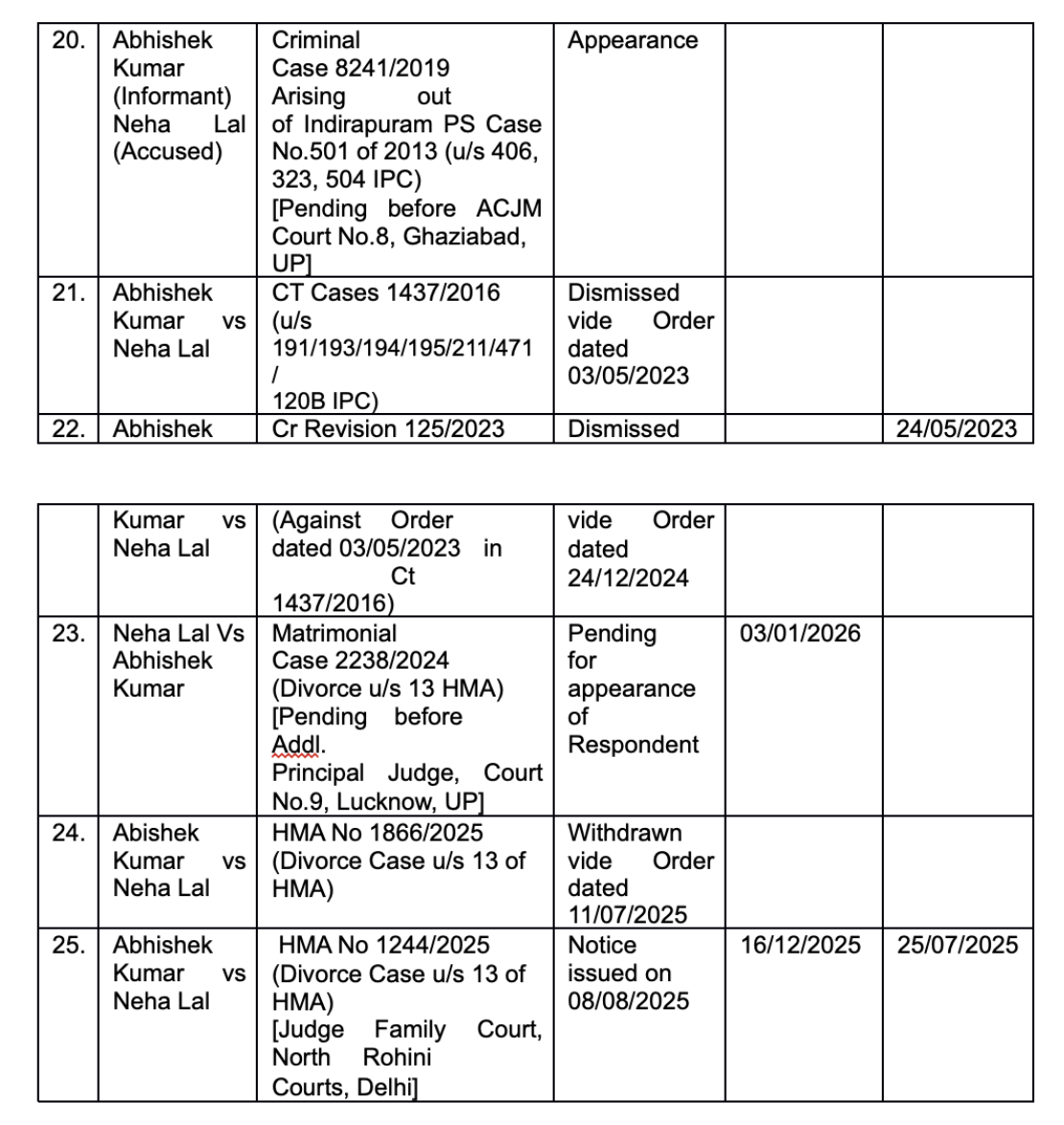
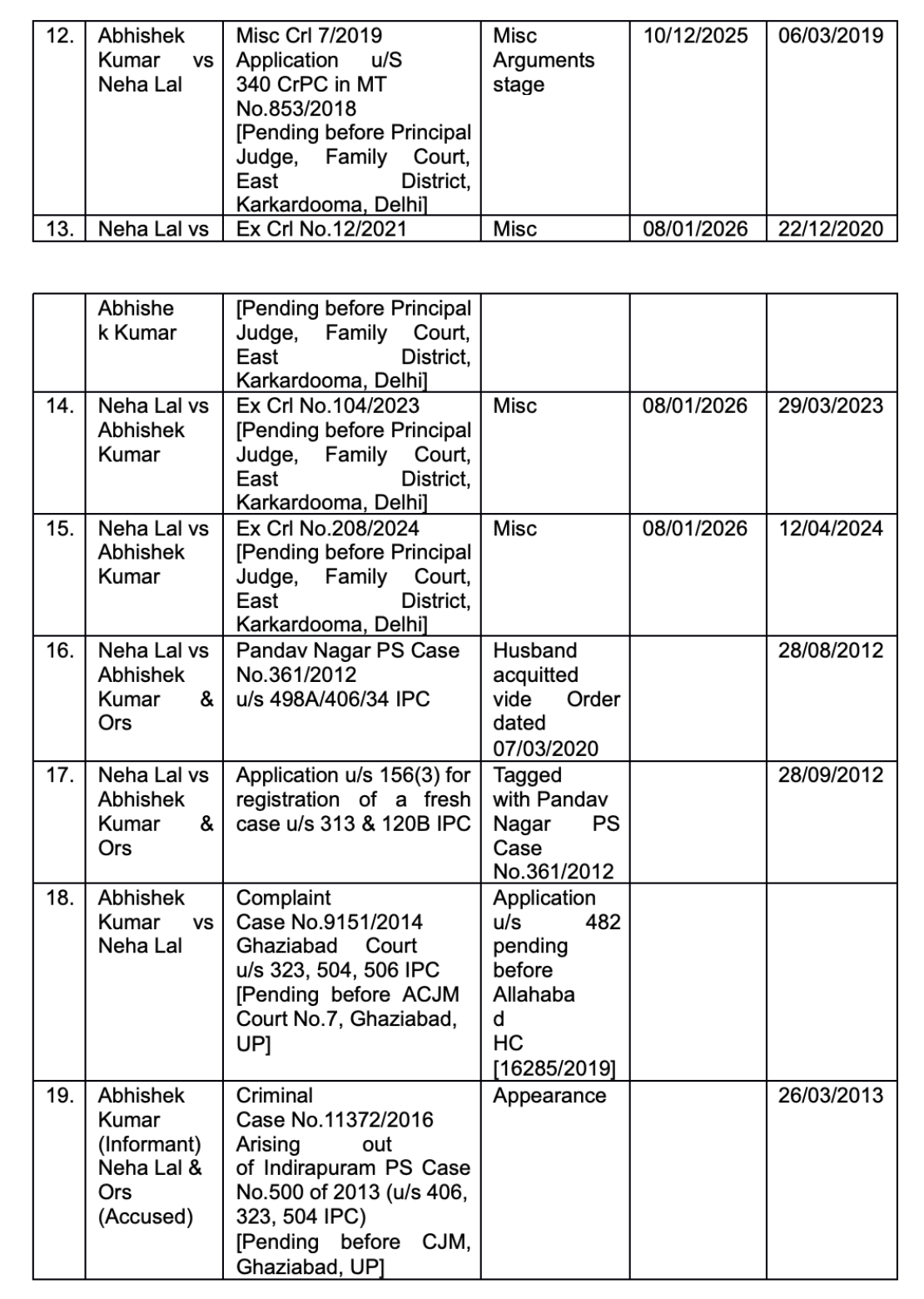
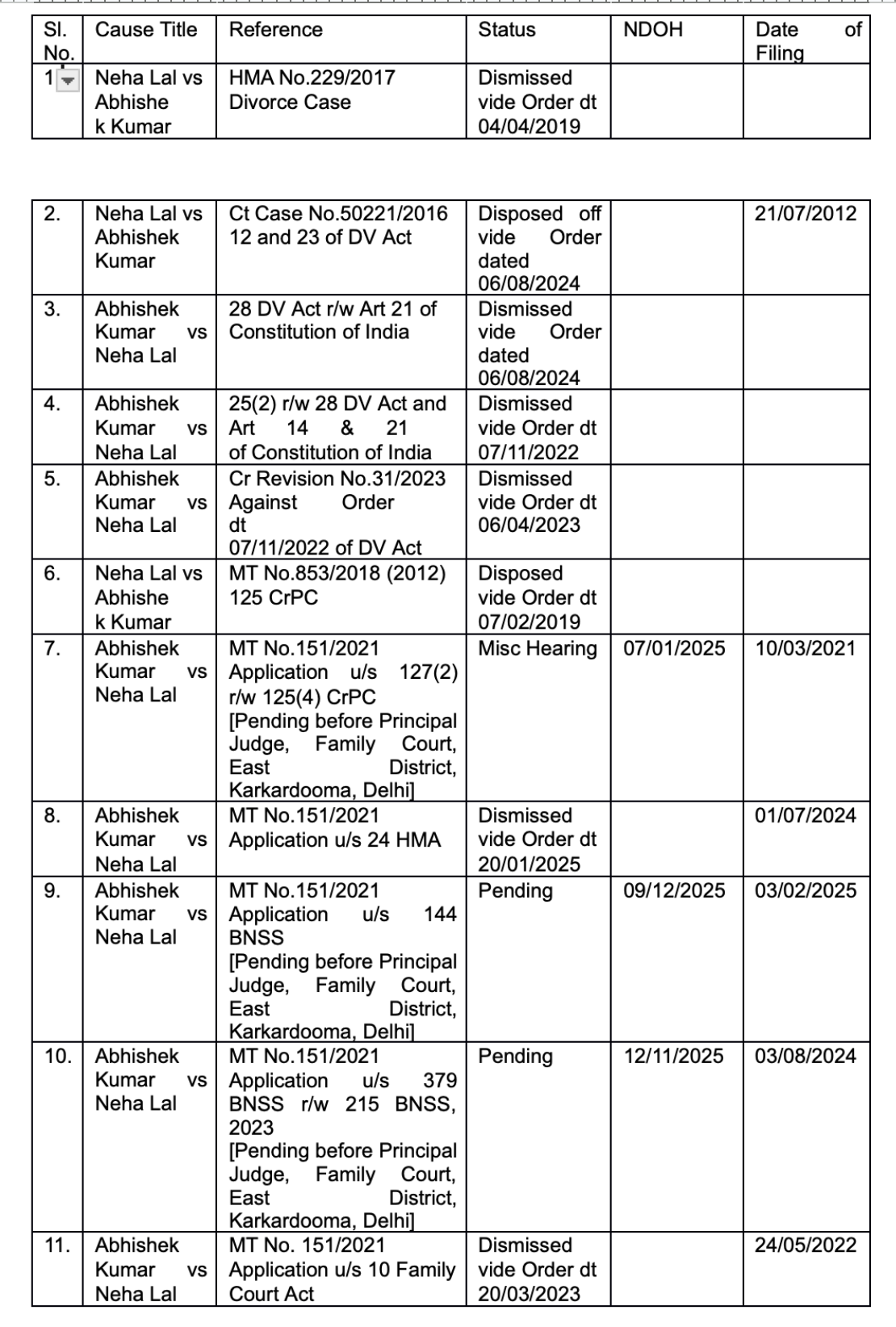
HIGH COURTS
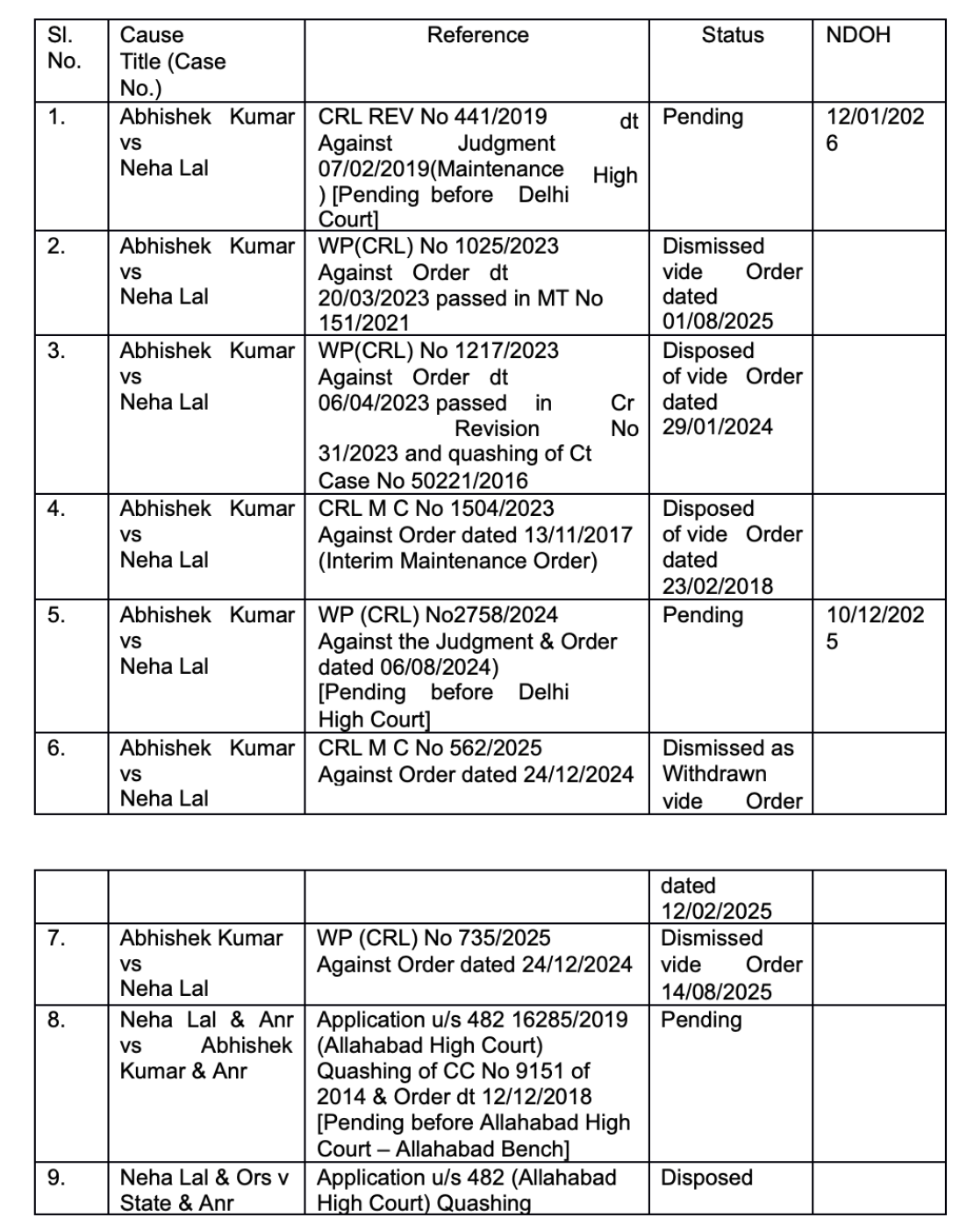
8.1 A list of cases was also filed by the respondent-husband on 24.11.2025, wherein certain new cases, pending as well as disposed of, came to light.
8.2 The details of additional cases which are pending between the parties, as per the list filed by the respondent-husband on 24.11.2025, are extracted below:
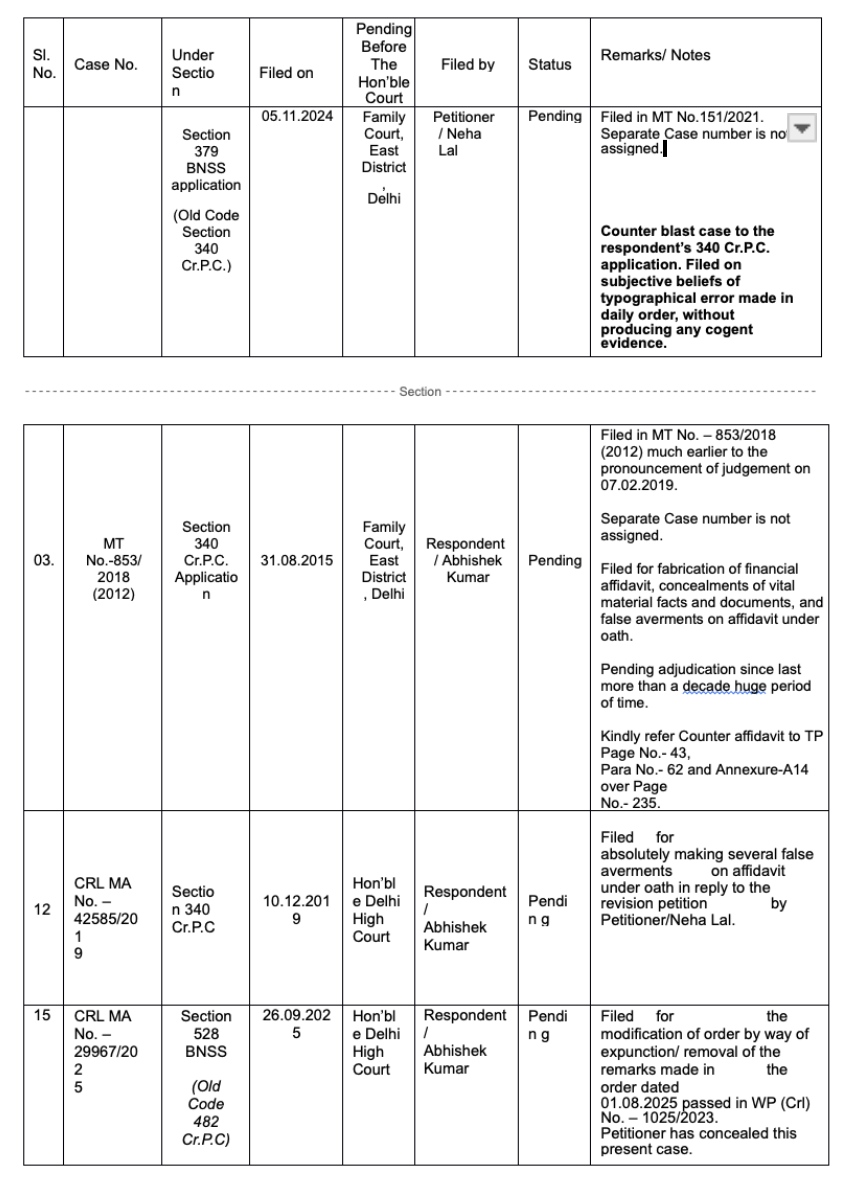
8.3 The details of additional cases which are disposed of between the parties, as per the list filed by the respondent-husband on 24.11.2025, are extracted below:
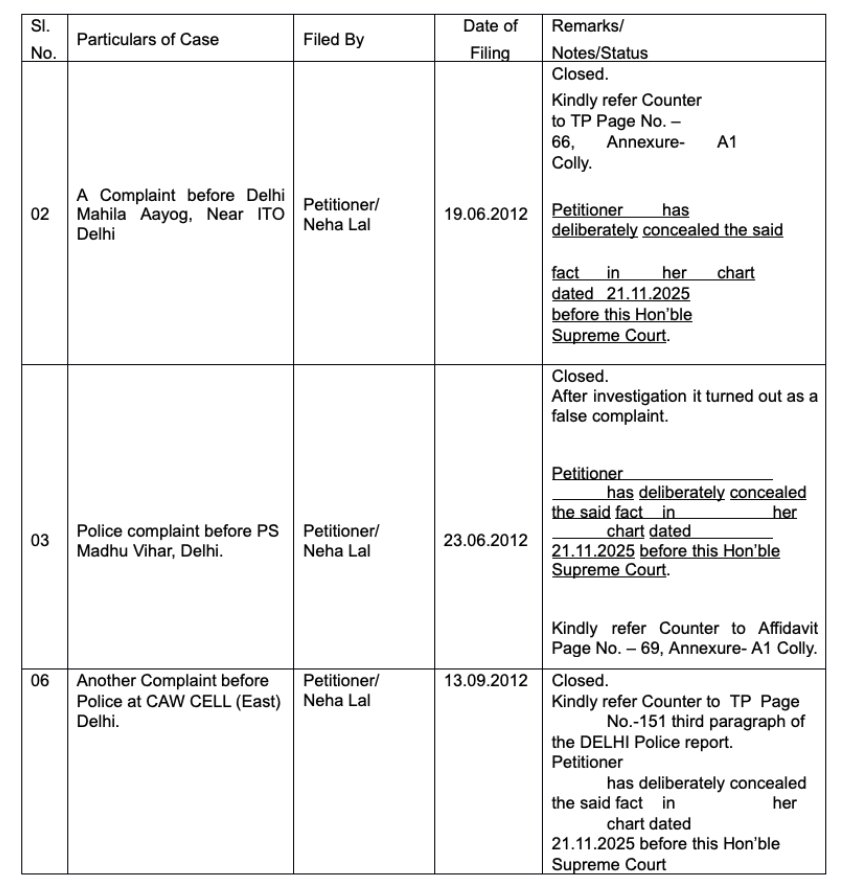
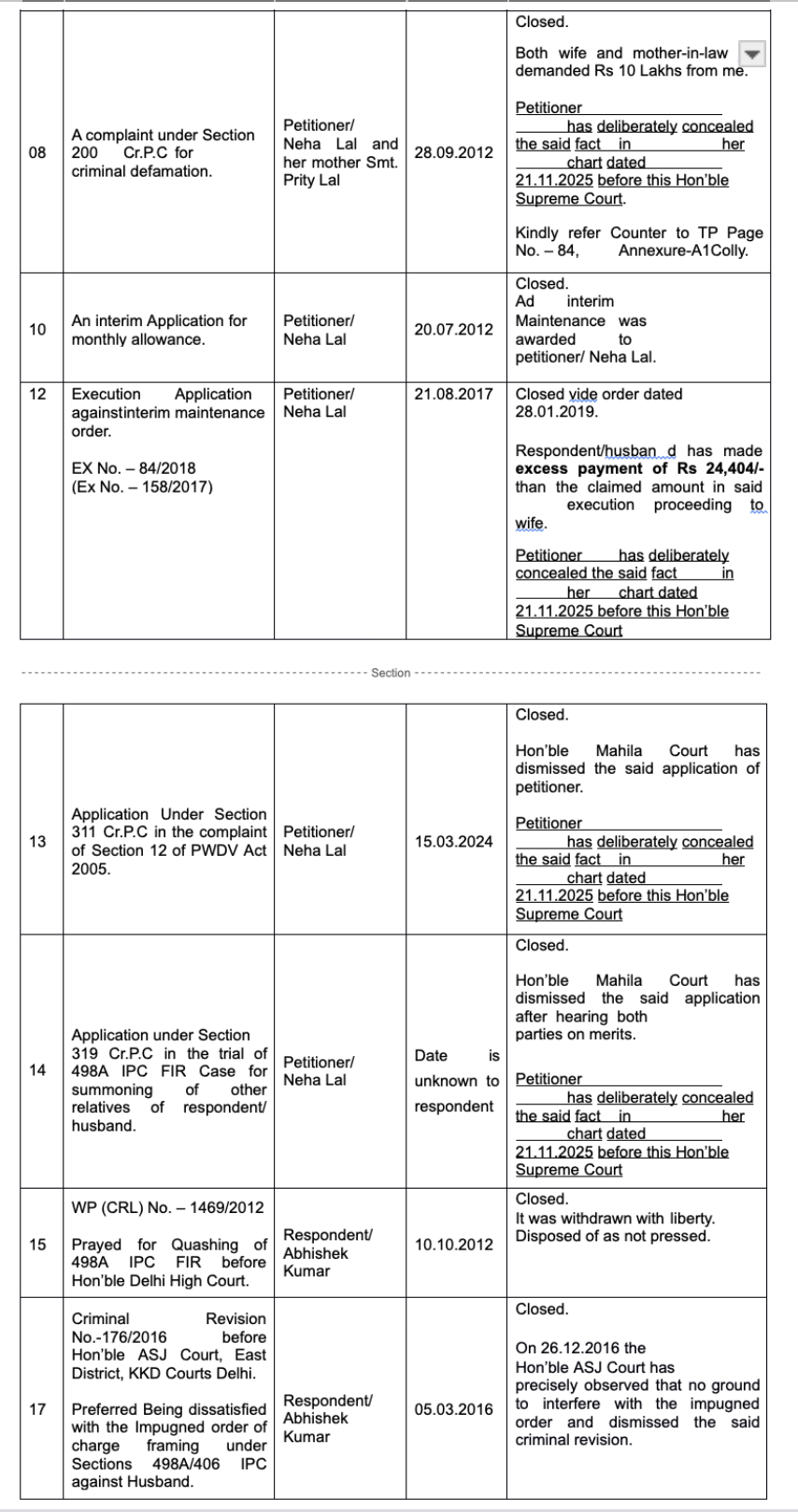
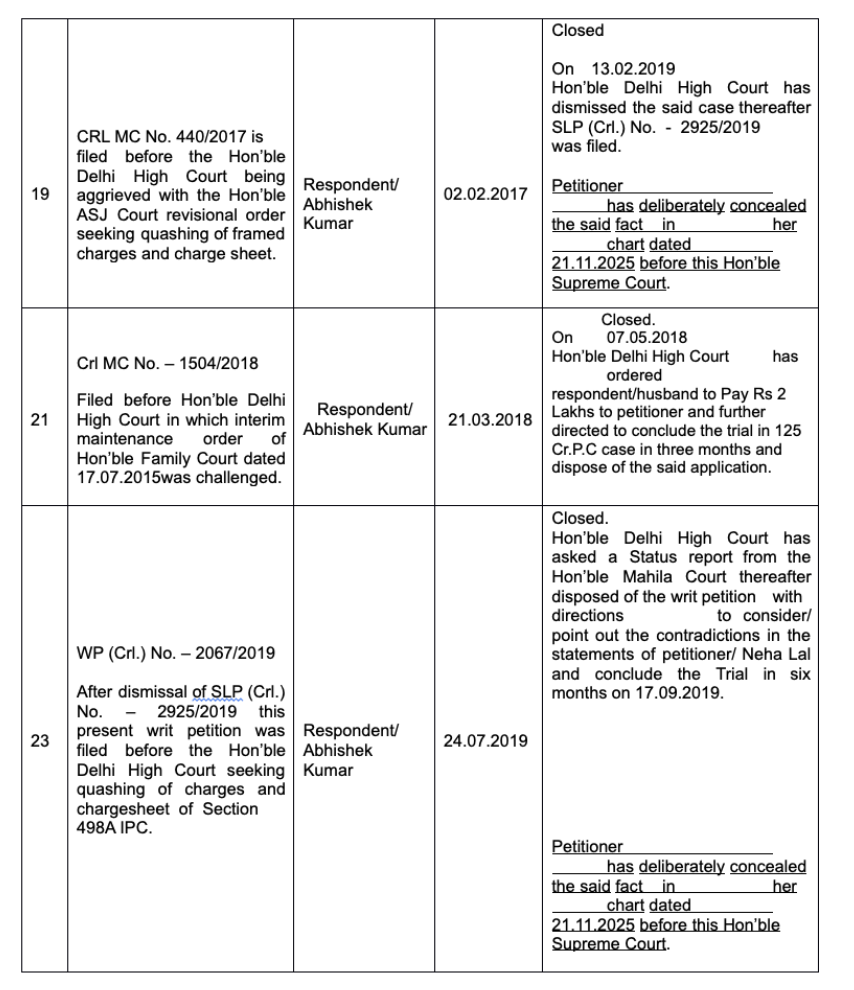
8.4 As the information regarding the number of cases filed, disposed of and other particulars thereof was still not found to be complete, this Court had no choice but to make a request to the Registrars General of the concerned High Courts to verify the information furnished by the parties before this Court, as the order passed by this Court could not be vague or incomplete, and the idea was to deal with all the issues between the parties and for that purpose correct details of the cases were required.
8.5 If the list submitted by the petitioner and the respondent is compared with the information as received from the High Court of Delhi, the following discrepancies were noticed:
(i) Crl. M.A. No.7920 of 2019 in Crl. Rev. P. No.441 of 2019 was not found in the list provided by the parties, however, finds mention in the list received from the High Court of Delhi.
(ii) Crl. M.A. No.42585 of 2019 in W.P. (Crl.) No.1025 of 2023 was not found in the list provided by the petitioner, however, the case is mentioned in the lists received from the respondent as well as the High Court of Delhi.
(iii) W.P. (Crl.) No.2758 of 2024 is found in all the lists given by petitioner, respondent and the High Court of Delhi. The only addition in the list received from the High Court of Delhi is that judgment in the case has been reserved. (iv) Application under Section 379 read with 215 BNSS filed in MT Case No.151 of 2021 was not found in the list provided by the petitioner, however, the case is mentioned in the lists received from the respondent as well as the High Court of Delhi.
(v) The petitioner in the list provided by her, has mentioned MT Case No.151 of 2021 at three places, namely, at serial no.7, 9 and 10. The only difference being that at serial no.10, it is stated to be an application filed under Section 379 read with 215 of BNSS, 2023. In the list provided by the respondent, in MT Case No.151 of 2021, multiple applications were filed which are stated to be pending. In the list received from the High Court of Delhi, multiple applications were filed in MT Case No.151 of 2021, out of which two were disposed of whereas three are pending.
(vi) At serial no.2 in the cases before the Family Courts, Delhi District Courts, in the list as received from the High Court of Delhi, case bearing MT No.609 of 2025 filed under Section 144 of BNSS, 2023 is stated to be pending before Family Court, District East, Karkardooma Courts, Delhi. The same is not mentioned in the list provided by the parties.
(vii) Application under Section 340 of CrPC filed in MT No.853 of 2018 was not found in the list provided by the petitioner, however, the case is mentioned in the lists received from the respondent as well as the High Court of Delhi.
8.6 If the list submitted by the petitioner and the respondent is compared with the information as received from the High Court of Judicature at Allahabad, the following discrepancies were noticed:
(i) In the list provided by the respondent, reference has been made to the case pertaining to FIR No.501 of 2013 only.
(ii) As per the information received from the High Court of Judicature at Allahabad, common chargesheet is stated to have been filed in Crime Case No.50/2013 and FIR No.501/2013 both the aforesaid cases. In addition, Case No.2012 of 2019 has been mentioned where the proceedings by the High Court have been stayed.
8.7 The information which has been received after verification from the Registrars General of both the High Courts shows that the information, as furnished by the parties before this Court, was not complete.
8.8 As per the information received from the High Court of Judicature at Allahabad and the High Court of Delhi, the following cases are found to be pending between the parties before the High Courts, the Family Courts and the District Courts:

9. Besides the aforesaid pending cases, the details, as has been extracted in the previous part of the judgment, show the number of cases which were filed by both the parties against each other which have been dismissed or disposed of.
10. The petitioner-wife has invoked the jurisdiction of this Court to dissolve the marriage between the parties by filing application under Article 142 of the Constitution of India. It is on the grounds of irretrievable breakdown of marriage. Otherwise, under the Hindu Marriage Act, 19552, this is not a ground on which divorce can be sought or granted.
11. In Shilpa Sailesh’s case (supra), one of the questions considered by this Court was whether this Court can grant divorce in exercise of power under Article 142 of the Constitution of India in case of complete and irretrievable breakdown of marriage. The answer to the aforesaid question was in positive. This Court considered that irretrievable breakdown of marriage is not a ground for divorce under the 1955 Act, however, the same does not debar this Court to exercise the power to dissolve a broken and shattered marriage in exercise of its power under Article 142 of the Constitution of India. It is in the interest of the society that the marriages, as far as possible, should be maintained. If there is failure in the efforts for reconciliation and it is found that marriage has been wrecked beyond the scope of salvage, it is in the interest of all concerned to recognize that fact and dissolve the marriage, otherwise the litigation, sufferings by all the parties and the miseries may continue. This Court held that such discretionary power can be exercised to do complete justice. Despite opposition by the parties, this Court can dissolve the marriage if there is no possibility of parties living together. Continuation of formal legal relationships in such circumstances would not be justified.
11.1 The relevant factors to be considered by this Court to form an opinion as to whether the marriage has irretrievably broken down have been enumerated in paragraph ‘63’ of the aforesaid judgment and the same is extracted below:
“63. That the marriage has irretrievably broken down is to be factually determined and firmly established. For this, several factors are to be considered such as the period of time the parties had cohabited after marriage; when the parties had last cohabited; the nature of allegations made by the parties against each other and their family members; the orders passed in the legal proceedings from time to time, cumulative impact on the personal relationship; whether, and how many attempts were made to settle the disputes by intervention of the court or through mediation, and when the last attempt was made, etc. The period of separation should be sufficiently long, and anything above six years or more will be a relevant factor. But these facts have to be evaluated keeping in view the economic and social status of the parties, including their educational qualifications, whether the parties have any children, their age, educational qualification, and whether the other spouse and children are dependent, in which event how and in what manner the party seeking divorce intends to take care and provide for the spouse or the children. Question of custody and welfare of minor children, provision for fair and adequate alimony for the wife, and economic rights of the children and other pending matters, if any, are relevant considerations. We would not like to codify the factors so as to curtail exercise of jurisdiction under Article 142(1) of the Constitution of India, which is situation specific. Some of the factors mentioned can be taken as illustrative, and worthy of consideration.”
(emphasis supplied)
11.2 The specific question framed with regard to exercise of power under Article 142 of the Constitution of India and the answer thereto is extracted below:
“(iii) Whether this Court can grant divorce in exercise of power under Article 142(1) of the Constitution of India when there is complete and irretrievable breakdown of marriage in spite of the other spouses opposing the prayer?
x x x
76. This question is also answered in the affirmative, inter alia, holding that this Court, in exercise of power under Article 142(1) of the Constitution of India, has the discretion to dissolve the marriage on the ground of its irretrievable breakdown. This discretionary power is to be exercised to do “complete justice” to the parties, wherein this Court is satisfied that the facts established show that the marriage has completely failed and there is no possibility that the parties will cohabit together, and continuation of the formal legal relationship is unjustified. The Court, as a court of equity, is required to also balance the circumstances and the background in which the party opposing the dissolution is placed.”
12. Prior to the aforesaid Constitution Bench judgment, in Rakesh Raman vs. Kavita3, this Court observed that multiple court cases between the parties and repeated failure in mediation are testimony of marriage being broken down. Relevant extract from the judgment is as under:
“15. The multiple Court battles between them and the repeated failures in mediation and conciliation is at leasttestimony of this fact that no bond now survive between the couple, it is indeed a marriage which has broken down irretrievably.”
13. There are various other instances where this Court, in exercise of power under Article 142 of the Constitution of India, had dissolved the marriage on account of irretrievable breakdown considering the totality of the facts and circumstances in those cases. This is despite the fact that one of the spouses was not consenting to the same.
(i) In Vikas Kanaujia vs. Sarita4, this Court passed the decree of divorce on the grounds of irretrievable breakdown of marriage even though the wife was not consenting for passing of such decree.
(ii) Prakashchandra Joshi vs. Kuntal Prakashchandra Joshi @ Kuntal Visanji Shah (((2024) 1 SCR 697 : 2024 INSC 55)), is a case in which the wife had chosen not to appear before Court despite service. Still this Court found that case to be fit for passing a decree of divorce while proceeding the wife ex-parte.
(iii) In Vineet Taneja vs. Ritu Johari ((MANU/SCOR/93862/2024 : MA No.2009 of 2023 in SLP (C) No.3667 of 2023)), despite objection by the husband, this Court dissolved the marriage in exercise of power under Article 142(1) of the Constitution of India finding that the facts clearly suggested that to be a fit case of irretrievable breakdown of marriage.
(iv) Rinku Baheti vs. Sandesh Sharda5 is another such case where this Court dissolved the marriage in exercise of power under Article 142 of the Constitution of India. The order was passed in a Transfer Petition filed by the petitioner-wife therein. It was a case of second marriage of both the parties.
(v) In Nayan Bhowmick vs. Aparna Chakraborty6, this Court dissolved the marriage in exercise of power under Article 142 of the Constitution of India finding that the parties therein were living separately for more than two decades and there was no sanctity left in their marriage. Grant of divorce was not to have devastating effect on any third party, as there was no child born from the wedlock. The proceedings arose from a divorce petition filed by the husband.
14. The following observation made by this Court in Achin Gupta vs State of Haryana & Anr7 which are apt for the situation are extracted below:
“32. Many times, the parents including the close relatives of the wife make a mountain out of a mole. Instead of salvaging the situation and making all possible endeavours to save the marriage, their action either due to ignorance or on account of sheer hatred towards the husband and his family members, brings about complete destruction of marriage on trivial issues. The first thing that comes in the mind of the wife, her parents and her relatives is the Police, as if the Police is the panacea of all evil. No sooner the matter reaches up to the Police, then even if there are fair chances of reconciliation between the spouses, they would get destroyed. The foundation of a sound marriage is tolerance, adjustment and respecting one another. Tolerance to each other’s fault to a certain bearable extent has to be inherent in every marriage. Petty quibbles, trifling differences are mundane matters and should not be exaggerated and blown out of proportion to destroy what is said to have been made in the heaven. The Court must appreciate that all quarrels must be weighed from that point of view in determining what constitutes cruelty in each particular case, always keeping in view the physical and mental conditions of the parties, their character and social status. A very technical and hyper sensitive approach would prove to be disastrous for the very institution of the marriage. In matrimonial disputes the main sufferers are the children. The spouses fight with such venom in their heart that they do not think even for a second that if the marriage would come to an end, then what will be the effect on their children. Divorce plays a very dubious role so far as the upbringing of the children is concerned. The only reason why we are saying so is that instead of handling the whole issue delicately, the initiation of criminal proceedings would bring about nothing but hatred for each other. There may be cases of genuine ill-treatment and harassment by the husband and his family members towards the wife. The degree of such ill-treatment or harassment may vary. However, the Police machinery should be resorted to as a measure of last resort and that too in a very genuine case of cruelty and harassment. The Police machinery cannot be utilised for the purpose of holding the husband at ransom so that he could be squeezed by the wife at the instigation of her parents or relatives or friends. In all cases, where wife complains of harassment or ill-treatment, Section 498A of the IPC cannot be applied mechanically. No FIR is complete without Sections 506(2) and 323 of the IPC. Every matrimonial conduct, which may cause annoyance to the other, may not amount to cruelty. Mere trivial irritations, quarrels between spouses, which happen in day-to-day married life, may also not amount to cruelty.”
14.1 In some of the FIRs, the allegations are also made under Sections 377 and 376 IPC against the family members of the parties.
15. If the facts of the case in hand are examined in the light of the law laid down by the Constitution Bench of this Court in Shilpa Sailesh’s case (supra) and the other judgments referred to above, we find that the marriage of the parties was solemnized on 28.01.2012. They have stayed together only for a period of 65 days and ever since then they are into litigation one after another. Once they are residing separately for more than a decade, there is no question of rehabilitation and cohabitation. Efforts were also made for reconciliation but failed. Before this Court too, the matter was referred for mediation vide order dated 22.07.2025 and fixed for report of the Mediator on 14.10.2025. However, on an application (I.A.No.176081 of 2025) filed by the respondent in-person, the date of hearing was preponed as even the learned counsel appearing for the petitioner also submitted that the process of mediation could not take off. As a result, there are no chances for settlement of the dispute.
16. The parties are well qualified. The petitioner, as has been contended by the respondent, is working in the company of her sister and earning handsomely. The respondent is also qualified, however, he has stated that he had resigned from the job of Engineer. The age of the petitioner is about 38 years and the respondent is about 46 years old. As the parties hardly stayed together there is no child born from the wedlock though the respondent claims that petitioner had aborted a child without his consent, however with no convincing proof.
17. Coming again to the litigation between the parties, we may add that the details thereof have been noticed in paragraph 8 as above. Number of cases have been disposed of whereas some are still pending.
18. In the application filed by the petitioner-wife under Article 142 of the Constitution of India, no claim for any alimony has been made by her. She has prayed for quashing of the proceedings in the cases which are stated to be pending in different Courts at Delhi, Allahabad, Page 27 of 34 Ghaziabad and Lucknow. The details of cases, as furnished by the parties, were verified from the Courts concerned and for passing the order, we are referring and relying upon the details provided by the Courts concerned.
19. At the time of arguments, serious objections were raised by the respondent, who appeared in-person, to the prayer made in the application filed by the petitioner. He had submitted that the petitioner has spoiled his life. She had been misrepresenting facts before the Courts with a motive to mislead for which applications have been filed by him under Section 340 of CrPC/379 BNSS. He had further submitted that he does not consent to passing of decree of divorce.
20. From the facts of the case as noticed above, we find this to be a clear case of irretrievable breakdown of marriage where the parties do not intend to live together and cohabitate. Rather they may not be able to reconcile seeing the level of bitterness generated with the passage of time. They may not have been made for each other. Some time is taken by the young couples to understand each other and adjust accordingly. No one can be said to be perfect. Level of tolerance has gone down while level of ego has risen up. May be the differences were so much that the couple could stay together only for 65 days and immediately thereafter litigation started. It may be impossible now to put the clock back and live together after forgetting the bitterness, which has been created in last more than a decade.
21. They have indulged into filing more than 40 cases against each other. Warring couples cannot be allowed to settle their scores by treating Courts as their battlefield and choke the system. If there is no compatibility, there are modes available for early resolution of disputes. Process of mediation is the mode which can be explored at the stage of pre-litigation and even after litigation starts. When the parties start litigating against each other, especially on criminal side, the chances of reunion are remote but should not be ruled out.
22. Practice of law is said to be noble profession. Whenever the parties in matrimonial dispute have differences, the preparation starts as to how to teach lesson to the other side. Evidence is collected and, in some cases, even created, which is more often in the era of artificial intelligence. False allegations are rampant. As any matrimonial dispute has immediate effect on the fabric of the society, it is the duty of all concerned to make earnest effort to resolve the same at the earliest before the parties take strong and rigid stand. There are mediation centres in all districts where pre-litigation mediation is also possible. In fact, it is being explored in number of cases and the success rate is also encouraging. In many cases, the parties, after resolution of their disputes, has also started living together.
23. The problem is more after the birth of a child or children. Many a times, he/she becomes a bone of contention between the warring parties. His/her custody is another battle which starts before Court. In many cases, the orders passed by the Courts are not even complied with.
24. First and the foremost, earnest effort should be made by the parties and to be guided by the advocates, whensoever consulted in the process, is to convince them for a pre-litigation mediation. Rather in some cases, their counselling may be required. Even if a case is filed in a Court on a trivial issue such as maintenance under Section 144 of BNSS, 2023 (earlier Section 125 of CrPC, 1973) or Section 12 of the Protection of Women from Domestic Violence Act, 2005, the first effort required to be made by the Court is to explore mediation instead of calling upon the parties for filing replies as allegations and counter allegations sometimes aggravate the dispute. Even when a complaint is sought to be registered with the police of simple matrimonial dispute, first and the foremost effort has to be for re-conciliation, that too, if possible, through the mediation centers in the Courts, instead of calling the parties to the police stations. This sometimes becomes a point of no return specially when any of the parties is arrested, may it be even for a day.
25. In the changing times, the matrimonial litigation has increased manifolds. Even this Court is flooded with transfer petitions, mainly filed by the wives, seeking transfer of the proceedings initiated by their husbands, may be at the first instance or as a counter blast. In such situations, it is the duty of all concerned including the family members of the parties to make their earnest effort to resolve the disputes before any civil or criminal proceedings are launched.
26. However, from the facts noticed above, we find this to be a case of irretrievable breakdown of marriage, where the parties stayed together only for 65 days, are separated for the last more than a decade and have been indulging into litigation one after another. We find this to be a fit case for exercise of our discretion under Article 142 of the Constitution of India to dissolve the marriage between the parties. As a result, by passing the decree, we dissolve the marriage between the parties. No alimony has been claimed by the petitioner-wife and all her previous claims stand settled.
27. It is directed that the parties shall not indulge in further litigation with reference to their matrimonial dispute.
28. Now coming to the cases pending between the parties. All the cases pending between the parties, as mentioned in paragraph No.8.8, shall stand disposed of without any further action by them. However, the following applications filed by the parties raising plea of perjury shall continue because no one can be permitted to pollute the stream of justice, as emphasized by this Court in Kusha Duruka vs. The State of Odisha8. The cases being:
(i) Crl. M. A. No.42585 of 2019 in W. P. (Crl.) No.1025 of 2023 (under Section 340 CrPC)
(ii) Application under Section 379 read with 215 BNSS filed in MT No.151 of 2021
(iii) Application under Section 379 read with 215 BNSS filed in MT No.151 of 2021
(iv) Misc. Crl. No.7 of 2019 filed in MT No.853 of 2018 (v) Application under Section 340 CrPC in MT No.853 of 2018
29. It is clarified that if besides the cases mentioned in the paragraph 28, any other application(s) filed by the parties either under section 340 CrPC or under Section 379 read with 215 of BNSS, 2023, the same shall be dealt with on merits by the concerned Courts and will not be disposed of, in view of this order passed by this Court.
30. A copy of the order passed by this Court shall be sent to the Courts concerned for taking action as per the direction in this order. However, if there is any other case arising out of matrimonial dispute, though not mentioned in the list, but pending, the same shall also stand disposed of on production of copy of this order by the parties.
31. No further order is required to be passed in the Transfer Petition and the same is disposed of.
32. In view of the fact that the parties stayed together only for a period of 65 days and have indulged in numerous litigations for the last more than a decade apparently with a view to settle scores, in our opinion, both of them deserve to be penalised with costs, which is quantified at ₹10,000/- each, as a token amount. Let the cost be deposited with the Supreme Court Advocates on Record Association.
33. Pending application(s), if any, shall also stand disposed of.