


Pronouncement of Reserved Judgements by High Courts
Pila Pahan @ Peela Pahan v State of Jharkhand
Case Summary
The Supreme Court held that delay in pronouncement of a reasoned judgement causes irreparable loss to the parties. It issued comprehensive guidelines under Article 142, for the pronouncement of reserved judgements, uploading of judgements, monitoring of delayed matters and remedies available to litigants in cases of prolonged delay before High Courts.
...
Case Details
Judgement Date: 29 May 2026
Citations: 2026 INSC 604 | 2026 SCO.LR 6(1)[5]
Bench: Surya Kant CJI, Joymalya Bagchi J
Keyphrases: Delayed pronouncement of reserved judgements—High Courts—Article 21—Article 142—Reserved judgements remained unpronounced for months and years—Reasoned judgements—Three months from date of reserving judgement
Mind Map: View Mind Map
Judgement
SURYA KANT, CJI.
1. The instant proceedings arise from various Writ Petitions which, though individual in origin, sought similar prayers for “pronouncement of reserved judgements” statedly pending for Signature Not Verified indefinite periods of time before certain High Courts. The influx of these cases, coupled with the startling picture presented regarding delays, brought into focus a broader issue affecting the administration of justice in several High Courts across the country.
2. In view of this, the scope of the proceedings was expanded to address a question of wider constitutional significance. The objective was to identify and lay down comprehensive and binding guidelines to remedy the persistent delay in the pronouncement of reserved judgements by High Courts, so as to ensure that the reliefs claimed are not rendered nugatory merely owing to the delayed delivery of the final decision.
A. FACTS
3. We find it appropriate to first recapitulate the sequence of events that led to the filing of these petitions and the subsequent developments that arose during the course of the proceedings before this Court.
3.1.Without getting into the intricate details of the individual cases before us, and treating Writ Petition (Crl.) No. 169/2025 as the lead case for illustrative purposes, suffice it to note that Petitioner Nos. 1, 2 and 3 were convicted by the Trial Courts in Jharkhand under Section 302 of the Indian Penal Code, 1860 (IPC) and other related offences and were sentenced to life imprisonment in 2012 and 2014. Petitioner No. 4, however, was convicted under Sections 376 and 346 of the IPC and sentenced to life imprisonment in 2018. Each of them had already served over a decade in actual custody (which includes the period of incarceration pending trial) when they sought to prefer criminal appeals before the High Court of Jharkhand, where arguments were heard, and judgments were reserved in their appeals, seemingly, between January and June 2022.
3.2. Owing to the undue delay in pronouncing the reserved judgments, the Petitioners have approached this Court by means of the instant petitions, seeking appropriate directions to the High Court to pronounce the same expeditiously.
3.3. This Court, on the first date of hearing, on 23.04.2025, directed the Registrar General of the High Court of Jharkhand to submit a report on all cases in which judgments were reserved more than two months ago and were pending pronouncement, along with Bench-wise details.
3.4. In compliance thereof, the Registrar General submitted a status report, which was taken on record by this Court on 05.05.2025. The report inter alia disclosed that 56 matters, including criminal appeals, had been finally heard by a Division Bench of the High Court on various dates between 04.01.2022 and 16.12.2024, with final pronouncements still awaited in each. Further, 11 matters were reserved by a Single Judge Bench on dates ranging from 25.07.2024 to 27.09.2024. The details of the appeals preferred by the Petitioners, however, were not included in the said report.
3.5. On the same date, we were apprised of an article published in the Indian Express, an English-language daily newspaper, titled “After SC rap, HC decides 75 Criminal Appeals in a week”, indicating that the High Court had pronounced a record 75 criminal appeals within a week.
3.6. Consequently, vide order dated 05.05.2025, we directed the Registrar General of the High Court of Jharkhand to furnish the list of all 75 criminal appeals where the judgements had been pronounced, including details of the date when the said judgements were reserved, as well as the fate of the criminal appeals filed by the Petitioners.
3.7. Enlarging the scope of these proceedings, we further directed High Courts throughout the country to submit reports disclosing cases in which judgments had been reserved on or before 31.01.2025 and remained unpronounced, along with Bench-wise particulars. In the interregnum, this Court learnt of another issue regarding the delay in uploading judgements/orders to the respective High Court websites for matters where the operative part of the said judgement/order had already been pronounced in open court. To understand the scope of this issue, the Registrar Generals of all the High Courts were further directed to submit an additional report, providing complete descriptions of the dates of pronouncement of judgments and the dates on which such judgments were uploaded to the respective High Court websites.
3.8. Thereafter, when the matter was taken up on 13.05.2025, this Court noted that all four Petitioners had been released from custody pursuant to judgments delivered by the High Court of Jharkhand in their respective criminal appeals. However, as indicated earlier, the instant petitions were nevertheless kept pending in view of the larger issue they raised.
3.9. As the extent of the problem relating to the delayed pronouncement of judgments across High Courts became evident, several other matters involving similar grievances and praying for similar reliefs, arising in both criminal and civil proceedings, were tagged with the lead case.
3.10. In this backdrop, we requested Ms. Fauzia Shakil, learned Advocate, to assist this Court in the capacity of Amicus Curiae. Pursuantly, Ms. Fauzia, with the able assistance of Ms. Tasmiya Taleha and Ms. Mallika Agarwal, painstakingly analysed the reports received from various High Courts and pointed out that the information had been submitted in varying formats, thereby making collation difficult. In view thereof, vide order dated22.09.2025, all High Courts were requested to modify the existing format to ensure that uploaded and certified copies of their judgments clearly disclose the date of reservation, the date of pronouncement, and the date of uploading on the website, along with a specification as to whether the operative part alone or the full judgment had been pronounced.
3.11. The learned Amicus thereafter compiled and filed a consolidated report in four volumes, containing a High Court-wise analysis of delayed pronouncements. The learned Amicus was further requested vide order dated 16.02.2026 to consolidate all the suggestions and recommendations received from the High Courts for the issuance of uniform general judicial guidelines.
3.12. Learned Amicus accordingly submitted the draft guidelines, which were directed to be circulated to the Registrars General of all the High Courts for their respective suggestions, and the matter was thereupon reserved for orders.
B. Analysis
4. Having considered the material on record, along with the suggestions received from several High Courts in response to the draft guidelines circulated by the learned Amicus, we are of the view that this is a fit case warranting the intervention of this Court to formulate uniform guidelines to address delays in pronouncing reserved judgements across all High Courts in the country.
5. At the outset, we record our appreciation for the assistance rendered by Ms. Fauzia Shakil, learned Amicus Curiae. She, together with her team, was entrusted with the arduous task of collating, verifying, and analysing data received from various High Courts, as well as proposing guidelines for uniform application. Their diligence and thoughtful contributions proved invaluable to the effective conduct of these proceedings.
6. The exercise undertaken by learned Amicus culminated in a set of recommendations intended to address the concerns specified in the earlier paragraphs. They are reproduced as follows:
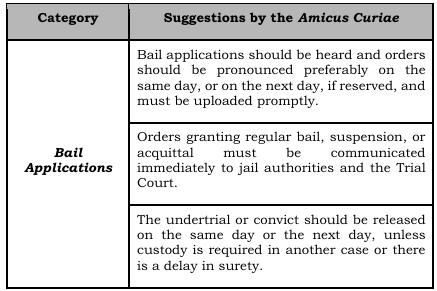
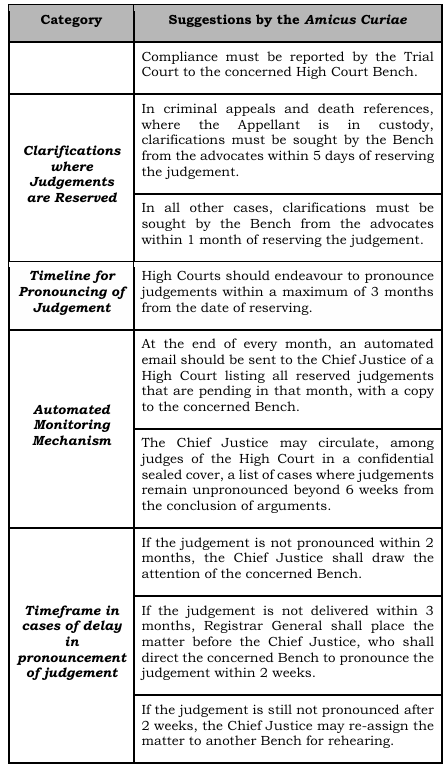
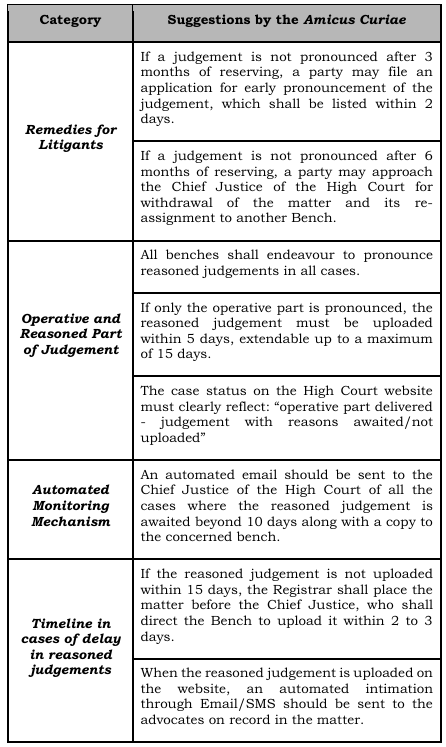
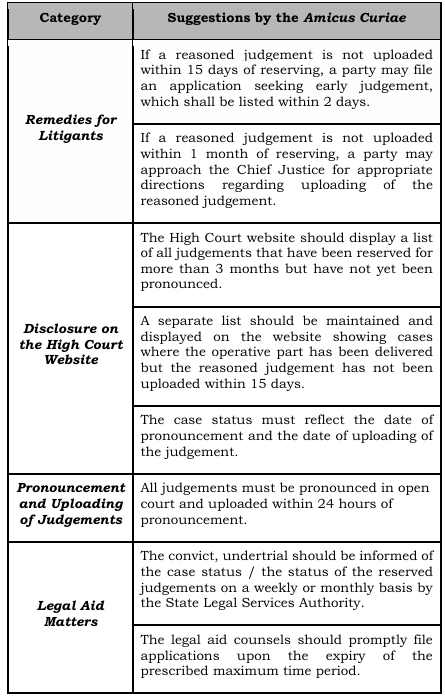
7. We find that the above suggestions made by learned Amicus have been fashioned on the sheet anchor of the data and responses received from the High Courts themselves. These recommendations are, in our assessment, both precise and practicable.
8. Crucially, Volume I submitted by learned Amicus during the course of proceedings, offers a comprehensive account of the pendency of reserved judgments across High Courts. The pan-India scenario is deeply disquieting. Reserved judgments have remained unpronounced for months, and in some instances, for years. The report makes it clear that the problem is pervasive and brooks no further delay in its redress.
9. It goes without saying that we cannot turn a Nelson’s Eye to the human dimension of this problem, and it must be noted that each delayed judgement in that compilation represents a litigant whose case has been heard but whose fate hangs in the balance. The right to life and personal liberty guaranteed under Article 21 of the Constitution is not confined to the expeditious conduct of a trial. It extends to every stage of the proceeding and is as much violated by such delay in pronouncing a reserved judgement as by a denial of the right to be heard.
10. The weight of this delay falls with particular severity on those held in custody, for whom each day without a pronouncement is a day of continued confinement. A convict whose appeal has been reserved, or an accused who has sought bail and is awaiting the court’s decision, cannot be expected to accept the court’s silence with equanimity.
11. The interval between the hearing and the pronouncement also affects the quality of the adjudication, as a judgment bears the imprint of the arguments that preceded it, and it reflects them most faithfully when it follows them closely. Beyond this, there is a broader dimension. Courts are institutions of trust, and the regularity with which they speak after reserving judgement is part of what sustains that trust. Such regularity in pronouncement is neither a procedural nicety nor a matter of administrative convenience. It is the condition on which citizens’ confidence in the justice delivery system rests.
12. Being well-aware of these considerations, this Court has, time and again, impressed upon the High Courts the importance of pronouncing reserved judgements within a reasonable time. In Anil Rai v. State of Bihar,1 a 2-Judge Bench of this Court noted that though, for High Courts, no period for pronouncement of judgement is contemplated under the Civil Procedure Code, 1908 or the Code of Criminal Procedure, 1973, it must be done without delay and accordingly, issued the following guidelines:
“10. Under the prevalent circumstances in some of the High Courts, I feel it appropriate to provide some guidelines regarding the pronouncement of judgements which, I am sure, shall be followed by all concerned, being the mandate of this Court. Such guidelines, as for the present, are as under:
(i) The Chief Justices of the High Courts may issue appropriate directions to the Registry that in a case where the judgement is reserved and is pronounced later, a column be added in the judgement where, on the first page, after the cause-title, date of reserving the judgement and date of pronouncing it be separately mentioned by the Court Officer concerned.
(ii) That Chief Justices of the High Courts, on their administrative side, should direct the Court Officers/Readers of the various Benches in the High Courts to furnish every month the list of cases in the matters where the judgements reserved are not pronounced within the period of that month.
(iii) On noticing that after conclusion of the arguments the judgement is not pronounced within a period of two months, the Chief Justice concerned shall draw the attention of the Bench concerned to the pending matter. The Chief Justice may also see the desirability of circulating the statement of such cases in which the judgements have not been pronounced within a period of six weeks from the date of conclusion of the arguments amongst the Judges of the High Court for their information. Such communication be conveyed as confidential and in a sealed cover.
(iv) Where a judgement is not pronounced within three months, from the date of reserving it, any of the parties in the case is permitted to file an application in the High Court with a prayer for early judgement. Such application, as and when filed, shall be listed before the Bench concerned within two days excluding the intervening holidays.
(v) If the judgement, for any reason, is not pronounced within a period of six months, any of the parties of the said lis shall be entitled to move an application before the Chief Justice of the High Court with a prayer to withdraw the said case and to make it over to any other Bench for fresh arguments. It is open to the Chief Justice to grant the said prayer or to pass any other order as he deems fit in the circumstances.”
[Emphasis Supplied] [Sic]
13. The matter did not rest there. For instance, in Ratilal Jhaverbhai Parmar v. State of Gujarat,2 this Court supplemented the guidelines issued in Anil Rai (supra) to the following extent:
“19. Such categories of cases demand the high courts to lay down the law in clear terms for comprehension of all concerned. Obviously, this process is time consuming and the time limit for delivering judgements by the high courts as laid down in Anil Rai v. State of Bihar6, at times, is breached. We have full trust and confidence in the learned Judges of the high courts since they are well-equipped to tackle any kind of pressure situation. However, while it would be prudent to leave it to the learned Judges to pick any one of the three options [(i) dictation of the judgement in open court, (ii) reserving the judgement and pronouncing it on a future day, or (iii) pronouncing the operative part and the outcome, i.e., “dismissed” or “allowed” or “disposed of”, while simultaneously expressing that reasons would follow in a detailed final judgement supporting such outcome], it would be in the interest of justice if any learned Judge, who prefers the third option (supra), makes the reasons available in the public domain, preferably within 2 (two) days thereof but, in any case, not beyond 5 (five) days to eliminate any kind of suspicion in the mind of the party losing the legal battle. If the pressure of work is such that in the assessment of the learned Judge the reasons in support of the final judgement cannot be made available, without fail, in 5 (five) days, it would be a better option to reserve the judgement. Also, if the ultimate order would have the effect of changing the status of the parties or the subject matter of the lis, it would always be advisable to stick to the course envisaged in Order XX…”
[Emphasis Supplied] [Sic]
14. This Court in fact, while reiterating the guidelines laid down in Anil Rai (supra), has, from time-to-time, issued further directions in the same tenor, calling upon the Chief Justices of the High Courts to exercise closer administrative oversight of pending reserved matters.3
15. It is appropriate to mention here that this Court has been issuing directions governing the outer limits for pronouncement of judgments by the High Courts, owing to the statutory lacuna in this regard, a situation not faced by the Trial Courts.4 We therefore deem it necessary to revisit and restate these directions in more comprehensive and definitive terms.
16. To that end, and in exercise of the jurisdiction vested in this Court under Article 142 of the Constitution, we hereby issue the following comprehensive guidelines, which shall hereafter operate as binding directions upon all High Courts across the country:
A. Procedural Timelines re Pronouncement of Judgements/Orders
I. Timelines
a. In a matter where the judgement is reserved, the High Court shall endeavour to pronounce a reasoned judgement promptly, within a maximum period of 3 months from the date of reserving such judgement.
b. The High Courts shall display extra promptitude in pronouncing judgements and orders in matters of personal liberty, e.g. regular bail, anticipatory bail, criminal appeals (where the convict is in custody), death references, etc.
c. As soon as the bail application is heard, the order should preferably be pronounced and uploaded on the same day. In the event the order is reserved, it is expected to be pronounced on the next day and uploaded to the website.
d. Orders granting regular bail, suspending sentence, or acquitting a convict in custody should be communicated to the jail authorities and the Trial Court on the date it is pronounced.
e. Consequent upon the outcome of serial number (d) above, the undertrial/convict must be released on the same day or, at most, on the next day, unless they are required to be taken in custody in another case, or there is a delay in complying with the bail conditions, etc.
f. The compliance with the order must be reported by the Trial Court to the Bench of the High Court that passed the order.
g. In the event the judgment in a criminal appeal/death reference is reserved, and the appellant is in custody, the clarifications, if any, required by the Bench from the advocates be sought within 7 days of the date of reserving the judgment.
h. In all other matters, the clarifications, if any, should be sought not beyond 1 month of the date of reserving the judgment.
i. Where, after hearing the parties, the Bench is of the opinion that any delay in pronouncement of a reasoned judgement will cause irreparable loss to the parties and urgent orders are required, the operative part may be pronounced in Court, and the reasoned judgement be uploaded within 7 days or a maximum of 15 days, if practical difficulties are faced by the High Court. Such cases may include habeas corpus matters, criminal appeals resulting in the acquittal of a convict in custody, matters relating to demolition/eviction, matters relating to admission to educational institutions, or other urgent cases.
j. A reasoned judgement pronounced in open court should be uploaded on the High Court website within 24 hours.
II. Accountability
a. The Chief Justices of the High Courts, on the administrative side, are requested to make necessary changes to the High Court website, where at the end of every month, an automated email is sent to the Chief Justice of the High Court, specifying all the reserved judgements pending in that month, along with a copy of the email to the Bench that has reserved the judgement.
b. The Chief Justice of the High Court may also circulate the statement of the cases, in which the judgments have not been pronounced within 2 months from the date of reserving such judgment, amongst the Judges of the High Court for their information. The communication shall be conveyed as confidential and in a sealed cover.
c. In the event the reserved judgment is not delivered within 3 months, the Registrar General shall place the matters before the Chief Justice for orders, and the Chief Justice shall bring it to the notice of the concerned Bench for pronouncing the judgment within 2 weeks thereafter.
d. In the event the reserved judgment is still not delivered within the extended period of 2 weeks, the Chief Justice should assign the case to another Bench with a notification to the advocates and the parties. The new Bench to which the matter is assigned shall obviously rehear the case and pronounce the judgment promptly.
e. Where the operative part of the judgement has been pronounced in open court, and the reasoned judgement is not uploaded within 15 days, the Registrar General shall place the matters before the Chief Justice for orders, and the Chief Justice shall bring it to the notice of the concerned Bench for uploading the reasoned judgement within the next 3 days.
III. Remedies
a. In case the judgment is not pronounced upon the expiry of 3 months from the date of reserving, any party to the lis shall be entitled to file an application in the High Court with a prayer for early judgment.
(ai) Such an application shall be listed before the concerned Bench within two days, excluding the intervening holidays.
(aii) The Registry shall inform the Chief Justice of the High Court of all such applications filed.
(aiii) If the judgment, for any reason, is not pronounced within a period of 3 and a half months from the date of reserving, any party to the lis shall be entitled to move an application before the Chief Justice of the High Court with a prayer to withdraw the said case and make it over to any other Bench for fresh hearing.
b. In case the reasoned judgement is not uploaded upon the expiry of 15 days from the date of pronouncement of the operative part, any party to the lis is permitted to file an application in the High Court with a prayer for early
(bi) Such an application shall be listed before the concerned Bench within two days, excluding the intervening holidays.
(bii) The Registry shall inform the Chief Justice of the High Court of all such applications filed.
(biii) If the reasoned judgement, for any reason, is not uploaded within 1 month from the date of pronouncement of the operative part, any party to the lis shall be entitled to move an application before the Chief Justice of the High Court with a prayer to withdraw the said case and make it over to any other Bench for fresh hearing.
B. Measures to Increase Transparency
I. Format of Judgements/Orders
a. The certified copy of the judgment should mention the date of reserving the judgment, the date of pronouncing the judgment, and the date of uploading the judgment.
b. Where the operative part of the judgement has already been delivered, the date of pronouncing the operative part shall be the date of pronouncement, and the date on which the reasoned judgement is uploaded will be the date of uploading.
II. Updates to the High Court Website
a. After the conclusion of final hearing, the date of reserving judgement must be reflected against the case status on the High Court website.
b. If only the operative part of the judgment is delivered, the case status on the High Court website must reflect accordingly.
c. When the reasoned judgement is uploaded on the website, an automated intimation through email/SMS be sent to the advocates representing the parties.
17. The Registrars General of the High Courts are directed to place these guidelines before the Chief Justices of their respective High Courts so that appropriate steps are taken to incorporate necessary amendments into the High Court Rules and their official websites.
18. It would be apposite at this stage to place the directions issued hereinabove in their proper context, bearing in mind the exceptional responsibilities entrusted to the High Courts under the Constitution of India. As Constitutional Courts and guardians of fundamental as well as legal rights, the High Courts occupy a position of singular importance within our constitutional architecture.
19. For a vast majority of citizens, they constitute the first and most immediate forum for the vindication of rights and the redressal of grievances. It is to the High Court that a citizen turns when personal liberty is imperilled, when executive action is alleged to have transgressed constitutional limitations, or when the exercise of public power calls for judicial scrutiny. In innumerable instances, the controversies brought before the High Courts are not limited to the interests of an individual litigant, but concern questions carrying consequences for entire communities, and at times, for society at large.
20. The volume, breadth, and diversity of matters that come before the High Courts are themselves a measure of the mammothian obligations they shoulder. Their jurisdiction, particularly under Articles 226 and 227 of the Constitution, is of remarkably wide amplitude and without close parallels in the contemporary world. Bail applications, habeas corpus applications, and criminal appeals where questions of personal liberty remain at stake; disputes concerning livelihood and property; family matters; commercial causes; and a broad spectrum of constitutional and public law challenges, together, form part of their daily docket. In a nation of India’s size and demographic heterogeneity, it is perhaps inevitable that the High Courts serve as the principal judicial fora to which citizens flock in large numbers, across regions and social circumstances, seeking protection of the law.
21. The Judges of the High Courts bear these obligations day after day, under conditions that few judicial institutions elsewhere may be called upon to endure, often carrying rosters that extend far beyond a hundred matters a day. Such circumstances have created an environment in which Judges are required not only to adjudicate competing claims in accordance with the law, but also to constantly weigh urgency against volume so that no case remains unattended for want of judicial time. We have frequently been informed of instances where Judges sit well past their usual court timings to hear pending cases and thereafter, retire to their offices to fulfil their remaining judicial duties. Their daily tasks, thus, extend far beyond solely interpreting legal principles and involve a continuous and unrelenting race against time to ensure that rights, entitlements, and legitimate expectations brought before them are not rendered illusory by the mere passage of time.
22. We therefore have no hesitation in observing that, notwithstanding severe institutional pressures and ever-growing caseloads, the High Courts have, over decades, discharged their constitutional obligations with dedication, resilience, and distinction. Their continued functioning under such circumstances stands as a testament to the institutional strength, sense of duty, and enduring commitment that have long characterized this nation’s judiciary. It is precisely because we recognise these burdens and seek to facilitate the effective discharge of constitutional responsibilities that implementing measures, such as those elaborated in Paragraph 16, become necessary.
C. CONCLUSION
23. Having regard to the foregoing discussion, the directions set out herein are intended to ensure that proceedings before the High Courts culminate in the pronouncement of judgements within a defined and reasonable timeframe. These measures are issued in the confidence that a structured framework will assist the High Courts in the consistent discharge of their constitutional responsibilities, while preserving the quality and deliberative character of judicial decision-making. We have every reason to believe that the High Courts will give effect to these directions fully and faithfully.
24. At this juncture, we clarify that the observations and directions issued hereinabove shall neither be construed nor interpreted as adverse remarks against the functioning or conduct of any learned Judge of the High Court of Jharkhand or of any other High Court. The aforesaid general directions are not intended to cast any aspersion upon, nor do they bear any nexus with, any individual learned Judge of a High Court.
25. In view thereof, the instant Writ Petitions are disposed of in terms of the directions issued in Paragraph 16.
26. Pending applications, if any, also stand disposed of in the above terms.
- (2001) 7 SCC 318 [↩]
- 2024 SCC OnLine SC 2985 [↩]
- Ravindra Pratap Shahi v. State of U.P., 2025 SCC OnLine SC 1813; Rajan v. The State of Haryana, Criminal Appeal No. 3904/2025 [↩]
- Section 353(1), Code of Criminal Procedure, 1973; Section 392, Bharatiya Nagarik Suraksha Sanhita, 2023; Order XX Rule 1, Code of Civil Procedure, 1908 [↩]