


Analysis
Crocs-Bata: Supreme Court misses opportunity to clarify a key question of design and trademark law
In treating ‘trade dress’ and ‘trademark’ as distinct concepts, two benches of the Delhi High Court may have overlooked a doctrinal point
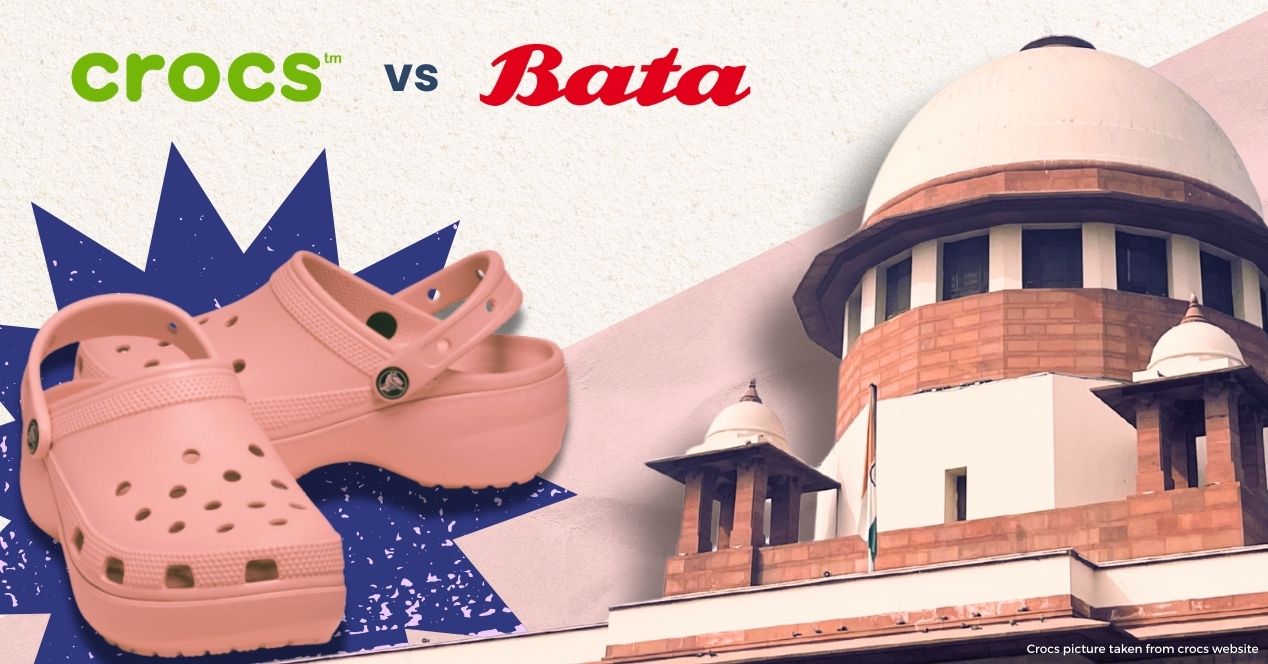
It is not often that intellectual property (IP) disputes make it to the Supreme Court. Several aspects of Indian IP law remain unsettled with High Courts adopting different philosophies. Litigants often surrender without moving the Supreme Court to clarify the law. However, a recent IP issue regarding the interface between trademark law and design law made it to the Court, giving the top court the opportunity to decide and clarify a substantial question of law.
Crocs Inc. USA, the registered proprietor of a design for the shape of its footwear (clog-like silhouette with ventilation holes), sued Bata and other manufacturers for using the same product design. Crocs sued for both design infringement and trademark passing off. The passing off claim was made on the grounds that the shape of the shoe had become a trademark i.e. a source-identifier through use in the market.
The issue was whether the holder of a valid design registration can sue for both design infringement and passing off. This point is a contentious one because both intellectual property rights regimes—designs and trademarks—provide distinct rights and remedies.
Choosing the right regime is crucial, as it can make or break the case. As per the Designs Act, 2000, once a design starts functioning as a trademark, the design registration can be cancelled. In essence, a plea of passing off for a registered design can sound the death knell of a design infringement action. Unsurprisingly, this has triggered significant litigation, with parties battling over which regime they can invoke and the benefits each one unlocks.
The design-trademark interface
Design law protects the aesthetics or ornamental aspects of a product—shapes, patterns, surface decorations. It protects how something looks and not who made it. Hole patterns and curved silhouettes of a shoe; patterns etched on mirror frames; shapes of bottles—all of these may be registered as designs. Designs are protected by registration under the Designs Act, 2000, for a term of 15 years. They are enforced by instituting design infringement suits.
Trademark law protects something that identifies the source of a product, i.e. the maker of the product. It protects names, symbols and even shapes and product designs that consumers associate with a source. For example, names like Coca Cola, or Nike’s swoosh symbol are conventional trademarks. But trademarks can also take unconventional forms like shapes and product packaging. The shape of the Zippo lighter and the packaging of Ferrero Rocher chocolates are examples. Registered trademarks are enforced by instituting trademark infringement suits and unregistered trademarks are enforced through ‘passing off’ actions.
These laws intersect when it comes to protecting shapes of products (since they may be protected under both regimes). However, for a design to remain valid, the design must continue to fit the definition of a ‘design’, which explicitly excludes trademarks. The treatment of shapes that are not registered as trademarks but may be functioning as source-identifiers in the market have especially confused courts.
How the confusion arose
In 2013, in Mohan Lal v Sona Paint & Hardwares, a three-judge Bench of the Delhi High Court held that both a passing off action and design infringement action could be initiated for the subject matter. However, the court found that different suits would have to be initiated. The court viewed the two remedies as inconsistent, and therefore incapable of being joined in a composite suit. This Bench also held that once a design is registered, nothing in the law restricts its use as a trademark.
Then, in 2018, a five-judge Bench of the Delhi Court came to a different conclusion in the Carlsberg case. It held that a composite suit could lie since there was no statutory bar, and the Civil Procedure Code expressly permits joining causes of action. The Bench also held that a registered design, if used as a trademark, could be cancelled under the Designs Act, 2000 (due to the express exclusion in the definition of design).
After these two cases, the answer to the question of whether a passing off action can be initiated for the same subject matter covered by a design registration was a clear yes. Despite this clarification, confusion persisted over the scope of the passing off action. This was because of how Carlsberg interpreted Mohan Lal.
“…The larger legal formulation in Mohan Lal (supra), that a passing off action i.e. one which is not limited or restricted to trademark use alone, but the overall get up or “trade dress” however, is correct; as long as the elements of the design [are] not used as a trademark, but a larger trade dress, get up, presentation of the product through its packaging and so on, given that a ‘passing off’ claim can include but it also broader than infringement of a trademark, the cause of action against such use lies.” (para 43, emphasis mine)
Confusion continues with Crocs
In Crocs, a Single Judge of the Delhi High Court read this passage to mean that a passing off action must relate to something more than the design alone. The design should not be used as a trademark (i.e., as a source-identifier). On this view, a passing off suit for the same subject matter as the design registration would not be maintainable because the claim would really be to the design alone. Thus, the bar for maintainability of a passing off suit was set quite high. The plaintiff would have to show use of not just the same shape of the shoe but also similar colours, similar boxes, advertisements, and so on.
The Single Judge applied the doctrine of election to disregard the argument that the shoe’s shape itself had become a trademark (on the basis of which a passing off action would ordinarily lie). According to the Single Judge, the Designs Act, 2000 was a complete code for shapes. Since the plaintiff had elected to be governed by this law through its design registration, they had abandoned or waived trademark rights to the shape.
A Division Bench of the Delhi High Court reversed this decision on appeal. It held that Mohan Lal and Carlsberg did not require “something more” and a passing off suit was maintainable for the same subject matter. The crucial distinction was between “mere trademark use” and “use as a trade dress” of the registered design. According to the Division Bench, “trademark use” of a registered design would not constitute passing off. But if the registered design was used as a “trade dress”, a claim for passing off could sustain. Since the shoe’s shape was part of its trade dress, a passing off action was held to be sustainable.
Both courts had different views on what constitutes a trade dress for the purpose of the design-trademark overlap. While the Single Judge adopted a higher standard of taking into account the wider look and feel of the product (“other/extra features and goodwill”), the Division Bench lowered the standard to confine it to the product’s shape (“something more” is not necessary, it said).
Missed opportunity to clarify and correct the law
Bata and the other defendants filed an SLP before the Supreme Court seeking clarity on a limited point of law: the scope of a maintainable passing off action. All the verdicts discussed above were on this limited point of maintainability and did not go into substantive matters as a full trial is yet to take place.
On 14 November 2025, a Bench of Justices P.V. Sanjay Kumar and Alok Aradhe of the Supreme Court dismissed the petition stating that “the Delhi High Court had merely restored the suits for consideration by trial court” and therefore there was no occasion to intervene. By doing so, the Supreme Court missed an important opportunity to correct and clarify the law. The Single Judge and the Division Bench interpreted Carlsberg in different ways, and both decisions contain errors on the design–trademark interface.
Both Benches incorrectly held that passing off actions would not lie for designs that are used as trademarks. They required the design to be used as a trade dress. Doctrinally, this distinction does not fit well with established trademark law. Several courts have held trade dresses to be equal to trademarks. For example, the Ferrero Rocher chocolate’s distinctive trade dress—its packaging, colour and shape—has been protected as a trademark. The Zippo lighter’s distinctive shape has also secured trademark protection. Trade dresses can be trademarks for the purpose of passing off. Both courts were thrown off due to Carlsberg and the Supreme Court should have clarified the position once and for all.
Further, there was no need for this digression. There is no bar that prevents the initiation a passing off action for subject matter covered by a design registration. The statutory definition of ‘design’ excludes a trademark (both registered and unregistered). Once a design begins functioning as a trademark (whether a name, symbol, shape, or product configuration), it transforms into a trademark.
At that point, a passing off action is maintainable, and the design registration may fall. As has been discussed in the past, the law permits passing off actions even when the subject matter overlaps with a registered design. The Supreme Court should have clarified the five-judge Carlsberg decision and settled the doctrinal position.
The author is an intellectual property lawyer based in Bengaluru. She can be reached at aparajita@lathlaw.com.
Related articles

Analysis
Personality rights: The law must not overprotect fame
A look at the spate of image-related cases filed by stars—through the prism of the rights to publicity, expression, privacy and livelihood

Analysis
Lifting the veil
A habeas plea concerning five missing Rohingyas has led to concerns on the safeguards owed to non-citizens.
Analysis
Belated scrutiny
As the Supreme Court scrutinises the Special Intensive Revision, the question is whether justice delayed can still protect the franchise
Analysis
The CJI Surya Kant era begins
CJI Surya Kant’s first week sets the tone for his 14-month long tenure

Analysis
Institutional imprint
Despite delivering a clutch of constitutional rulings, CJI Gavai’s tenure may be remembered for the administrative changes he pushed through