


Eligibility for Default Bail
Shaurya Sunil Kumar Singh v Central Bureau of Investigation
Case Summary
The Supreme Court held that non-filing of additional chargesheet copies under Section 193(8) of the Bharatiya Nagarik Suraksha Sanhita, 2023 does not entitle an accused to default bail, since that right ceases once a compliant chargesheet is filed within the statutory period.
The appellant was arrested in a cyber-fraud investigation involving mule...
Case Details
Judgement Date: 1 July 2026
Citations: 2026 INSC 666 | 2026 SCO.LR 7(1)[4]
Bench: Sanjay Karol J, N.K. Singh J
Keyphrases: Registration of First Information Report (FIR)—Arrest and police custody—Chargesheet filed under Section 193(3) BNSS—Copies under Section 193(8) not supplied—Application for default bail—Rejection by Special Court and Bombay High Court—Non-filing of copies does not entitle default bail
Mind Map: View Mind Map
Judgement
SANJAY KAROL, J.
1. Leave granted.
2. The present appeal has been preferred against the impugned judgment and order dated 06.02.2026 in CRA No. 475 of 2025 passed by the High Court of Judicature at Bombay, whereby the plea of the appellant – accused for default bail came to be dismissed in connection with FIR No. RC0682025E00041 dated 04.07.2025 registered under Sections 61(2) read with 318, 336 and 340 of the Bharatiya Nyaya Sanhita, 20232; Section 7 of the Prevention of Corruption Act, 1988 and Section 66 of the Information Technology Act, 2000.
3. The subject FIR came to be registered against (i) SP Cargo and Courier Services Pvt. Ltd; (ii) Sudhir Palande; (iii) Unknown private persons, and (iv) Unknown bank officials. The case set in the FIR is that reliable information was received by the Central Bureau of Investigation3, Mumbai that unknown cyber criminals are using sophisticated digital means to extort money from individuals. This has included using tools for impersonation and creating forged documents. Further, they are being assisted by bank officials for the deposit of the cyber fraud proceeds into their bank accounts. The bank officials were abusing their official positions by opening and operating mule accounts based on forged KYC documents, without proper verification.
4. Specifically, SP Cargo and Courier Services Pvt. Ltd. is one mule company, whose bank account was used for deposit and further transfer of proceeds of cybercrime by its operator Mr. Sudhir Palande. In conspiracy with cyber criminals, innocent people were cheated by methods such as digital arrest, custom fraud and phishing attacks to transfer money into the said account. On 02.07.2025, an amount of 3.81 crores was transferred into the said account and the said amount was further transferred to other mule accounts by Mr. Sudhir Palande. For this, he received commission of lakhs of rupees as consideration.
5. The case put forth by the CBI against the appellant herein, Mr. Shaurya Sunil Kumar Singh, is that he assisted the main accused, Mr. Sudhir Palande, with logistical support. He transported cheque books, ATM cards and SIM cards used for the above offences. He was privy to the criminal conspiracy and received a consideration from them. Moreover, he also facilitated payments for the conspirators and the mobile phones used for the transfers on 02.07.2025 are in the possession of the appellant.
6. At this stage, certain undisputed dates are relevant. The appellant was taken into custody on 13.07.2025 at CBI Office, Nagpur. On the same day, he was presented before Special Judge, CBI, Nagpur and transit remand was obtained to Special Judge, CBI, Mumbai. On 14.07.2025, he was presented before Special Judge, CBI, Mumbai and was remanded to police custody till 19.07.2025. On 19.07.2025, the Special Judge extended his police custody till the next day. Thereafter, on 20.07.2025, he was sent to judicial custody.
7. Meanwhile, the appellant sought regular bail which came to be numbered as CBI Bail Application No. 714 of 2025 in Remand Application No. 951 of 2025, but was dismissed vide order dated 25.07.2025 by Special Judge, CBI.
8. On 02.09.2025, prosecution filed chargesheet against the appellant along with other accused persons namely, Sudhir Palande and Yash Thakur under Sections 61(2) read with 318, 319, 336, 340 of the BNS and Sections 66, 66D of the IT Act. A copy thereof was supplied to the appellant on 23.09.2025.
9. Pertinently, it is the case of the appellant that the copies of the charge-sheet along with documents related thereto were not filed and supplied to him within the statutory period. Hence, he became eligible for default bail on 11.09.2025, for copies of the chargesheet had still not been filed or supplied to him. Consequently, on 17.09.2025 the appellant filed an application seeking default bail under Section 187(3) of the Bharatiya Nagarik Suraksha Sanhita, 20234 before Special Judge, CBI which, Vide order dated 25.09.2025 was dismissed by the Special Judge, CBI, Greater Mumbai, observing that the appellant had failed to point out any authoritative ruling, entitling an accused to default bail, on the ground of non-filing of certain documents or non-supply of the chargesheet to the accused.
10. Aggrieved thereof, the appellant preferred a revision application bearing number 475 of 2025 before the High Court of Judicature at Bombay.
11. Meanwhile, on 18.10.2025 cognizance of offences under Sections 318, 319, 336 and 340 of BNS and Sections 66, 66D of the IT Act was taken by the Special Judge, CBI.
12. The High Court vide the impugned order dated 06.02.2026 dismissed the revision application of the appellant, observing that the benefit of default bail would arise only when the chargesheet is not filed within the prescribed period. Furthermore, not providing a copy of the charge sheet is not a ground for the grant of default bail.
13. We have heard the learned counsel for the appellant and the learned ASG for the respondent CBI. The appellant has submitted that the requirement to file copies of the chargesheet under Section 193(8) of the BNSS is mandatory in nature. Moreover, the legislative intent in such requirement being mandatory is fortified by Section 230 of the BNSS, which requires supply of a copy of the police report to the accused within fourteen days of production or appearance of the accused.
14. Per Contra, the CBI has submitted that this Court has categorically held that the right to statutory bail exists only when the police fails to file chargesheet within the prescribed period of sixty/ninety days. Furthermore, for compliance with Section 230 BNSS, a copy of the chargesheet was supplied to the Magistrate, to be supplied to the appellant on 23.09.2025 within three days of appearance before the Magistrate, which was on 20.09.2025.
15. The issue which arises for consideration is whether the filing of charge-sheet without additional copies as required by Section 193(8) of the BNSS would entitle the appellant for the benefit of default bail?
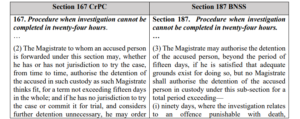
16. At the outset, we deem it appropriate to extract the statutory provisions concerning default bail in the BNSS and corresponding sections of the erstwhile Criminal Procedure Code, 19735. The relevant portion of Section 167 of the CrPC and the corresponding Section 187 of the BNSS reads:
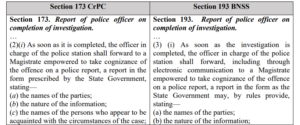
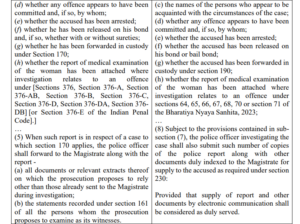
17. The relevant provisions governing a charge-sheet are Section 173 of the CrPC and corresponding Section 193 of the BNSS. They are extracted hereunder:
18. Reference has also been made to Section 230 of the BNSS and the corresponding Section 207 of the CrPC which read as under:
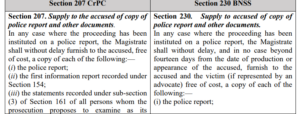
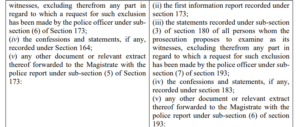
19. On a conjoint reading of the above sections, we come to the following conclusions: (a) The section(s) governing default bail, i.e., Section 167(2) of the CrPC and Section 187(3) of the BNSS are substantially identical. They only differ in phraseology; however, the import thereof remains the same; (b) When it comes to filing a police report, under Section 173 of the CrPC and Section 193 of the BNSS, the form thereof remains substantially same. An addition is Section 193(8) of the BNSS, whereby the investigating officer is required to file additional copies of the report, for supply to the accused; and (c) For supply of the police report and other documents to the accused, a timeline has been instituted of fourteen days from the date of production or appearance of the accused under Section 230 of the BNSS.
20. At this stage, we find it relevant to enumerate certain principles concerning the relief of default bail, as expounded by various pronouncements of this Court:
a) The right to default bail is an indefeasible right that flows from Article 21 of the Constitution. [Saravanan v. State6; Fakhrey Alam v. State of Uttar Pradesh7];
b) The grant of default bail to an accused is not a release from custody on merits, but on the failure of the investigating agency to file the chargesheet within a period of sixty or ninety days, as prescribed. [State v. T. Gangi Reddy8];
c) The right to default bail comes to an end upon filing of the chargesheet within the prescribed time period. [Suresh Kumar Bhikamchand Jain v. State of Maharashtra and Anr9] + [SFIO v. Rahul Modi10]
d) The object behind the provision for default bail is to ensure expeditious investigation and prevent laxity therein. [T. Gangi Reddy (Supra)] and
e) An application for default bail may also be made orally. Courts cannot be too technical in matters of personal liberty. [Rakesh Kumar Paul v. State of Assam11; Bikramjit Singh v. State of Punjab12]
21. Having considered the above statutory provisions and pronouncements of the Court, we are of the view that simple non-filing of additional copies of the chargesheet/police report will not entitle the appellant to the relief of default bail. This Court while considering default bail under the erstwhile CrPC has expounded that the relief of default bail is limited to non-filing of the charge-sheet itself and once the charge-sheet is filed in its proper form, the question of default bail does not arise. This Court in Judgebir Singh v. NIA (((2023) 17 SCC 48)) had observed as follows:
“33. The scheme of CrPC as noticed above clearly delineates that the provisions of Section 167CrPC give due regard to the personal liberty of a person. Without submission of charge-sheet within 60 days or 90 days as may be applicable, an accused cannot be detained by the police. The provision gives due recognition to the personal liberty. However, as explained by this Court in Dinesh Dalmia v. CBI [Dinesh Dalmia v. CBI, (2007) 8 SCC 770 : (2008) 1 SCC (Cri) 36] , such a right of default bail although a valuable right, yet the same is a conditional one, the condition precedent being pendency of the investigation. Therefore, once the investigation is complete with the filing of the police report, containing the details specified under Section 173(2)CrPC, the question of a claim or grant for default bail does not arise.” (emphasis supplied)
22. More recently, we place reliance on the exposition of this Court in CBI v. Kapil Wadhawan13, wherein this Court expounded that even in the scenario that all documents relied upon by the prosecution are not filed with the charge-sheet, the same would not invalidate or vitiate the chargesheet itself. It was observed:
“23. The benefit of proviso appended to sub-section (2) of Section 167 of the Code would be available to the offender only when a charge-sheet is not filed and the investigation is kept pending against him. Once however, a charge-sheet is filed, the said right ceases. It may be noted that the right of the investigating officer to pray for further investigation in terms of sub-section (8) of Section 173 is not taken away only because a charge-sheet is filed under sub-section (2) thereof against the accused. Though ordinarily all documents relied upon by the prosecution should accompany the charge-sheet, nonetheless for some reasons, if all the documents are not filed along with the charge-sheet, that reason by itself would not invalidate or vitiate the charge-sheet. It is also well settled that the court takes cognizance of the offence and not the offender. Once from the material produced along with the charge-sheet, the court is satisfied about the commission of an offence and takes cognizance of the offence allegedly committed by the accused, it is immaterial whether the further investigation in terms of Section 173(8) is pending or not. The pendency of the further investigation qua the other accused or for production of some documents not available at the time of filing of charge-sheet would neither vitiate the charge-sheet, nor would it entitle the accused to claim right to get default bail on the ground that the charge-sheet was an incomplete charge-sheet or that the charge-sheet was not filed in terms of Section 173(2)CrPC.” (emphasis supplied)
23. Applying the aforesaid exposition of law, in our considered view, the non-filing of additional copies of the charge-sheet under Section 193(8) would not vitiate the chargesheet/police report itself. As was the case under the erstwhile CrPC, the position under BNSS is to remain that the right to default bail arises when the chargesheet is not filed within a period of sixty or ninety days, as applicable. Once the chargesheet is filed, in compliance with the form prescribed under Section 193(3) BNSS, within the aforesaid period, the right to default bail ceases. Non-compliance with Section 193(8) of the BNSS cannot be construed to give the same result as Section 187(3) of the BNSS.
24. Furthermore, the aforesaid reasoning is in line with the exposition of this Court in Central Bureau of Investigation v. R.S. Pai (((2002) 5 SCC 82)). This Court, while construing Section 173(5) of the CrPC which required supporting documents and witness statements to be supplied to the Magistrate along with the police report, held this section to be directory in nature. It was observed:
“7. From the aforesaid sub-sections, it is apparent that normally, the investigating officer is required to produce all the relevant documents at the time of submitting the charge-sheet. At the same time, as there is no specific prohibition, it cannot be held that the additional documents cannot be produced subsequently. If some mistake is committed in not producing the relevant documents at the time of submitting the report or the charge-sheet, it is always open to the investigating officer to produce the same with the permission of the court. In our view, considering the preliminary stage of prosecution and the context in which the police officer is required to forward to the Magistrate all the documents or the relevant extracts thereof on which the prosecution proposes to rely, the word “shall” used in sub-section (5) cannot be interpreted as mandatory, but as directory. Normally, the documents gathered during the investigation upon which the prosecution wants to rely are required to be forwarded to the Magistrate, but if there is some omission, it would not mean that the remaining documents cannot be produced subsequently. Analogous provision under Section 173(4) of the Code of Criminal Procedure, 1898 was considered by this Court in Narayan Rao v. State of A.P. [AIR 1957 SC 737 : 1958 SCR 283 : 1957 Cri LJ 1320] (SCR at p. 293) and it was held that the word “shall” occurring in sub-section (4) of Section 173 and sub-section (3) of Section 207-A is not mandatory but only directory. Further, the scheme of sub-section (8) of Section 173 also makes it abundantly clear that even after the charge-sheet is submitted, further investigation, if called for, is not precluded. If further investigation is not precluded then there is no question of not permitting the prosecution to produce additional documents which were gathered prior to or subsequent to the investigation. In such cases, there cannot be any prejudice to the accused. Hence, the impugned order passed by the Special Court cannot be sustained. (emphasis supplied)
25. Similarly, this Court in Narendra Kumar Amin v. CBI and Ors14 while rejecting the plea for default bail on the contention that the chargesheet therein had not been filed with the full set of documents had observed that as the police report was in compliance with requirement of Section 173(2) and within the stipulated time period of ninety days, the High Court has rightly rejected bail:
“15. …. On the contrary, the three-Judge Bench of this Court in the decision in CBI v. R.S. Pai [(2002) 5 SCC 82 : 2002 SCC (Cri) 950] case, after referring to the earlier judgment of the coordinate Bench in Narayan Rao case [Narayan Rao v. State of A.P., AIR 1957 SC 737 : 1957 Cri LJ 1320 : 1958 SCR 283] categorically held that the word “shall” used in sub-section (5) cannot be interpreted as mandatory, but directory. The said statement of law is made after considering the provisions of Section 2(r) read with Sections 173(5) and (8) CrPC. Therefore, filing of the police report containing the particulars as mentioned under Section 173(2) amounted to completion of filing of the report before the learned ACJM, cognizance is taken and registered the same. The contention of the appellant that the police report filed in this case is not as per the legal requirement under Sections 173(2) and (5) CrPC which entitled him for default bail, was rightly rejected by the High Court and does not call for any interference by this Court.” (emphasis supplied)
26. In the above backdrop, we are of the considered view that the present appellant is not entitled to the relief of default bail. Undoubtedly, it is borne from the record that the chargesheet/police report stood filed within the prescribed statutory time before the magistrate on 02.09.2025. The contents thereof, being in compliance with Section 193(3) BNSS. Consequently, on 02.09.2025, the right to default bail became extinguished and the appellant ought to have applied for regular bail. Moreover, it is also a matter of record that cognizance has also been taken on the chargesheet filed by the investigating agency. This order has not been challenged to date, thereby implying that the contents of the charge-sheet are in accordance with law.
27. Consequently, in our view, the Courts below have rightly held that the non-filing of a copy of the chargesheet cannot become a ground for default bail and the submission of the appellant cannot be accepted.
28. Before parting with this appeal, we deem it appropriate to consider Crl. M.P. No. 161327 of 2026 wherein the appellant submits that his prayer for regular bail has not been considered in view of the present appeal. We clarify that the regular bail application of the appellant is to be considered on its own merits, in accordance with law, independent of this appeal and observations made herein. As observed above, consideration of default bail is not one on merits.
29. In view of the above, the present appeal is dismissed. The impugned order dated 06.02.2026 in CRA No. 475 of 2025 passed by the High Court of Judicature at Bombay is affirmed.
30. Pending application(s), if any, shall stand disposed of.
- Hereinafter ‘subject FIR’ [↩]
- Hereinafter ‘BNS’ [↩]
- Hereinafter ‘CBI’ [↩]
- Hereinafter ‘BNSS’ [↩]
- Hereinafter ‘CrPC’ [↩]
- (2020) 9 SCC 101 [↩]
- (2021) 20 SCC 636. [↩]
- (2023) 4 SCC 253 [↩]
- (2013) 3 SCC 77 [↩]
- (2023) 15 SCC 311 [↩]
- (2017) 15 SCC 67. [↩]
- (2020) 10 SCC 616 [↩]
- (2024) 3 SCC 734 [↩]
- (2015) 3 SCC 417. [↩]