


Scope of Referee Judge under CrPC 1973
Dr. Rakesh Kumar Gupta v State of Uttar Pradesh & Ors.
Case Summary
The Supreme Court held that a third referee judge under Section 392 of the Code of Criminal Procedure, 1973, when referred a case due to a split opinion in a Division Bench, is strictly confined to the specific points of disagreement. The referee judge cannot independently reopen, re-evaluate or overturn...
Case Details
Judgement Date: 9 June 2026
Citations: 2026 INSC 632 | 2026 SCO.LR 6(3)[12]
Bench: Dipankar Datta J, S.C. Sharma J
Keyphrases: Conviction of three accused—Appeal against conviction—Division Bench—High Court—Difference in opinion—Opinion of third-judge—Section 392—Code of Criminal Procedure 1973—All three acquitted—Special Leave Petition—Third-judge bound to unanimous acquittal—Appeal limited to difference in opinion—Sajjan Singh v State of M.P. referred to a larger bench.
Mind Map: View Mind Map
Judgement
1. Rakesh Kumar Gupta1 and the State of Uttar Pradesh2, in separate appeals, challenge the judgment and order dated 22nd March, 2018 of a learned Single Judge of the High Court of Judicature at Allahabad3. While allowing the criminal appeal4 presented by the Rastogi brothers – Anil, Ajay and Atul5 (respondents 2 to 4 in the appeal of the complainant and respondents 1 to 3 in the appeal of the State), the learned Judge acquitted the siblings and set aside their conviction under Section 302 read with Section 149 of the Indian Penal Code, 18606 and the sentence of life imprisonment. The conviction of the siblings, under Section 148 IPC and imprisonment of two years, was also set aside.
2. Facts, as have unfolded, would present an interesting question to be answered by us. We shall formulate the question a little later after adverting to the basic undisputed facts.
FACTS
3. The siblings were tried by the IInd Additional Sessions Judge, Lucknow7, in a sessions triable case8 arising out of Case Crime No.120/1991 under Sections 148, 149, 302/149, IPC, registered at Police Station Wazirganj, Lucknow. The father of the siblings and one Giriraj Rastogi were the co-accused. The father died during the trial, leaving the other 4 (four) accused to face the trial. By his judgment dated 31st January, 2001, the Sessions Judge convicted the siblings for the charges noted above and on the same day, sentenced them to life imprisonment. However, co-accused Giriraj Rastogi was acquitted of all the charges.
4. Aggrieved by the conviction and sentence imposed upon them, the siblings carried the same in a composite appeal before the High Court under Section 374(2) of the Code of Criminal Procedure, 19739. Such appeal was heard by a Division Bench [cor: Bhanwar Singh and Devi Prasad Singh, JJ]. Separate judgments dated 11th July, 2006 were pronounced by the Judges of the Division Bench. Bhanwar Singh, J. upheld the conviction of Anil and Ajay but acquitted Atul. Devi Prasad Singh, J. however, maintained the conviction of the siblings. The Judges comprising the Division Bench were, thus, divided in their opinion insofar as Atul is concerned and not Anil and Ajay. Upon such difference of opinion, by a separate order recorded on 11th July, 2006, the appeal was directed to be placed before a third Judge10 to be nominated. The referee Judge [Vikram Nath, J. (as His Lordship then was)] by the impugned judgment and order not only agreed with the opinion of Bhanwar Singh, J. that Atul ought to be acquitted and eventually acquitted him, His Lordship also proceeded to reverse the concurring opinion of Bhanwar Singh, J. and Devi Prasad Singh, J. (recorded in their separate judgments) convicting Anil and Ajay. It was held that based on the materials on record, the prosecution had failed to drive home the charges against Anil and Ajay. As a consequence, Anil and Ajay were also acquitted.
5. It is in these circumstances that the complainant and the State approached this Court with the separate special leave petitions under consideration, out of which these appeals arise. Permission, sought for by the complainant to file the special leave petition, was granted and notice issued by a coordinate Bench on 8th October, 2018. Notice on the State’s special leave petition was issued on 2nd August, We find from the record of proceedings that the special leave petitions had been listed before separate coordinate Benches on several occasions during the last 7 (seven) years but no effective hearing could take place till 2nd February, 2026, when we had the occasion to hear Mr. Mudit Sharma, learned counsel for the complainant, Mr. Sidharth Luthra, learned senior counsel for the siblings and Mr. Chandrika Mishra, learned counsel for the State.
SUBMISSIONS
6. Mudit Sharma appearing for the complainant has advanced the following propositions:
(i) The delivery of the third Judge’s opinion is a substantive statutory obligation and not an empty formality. Section 392 of the 1973 Code contemplates a mandatory two-stage process: (i) the third Judge must first deliver an independent opinion; and (ii) the judgment then follows that opinion. The two stages are distinct, the opinion comes first and the judgment is its consequence. In the present case, no opinion is delivered.
(ii) The power of the third Judge not to refer the matter to a larger Bench under the proviso to Section 392 of the 1973 Code is not unbridled or unregulated. It is a structured judicial discretion, controlled by the contours of judicial propriety and the principles articulated by the decision of this in Pankajakshi (Dead) through Legal Representatives v. Chandrika11 [5-J].
(iii) The judgment of this Court in Sajjan Singh v. State of Madhya Pradesh12[2-J] requires reconsideration by a larger Bench, insofar as it holds that the third Judge is required to examine the whole case independently including issues on which the Division Bench was unanimous without being obliged to first invite submissions on his opinion or to consider reference to a larger Bench.
(iv) The impugned judgment is erroneous both on facts and law.
7. Mr. Luthra, representing the siblings, has painstakingly placed before us the provisions of Section 429 of the Code of Criminal Procedure, 189813, the provisions of Section 392 of the 1973 Code, the 41st Report of the Law Commission of India, Government of India, Ministry of Law14 as well as various precedents dealing with Section 429 of the 1898 Code as well as Section 392 of the 1973 Code.
(i) Luthra highlighted the evolution of the law on the subject by tracing its historical development through three distinct phases:
A. Historical Development under Section 429 of the 1898 Code from 1910 to 1995
a. Early judicial interpretation under Section 429 of the 1898 Code reflected differing approaches regarding the jurisdiction of the third Judge. In Sarat Chandra Mitra vs. Emperor15, the High Court at Calcutta, although not in detail, observed that where disagreement between judges related only to one of the two accused, the “case” to be referred to the third judge was confined to that accused.
Subsequent legislative discussions in 191416), 191717) and 192218) reveal that Parliament considered, but ultimately rejected, amendments intended to restrict the power of the third Judge or require rehearing before a larger Bench. It is submitted that the statutory language was deliberately retained in its original form.
b. In Granade Venkata Ratnam v. The Corporation of Calcutta19, a third Judge of the High Court at Calcutta observed that “a third Judge would not differ upon a point on which both the referring Judges were agreed unless there were strong grounds for doing so” (emphasis supplied by Mr. Luthra, who submitted that this shows that the third Judge could even differ on points where the referring Judges had concurred).
c. Subsequent decisions in Ahmad Sher. vs. Emperor20
and Emperor vs. Chunna Singh & Ors.21 took the same view as taken in Sarat Chandra Mitra (supra), that is, the third Judge is to reexamine the case of only that accused over which there is a disagreement. In Subedar & Ors. vs. The State22, the third Judge found all appellants not guilty (despite the case having been sent to him qua one accused). This decision was objected to by one of the two Judges of the Division Bench and the matter sent back to a third Judge again who after taking note of the previous decisions in Sarat Chandra Mitra (supra) and Granade Venkata Ratnam (supra) observed that a third Judge is not restricted only to the exact point of disagreement and may adopt an intermediate or even different view.
d. Thus, the pre-1956 jurisprudence, Mr. Luthra submitted, treated the entire appeal of all the appellants as open before the third Judge and not merely of the appeal where there is a disagreement.
B. Jurisprudence between 1956 and 1980
e. In this phase, the Supreme Court initially adopted a broad interpretation of Section 429 of the 1898 Code. In Babu & Ors. v. State of U.P.23 and Hethuba @ Jithuba Madhuba & Ors. vs. State of Gujarat24, it was observed that the third Judge was free to resolve the matter as he deemed fit and could deal with the whole case.
f. However, in Bhagat Ram v. State of Rajasthan25, the Supreme Court adopted a narrower construction. The Court held that where the Division Bench had conclusively affirmed acquittal on certain charges and differed only on limited issues, the third Judge could examine only the point of difference and could not reopen matters already unanimously decided. Relevant paragraph from the judgment is reproduced below:
13. In view of the fact that the State appeal against the acquittal of Bhagat Ram for offences under Sections 120-B, 218, 347 and 389 IPC, had been dismissed by the Division Bench, it was, in our opinion, not permissible for the third Judge to reopen the matter and convict Bhagat Ram for offences under Sections 347, 389 and 120-B IPC. The matter had been referred under Section 429 of the Code of Criminal Procedure to Jagat Narayan, J., because there was a difference of opinion between Tyagi, J., and Lodha, J., regarding the correctness of the acquittal of Bhagat Ram for offences under Section 161 IPC and Section 5(1)(a) of Prevention of Corruption Act. Jagat Narayan, J., could go only into this aspect of the matter and arrive at his conclusion…
g. Subsequently, in State of U.P. v. Dan Singh & Ors.26, the Supreme Court clarified that the opinions expressed by the two Judges prior to reference are not final judgments; the enforceable judgment (against which a special leave petition is maintainable) emerges only after the opinion of the third Judge is delivered. It was held:
23. According to this section if there is a difference of opinion amongst the Judges of the Bench, then their opinions are laid before another Judge. It is only after the third Judge gives his opinion that the judgment or order follows. It is clear from this that a judgment or order which can be appealed against, under Article 136 of the Constitution, is only that which follows after the opinion of the third Judge has been delivered. What B.N. Katju and Rajeshwar Singh, JJ. wrote was not their judgments but they were their opinions. Due to disagreement amongst them, Section 392 of the Code of Criminal Procedure required the appeal as a whole to be laid before the third Judge (V.P. Mathur, J. in this case) whose opinion was to prevail. The first order of 15-4-1987 was clearly not contemplated by Section 392 of the Code of Criminal Procedure and is, therefore, non est.
h. Following this, Mr. Luthra submitted that where a two-Judge Bench delivers differing views on a legal issue, the opinions expressed are merely individual opinions of the Judges and do not constitute an enforceable judgment of the Court.
C. Post-1980: Expansion of the Third Judge’s Jurisdiction
i. A wider interpretation as firmly adopted by the Supreme Court in State of A.P. v. P.T. Appaiah27. Rejecting the contention that the third Judge was confined only to the point of disagreement, the Court held that the third Judge was competent to independently examine the entire case, including acquitting the accused despite concurrent findings of guilt by the Division Bench. The Court expressly declined to follow Bhagat Ram (supra) in light of earlier larger Bench decisions by holding as follows:
3. In Union of India v. B.N. Ananti Padmanabiah [(1971) 3 SCC 278, 280 : 1971 SCC (Cri) 535, 537 : 1971 Supp SCR 460] which was unreported when Bhagat Ram case [(1972) 2 SCC 466, 471 : 1972 SCC (Cri) 751, 756 : (1972) 3 SCR 303] was decided, a three-Judge Bench of this Court confirmed the decision in Hethubha case [(1970) 1 SCC 720, 723 : 1970 SCC (Cri) 280, 283 : (1971) 1 SCR 31]. In this case the accused who were found guilty of offences under Sections 5(2) and 5(1)(c) and 5(1)(d) of the Prevention of Corruption Act, 1947 as well as Sections 467 and 471 of the Penal Code, 1860 by the Special Judge, Gauhati, challenged the order of conviction in the High Court of Assam and Nagaland. On difference of opinion between the two Judges of the Division Bench of the High Court, the case was referred to a third Judge. Before the third Judge a new plea was advanced that the Magistrate at Delhi had no jurisdiction to accord sanction to an Inspector of the Delhi Special Police Establishment to investigate the case in Assam. The third Judge held that an order of a magistrate of the local jurisdiction was necessary, that only a magistrate of the district where the crime was committed and no magistrate outside the jurisdiction was competent to make an order for investigation and accordingly the learned Judge quashed the proceedings before the Special Judge. In appeal to this Court it was contended that the third Judge could only deal with the difference between the two Judges and not with the whole case. This contention was rejected with the observation: [SCC p. 280: SCC (Cri) p. 537, para 6]
This question came up for consideration in the recent unreported decision in Hethubha v. State of Gujarat [(1970) 1 SCC 720, 723 : 1970 SCC (Cri) 280, 283 : (1971) 1 SCR 31] …. This Court held that the third learned Judge could deal with the whole case. The language of Section 429 of the Code of Criminal Procedure is explicit that the case with the opinion of the Judges comprising the Court of Appeal shall be laid before another Judge of the same court. The other noticeable feature in Section 429 of the Code of Criminal Procedure is that the judgment or order shall follow the opinion of the third learned Judge.
In view of these authorities which were not noticed in Bhagat Ram case [(1972) 2 SCC 466, 471 : 1972 SCC (Cri) 751, 756 : (1972) 3 SCR 303] we are unable to agree that the learned third Judge in the instant case to whom it was referred under Section 429 overstepped the limits of his jurisdiction in deciding the case as he did.
(emphasis ours)
j. The principle was affirmed in Sajjan Singh (supra) in the following words:
10. Statement of law is now quite explicit. It is the third Judge whose opinion matters; against the judgment that follows therefrom that an appeal lies to this Court by way of special leave petition under Article 136 of the Constitution or under Article 134 of the Constitution or under Section 379 of the Code. The third Judge is, therefore, required to examine whole of the case independently and it cannot be said that he is bound by that part of the two opinions of the two Judges comprising the Division Bench where there is no difference. As a matter of fact the third Judge is not bound by any such opinion of the Division Bench. He is not hearing the matter as if he is sitting in a three-Judge Bench where the opinion of majority would prevail. We are thus of the opinion that Prasad, J. was not right in his approach and his hands were not tied as far as the three appellants, namely, Gajraj Singh, Meharban Singh and Baboo Singh before him were concerned in respect of whom both Judges of the Division Bench opined that they were guilty and their conviction and sentences were to be upheld.
(emphasis ours)
k. In Nagen Das v. State of Assam28, a three-Judge Bench of the Gauhati High Court held that difference of opinion between judges hearing a criminal appeal under Section 392 requires reference of the entire case to a third Judge, who is empowered to hear and consider the whole matter independently and is not confined merely to the points of disagreement and the judgment or order ultimately follows the opinion of the third Judge. Further, after the third Judge delivers its opinion, then the two Judges of the Division Bench cannot seek reference to larger Bench. Relevant excerpt from the said decision is reproduced hereunder:
21. ………. in the event of the difference of opinion between the Judges hearing the Appeal, the Appeal shall be laid before another Judge of his Court for hearing of the whole case and who on hearing the case deliver his opinion and the judgment or Order will abide by the opinion of the third Judge. The third Judge can or will deal with the whole case and therefore the third learned Judge is altogether uninhibited in resolving the difference. The Parliament did not intend to make any departure from the legal position resolved by the Highest Judicial Authority of the land and accordingly maintained the statutory scheme unimpaired. Therefore the Legislature in its wisdom did not seek to clarify the expression ‘Case’ and left the matter to the discretion of the Bench hearing the case. There is an obvious difference between a Civil and Criminal cases. Precise and definite issues can be framed in a Civil case and the controversial issues can be marked and defined with ease. Therefore under the corresponding provisions in the Letters Patent of High Courts and in the Code of Civil Procedure, the view of the majority of all the Judges including those who first heard the case prevails in a Civil matter. It is not workable in most Criminal Cases where the findings are intermixed and intermingled.
l. In State of Chhattisgarh v. Shankar Haldhar29, the High Court of Chhattisgarh at Bilaspur speaking through Prashant Kumar Mishra, J. (as His Lordship then was), after referring to Babu (supra), P.T. Appaiah (supra) and Sajjan Singh (supra) noted at paragraph 9 that:
“It is thus settled by the Hon’ble Supreme Court that the third Judge can hear the Appeal afresh and deliver his own opinion which may altogether be different opinion than the two rendered by the differing Judges.”
m. A similar view was taken by the High Court at Calcutta, speaking through Joymalya Bagchi, J. (as His Lordship then was), in Krishna Pradhan v. State of West Bengal30. The Court held that under Section 392 of the 1973 Code, the third Judge must independently examine and decide the entire case objectively assessing the differing opinions of the Division Bench without being bound by either view. We quote the relevant passages hereunder:
9. Section 392 CrPC postulates in the event of difference of opinion between two Judges, the matter shall be referred to a third Judge and the said Judge after hearing on such points as he deems fit and proper shall deliver an opinion and the matter shall be disposed of in terms of his opinion.
10. The third Judge may also, in an appropriate case, direct the appeal be reheard and decided by a larger Bench of Judges.
11. Interpreting the aforesaid provision, the Supreme Court in Sajjan Singh State of M.P. [Sajjan Singh v. State of M.P., (1999) 1 SCC 315 : 1999 SCC (Cri) 44 : AIR 1998 SC 2756], inter alia, held while dealing with a reference under Section 392 CrPC the third Judge is required to examine the whole case independently and cannot be said to be bound even by that part of the judgment…
12. As the third Judge is to consider the case independently and objectively weigh the two differing opinions of the Hon’ble Judges of the Division Bench, there is no rule of prudence or judicial etiquette that if the finding of one of the Hon’ble Members of the Division Bench is of acquittal, the same ought to be favoured by the third Judge [Nemai Mondal State of W.B., 1965 SCC OnLine Cal 20 : AIR 1966 Cal 194] . The said ratio propounded by the Calcutta High Court in Nemai Mondal case [Nemai Mondal v. State of W.B., 1965 SCC OnLine Cal 20 : AIR 1966 Cal 194] was quoted with approval by the Supreme Court in Tanviben Pankajkumar Divetia v. State of Gujarat [Tanviben Pankajkumar Divetia v. State of Gujarat, (1997) 7 SCC 156 : 1997 SCC (Cri) 1004] .
n. The distinction between civil and criminal proceedings was also emphasised by Mr. Luthra. He submitted that unlike Section 98 of the Code of Civil Procedure, 1908, which confines reconsideration to specific points of law, Section 392 of the 1973 Code contains no such restriction. Criminal adjudication often involves interconnected findings relating to appreciation of evidence, culpability, and participation of multiple accused, making artificial compartmentalisation impracticable.
o. Lastly, Mr. Luthra submitted that the Judges comprising the Division Bench, after finding themselves in disagreement as regards Atul’s conviction, vide order dated 11th July, 2006, observed that they were divided in their opinion in Criminal Appeal No. 60 of 2001, and directed that “this appeal be laid with our different opinions as provided under Section 392 CrPC before another Judge of this court after being nominated”. The Joint Registrar (Listing) was also directed to obtain the requisite nomination.
p. This order was appealed before this Court31 by Anil and Ajay. Seven years later, Ajay filed a petition32 seeking directions to send the original records back to the High Court as the appeal before the third Judge had been listed. Taking note of the same, this Court passed an order dated 18th March, 2015 dismissing the appeals of Anil and Ajay as withdrawn and sent the records back to the High Court to enable the third Judge to dispose of the criminal appeal. Relevant paragraphs from the order dated 18th March, 2015, emphasized by Mr. Luthra, are reproduced below:
Therefore, by virtue of the description contained in Section 392 Cr.P.C. which stipulate as to how when divided opinion is expressed by learned Judges of a Bench, an appeal should be heard, the Division Bench which heard the appeal rightly referred the matter for being placed before a third Judge. It is, therefore, now for the third Judge to apply the stipulations contained in Section 392 Cr.P.C. and decide the appeal on merits. It is stated before us that the appeal has already been listed before the learned third Judge and is ripe for hearing. It is in the above-stated background the applicant/appellant has come forward with this Crl. M.P. for direction to send back the original records.
***
Since the question is no longer res integra and settled in the above referred to decisions, we are also convinced that the appellant can be permitted to argue the whole of the appeal before learned third Judge before whom the appeal has now been listed pursuant to the order of reference dated 11.07.2006. In the circumstances, though there is no question of remanding the case back to the learned third Judge as prayed for in this Crl. M.P., we permit the applicant/appellant to withdraw this appeal to enable the appellant to place all the contentions and rely upon the decisions placed before us while arguing the appeal before the learned third Judge. With that liberty to the applicant/appellant, this appeal is permitted to be withdrawn with a further direction to the Registry to send back all the records to the High Court to enable the learned third Judge to dispose of the Criminal Appeal No.60 of 2001 on merits. The appeal is, accordingly, dismissed as withdrawn.
(emphasis laid by Mr. Luthra)
(ii) Application of the above principles to the present case: In view of the law laid down in T. Appaiah (supra) and Sajjan Singh (supra), Mr. Luthra submitted that the referee Judge was fully competent to independently examine the entire appeal without being confined to merely resolving the narrow point of disagreement between the two Judges of the Division Bench.
QUESTIONS
8. The pure legal questions emerging from the scope and ambit of Section 392 of the 1973 Code, which we venture to answer, are:
(i) Whether, in view of a division of opinion between the two Judges of a Division Bench hearing an appeal under Chapter XXIX of the 1973 Code, the third Judge before whom the appeal is laid is obliged to deliver his opinion agreeing with either one of the two opinions or is such Judge empowered to give an opinion which is at divergence with the opinions penned by the two Judges who heard the appeal?
(ii) Whether the third Judge is obliged to render his opinion confined to the points of disagreement between the two Judges only, or that such Judge is competent and empowered in law to differ with the conclusions unanimously reached by both the Judges of the Division Bench and give his independent opinion which is at variance with such unanimous conclusion?
(iii) Whether the third Judge, upon the appeal being laid in terms of Section 392 of the 1973 Code, not bound by the unanimous conclusions of the two Judges of the Division Bench; if not, and in case of disagreement with the concurrent findings of the two Judges, should the third Judge not refer the appeal to be re-heard and decided by a larger Bench?
ANALYSIS
9. Answering the first question need not detain us for long. The options open for the referee Judge, when seized of a reference under Section 392 of the 1973 Code are not too wide. If a Judge of a Bench of two-Judges, while hearing an appeal, is inclined to maintain a conviction while the other Judge is not so inclined, the third Judge may accept either opinion and it is the third Judge’s opinion that the statute requires to be placed before the Division Bench for rendering the final judgment. It could also happen, as in Krishna Pradhan (supra), that the third Judge declines to agree with the view of either the presiding Judge of the Bench (in maintaining the conviction but commuting death sentence to life imprisonment) or the view of the companion Judge on the Bench (acquitting the convict). If the third Judge is of the considered view, for the reasons assigned, that additional evidence is required to be received under Section 391 of the 1973 Code in the manner stipulated to rectify irregularity, not being an incurable defect going to the root of the case, before the conviction is either maintained or reversed, that is an available course of action in terms of the decision of this Court in Rambhau v. State of Maharashtra33. It is noteworthy that the appeal in Krishna Pradhan (supra) was at the instance of a sole death-row convict and not three convicts in a composite appeal; therefore, the said decision is not an authority providing adequate guidance for answering the second and the third questions [formulated in paragraph 8 (supra)] arising for decision.
10. Moving on to the said questions [(ii) and (iii)], what emerges is this. Of the multiple precedents cited and relied on by Mr. Luthra, majority of them34) were rendered either prior to the 1973 Code being enacted and made operational or may be even thereafter, but while considering the text of Section 429 of the 1898 Code. The phraseology used in Sections 429 and 392 is significantly different, which we propose to note immediately hereafter; and, therefore, we are of the opinion that all these precedents would have no application when a reference is being dealt under Section 392 of the 1973 Code. Of the 3 (three) decisions35) of the high courts, which we have noticed at an earlier part of this judgment, the latter two were delivered after the decision of this Court in Sajjan Singh (supra). The learned Single Judges of the relevant high courts (Chhattisgarh and Calcutta) were bound by what Sajjan Singh (supra) ruled and, therefore, the said decisions are not apposite for answering the relevant questions remaining to be answered. In the other decision, i.e., Nagen Das @ Baldai Das (supra), the Full Bench of the Gauhati High Court proceeded on the basis that there is no significant difference between Section 429 of the 1898 Code and Section 392 of the 1973 Code, sans the proviso. For the reasons to be assigned hereafter, it would be clear that such an observation made in Nagen Das (supra) is erroneous.
11. We now proceed to deal with the merits of the contentions urged by Mr. Sharma and Mr. Luthra.
12. At the outset, the two provisions, i.e., Sections 429 and 392 are reproduced hereunder side by side for a comparative study and ascertainment as to whether the provisions are so similar that except the proviso, there is no difference.
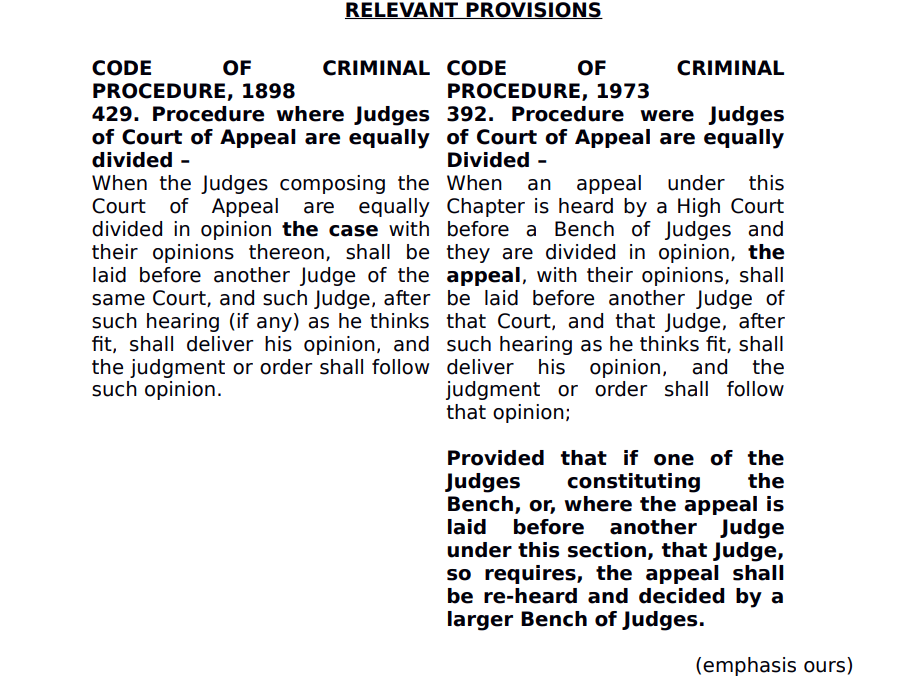 Without being overly concerned with the difference in the opening words of the two sections (old and new), bare reading thereof would reveal that while Section 429 required “the case” to be placed before “another Judge”, the ordainment of Section 392 is that “the appeal” shall be laid before “another Judge” in case of division of opinion between the two Judges of a Bench of a high court.
13. It would be appropriate at this stage to notice the law laid down in Sajjan Singh (supra), heavily relied on by Mr. Luthra as having laid down the law correctly upon due consideration of the precedents explaining the scope of Section 392 of the 1973 Code.
a. In Sajjan Singh (supra), eleven persons were tried for murder and related offences. The Trial Court acquitted one accused but convicted the remaining ten persons and sentenced them to life imprisonment. These convicted persons filed appeals before the High Court of Madhya Pradesh. The case was heard by two Judges of a Division Bench, but they differed in their views. Chitre, J. held that all ten convicted persons were guilty and their convictions should be upheld. Shukla, J. however, felt that only three of them were guilty and that the remaining seven should be acquitted. Because of this difference of opinion, the matter was referred to a third Judge under Section 392 of the 1973 Code. Prasad, J., the third Judge, opined in favour of acquittal of four convicts and upheld the conviction of the rest six, including the three persons whose conviction had already been upheld by both the Judges earlier. However, the third Judge did not independently examine the cases of those three convicts because he believed that he was bound by the unanimous opinion of the two Judges of the Division Bench. The convicts then approached the Supreme Court challenging this approach adopted by the third Judge.
b. This Court found the approach adopted by the third Judge to be erroneous. The Court observed that under Section 392 of the 1973 Code, it is ultimately the opinion of the third Judge that governs the matter and against the judgment flowing therefrom an appeal lies to the Supreme Court.
c. Paragraph 10 of the decision in Sajjan Singh (supra) has already been reproduced above.
14. The view expressed in Sajjan Singh (supra) fairly and squarely supports the proposition advanced by Mr. Luthra. Tested on the anvil of the ratio laid down in Sajjan Singh (supra), the referee Judge seems to be right in independently assessing the evidence on record and acquitting the siblings, notwithstanding the unanimous conclusions of Bhanwar Singh and Devi Prasad Singh, in relation to acceptance of the conviction and sentence recorded by the ASJ against Ajay and Anil. He may also seem to be justified in contending that Sajjan Singh (supra) has laid down the law more than quarter of a century back and having regard to the doctrine of stare decisis, its precedential value should be given due weight.
15. The referee Judge’s approach does find support from Sajjan Singh (supra). However, should Sajjan Singh (supra) not commend to us to lay down correct law, Anil and Ajay could prima facie lose the very foundation of their plea.
16. For a proper understanding of Section 392 of the 1973 Code, it is most important to read Section 374 thereof which confers the right of appeal on a convict. Since sub-section (2) of Section 374 is relevant, the same is quoted hereunder:
374. Appeal from convictions. —
(1) ***
(2) Any person convicted on a trial held by a Sessions Judge or an Additional Sessions Judge or on a trial held by any other Court in which a sentence of imprisonment for more than seven years has been passed against him or against any other person convicted at the same trial, may appeal to the High Court.
(3) ***
(4) ***
(emphasis ours)
17. Section 378 of the 1973 Code also provides for appeals. To the extent relevant for a decision here, the said provision reads as under:
378. Appeal in case of acquittal.— (1) Save as otherwise provided in sub-section (2), and subject to the provisions of sub-sections (3) and (5), —
(a) ***
(b) the State Government may, in any case, direct the Public Prosecutor to present an appeal to the High Court from an original or appellate order of an acquittal passed by any Court other than a High Court not being an order under clause (a) or an order of acquittal passed by the Court of Session in revision.
(2) ***
(a) ***
(b) ***
(3) No appeal to the High Court under sub-section (1) or sub-section (2) shall be entertained except with the leave of the High Court.
(4) ***
(5) ***
(6) ***
18. We have read the 1973 Code and the rules framed by the High Court in relation to criminal appeals, which are governed by Chapter XXIX of the 1973 Code. Neither the 1973 Code nor the rules of the High Court bar a composite appeal being presented by several convicts or a composite appeal by the State challenging acquittal of more than one acquitted accused after a joint trial.
19. Reading the provisions of Section 374 of the 1973 Code invoked by the siblings together with the rules framed by the High Court, we are inclined to the view that multiple accused upon being tried by a Court of Sessions and upon being sentenced to imprisonment for more than 7 years, if they so choose, may appeal to the High Court jointly. In the absence of any bar precluding multiple convicts to join in one composite appeal, we presume, that the composite appeal came to be filed by the siblings and accepted by the Registry of the High Court.
20. However, we are of the opinion that though the siblings, in the present case, chose to jointly appeal to the High Court by presenting a composite appeal, in effect, there were three appeals before the High Court by the siblings rolled up in one memorandum of appeal giving rise to registration of a single criminal appeal.
21. We may now note what the learned Judges of the Division Bench held. The judgment of Bhanwar Singh, J. records as follows:
In view of the discussions made above, we are of the decisive opinion that the appeal preferred by the two accused appellants namely, Anil Rastogi and Ajay Rastogi deserves to be dismissed.
Their conviction under Sections 302/149 and 148 I.P.C. and the sentences as awarded by the trial Court are hereby confirmed.
However, the appeal, as preferred by Atul Rastogi, is allowed. As a consequence, Atul Rastogi is held not guilty of the charges under Section 302 read with Section 149 and Section 148 I.P.C. His conviction and sentences are set aside. He stands acquitted of the charges levelled against him. The bail bonds of Atul Rastogi shall stand cancelled and the sureties are hereby discharged.
However, the judgment of conviction and sentence as delivered by the learned trial Court against Anil Rastogi and Ajay Rastogi is confirmed. The two Convicts Anil Rastogi and Ajay Rastogi, who were on bail during the pendency of this appeal will now be taken into custody and sent to jail to serve out the sentences awarded to them by the learned trial Court learned Chief Judicial Magistrate, Lucknow shall issue non-bailable warrants of arrest accordingly and submit compliance report within one month.
(emphasis ours)
Devi Prasad Singh, J., however, concluded as follows:
30. In view of the discussion made herein above, all the 3 appellants being the part and parcel of unlawful assembly may be convicted under section 149/148/302 of the Indian Penal Code. Sri Atul Rastogi, appellant No. 3 was also equally responsible for the brutal murder of the deceased in view of the provisions contained under section 148/149 of the Indian Penal Code. The present appeal filed by the appellants is devoid of merit, hence dismissed.
The judgment and order of conviction and sentence rendered by the IInd Addl. Sessions Judge, Lucknow in S.T. No. 527/93 calls for no interference and is hereby confirmed. The appellants who are on bail be taken into custody and he sent to the jail in view of sentence awarded by the sessions court.
Let a non bailable warrant be issued against the appellants through the Chief Judicial Magistrate, Lucknow forthwith.
(emphasis ours)
22. In view of the disagreement, insofar as the finding returned against Atul is concerned, Bhanwar Singh, J. made the following order:
“Since my esteemed brother Hon’ble Mr. Justice Devi Prasad Singh has partly agreed and partly dissented with my Judgment, the word we wherever it has been used in connection will Atul shall be read as I.”
(emphasis ours)
23. We also find from the records the reference made by the Judges on 11th July, 2006 to a third Judge in the following words:
Since we have a divided opinion in the Criminal Appeal No. 60 of 2001, this appeal be laid with our different opinions as provided under Section 392 CrPC before another Judge of this court after being nominated. The Joint Registrar (Listing) may obtain the requisite nomination.
(emphasis ours)
24. Bhanwar Singh and Devi Prasad Singh, JJ. having concurred with the ASJ insofar as the conviction and sentence under challenge at the instance of Anil and Ajay are concerned and in light of the observations made by them in their respective judgments, extracted supra, it admits of no doubt that the conviction and sentence under challenge were confirmed and the appeals at the instance of Ajay and Anil stood dismissed without any disagreement.
25. However, Bhanwar Singh and Devi Prasad Singh, having differed in respect of the conviction of Atul recorded by the ASJ, no final judgment in relation thereto could have been or was pronounced. The differing views on Atul’s conviction (recorded by the ASJ) expressed by both Bhanwar Singh, J. and Devi Prasad Singh, J. were their opinions, and not judgments, and in such circumstances the Judges had rightly referred to the third Judge for his opinion as to the further course of action in relation to Atul’s conviction as per the legal and statutory obligation engrafted in Section 392 of the 1973 Code.
26. The direction given by the Judges of the Division Bench has been noted in one of the preceding paragraphs. What we perceive, on a careful reading of the order of reference, is that it was only the appeal of Atul which was directed to be placed before the third Judge and not the appeals of Ajay and Anil, notwithstanding that instead of individual appeals by the siblings there was only one composite appeal which came to be filed jointly by them, was registered and assigned a single number.
27. We reiterate, on a conspectus of the facts and circumstances discussed above leading to the referee Judge assuming jurisdiction, that though there was a composite appeal presented by the siblings, in law, the siblings had individually appealed to the High Court exercising their right of appeal taking the aid of Section 374(2) of the 1973 Code. In view of the separate but unanimous judgments rendered by Bhanwar Singh, J. and Devi Prasad Singh, J. dealing with the appeals of Ajay and Anil, the inevitable and irresistible conclusion is that their appeals were dismissed. There being no division of opinion, the appeals of Ajay and Anil could not and should not have been placed before the third Judge. Since, however, there remained a division of opinion regarding the appeal of Atul, only such appeal should have been placed before the third Judge.
28. We feel, there are strong grounds for so opining.
29. First, we observe that the difference in phraseology of Section 429 of the 1898 Code and section 392 of the 1973 Code is significant. While Section 429 dealt with “the case”, Section 392 opens with “an appeal” and it is closely followed by “the appeal”. How does one construe “an appeal” and “the appeal” in Section 392 of the 1973 Code?
30. At this stage, adverting to a bit of English grammar is considered inevitable. “A”, “an” and “the” are all articles. While “a” and “an” are indefinite36(also called indeterminate) articles, “the” is the definite37 article. It is not unusual to find “a”/”an” and “the” in one sentence. Legislatures are prone to use “a”/”an” for the first mention to trigger the provision. Then, “the” is used anaphorically to refer back to that same thing. It prevents ambiguity and limits the later clause to the instance already introduced. This is, in our opinion, also a basic statutory construction: the indefinite article sets up the class, the definite article picks out the individual instance from that class.
31. In the context of “an appeal” in Section 392, the words refer to “an appeal” that fits the situation described whereas “the appeal” is referable to the same appeal just spoken of. Thus, “an appeal” which opens the scope applies to any appeal under Chapter XXIX that is heard by a Bench and results in a divided opinion and “the appeal” narrows to the specific appeal where such division has occurred. The words “the appeal”, thus, have to be read as referring back to “an appeal”.
32. In plain terms, “an appeal” means any appeal filed by a convict or the State that is heard by a Division Bench and results in the Judges either agreeing or disagreeing, whereas “the appeal” refers to that particular appeal in which the disagreement has occurred.
33. There are other provisions in the 1973 Code which use “an appeal” followed by “the appeal”, viz. Sections 374 and 378. Similarly, one finds “any proceeding” followed by “the proceeding” in Section 397 thereof.
34. Sajjan Singh (supra), in our humble opinion, is not an authority on the construction of “an appeal” vis-à-vis “the appeal” found in Section 392. This Court did not advert to the anaphoric use of the definite article. The judgment is, therefore, distinguishable on the point of statutory interpretation.
35. Further, what does not escape our attention is the fortuitous circumstance of filing of a composite appeal by the siblings. Supposing that instead of a composite appeal, the siblings had filed three separate appeals against the common judgment of conviction recorded by the ASJ and the appeals of Ajay and Anil were dismissed either by a common judgment or separate judgments of the Judges comprising the Division Bench. The fate of Ajay and Anil would be sealed, unless they successfully invoke the jurisdiction of this Court under Article 136 of the Constitution. However, had the Judges while dismissing the appeals of Ajay and Anil then proceeded to record individual opinions in respect of Atul and such opinions were divergent, it is only the appeal of Atul that would call for a reference to the third Judge in terms of Section 392 of the 1973 Code and not the unanimous dismissal of the appeals of Ajay and Anil. Can any litigant take advantage of a fortuitous circumstance like this? Would the approach not result in derivation of an advantage by those filing a composite appeal on the one hand and disadvantage for those convicts who choose to file separate appeals and not a composite appeal? Is it not discrimination, breaching Article 14 of the Constitution? Our research does not reveal any authoritative decision of this Court on the point and, therefore, the need is felt for a deeper study of the issues.
36. Additionally, accepting the reasoning in Sajjan Singh (supra) could work out irrational, anomalous and undesirable results. Take for instance a case where a composite appeal under Section 374(2) of the 1973 Code is filed by 3 (three) convicts. There is no difference of opinion between the two Judges of the Division Bench that two of the appellants have been erroneously convicted and that acquittal should be and is ordered. But there is a difference of opinion with regard to the third convict. One Judge is of the opinion that the said appellant has been correctly convicted while the other Judge is of the opinion that he too ought to be acquitted. If the appeals of all the three convicted appellants are placed before the third Judge consequent upon division of opinion only in respect of one convict, all three would run the risk of being convicted by the third Judge notwithstanding that in respect of two of the convicted appellants, the Judges are ad idem that they are entitled to be acquitted. This, effectively, would result in the third Judge reversing the unanimous acquittal recorded by two Judges of a Division Bench of the same high court. This situation, in our view, does not appear to have been visualised by the coordinate Bench in Sajjan Singh (supra).
37. Or, take a converse case. There is a composite appeal by the State challenging the acquittal of three accused persons under Section 378 of the 1973 Code. After grant of leave to appeal, there is no difference of opinion between the two Judges that two of the accused have been correctly acquitted. But there is a difference of opinion with regard to the third acquitted accused. While one of the Judges favours upholding of the acquittal, the other Judge is in favour of reversing the acquittal and ordering his conviction. Following Sajjan Singh (supra), all three acquitted accused could end up in conviction being recorded against them. This is also a situation which ought to have been visualized.
38. Insofar as the contention raised by Mr. Luthra based on the order of this Court dated 18th March, 2015 permitting withdrawal of the criminal appeals by Ajay and Anil, the observations made therein are treated as obiter. Once this Court was inclined to allow withdrawal, as prayed by Ajay (and also Anil) having regard to listing of the appeal before the referee Judge, it was indeed not necessary for this Court to indicate how the appeal was to be heard and decided. Suffice it to record, the reference to the third Judge made by Bhanwar Singh and Devi Prasad Singh, JJ., quoted in paragraph 23 (supra) appears to be most relevant and much would depend on it for comprehension as to what was referred.
39. Moreover, one other significant aspect requires mention. It is not too clear as to whether the complainant was a party to the appeals dealt with by this Court by the order dated 18th March, 2015; if not, it is not binding on him.
40. Finally, what remains is the question of judicial discipline, propriety and comity. A mechanical application of the law laid down in Sajjan Singh (supra) would render these integral components of a just and fair criminal justice delivery system redundant.
41. Thus, while recording our respectful disagreement with the view expressed in Sajjan Singh (supra), we refer the question as to whether Sajjan Singh (supra) lays down correct law for decision to a larger Bench of such strength, as the Hon’ble the Chief Justice may constitute. However, we prefer to reserve our answers to the questions [(ii) and (iii)] formulated in paragraph 8 (supra).
42. These appeals may be laid before an appropriate Bench for pronouncing the final judgment thereon, after the larger Bench delivers its opinion.
- complainant [↩]
- State [↩]
- High Court [↩]
- No.60/2001 [↩]
- the siblings, wherever referred to collectively, hereafter [↩]
- IPC [↩]
- ASJ [↩]
- Session Trial No.527/1993 [↩]
- the 1973 Code [↩]
- the referee Judge [↩]
- (2016) 6 SCC 157 [↩]
- (1999) 1 SCC 315 [↩]
- the 1898 Code [↩]
- September, 1969 [↩]
- ILR [1911] 38 Cal 202 =1910 SCC Online Cal 178 [↩]
- A bill moved in 1914 proposed to amend S.429 CrPC in the following way:
When the Judges composing the Court of Appeal are equally divided in opinion,
the case shall be re-heard before them and another Judge of the Court, and the
judgement or order shall follow the opinion of the majority of the Judges so re-hearing
the case
(see: Government of India Gazette, 1914, Pt. V, p.111 [↩] - In 1917, the Select Committee proposed addition of proviso to the then existing S. 429:
Provided that, if either of the Judges composing the Court of Appeal so require.
the appeal shall be re-heard before them and another Judge or if the Chief Justice or the
Judicial Commissioner so directs, before a third Judge and the judgement or order shall
follow the opinion of the majority of the Judges so re-hearing the case
(see: Government of India Gazette, 1917, Pt. V, p.107 [↩] - Amendment/addition of S. 429 was not accepted by the Select Committee in 1922:
In view of the fact that the difficulty which the amendment is intended to meet is
probably of rare occurrence, and that the second portion of the proviso will be
inapplicable in the case of Judicial Commissioners Courts which do not at present consist of five Judges, we prefer to leave the law as it is, and we delete this clause.
(see: Government of India Gazette, 1922, Pt. V, pp. 263 & 264 [↩] - AIR 1919 Cal 862 [↩]
- AIR 1931 Lah 513 [↩]
- ILR (1943] All 82 [↩]
- AIR 1956 All 529 [↩]
- AIR 1965 SC 1467, para 7 [↩]
- (1970) 1 SCC 720, para 10 [↩]
- (1972) 2 SCC 466 [↩]
- (1997) 3 SCC 747 [↩]
- (1980) 4 SCC 316 [↩]
- 1997 SCC OnLine Gau 73 [↩]
- 2019 SCC OnLine Chh 127 [↩]
- (2025) 1 HCC (Cal) 159 [↩]
- Criminal Appeal Nos. 1123 and 1117 of 2007 [↩]
- Crl. MP No. 20113 of 2014 [↩]
- (2001) 4 SCC 759 [↩]
- Sarat Chandra Mitra (supra), Grenade Venkata Ratnam (supra), Ahmad Sher (supra), Emperor (supra), Subedar (supra), Hethuba (supra), B.N. Ananti Padmanabiah (supra), P.T. Appaiah (supra [↩]
- Nagen Das @ Baldai Das (supra), State of Chhattisgarh (supra), Krishna Pradhan (supra [↩]
- referring to any member of a class, not a specific one [↩]
- referring to a specific, known one [↩]