


Permanent Commission for Women Officers in Armed Forces
Sucheta EDN v Union of India
Case Summary
The Supreme Court held that women serving as Short Service Commission (SSC) officers cannot be denied Permanent Commission (PC) after qualifying eligibility.
The appellants, women SSC officers in the armed forces, approached the Principle Bench of the Armed Forces Tribunal (AFT) at New Delhi, arguing that they were denied PC...
Case Details
Judgement Date: 24 March 2026
Citations: 2026 INSC 280 | 2026 SCO.LR 3(5)[22]
Bench: Surya Kant CJI, Ujjal Bhuyan J, N.K. Singh J
Keyphrases: Women officers—Armed Forces—Short Service Commission—Demand—Permanent Commission—Ministry of Defence v Babita Puniya—Plea dismissed by Armed Forces Tribunal—Supreme Court Civil Appeal—Challenging lower comparative merit—PC matter of constitutional obligation—AFT order set aside.
Mind Map: View Mind Map
Judgement
SURYA KANT, CJI.
Delay condoned. Leave granted.
2. Applications for intervention are allowed, and the Applicants therein are directed to be impleaded as Intervenors.
3. The instant batch of appeals has been instituted by 6 Short Service Commission Women Officers (SSCWOs) in the Indian Air Force, seeking the grant of Permanent Commission (PC) after being denied such relief through successive selection processes. At stake is the manner in which performance, eligibility, and merit were assessed for all Short Service Commission Officers (SSCOs) after years of service on a time-bound commission.
4. The Appellant-SSCWOs approached the Armed Forces Tribunal, Principal Bench at New Delhi (AFT) as well as the High Court of Delhi (High Court), seeking redressal after being denied the grant of PC on three separate occasions. The AFT, vide its judgement dated 26.09.2023, and the High Court, vide its judgement dated 19.02.2024 (Impugned Judgements), dismissed their Original Applications (OAs) and Writ Petition on the ground that the Appellants either failed to meet the Minimum Performance Criteria or that they were placed low in the order of comparative merit.
A. Facts
5. The catalyst giving rise to these cases is an extended policy embargo on the grant of PC to all SSCOs commissioned after 25.05.2006 in the Air Force. This embargo was lifted suddenly, in the final years of their tenure, so that all the SSCOs commissioned after 25.05.2006 could be afforded an opportunity to compete for PC under a newly-introduced framework. In order to appreciate the issues that fall for our determination, it is necessary to trace the relevant factual and institutional developments leading to the initiation of these appeals.
5.1. The Air Force is broadly organised into two principal branches, i.e. the Flying Branch and the Ground Duty Branch, each comprising multiple specialised streams. As in the Army and the Navy, commissioned service in the Air Force is of two kinds, namely, PC and Short Service Commission (SSC). The SSC Scheme was conceived as a short-term mechanism to induct SSCOs for a limited tenure, primarily to address officer shortages at the junior levels. The first SSC entry was introduced in 1985 only for men in the Technical Ground Duty Branch [Aeronautical Engineering (AE)], followed by the induction of male SSCOs into 6 streams of the Flying Branch in 1990.
5.2. The Government of India decided, in 1992, to open certain branches/streams of the Air Force to women on an experimental basis, in order to “assess their effective utilisation”. Women were accordingly inducted into the Air Force for the first time in 1993, initially for a tenure of 5 years. During this period, male SSCOs were also inducted into
additional Ground Duty branches/streams. Under the prevailing induction schemes, such officers were to be considered for the grant of PC upon completion of their initial tenure. Initially, SSCWOs were commissioned only in the Administration, Education, and AE branches/streams, but in subsequent years, SSC entry for women was extended to all streams of the Flying Branch, except for the Fighter stream, which was opened to women only in 2015.
5.3. In 1998, the tenure of SSCWOs was extended by an additional 5 years, thereby deferring their pending consideration for the grant of PC. Prior to 2001, SSC Schemes were governed by differing terms and conditions, depending on the respective branch/stream, resulting in tenure structures such as ‘5 + 6 + 4’ years and ‘6 + 5 + 4’ years.
5.4. Following a comprehensive review of the prevailing SSC Schemes, these disparate schemes were consolidated under a ‘Rationalised SSC Scheme with Uniform Terms and Conditions of Service’ (Rationalised Scheme), which came to be implemented with effect from 23.04.2001. The Rationalised Scheme stipulated a term of ‘10 + 5’ years for SSCOs in both the Flying and Ground Duty Branches. This framework was subsequently amended in 2005 and 2007, whereby the tenure for SSCOs in the Ground Duty Branch was revised to ‘10 + 4’ years, while that for the Flying Branch was fixed at 14 years, with no provision for further extension. This Rationalised Scheme, as amended, continues to govern SSC tenure.
5.5. In the aftermath of the Kargil War, the Government of India constituted the Ajay Vikram Singh Committee to undertake cadre restructuring of the Armed Forces. As part of a cadre management exercise, the Air Force issued Human Resource Policy (HRP) 21/2006 dated 25.05.2006, which purported to suspend the grant of PC to all SSCOs inducted after that date, irrespective of gender. Prior to this policy, only male SSCOs had been offered and considered eligible for PC.
5.6. Meanwhile, several SSCWOs of the Army and the Air Force approached the High Court seeking the grant of PC. The SSCWOs in the Air Force contended that they were not considered for PC, notwithstanding that the induction advertisements indicated that PC would be offered to willing officers subject to suitability. Furthermore, their male counterparts had been considered for the same. Subsequently, by its judgement dated 12.03.2010 in Babita Puniya v. Secretary,1 the High Court ruled that SSCWOs in the Air Force could not be denied PC on the ground that their induction was merely experimental. It was accordingly held that SSCWOs who had opted for PC but were instead granted extension were entitled to PC at par with their male counterparts. However, these benefits were confined to SSCWOs recruited prior to 25.05.2006.
5.7. In order to implement the judgement dated 12.03.2010 and to lay down guidelines governing the grant of PC and extension to SSCWOs, the Air Force formulated HRP 04/2010. This policy prescribed certain Qualitative Requirements (QRs) as eligibility criteria in order to be considered for PC by the Board. These QRs included: (i) A minimum average grading of 6.5 on the Annual Confidential Reports (ACRs) [also known as, Appraisal Reports (ARs)] for the preceding 3 years; (ii) A minimum grading of 6 in the ACRs under consideration in each of the professional and behavioural factors listed; and (iii) Medical category of A2G2(P/T)/A4G2(P/T) or above. Pursuant to this framework, in 2010, PC was granted to 42 willing SSCWOs, who satisfied the prescribed criteria.
5.8. Thereafter, 13 male SSCOs of the Air Force approached the AFT, aggrieved by the continued suspension of the grant of PC, despite their women counterparts being considered for the same pursuant to the judgement dated 12.03.2010. The AFT delivered its decision dated 22.02.2011 in Sqn. Ldr. Lalit Kumar Tandon and Ors. v. Union of India and Ors.2, allowing the petitions and holding that all SSCOs commissioned prior to 25.05.2006 were entitled to equal consideration for PC.
5.9. With a view to implement the aforesaid decision, as well as to ensure continued compliance with the judgement dated 12.03.2010, the Air Force issued HRP 03/2011, providing for consideration for PC to all SSCOs of the Ground Duty Branch commissioned prior to 25.05.2006, irrespective of gender. HRP 03/2011 stipulated that the grant of PC would depend on: (i) Written willingness of the officer to be considered for the grant of PC; (ii) Suitability on the basis of QRs, medical category, and disciplinary and vigilance clearances; (iii) Availability of vacancies in their respective branches; (iv) Position in merit; and (v) The decision of the Board of Officers (BoO) constituted for this purpose. The QRs laid down were similar to those of the earlier stated policy, with some variations owing to the date of induction and the course governing induction. Pursuant to HRP 03/2011, between 2011 and 2015, 71 male SSCOs and 294 SSCWOs were granted PC.
5.10. The Appellant-SSCWOs were commissioned into various branches/streams of the Air Force in 2007. Merely a year later, by a letter dated 26.09.2008, the Ministry of Defence conveyed the President’s sanction to offer PC prospectively to the SSCWOs to be inducted in Judge Advocate General (JAG) Department and Army Education Corps (AEC) of the Army and their corresponding branch/cadre in the Navy and Air Force, Accounts Branch of the Air Force, and Naval Constructor of the Navy, in addition to the existing provisions for grant of PC to male SSCOs.
5.11. This was followed by a communication dated 11.11.2011 issued by the Ministry of Defence, regarding the policy on induction and employment of women in the Armed Forces. It conveyed the sanction for consideration of SSCWOs for the grant of PC, along with the male SSCOs, in the branches as specified in the letter dated 26.09.2008. In addition, in the Air Force, SSCWOs would be eligible for consideration for PC in the Technical, Administration, Logistics, and Meteorology branches. At the same time, it was emphasised that uniform QRs would apply to male and
female SSCOs, and that the grant of PC would remain subject to service requirements, vacancies, suitability, merit, and willingness as decided by each service. Notwithstanding the above-mentioned communications, the Air Force stood firm on HRP 21/2006 and declined to consider any SSCOs commissioned after 25.05.2006 for the grant of PC.
5.12. However, a significant shift occurred in 2018 and 2019, when the Air Force undertook a further revision of its PC policy. By virtue of HRP 06/2018 and HRP 01/2019, all SSCOs of the Flying Branch and the Ground Duty Branch (excluding medical and dental officers), respectively, were entitled to be considered for PC. HRP 01/2019, in particular, was introduced with a view to address the aspirations of SSCOs commissioned after 25.05.2006 in all the Ground Duty branches, who had earlier been excluded due to the suspension effected by HRP 21/2006.
5.13. It was specified that all serving SSCOs, commissioned after 25.05.2006, would be eligible for consideration for the grant of PC in the last three years of their service, subject to the conditions laid down in HRP 01/2019. The policy expressly clarified that mere eligibility for consideration would not automatically translate into the grant of PC.
5.14. Under this framework, each SSCO was to be considered thrice, upon completion of their 11th, 12th, and 13th years of SSC tenure. Such consideration was subject to: (i) Service requirement; (ii) Cadre vacancy;
(iii) Willingness of the SSCO; (iv) Suitability of the SSCO on the basis of the QRs/medical category laid down in this HRP; (v) Position of the SSCO in the order of merit; (vi) Recommendation by the BoO duly constituted for the purpose; and (vii) Grant of approval by the Competent Authority. Appendix A of this policy laid down the ‘Minimum Performance Criteria for Consideration,’ also known as the QRs. It is elaborated as follows:
“2. Assessment Criteria
(a) No. of ARs: ARs covering a period of last five years preceding the BoO would be considered for grant of PC.
(b) Minimum AR Aggregate: SSCOs should have minimum average of 7.00 in the last five years available ARs (AR avg is not to be rounded off).
(c) Mandatory Qualities: A minimum grading of 6.00 (in ARs under consideration) in Mandatory Qualities (MQs) in the ARs under consideration as listed in AFO 06 of 2012 on “Appraisal Report: IAF Officers” for Sqn. Ldrs. and Wg. Cdrs. and as amended from time to time. In case, the grading is below 6.00 in any MQ, the officer would become ineligible for consideration for grant of PC.
3. Mandatory In-Service Courses (MISC): The officer should have scored a minimum average CGPA of 6.00 in the applicable MISCs (BASCO, BPKC, ISCO, & APKC).
4. Categorisation: For being considered by the BoO, the officer should hold a valid Category of at least Cat ‘C’.
5. Medical Category: Current medical category at the time of consideration required for grant of PC would be as follows:-
(a) A4G2(P/T) or higher.
(b) A serving SSCO in temporary low medical category below A4D2, who in all likelihood is expected to regain his/her medical category in accordance with the opinion of DGMS (Air), would be considered in the BoO. In such a case, if he/she is selected for grant of PC, he/she would require to upgrade his/her medical category to A4G2(P/T) or higher for grant of PC by the end of SSC tenure. In case of failure to regain requisite medical category by the end of SSC tenure, the officer would be released from service on completion of the SSC tenure.”
[Sic]
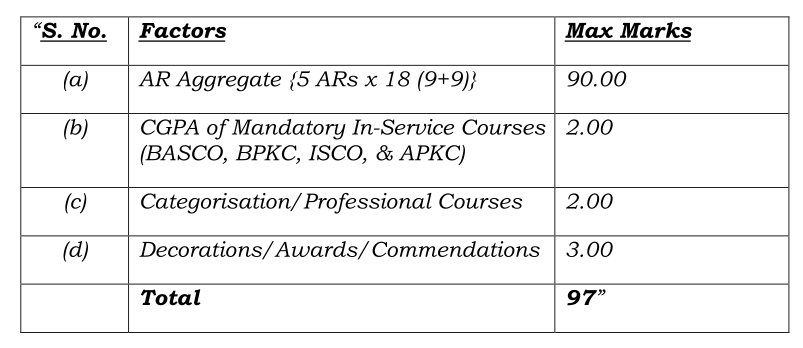
5.15. Further, Appendix C prescribed the method of preparation of the merit list, allocating marks primarily on the basis of AR aggregates, with limited weightage for in-service courses, categorisation, and honours. The marks were apportioned in the following manner:
5.16. Pursuant to the release of this policy, a Board was convened in March 2019. Although all the Appellant-SSCWOs submitted their willingness to be considered for PC, some of them were not considered owing to their failure to meet the Minimum Performance Criteria. Thereafter, upon improving their eligibility parameters, they were considered in the 2020 and 2021 Boards but were not granted PC due to the limited number of vacancies and lower comparative merit. They were subsequently released from service following the declaration of the results of the 2021 Board on 24.05.2021.
5.17. The aggrieved Appellants in Diary Nos. 28412, 28420, 28428, 28432, and 47092 of 2024 filed their Original Applications (OAs) before the AFT, seeking, inter alia: (i) to set aside HRP 01/2019 to the extent of its alleged arbitrariness; (ii) to direct the Respondents to grant PC to the Applicants;
and (iii) to direct the Respondents to produce signals/documents related to the declassification of vacancies with respect to the SSCOs for the Boards of 2019, 2020, and 2021. Besides this, they sought an interim stay on their release from service. However, such interim relief was denied by the AFT on 04.06.2021 and subsequently by the High Court on 11.06.2021.
5.18. The AFT, vide its Impugned Judgement dated 26.09.2023, dismissed the OAs as bereft of any merit, holding that the Appellants, having participated in the process with knowledge of the governing HRP, could not subsequently challenge its terms. Furthermore, the Appellants were denied PC on account of their failure to meet the Minimum Performance Criteria or low placement in the order of comparative merit.
5.19. The remaining Appellant, i.e. the Petitioner in SLP (C) No. 16548/2024, was commissioned in January 2007 and was proposed to be released from service on 01.01.2021, i.e. prior to the Selection Board of 2021. She was not considered by the 2019 Board as she did not meet the Minimum Performance Criteria and was not granted PC in the 2020 Board owing to inter se low merit. Challenging the fairness of HRP 01/2019 and submitting that her right to be considered thrice under the policy would be taken away if she were discharged in January 2021, she approached the AFT. The AFT, on 16.03.2021, declined to interfere with the policy merely because it applied harshly to the Appellant, but permitted her to continue in service till she was considered a third time by the Selection Board. When the Appellant was not granted PC in the 2021 Board, she approached the High Court by way of a Writ Petition, challenging the AFT’s order dated 16.03.2021 and claiming that she ought to have been considered as per the eligibility conditions laid down in HRP 21/2006. Vide the Impugned Judgement dated 19.02.2024, the High Court has dismissed her challenge on the ground that the assessment undertaken by the Boards in 2020 and 2021 had not been assailed.
5.20. What emerges is that some of the Appellant-SSCWOs before us have been held ineligible for PC owing to their failure to meet the Minimum Performance Criteria in at least one Board and being classified as low in comparative merit in successive Boards, while others have been denied PC because of their low comparative merit in all three Boards. It is against this factual and procedural backdrop that the instant appeals have been instituted.
5.21. It may also be noticed that three SSCWOs who were commissioned in 2011, have assailed the Boards conducted in 2023, 2024, and 2025, owing to which they were not granted PC. Such a challenge has been made, at this stage, by filing applications for impleadment and directions in the Civil Appeal arising out of Diary No. 28412/2024. This Court has, during the pendency of these applications, passed interlocutory orders permitting the Intervenor-SSCWOs to continue in service.
B. Contentions of the Parties
6. Dr. Menaka Guruswamy, learned Senior Counsel and Ms. Garima Sachdeva, learned Counsel, appearing on behalf of the Appellants, assailed the Impugned Judgements and mounted a substantive challenge to the fairness and method of implementation of HRP 01/2019. They advanced the following submissions:
(a) HRP 01/2019 was implemented impulsively, in undue haste, depriving several meritorious and otherwise qualified SSCOs of a reasonable gestation period to prepare for the Board and to meet the newly-prescribed Minimum Performance Criteria. Although the policy contemplated that the Board would ordinarily be convened in May each year, the first Board in 2019 was held in March, barely one and a half months after the policy came into force. This stood in stark contrast to the extended transition period afforded under the revised Promotion Policy from Wing Commander to Group Captain, which was implemented only after sufficient advance notice.
(b) Furthermore, the Appellant in Diary No. 28412/2024 and the Intervenor in I.A. No. 127999/2025 were on maternity leave immediately prior to or during the 2019 Board proceedings. Their most recent ACRs, therefore, reflected comparatively lower gradings, which did not accurately capture their overall competence or performance across their service tenure.
(c) At the time of the Appellants’ induction, the grant of PC to SSCOs had been suspended across the board. This suspension remained operative until 2019, by which time the Appellants had completed a
substantial portion of their tenure. Their ACRs were thus authored in an environment where it was presumed that they would be released upon completion of 14 years of service, without any prospect of long-term retention. Such grading was necessarily casual and not oriented towards evaluating suitability for career progression. This phenomenon mirrored the concerns recognised by this Court in Lt. Co. Nitisha & Ors v. Union of India & Ors.3, where officers assessed without any perceived career horizon were held to have been disadvantaged in subsequent selection processes. Moreover, the very same set of ACRs that had been utilised in the 9th year of service to determine suitability for extension was later reused in the 11th, 12th, and 13th years to assess suitability for PC, despite having been recorded without any intention of evaluating long-term potential. Finally, the Appellants were never informed of their ACR gradings or relative merit position.
(d) The Air Force introduced a new policy in 2017 whereby Initiating Officers (IOs) were required to separately justify any grading of 7.5 or above in the ACRs, at least 3 months in advance. This requirement operated as a structural impediment for SSCOs who were, at that time, still ineligible for PC and therefore, unlikely to be nominated for such enhanced gradings. In contrast, officers with prospects of career advancement continued to receive higher scores.
(e) Women could be commissioned in the Air Force only through the SSC Scheme, whereas men could enter either through the SSC Scheme or the PC Scheme, which effectively provided a near-direct pathway to PC. Male SSCOs were also afforded an opportunity, after 10 years of service, to convert to the PC Scheme, whereas SSCWOs could become PC officers only upon selection through the PC Board. Officers inducted through the PC Scheme were eligible to appear before their first promotion board for the rank of Group Captain after 15 years of service and, even if not selected, could attain the select rank of Group Captain (Time Scale) in their 26th year without further scrutiny. Such officers were also not required to satisfy the QRs prescribed under HRP 01/2019. Consequently, higher ACR gradings were naturally reserved for officers with avenues for long- term career progression.
(f) Categorisation courses, introduced from 2008 onwards in various branches/streams, were voluntary courses undertaken to enhance professional competence. The category grading obtained through such courses remained valid only for one year. Further, eligibility for higher-level courses depended upon the existing grading. For instance, to avail a Categorisation A course (the highest course), the respective SSCO had to have successfully completed a Categorisation B course. HRP 01/2019 introduced, for the first time, the grades obtained in these courses as a Minimum Performance Criteria and as an Evaluation Criterion for the grant of
PC. SSCOs lacking the minimum Category C qualification were rendered ineligible for consideration, while those possessing a valid Categorisation were assigned marks depending upon the level attained. Due to the abrupt implementation of this policy, the Appellants were unable to obtain the requisite grades in these courses in time and were consequently declared ineligible. Even after obtaining the minimum Categorisation, there was insufficient time to improve it further before the next Board, particularly since such courses were conducted only twice a year.
(g) Similarly, the Respondents introduced, for the first time, as an eligibility criterion for consideration for PC, a minimum CGPA of 6 in the Mandatory In-Service Courses (MISCs). These courses had been completed by the Appellants during the early years of their service, without any indication that such scores would later determine their eligibility for PC. The retrospective reliance on such scores thus operated unfairly against the Appellants.
(h) The Respondents failed to disclose the number of vacancies against which the SSCOs were being considered prior to the commencement of the respective Boards. Such vacancies were declassified only at the stage of declaring the results. During the Boards held in 2019, 2020, and 2021, the number of available vacancies was extremely limited. However, in 2025, as many as 115 SSCOs were granted PC, including some who allegedly did not possess valid Categorisation, indicating inconsistency in approach to the detriment of the Appellants.
(i) An SSCO released from service receives substantially fewer pensionary and terminal benefits than an Airman. An Airman becomes eligible for pension upon completion of 15 years of service and may even opt for discharge with pension after 12 years at certain ranks. This disparity compounds the hardship faced by the SSCOs denied PC.
7. Per contra, Ms. Aishwarya Bhati, learned Additional Solicitor General of India, appearing on behalf of the Respondents, supported the findings returned by the AFT and the High Court as well as the policy regime governing the consideration for PC, and forcefully urged that:
(a) The prescription of Minimum Performance Criteria for the grant of PC falls squarely within the administrative domain of the Air Force, as an employer, tasked with maintaining operational readiness and organisational efficiency. The Air Force is entitled to revise eligibility conditions in response to evolving organisational requirements. Thus, judicial review of such policies and frameworks must remain confined to examining whether a policy is implemented lawfully and in a reasonable manner. The Courts cannot substitute their views for those of the Executive in matters concerning the country’s Armed Forces and their combat readiness.
(b) By seeking sympathetic consideration on the ground of being on maternity leave during one of the Boards, some of the Appellants and Intervenors were attempting to raise new issues before this Court, which were not agitated previously before the AFT. New factual grounds, not previously urged before the AFT, cannot be introduced in appellate proceedings for the first time.
(c) The Air Force’s policies have always been gender-neutral, as all officers have been treated equally in terms of postings, promotions, and pay. From 2010 to 2023, 631 SSCOs were granted PC, of which
441 were SSCWOs, signifying that gender has never been the determining factor when granting PC. Furthermore, unlike the Army, where SSCWOs were historically ineligible for PC, the Air Force suspended the grant of PC to all SSCOs commissioned after 25.05.2006, irrespective of gender.
(d) Furthermore, successive HRPs governing the grant of PC namely, HRP 04/2004, HRP 04/2010, and HRP 03/2011, consistently prescribed minimum ACR averages as eligibility criteria for consideration for PC or extension. For example, HRP 04/2004 and HRP 04/2010 required a minimum average ACR grading of 6.5 over the preceding three years, along with a minimum score of 6 in each professional and behavioural factor. HRP 03/2011 raised the minimum average to 7 while retaining the other requirements. These standards applied equally to the Appellant-SSCWOs when being considered for extension of service. HRP 01/2019 carried forward substantially similar ACR requirements. Since these criteria remained consistent across policies, all SSCOs were fully aware of them and could not claim prejudice from the sudden introduction of new standards.
(e) Officers inducted through the PC Scheme and those inducted through the SSC Scheme could not be treated as similarly situated, as they are governed by fundamentally different terms and conditions of service. PC officers are inducted with the objective of serving until superannuation, whereas SSCOs are inducted for a limited tenure to maintain a youthful and combat-ready force, particularly given the demanding operational conditions in which Air Force personnel function.
(f) Pursuant to the recommendations of the Ajay Vikram Singh Committee, the Air Force has been endeavouring to increase intake through the SSC Scheme, while reducing the strength of the permanent cadre. This policy ensures a lower average age profile in the Air Force and improved promotional prospects for officers in the regular cadre. At present, the bulk of shortages exists in the non- select ranks. Increasing the number of officers granted PC, despite a negligible deficiency in the select ranks, would adversely affect the morale, aspirations, and career progression of other officers.
(g) The Categorisation scheme, introduced in 1989 initially for one branch and later extended across most streams, aims to enhance professional competence, standardise evaluation of expertise, and distinguish officers based on professional calibre. It has long been used as a criterion to select officers for key field appointments, diplomatic assignments, postings abroad, as well as cross- streaming of officers in the AE branch.
(h) Along the same lines, the MISCs were introduced in 2008 along with a CGPA-based system of grading to encourage sustained performance during the formative stages of an officer’s career. The CGPA was intended to serve as an objective numerical measure of merit in addition to ACRs for evaluating officers at various stages in their careers.
(i) In an organization such as the Air Force, where competition is stiff and vacancies have always been limited, granting PC to the Appellants and the Intervenors, without regard to their merit position and the available vacancies, would unfairly disadvantage other deserving SSCOs who ranked higher in merit but did not seek to challenge the results of the Boards. Merit-based selection is essential to maintain fairness, discipline, and organizational integrity.
C. Issues
8. Viewed in the context of the regulatory regime applicable to the Air Force and the submissions advanced on either side, the questions that fall for our adjudication in these appeals may be formulated as follows:
i. Whether the ACRs of the Appellants were graded casually without adjudging their suitability for promotion and thus, adversely impacted their inter se merit?
ii. Whether the prescription of Minimum Performance Criteria based on CGPA in MISCs and Categorisation arbitrarily excluded SSCOs from consideration for PC?
iii. Whether the assessment undertaken in HRP 01/2019 is vitiated for any other reasons
D. Analysis
D.1 Issue No. 1: Alleged Casual Grading of the Appellants’ ACRs
9. This issue pertains to the manner in which the Appellants’ ACRs were finalized and the extent to which those assessments affected their consideration for the grant of PC. Since ACRs constitute the principal material on the basis of which suitability and inter se merit are determined, it becomes necessary to examine whether the ACRs relied upon by the BoO faithfully reflected the Appellants’ professional performance and long-term potential within the Air Force.
10. To this end, the Appellants contend that the ACRs, forming the foundation of their assessment for the grant of PC, do not represent a fair or reliable measure of their suitability for career advancement or long-term retention. According to them, these ACRs were authored in a policy environment in which they were never eligible for PC and were expected to serve only a finite tenure before being discharged. The
Respondents, on the other hand, maintain that the ACRs were assessed objectively and uniformly and that the Appellants’ non-selection resulted solely from their comparatively lower merit.
11. That being so, and in order to appreciate the nature of the controversy, it is necessary to examine the role played by ACRs within the Air Force. An ACR is a structured evaluative document prepared by the IO, Reviewing Officer (RO), and Senior Reviewing Officer (SRO) to assess an officer’s competence, performance, and suitability for particular kinds of future employment within the service. Crucially, the nature of this assessment is shaped by the objective for which the ACR is written, i.e., whether it is for the extension of service, promotion, or long-term retention. The evaluative lens applied by the chain of assessing officers is therefore conditioned by their understanding of the career trajectory available to the officer concerned.
12. In the case of the Appellants, since they were commissioned after 25.05.2006, the governing policy throughout the bulk of their service tenure was that they were ineligible for PC. This position is not in dispute. The recruitment advertisements and HRPs governing the terms of induction and service made it abundantly clear that their engagement was for a limited duration, ordinarily culminating in release upon completion of the prescribed tenure, subject only to the possibility of a 4-year extension. Even subsequent policies concerning the grant of PC consistently confined such consideration to all SSCOs commissioned prior to 25.05.2006. Thus, from 2006 until 2019, there existed no institutional expectation that any SSCOs commissioned after 25.05.2006 would be retained on a permanent basis.
13. It is against this policy backdrop that the ACRs of the Appellants were authored. The IOs, ROs, and SROs assessing their performance were necessarily concerned with determining suitability for continuation within a short-term framework, particularly for the purpose of granting extension after completion of the initial tenure. Even after such extensions were granted in 2017, the underlying premise remained unchanged: the Appellants had no pathway to long-term career progression or advancement to higher command positions within the Air Force. The appraisal process, therefore, operated within clearly circumscribed limits.
14. The position altered only with the introduction of HRP 01/2019, which, for the first time, opened a window for all serving SSCOs commissioned after 25.05.2006 to be considered for PC. While the policy sought to broaden opportunities for serving SSCOs, it simultaneously required them to compete for PC on the basis of ACRs that had been written for an entirely different purpose. The reports, originally intended to assess eligibility only for extension, were retrospectively treated as reliable indicators of suitability for long-term retention, higher responsibility, and advanced leadership potential. In essence, the assessments grounded in a particular context were transplanted into another without accounting for the diverging objectives of assessment. This methodological mismatch in evaluation permeated all ACRs graded until
the implementation of HRP 01/2019. Although ACRs written after 2019 may have reflected the revised policy environment, they constituted a minority portion of the material considered to determine the grant of PC, and as such, were insufficient to offset the weight of earlier reports authored under a contrary assumption.
15. Viewed in this light, the Respondents’ submission that the minimum average ACR grading required for extension and for PC remained broadly consistent does not adequately address the real substance of the issue before us. The controversy does not lie in the numerical thresholds prescribed by policy, but in the qualitative context in which those gradings were awarded. An assessment undertaken to evaluate performance within a limited service horizon cannot be treated as an assessment of suitability for permanent absorption. To do so would be to overlook the basic premise upon which the appraisal was originally conducted.
16. The same principle has been recognised in two judgements of even date, being Lt. Col. Pooja Pal and Ors. v. Union of India and Ors., z((Civil Appeal Nos. 9747 – 9757/2024.)) and Yogendra Kumar Singh v. Union of India and Ors.4 whereby we have laid down that when officers in the Army and Navy are evaluated under the prevailing assumption that they have no future in the service, the appraisal process itself becomes structurally distorted. Years of assessment conducted without reference to long-term career progression cannot later be deployed to the disadvantage of such officers when they are suddenly placed in the competitive fray for PC. Ultimately, the fairness of the selection process cannot be assessed in isolation from the conditions under which the underlying evaluative material was generated.
17. In such circumstances, we have no option but to conclude that the ACRs of the Appellants were authored in an environment where their suitability for PC was never meaningfully contemplated. The subsequent use of such reports, which are not truly indicative of their suitability for long- term career progression, to determine their eligibility for PC is thus inherently unfair and arbitrary. In effect, such use has materially prejudiced their consideration for the grant of PC.
D.2 Issue No. 2: The Abrupt Introduction of New Eligibility Criteria
18. Apart from the concerns regarding the subjective distortion in the assessment of SSCOs through ACR gradings, the Appellants have also questioned the sudden introduction of new Minimum Performance Criteria for eligibility to be considered for the grant of PC under HRP 01/2019. In particular, the requirement of possessing a Categorisation of at least Category ‘C’, is said to have resulted in a substantial number of SSCOs being declared ineligible during the Boards conducted in 2019 and even in 2020.
19. On the other hand, the Respondents have defended these eligibility prescriptions as operationally necessary and uniformly applicable to all SSCOs covered by HRP 01/2019.
20. The Minimum Performance Criteria for the grant of PC under HRP 01/2019 is set out in Appendix A thereto, an extract of which has already been reproduced in Paragraph 5.14 above. While we have adverted, in the preceding issue, to the lack of objectivity in ACR gradings, the instant issue raises an additional and independent concern, namely, the manner in which these newly-introduced Minimum Performance Criteria were applied to the Appellants during the Boards convened under HRP 01/2019.
21. For the purposes of this issue, it is sufficient to refer to two specific requirements prescribed in Appendix A. First, the concerned SSCO must secure a minimum average CGPA of 6.0 in the MISCs, i.e. the Basic Air Staff Course: Officers, the Intermediate Air Staff Course: Officers, the Basic Professional Knowledge Course: Officers, and the Advanced Professional Knowledge Course: Officers. Second, the concerned SSCO must possess a Categorisation of at least Category ‘C’.
22. Learned Senior Counsel/Counsel appearing for the Appellants have fairly acknowledged that the imposition of minimum performance thresholds for the purpose of service progression is not per se the ground of challenge, as such matters lie primarily within the policy domain of the Air Force and must necessarily take into account technical
considerations, operational requirements, and leadership experience. There is no assertion that the criteria themselves are intrinsically unlawful. The gravamen of the Appellants’ grievance lies in the manner and timing of their introduction and implementation.
23. The Appellants belong to the first batches of SSCOs considered under HRP 01/2019. At the time of their induction in 2007, HRP 21/2006 had already suspended the grant of PC to all SSCOs commissioned after 25.05.2006. As such, they were borne into the service where neither the Authorities nor the Senior Officers envisaged any prospect of long-term career progression for such SSCOs.
24. It is not disputed that MISCs and Categorisation were available to the Appellants during their service. MISCs formed part of the normal progression of SSCOs, while Categorisation could be pursued voluntarily through training and evaluation. However, there was never any indication that performance in MISCs or the acquisition of Categorisation would later determine eligibility for PC. Indeed, earlier policies governing the grant of PC, including HRP 03/2011, did not prescribe any minimum requirement relating to MISC performance or Categorisation. It is, therefore, reasonable to infer that, prior to HRP 01/2019, there existed no tangible career incentive for SSCOs to excel in MISCs or to seek Categorisation proactively.
25. The position altered fundamentally with the issuance of HRP 01/2019 on 16.01.2019, by which MISCs and Categorisation suddenly assumed
decisive importance in determining eligibility to even be considered for the grant of PC. Once such criteria were introduced, it would be natural for the SSCOs to attempt to achieve the requisite Categorisation at the very least, even if they could not improve their performance in the MISCs belatedly.
26. However, the Respondents, seemingly in a hurry to implement the new policy for the grant of PC, issued directions to conduct the first Board for all eligible SSCOs as early as March 2019, though HRP 01/2019 had only been introduced in January 2019 and itself stipulated that the ordinary timeline for the conduct of the annual Board would be in May of that year. This accelerated timeline effectively deprived many SSCOs of any meaningful opportunity to comply with the newly-introduced requirements, particularly the acquisition of Categorisation. As a result, a significant number of SSCOs were rendered ineligible at the threshold without any realistic chance to remedy the deficiency.
27. It has been submitted before us that, ordinarily, Categorisation sought to be achieved in any given year becomes available only in the month of November. Consequently, even after becoming aware in January 2019 that Categorisation had been made mandatory, none of the SSCOs could realistically obtain the requisite qualification before November 2019, if they did not already possess it. The convening of the Board in March 2019, therefore, left them without any feasible avenue to become eligible for consideration for PC in that cycle.
28. This anomaly assumed greater significance when viewed in the broader context of the initial Boards conducted under HRP 01/2019. Those Boards involved a large pool of SSCOs competing for a relatively smaller number of vacancies, especially when compared to subsequent Boards. Moreover, in each ‘look’, a varied combination of positive and negative factors, including applicable ACRs, enhanced qualifications, and newer honours and awards, would come into play to determine the position of each SSCO within the order of inter se merit.
29. Since HRP 01/2019 limits the opportunity to be considered for PC to merely three chances, and since the circumstances surrounding each round may materially affect the evaluation of merit, the ability to participate meaningfully in every ‘look’ assumes considerable importance. Each round of consideration thus represents a valuable opportunity for an eligible SSCO to be assessed for the grant of PC.
30. Viewed from this angle, the precipitous conduct of the first Board in March 2019 deprived the Appellants of one of the three promised and evidently, precious, opportunities for consideration for PC. Acceptance of the Respondents’ argument would, in effect, legitimise a situation where eligibility hinged on prior voluntary actions taken at a time when such actions bore no relevance to future career prospects.
31. A related grievance has also been raised by certain SSCWOs who were unable to be effectively considered during one of the years due to pregnancy, resulting in a temporary lowering of medical category and
fitness grading. It is a well-settled principle of law and social equality that the choice to become a parent cannot be equated with an unwillingness to pursue professional advancement. The Respondents have not placed before us any material to suggest that such officers, who lost a round of consideration due to an intervening pregnancy, were accommodated and assured the three opportunities for consideration envisaged under HRP 01/2019.
32. In light of the foregoing circumstances, we are constrained to hold that the hurried implementation of HRP 01/2019, without affording any opportunity to the SSCOs to meet the newly-prescribed Minimum Performance Criteria, and without making adequate provision for officers who were unable to be considered for PC due to lower medical category and lesser average ACR scores on account of an intervening pregnancy, amounts to arbitrariness in the effect of the policy and is liable to invite interference from this Court.
D.3 Issue No. 3: Other Contentions Proffered by the Appellants
33. For the sake of completeness, it is necessary to advert to certain additional grievances raised by the Appellants. They have, inter alia, assailed the manner in which vacancies were computed for the Boards conducted in 2019, 2020, and 2021 under HRP 01/2019. It has also been urged that the Respondents did not publish any clear policy or framework stipulating how the vacancies would be identified, calculated, and apportioned amongst the eligible SSCOs.
34. However, in view of the findings already recorded in the preceding portions of this judgement and the directions we propose to issue hereinafter, we do not deem it necessary to undertake an exhaustive examination of the challenges relating to the determination of vacancies. It would be suffice to note that, vide a judgement of even date rendered by us, namely, Yogendra Kumar Singh (supra), concerning the Indian Navy, we have held that “the failure to disclose the evaluation criteria, vacancy computation methodology, and allied policy considerations prior to the conduct of the Selection Boards in 2020 and 2022 must be held to have violated basic norms of fairness and transparency.” While the decision in the instant appeals does not turn on this issue, the principle articulated therein is of general application. The same reasoning shall, therefore, govern the selection processes undertaken by the Air Force as well, both in the past and in future exercises of a similar nature.
E. Conclusion and Directions
35. In the backdrop of the policy reversal governing the grant of PC to SSCOs commissioned after 25.05.2006 in the Air Force and the challenges mounted thereto, it is appropriate, before parting with this judgement, to recapitulate the conclusions on the issues that have arisen for our determination. They are summarised as follows:
(i) The ACRs of the Appellants, having never been authored to assess their suitability for career progression, could not have been considered as indicative thereof, and utilized to deny them the grant of PC later on; and
(ii) The Minimum Performance Criteria, introduced for the first time in HRP 01/2019, was implemented in haste without affording the Appellants a reasonable opportunity to meet such criteria prior to the conduct of the first Board in 2019
36. At this stage, we may advert to the current status of the Appellants before us.
37. The original Appellants, who were inducted on SSC in 2007 and were considered for the grant of PC in 2019, 2020, and 2021, were released from service in 2021 itself. Notwithstanding the arbitrariness in certain aspects of the assessment process, it would not be prudent or in the interest of the operational effectiveness of the Air Force to direct reinstatement and/or reconsideration of the Appellants for the grant of PC. However, that alone cannot be a sufficient reason to deny any benefits to such deserving officers. In our opinion, the approach taken by us, albeit in a slightly different context, in Yogendra Kumar Singh (supra) would serve the interests of the Appellants as well as the larger structural requirements of the Air Force.
38. On the other hand, the Intervenors were commissioned only in 2011 and were not considered for the grant of PC till 2023. Presently, they continue to remain in service, protected by the interim orders passed by this Court. It seems to us that their grievances with the evaluation process applicable to them emanate from a different factual context than that which we have had occasion to examine in these appeals.
39. In this light, we consider it appropriate to allow these appeals and set aside the Impugned Judgement dated 26.09.2023 passed by the AFT and the Impugned Judgement dated 19.02.2024 passed by the High Court, with the following directions:
(i) The grant of PC to the SSCOs who have already been granted PC by the Boards convened in 2019, 2020, and 2021 shall not be disturbed;
(ii) As a one-time measure, all the SSCOs who were considered for the grant of PC in all three Boards convened in 2019, 2020, and 2021, shall be deemed to have completed substantive qualifying service of 20 years and shall be entitled to pension and all consequential benefits, except arrears of pay, on the basis that they have completed such minimum service. As a matter of abundant caution, we clarify that even those SSCOs whose three chances were to take place sequentially in 2019, 2020, and 2021 but were declared ‘ineligible’ in one or more of the Boards, shall also benefit from this direction;
(iii) The pension shall be fixed on the basis of the date of completion of the deemed service of 20 years, but arrears thereof, if any, shall be paid to the SSCOs only with effect from 01.01.2025;
(iv) The Intervenor-SSCWOs, who have been granted stay on release from service by this Court and who are aggrieved by the results of the Boards convened after 2021 in which they have been denied PC, may pursue their remedies in accordance with the law. If their
challenges are already pending before the AFT or the High Court, they may continue to pursue such claims. While pursuing such remedies, the stay granted on their release from service shall remain in operation, subject to the modification, if any, that may be made by the AFT or the High Court, as the case may be; and
(v) For all future Selection Boards, the Respondents shall issue appropriate General Instructions, prior to the conduct of such Board, laying down: the vacancies available in each branch/stream for each batch; the detailed criteria for evaluation along with the apportionment of marks for each criterion; and any other information that may be necessary to supply to the officers under consideration for that purpose.
40. Ordered accordingly.
41. Pending applications, if any, also stand disposed of in the above terms.
Lt. Col. Pooja Pal
Versus
Union of India
SURYA KANT, CJI.
Applications for intervention and impleadment are allowed, and the Applicants therein are directed to be impleaded as Intervenors.
2. The instant batch of appeals has been preferred by a group of roughly 73 Short Service Commission Officers (SSCOs) of the Indian Army, the vast majority of whom are women seeking the grant of Permanent Commission (PC). Their grievances centre on the fairness and reasonableness of the method adopted for their consideration, an issue that has repeatedly engaged Constitutional Courts and the relevant Tribunals over the last two decades.
3. To succinctly summarise the instant appeals, the Short Service Commission Women Officers (SSCWOs) approached the Armed Forces Tribunal, Principal Bench at New Delhi (AFT), praying for the grant of PC. However, vide judgements dated 03.07.2024 and 04.09.2024 (Impugned Judgements), the AFT dismissed their Original Applications (OAs), holding that there was no discrimination or bias against the SSCWOs and that the denial of PC was solely attributable to lower comparative merit. Notably, a few of their male counterparts, who were commissioned alongside them in September 2010 and March 2011, have also assailed the Impugned Judgements, aligning themselves with the women officers on certain common issues.
A. Facts
4. Before examining the legal aspects involved in dissecting the Appellants’ claims, it is incumbent upon us to trace the factual background that has culminated in the instant set of appeals.
4.1. The Appellant-SSCWOs belong to:
(i) Course No. 4 (SSCWOs-4) commissioned in September 2010;
(ii) Course No. 5 (SSCWOs-5) commissioned in March 2011;
(iii) Course No. 6 (SSCWOs-6) commissioned in September 2011; and
(iv) Course No. 7 (SSCWOs-7) commissioned in March 2012.
Two of the Intervenor-Appellants belong to Course Nos. 9 and 10, respectively. The male SSCOs commissioned in September 2010 (SSC- 90) are the counterparts of SSCWOs-4, while those commissioned in March 2011 (SSC-91) correspond to SSCWOs-5. Some of the male SSCOs come from the September 2011 and March 2012 batches. On the other hand, the Respondents before us comprise the Union of India represented through the Ministry of Defence, the Chief of Army Staff, and the Military Secretary.
4.2. The Appellant-SSCWOs mentioned above form part of the earliest batches to be considered for the grant of PC alongside their male counterparts by the bi-annual regular No. 5 Selection Board. At the time, their joint consideration was intended to represent a watershed moment in the evolution of gender parity within the Armed Forces. Yet, as
contended by the Appellant-SSCWOs, this formal parity often operated against the backdrop of service records shaped by varying evaluation regimes, much like asking runners, trained for years on different tracks, to compete suddenly on the same finishing stretch.
4.3. To appreciate the nature of their grievances and to understand why they have chosen to approach this Court, it is essential to first note the structure of the officer cadre in the Army. Broadly, it is divided into two categories: (i) the regular cadre, comprising Permanent Commission officers (PC officers); and (ii) the support cadre, which includes Permanent Commission (Special List) Officers, Service Commission Officers, and SSCOs.
4.4. The distinction between these cadres lies principally in tenure, career progression, and post-retirement benefits. While PC officers serve until the age of superannuation, SSCOs serve for a fixed tenure and are thereafter released from service. The scheme for the induction of SSCOs was introduced in 1964 and, at its inception, was open only to men. Initially, such officers were appointed for a tenure of five years, which was later extended to a ‘5 + 5’ model, with consideration for PC in the fifth year of service. Furthermore, in the Army, officers of two courses are commissioned in one calendar year, i.e. the officers of the 1st course are commissioned in March, while officers of the 2nd course are commissioned in September of the same year. The officers of both courses, together, are referred to as the batch of a particular year.
4.5. The policy governing the grant of PC was modified by a policy circular dated 15.01.1991 issued by the Government of India. This policy prescribed, inter alia, an annual cap of 250 vacancies for the grant of PC, a minimum cut-off score of 60%, and competitive selection on merit in circumstances where the number of eligible officers exceeded the prescribed ceiling. All SSCOs other than non-optees and those found unfit for retention were to be granted a five-year extension. The policy was implemented with immediate effect. Its relevant part reads as follows:
“(a) A maximum of 250 SSCOs will be granted Permanent Commission per year. The number of vacancies for the batches within the year will be allotted in proportion to their inter se strength.
(b) Minimum acceptable cut-off grant for grant of Permanent Commission to SSCOs will be 60%. This may, however, be reviewed by the Army HQs, every two years, keeping in view the rating tendencies as at that time.
(c) In case more than the specified number of officers make the grade from the batches considered in a year, the requisite number only, i.e., 250 will be granted Permanent Commission on competitive merit.
(d) All SSCOs, other than non-optees and those considered unfit for retention by the Selection Board, will be granted five year extension.”
[Sic] [Emphasis supplied]
4.6. This policy circular was supplemented by a File Noting dated 22.01.1991, which elaborated the mechanism for distributing PC vacancies across batches in proportion to their respective strengths and illustrated the method of calculation. It, inter alia, provides the following:
“2. The modalities for the implementation of the Govt. order ibid will be as under:-
a. The grant of PRC to the total No of SSCOs in a batch will be based on the Inter se batch strengths in one calendar year.
b. The No of PRC vacancies allotted to a batch, which are arrived of by applying the above ratio, would not be transferrable to the next batch even within the same calendar year:
c. In the calculation of the vacancies per batch, fractions would be rounded off to the next higher for the batch having a greater strength and, neglected for the smaller batch of the some calendar year.
3. The above is illustrated with the following example –
X Year
(a) Let 1 course intake be -240 GC’s
(b) Let 2 course intake be -80 GC’s
(c) Total intake for the year -320 GC’s
(d) Nos to be selected from the 1st course -240 x 250/320
= 187.5, say 188
(e) Nos to be selected from the 2nd course -80 x 250/320
= 62.5, say 62
(f) Total Nos to be selected in the year -188+62=250”
[Sic] [Emphasis supplied]
4.7. It is pertinent to note at this juncture that the above-extracted policy circular and File Noting were issued at a time when women were altogether excluded from induction into the Army. This position changed the following year, when, on 15.02.1992, the Government of India issued a notification under Section 12 of the Army Act, 1950, making women eligible for appointment as officers in limited cadres. Women were inducted through the Women Special Entry Scheme (WSES) as SSCOs
for an initial tenure of five years, with an express stipulation that they would not be eligible for PC and would be released upon completion of their service.
4.8. Over time, the tenure of women officers was extended through notifications dated 12.12.1996 and 28.10.2005, resulting in a total permissible tenure of fourteen years, structured as ‘5 + 5 + 4’ years. Despite these extensions, women officers continued to remain ineligible for consideration for PC.
4.9. Dissatisfaction with this arrangement culminated in the filing of a public interest litigation by Adv. Babita Puniya, before the High Court of Delhi (High Court), seeking parity for women officers in the consideration for PC. This marked the beginning of a prolonged series of interconnected litigation that eventually reshaped the service conditions of women officers in the Army for the better.
4.10. During the pendency of those proceedings, the Union Government issued two circulars dated 20.07.2006, discontinuing the WSES and introducing a new framework for commissioning women officers in technical and non-technical cadres within the Army. While these circulars modified training, tenure, and seniority provisions, they reiterated that women officers would not be eligible for PC, though they could seek a four-year extension after their initial term of ten years of service. The scheme of engagement was accordingly altered to ‘10 + 4’ years, which continues to hold the field. The first batch of women officers
under the new scheme, i.e. Course No. 1 (SSCWOs-1), was commissioned shortly thereafter.
4.11. The High Court, in the meantime, passed the landmark judgement in Babita Puniya v. Secretary1 on 12.03.2010, holding that once women were inducted into certain cadres, there could be no discrimination in the opportunities available to them within those cadres. By virtue of this finding, the High Court directed that in cadres where both men and women were recruited as SSCOs and where men were granted PC, the women officers were entitled to be considered for PC at par with their male counterparts. The Respondents assailed this decision before this Court through Civil Appeal No. 9367-9369/2011. During the pendency of the appeal, this Court vide an order dated 02.09.2011, declined to stay the operation of the High Court’s judgement and clarified that the same had remained in force from the date of its pronouncement since no order of stay had ever been passed against it. It is pertinent to note that all the instant Appellant-SSCWOs were commissioned after the pronouncement of the High Court’s decision and thus, at the time of their induction into the Army, they were entitled to consideration for the grant of PC.
4.12. Parallelly, by virtue of a letter dated 26.09.2008, later implemented through another letter dated 04.10.2010, women officers of the Judge Advocate General (JAG) and Army Education Corps. (AEC) cadres were made eligible for consideration and grant of PC alongside their male counterparts. The effect of these letters was that, though women were being commissioned in ten Arms and Services in the Army and despite the authoritative pronouncement by the High Court, eligibility for PC was confined to JAG and AEC cadres for women officers.
4.13. Shortly thereafter, a comprehensive policy dated 24.02.2012 was issued, detailing a structured methodology for the grant of PC to all the eligible SSCOs through a combination of objective and subjective criteria. To do so, the marks were apportioned between ‘computerised evaluation’ and ‘value judgement’ in a way whereby the former was assigned a weightage of 95%, while 5% weightage was reserved for the latter. The value judgement marking was to be rendered by the members of the No. 5 Selection Board.
4.14. Under this policy, a computerised Member Data Sheet (MDS) was generated, capturing the year-wise performance of each officer in their respective Courses, Special Achievements, Weak Points, Disciplinary Awards, and Honours and Awards. This would be accompanied by the recommendations of the Initiating Officer (IO) and Reporting Officer (RO) for the grant of PC or extension. The value judgement exercised by the members of the No. 5 Selection Board was required to take into account all the material reflected in the MDS, including liberal/strict reporting inconsistency in performance, nature and seriousness of disciplinary award(s), technical assessment, performance on courses, strong and weak points reflected in the pen picture, and appointments held by the officer under consideration.
4.15. To arrive at the computerised evaluation in the MDS, the Military Secretary’s Branch (MS Branch) would compute the relevant information, allot marks, and work out averages for the following parameters:
i. OAP: This is the overall performance of the officer, evaluated by taking the average of the figurative assessment of all ROs in the Annual Confidential Reports (ACRs), to be converted into a proportion of 75 marks.
ii. Honours and Awards: Marks allotted differ as per the honour/award received and are added, subject to the condition that the maximum marks granted in this category will not exceed 5 marks.
iii. Games and Sports/Special Achievements: Similarly, the marks are awarded as per the level represented, wherein marks for each achievement will be added, subject to the condition that the maximum will not exceed 5 marks.
iv. Performance on Courses: Here, the grading obtained on each course will be quantified out of 10 marks, and the average shall be taken of all courses attended.
v. Recommendation for PC and Extension of Service: In this, the recommendation of each RO in every ACR will be awarded with 0 marks for ‘YES’ and minus 2 marks for ‘NO’. However, if any officer
has mentioned ‘Not Applicable’ (NA), it will be indicated in the evaluation chest by code ‘C’.
vi. Weak Points: Minus 5 marks are awarded for reflection of any of the weaknesses listed.
For the conduct of the No. 5 Selection Board, the quantified marks for the overall performance of the officer would be obtained by adding the marks assigned for value judgement to the computerised evaluation. Finally, the members of the No. 5 Selection Board were also required to award a letter-grading to each of the officers under consideration, the options for which included: ‘B’ (recommended for PC); ‘BE’ (recommended for extension only); ‘Z’ (rejected for PC and extension); ‘W’ (withdrawn); and ‘D’ (deferred).
4.16. Against this backdrop, the process for convening the regular No. 5 Selection Board commenced with the issuance of instructions to the officers of SSCWOs-4 and SSC-90 on 17.01.2020. At that point in time, as a matter of policy, only SSCWOs in JAG and AEC cadres were eligible for PC, while all the others were to be considered only for a four-year extension.
4.17. Exactly a month later, on 17.02.2020, this Court pronounced its decision in Ministry of Defence v. Babita Puniya,5 affirming the earlier judgement of the High Court and directing the Respondents to consider all serving SSCWOs for the grant of PC, irrespective of whether any of them had completed fourteen years of service. To give effect to these directions, the Respondents convened a Special No. 5 Selection Board for SSCWOs commissioned between 1992 and 2009, who had not been considered for PC at the relevant time alongside their male counterparts.
4.18. As this decision coincided with the consideration cycle of the instant Appellants of SSCWOs-4 and SSC-90, their regular No. 5 Selection Board was rescheduled, and the officers were granted extensions in the meantime. Consequently, two parallel Selection Boards were held in 2020: (i) a Special Board for earlier batches of SSCWOs, as per the directions of this Court in Babita Puniya (supra); and (ii) a regular Board for SSCWOs-4, SSCWOs-5, SSC-90, and SSC-91, who had just become eligible for consideration for PC, having completed 10 years of service. The Respondents also issued further instructions, calling for fresh applications from SSCWOs-4 and 5 so that they could opt for PC and be considered accordingly.
4.19. The Respondents accordingly issued General Instructions dated 01.08.2020 to conduct the Special No. 5 Selection Board between 14.09.2020 and 25.09.2020, whereby 615 women officers commissioned from 1992 to 2009 would be considered for PC, excluding the officers from JAG and AEC cadres. Such officers were excluded from this Board as they had previously been deemed eligible to be considered for PC and had been duly considered at the relevant time with their male counterparts. As such, they fell beyond the scope of this Court’s directions and did not require to be considered a second time.
4.20. Simultaneously, the Respondents issued General Instructions dated 14.08.2020 to conduct the regular No. 5 Selection Board to consider the officers of SSCWOs-4, SSCWOs-5, SSC-90, and SSC-91 for the grant of PC.
4.21. In the meantime, the MS Branch instructed all IOs and ROs vide a letter dated 23.10.2020 to fill the ACRs of the women officers ‘carefully’, as they had become eligible to be considered for PC. This clarification was prompted by the fact that ROs were still erroneously endorsing ‘NA’ in the column regarding ‘recommendation for PC’ for the SSCWOs.
4.22. The results of the Special No. 5 Selection Board were declared on 19.11.2020, whereby the women officers were considered “on the same terms and criteria as their male counterparts” and were benchmarked against the last selected male officer. Aggrieved by this benchmarking, the manner in which the Special No. 5 Selection Board was conducted, and the steps taken by the Union to implement this Court’s decision in Babita Puniya (supra), multiple SSCWOs approached this Court once again, by virtue of Writ Petitions filed under Article 32 of the Constitution. The lead matter in this batch of petitions was Writ Petition
(C) No. 1109/2020, titled Lt. Col. Nitisha and Ors. v. Union of India and Ors.
4.23. While this Court was seized of the above-stated batch of Writ Petitions, the regular No. 5 Selection Board for the 4 courses previously stated was conducted in December 2020. The results were promptly posted on 11.01.2021, revealing a low success rate for women officers, with only 34.4% of the officers in SSCWOs-4 and 27.27% of the officers in SSCWOs-5 being granted PC.
4.24. Shortly after the results of the regular No. 5 Selection Board were declared, this Court pronounced its judgement dated 25.03.2021 in Nitisha v. Indian Army,3 directing the Respondents to grant PC to all the SSCWOs who fulfilled the cut-off grade of 60% in the Special No. 5 Selection Board, subject to their meeting the medical criteria prescribed by the General Instructions dated 01.08.2020. The effect of this judgement was that, out of 615 SSCWOs considered for the grant of PC through the Special No. 5 Selection Board, 507 were granted PC, while 108 others were allowed to continue in service till completion of 20 years’ pensionable service. Such a decision was rendered based on this Court’s finding that the pattern of evaluation employed by the Army to implement the decision of Babita Puniya (supra), namely, the benchmarking against the last selected male officer, disproportionately affected women due to years of casual grading and skewed incentive structures.
4.25. Dissatisfied with the results dated 11.01.2021 and the outcome of their respective statutory complaints, as well as in a bid to seek similar relief as was granted in Lt. Col. Nitisha (supra), the instant Appellant- SSCWOs approached the AFT with their individually-filed OAs. Through these OAs, they prayed for: (i) A direction to call for the records based on which the Respondents issued the letter dated 14.08.2020 and the policy circular dated 15.01.1991; (ii) A direction to the Respondents to conduct a Special No. 5 Selection Board to consider the Appellants for the grant of PC, and to be granted PC if they crossed the 60% cut-off without any upper limit on vacancies; and (iii) Alternatively, to be permitted to serve till completion of 20 years’ service to enable them to earn pension. On some similar grounds, the male officers of SSC-90 and SSC-91 also approached the AFT, praying for identical relief.
4.26. While these OAs were pending before the AFT, the Respondents proceeded to conduct the regular No. 5 Selection Board for the next batches, i.e. SSCWOs-6 with their male counterparts, and SSCWOs-7 alongside their male counterparts. Both these No. 5 Selection Boards were convened in 2021, and the results were declassified on 02.07.2021 and 06.12.2021, respectively. It seems that in these Selection Boards, the women officers did not fare substantially better than their seniors, leading to further challenges before the AFT, praying for identical reliefs as the batches preceding them.
4.27. The AFT, in the Impugned Judgements, considered whether the Appellant-SSCWOs were entitled to be considered as per the parameters of the Special No. 5 Selection Board, with modifications, as directed in Lt. Col. Nitisha (supra) and whether the Respondents were justified in considering the Appellant-SSCWOs in the regular No. 5 Selection Board alongside their male counterparts. Upon answering the first issue in the negative and the latter issue in the affirmative, the AFT dismissed the Appellants’ applications and rejected their prayer for leave to appeal to this Court. Ultimately, the AFT opined that:
i. Babita Puniya (supra) and Lt. Col. Nitisha (supra) applied to the Appellant-SSCWOs only to the limited extent of considering them for PC based on the existing policies. The decisive distinction lay in the fact that SSCWOs considered by the Special No. 5 Selection Board had never been considered for PC at the relevant time, despite their male counterparts having been evaluated. Whereas the Appellant-SSCWOs were considered contemporaneously with their male counterparts and thus suffered no prejudice from delayed consideration. On this basis alone, they were not entitled to the benefit of the directions in Lt. Col. Nitisha (supra). Further, as the reliefs in the earlier judgements were granted under the aegis of Article 142 of the Constitution, the AFT opined that it lacked the authority to extend similar relief to subsequent batches.
ii. The policy circular dated 15.01.1991 continued to govern all PC considerations, having never been amended or withdrawn. Since SSCWOs of the JAG and AEC cadres were granted PC within the ceiling of 250 vacancies, the policy was effectively gender-neutral in operation.
iii. Breach of the 250-vacancy cap occurred solely during exigencies such as the Kargil War or Operation Parakram and only with the prior approval of the MS Branch. Similarly, special sanction had
been obtained for additional vacancies created for the Special No. 5 Selection Board. As cadre strength, intake, and vacancies fell within the exclusive domain of Cadre Controlling Authorities guided by operational requirements, occasional deviations from the cap did not justify the creation of further vacancies to accommodate officers not selected on comparative merit.
iv. The No. 5 Selection Board is convened twice in a calendar year to consider two consecutive batches commissioned in September of one year and in March of the subsequent year, respectively, and not the two courses commissioned within the same calendar year. The annual ceiling of 250 vacancies is accordingly apportioned between the two batches considered by the Boards conducted in the same year, a practice consistently followed since the inception of the scheme in 1991.
v. The Appellant-SSCWOs suffered no prejudice due to the absence of ‘positive’ or ‘negative’ recommendations for PC in their ACRs, as such endorsements were excluded from the MDS placed before the Board. In any event, an analysis of 590 ACRs pertaining to 53 Appellant-SSCWOs revealed that 1,640 endorsements (90.75%) recommended PC, while 1,797 endorsements (98.08%) recommended extension. Only 79 endorsements were negative, while 123 were marked ‘NA’.
vi. An analysis of box grading obtained by the Appellant-SSCWOs on a scale of 1 to 9 indicated that 11.71% of the box grading earned was outstanding (9), while 87.21% of the box grading was above average (8). The balance of 1.07% was (7). Even those Appellants who earned ‘7’ as their box grading in some ACRs had been granted box gradings of ‘8’ and ‘9’ in most others. Since the substantial majority of the box grading earned by the Appellants was ‘outstanding’ and ‘above average,’ the ACRs could not be stated to have been casually initiated and without due diligence by the various assessing officers.
vii. Under Paragraph 3(d) of the policy dated 24.02.2012, 10 marks were assigned for performance on courses, calculated as the average of scores obtained. Accordingly, the number or nature of courses completed did not impact the overall score. In that respect, the Appellants had completed a total of 158 courses, wherein only 17.72% obtained ‘A’ grading, with the majority obtaining ‘B’ (51.25%) and ‘C’ (26.58%) gradings.
viii. The requirement of being ‘Adequately Exercised’ through criteria appointments was not mandatory for PC consideration, but only for promotion by the No. 3 Selection Board to the select rank of Colonel. The Appellants would become eligible for such consideration only in 2027 or 2028 and would, by then, have held the requisite appointments. Thus, the Appellant-SSCWOs’ contention that criteria appointments would have resulted in better evaluations was misplaced, as the No. 5 Selection Board assessed performance in the appointment held, not the nature of the appointment itself.
ix. With the promulgation of the policy dated 26.09.2008; the pronouncement of the High Court’s judgement dated 12.03.2010; and the decision of this Court in Babita Puniya (supra), all SSCWOs became eligible for consideration for PC. Thus, consideration for PC was no longer exclusively male, and it was expected that all SSCOs would be considered as per their batch strengths for 250 vacancies per year.
4.28. It is against this backdrop that the instant appeals have been instituted. It may be noted here that from 20.08.2024 onwards, this Court has passed multiple interlocutory orders, the most important being the order dated 09.05.2025, which was further clarified on 19.05.2025, directing that all the officers presently in service, whose matters were pending before this Court, the High Court, or the AFT, including Lt. Col. Geeta Sharma, would not be released from service.
B. Contentions of the Parties
5. Ms. V. Mohana, Ms. Rekha Palli, Dr. Menaka Guruswamy, and Mr. Abhinav Mukherji, learned Senior Counsel; Ms. Pooja Dhar, learned Advocate-on-Record; and Mr. Sudhanshu S. Pandey, learned Counsel, appearing on behalf of the Appellants, vociferously assailed the decisions of the AFT and advanced the following submissions:
(a) The ACRs play a pivotal role in the evaluation of a candidate for PC, as they account for 75 marks out of a total of 100 marks, rendering them determinative of an officer’s comparative merit. The Army follows a relative grading system based on a bell-curve, wherein the highest numerical grading of 9 (outstanding) is reserved for a small fraction of officers. Consequently, such a system of grading reflects the assessees’ position amongst their peers. Since the Appellant- SSCWOs were commissioned between September 2010 and March 2012, the cut-off dates for the ACRs were between 2019 and 2020, i.e., prior to the pronouncement of Babita Puniya (supra). This indicates that all their ACRs were graded during the period when women, as a whole, were considered ineligible for PC as a matter of policy. Owing to this entrenched idea that there was limited career progression for women officers, the ACRs were graded casually, with the assumption that they would have little to no bearing on long- term career prospects. In turn, this led to routine, middling gradings for SSCWOs, while higher grades were disproportionately concentrated amongst the male officers, who were in the running for PC. This phenomenon is judicially acknowledged in Lt. Col. Nitisha (supra).
(b) The letter dated 23.10.2020, issued by the MS Branch well after the decision in Babita Puniya (supra) was pronounced, instructing all IOs and ROs to exercise care while filling the ACRs of SSCWOs tacitly acknowledges that several of them were still incorrectly endorsing ‘NA’ in the column pertaining to recommendation for PC. Since most of the Appellants fell short of the respective cadre-wise cut-offs by a narrow margin of one or two marks, a fair appraisal of their service owing to their newfound eligibility for PC would likely have altered the outcome in their favour.
(c) From the 8th year of service, SSCOs are ordinarily detailed for criteria appointments in order to be classified as ‘Adequately Exercised’ for consideration by the No. 3 Selection Board for promotion to the select rank of Colonel. Such appointments entail higher responsibility, such as serving as an Officer Commanding or Company Commander in a certain project. Accordingly, the ACRs rendered during the tenure of such appointments are categorized as ‘criteria reports.’ Though criteria appointments are not assigned a distinct numerical weightage, they significantly influence the value judgement component of the assessment. However, since SSCWOs were not envisaged as future PC officers, the Appellant-SSCWOs were routinely denied such postings. Even in the few instances where the Appellant-SSCWOs were deployed in sensitive operational or counter-insurgency areas, the same was not reflected in their ACRs. Thus, the exclusion from holding criteria appointments and the omission to state such postings when held, in their ACRs, depressed their overall merit position.
(d) In the same vein, the Appellant-SSCWOs, being ineligible for PC prior to 17.02.2020, were never detailed systematically for the same, especially during the relevant time for the Junior Command Course. In contrast, their male counterparts were detailed for this course after their 6th year of service. Furthermore, while certain courses were not open to women officers at the relevant time in their careers, they were also not incentivised to partake in and complete other optional courses. Although performance in such courses attracts only 10 marks in the overall assessment and the score is arrived at by averaging the scores in all the courses completed, exposure to certain courses and the performance therein materially influences the ‘value judgement’. Thus, this differential access to career- advancing opportunities further skewed the comparative assessment against the SSCWOs.
(e) The policy dated 15.01.1991, capping the number of vacancies at 250 per year, has historically been breached on multiple occasions and has never been treated as an inflexible norm. This ceiling was breached in 1999, 2000, 2001, 2004, 2005, 2006, and 2007, resulting in more than 250 SSCOs being granted PC for each year. This Court, in Lt. Col. Nitisha (supra), itself noted that the policy circular dated 15.01.1991 was “not applied as a rigid norm.” Instead of being viewed as sacrosanct, this cap on vacancies was interpreted more as a guideline, which could be departed from as and when deemed necessary. Though cadre management and the release of additional vacancies remain a matter of policy, such discretion cannot be exercised arbitrarily in a manner that perpetuates discrimination.
(f) The cap on vacancies is outdated as it was premised on a strictly all-male induction model. Owing to this, a thumping majority of the male SSCOs who opted for PC were subsequently granted PC at the time of consideration for the same. This cap proved adequate to accommodate the optees even after women officers in JAG and AEC cadres were considered eligible for the grant of PC, since the strength of women officers in the two cadres was very low. In comparison, when the Army started considering male and female officers together for PC, the proportion of male SSCOs granted PC varied between 42% and 75%, whereas the proportion of SSCWOs granted PC varied only between 30% and 60%. The consistent gap of approximately 10 percentage points in satisfaction levels between male and female officers across multiple Boards warrants a recalibration of the annual number of vacancies for PC.
(g) The Respondents’ reliance on the A. V. Singh Committee Report’s recommendation that a ratio of 1:1.1 be maintained between PC officers and SSCOs was unsustainable, as those recommendations had never been fully implemented by the Respondents. Such recommendations were being invoked selectively to insulate cadre management decisions from judicial scrutiny. Furthermore, the reliance on the A. V. Singh Committee Report was undermined by the Respondents themselves as they promulgated a policy dated 25.01.2018 to re-employ retired PC officers of the rank of Brigadier or below, who were not above the age of 55 years, for a period of 2 years at a time, extendable on recommendation. This was statedly done to make up for existing deficiencies in the officer cadre, as also noted by this Court in Babita Puniya (supra). Owing to this policy, over 1,800 male officers had been re-employed. While retired PC officers were being re-employed, trained and experienced SSCWOs were being released from service. Any deficiency in personnel could have easily been overcome by granting PC to the SSCWOs at the relevant time.
(h) The Appellants, both men and women officers, are ad idem on the claim of incorrect calculation of vacancies for the courses of SSCWOs-4, SSC-90, SSCWOs-5, and SSC-91. As per the policy dated 15.01.1991 and the File Noting dated 22.01.1991, 250 vacancies were to be allotted to the courses commissioned in a single calendar year, based on their inter se batch strength. However, the Respondents computed vacancies based on the batch strength of the courses considered for PC in a given year, effectively converting a batch-based calculation into a Board-centric one. By virtue of this altered methodology, SSCWOs-4 and SSC-90, commissioned in September 2010, were allotted 131 vacancies. However, the course of officers commissioned in March 2010 was allotted 77 vacancies, as noticed by this Court in Lt. Col. Nitisha (supra). Since the vacancies were to be apportioned between the courses commissioned in the same calendar year, the correct number of vacancies available to the Appellants commissioned in September 2010 was (250 – 77), i.e. 173 vacancies. Owing to this miscalculation, 42 vacancies for the officers commissioned in September 2010 had been withheld.
(i) The Appellant-male SSCOs, at the time of being commissioned, had anticipated consideration for PC against a vacancy pool exclusively meant for male officers. Thus, the sudden expansion of the pool of competition eroded their legitimate expectation of being granted PC.
(j) The situation of the Appellant-SSCWOs is materially indistinguishable from the SSCWOs who approached this Court in Lt. Col. Nitisha (supra). Much like the officers in Lt. Col. Nitisha (supra), the instant Appellants could not have been made to compete with their male counterparts for PC, as the playing field was never equal, owing to casual grading of their ACRs and their lack of consideration for criteria appointments. Additionally, since the Union failed to undertake any meaningful course-correction to review the method of evaluation of ACRs and the cut-offs for future batches, as directed in Lt. Col. Nitisha (supra), the instant Appellants have been left in the lurch and are entitled to similar relief as granted in Lt. Col. Nitisha (supra).
(k) The SSCOs, both male and female, have dedicated the prime of their lives to serving in the Army. They have nevertheless been released
from service with no pension and few benefits. In contrast, PC officers are granted a pension on completion of 20 years of service. Similarly, the Jawans in the Army are entitled to pension after completion of 15 years’ service. Such differentiation places the SSCOs at a highly disadvantaged position for no justifiable reason.
(l) A juxtaposition has arisen whereby some of the Appellants have been released from service during the pendency of the instant appeals, despite their batchmates and juniors being allowed to continue in service or being permitted to rejoin shortly after being released from service.
6. Per contra, Ms. Aishwarya Bhati, learned Additional Solicitor-General of India, appearing on behalf of the Respondents, vehemently defended the Impugned Judgements and refuted the allegations of unfair evaluation with the aid of the following submissions:
(a) The entire assessment in the No. 5 Selection Board is anonymized by redacting the names of the officers, their unique identification numbers, and all other data that could reveal their identities. The only information available to the members of the Selection Board in the MDS consists of the course profile, gradings, honours and awards, and details of appointments. Since a large number of Appellant-SSCWOs had been endorsed with positive recommendations for PC, it could not be said that the Appellants were placed at a disadvantage by any means. In any event, the
details of such recommendations were removed from the MDS prepared for the members of the No. 5 Selection Board. Consequently, no discernible prejudice was caused to the Appellant-SSCWOs.
(b) There are no separate marks allotted for criteria appointments in the assessment for consideration for PC, indicating that it is not a mandatory criterion for the grant of PC and, as such, has no bearing on the overall scores. Furthermore, since criteria appointments are necessitated only when being considered for promotion by the No. 3 Selection Board to the first select rank of Colonel, such officers would be granted the required criteria appointments in due course of time.
(c) The 10 marks assigned for performance in the courses as per the policy dated 24.02.2012 are to be computed by simply averaging the scores received in all the completed courses. Thus, the number or nature of the courses completed has no bearing on the overall score or merit position.
(d) The decision to cap the total number of vacancies for PC in a given year at 250 is purely a cadre management issue, left to the discretion of the Army to decide as per the organisational need to maintain operational efficiency. Since the Armed Forces provide vital capabilities for defence, crisis response, deterrence, and power projection as and when required, they play an indispensable role in
ensuring the safety, stability, and prosperity of the nation in an increasingly complex geopolitical landscape. Thus, sustaining and modernizing the Armed Forces remains a paramount priority for safeguarding national interests and promoting global security.
(e) The cap on vacancies, as explicated in the policy circular dated 15.01.1991, was not contemplated to apply only to male SSCOs because once women officers in JAG and AEC cadres became eligible for the grant of PC, the existing cap on vacancies was maintained. The grant of PC to women officers of those two cadres thus fell within the specified cap, emphasizing the gender-neutrality of the policy.
(f) The cap on vacancies had been breached between 1999 and 2008 for two reasons: (i) the older, now extinct policies led to some officers being considered for PC twice; and (ii) the operational requirements and exigencies of service at the time of the Kargil War and during Operation Parakram. Past breaches of the ceiling on vacancies were exceptional responses to policy transitions or national security urgencies, none of which apply to the Appellants’ cases. Regardless, the cap of 250 vacancies had not been breached since 2008, indicating the Respondents’ intention to abide by it strictly.
(g) As per the recommendations of the A. V. Singh Committee Report, the Army was trying to achieve the optimum officer ratio of 1:1.1 between the regular and the support cadres. This ratio was derived
to lower the overall age profile of officers, especially those in junior and middle leadership levels, who are closely engaged in combat and are posted in harsh operational environments. This Report also noted that a higher age profile impinges on the performance of officers as the risk-taking capability diminishes, physical fitness standards required for high altitude and glaciated terrain become difficult to maintain, and alertness at night is adversely affected. Maintaining the ideal ratio of 1:1.1 is necessary to sustain the pyramidal structure of the Army, wherein it requires a much larger base of junior officers to be commanded by a much narrower pool of regular officers. The ceiling on vacancies acts as the key to achieve this level of structural efficiency, and accordingly, since June 2022, the Competent Authority declined to release additional vacancies for the grant of PC.
(h) In a similar vein, the shortfall of officers in the Army is largely between the ranks of Lieutenant to Lt. Colonel, i.e. the non-select ranks, and currently, there is a negligible deficiency in the select ranks. Increasing the cap on vacancies or granting PC to more officers would compromise the optimum officer ratio, thus creating a ‘bulge’ in the pyramid. This bulge would reduce the number of PC slots available to junior officers, while simultaneously expanding the competitive pool for promotion to the higher select ranks. This would lead to a devastating situation, resulting in huge non- employment, cadre stagnation, and poor cadre aspirations, ultimately impacting the career progression of future batches and the senior officers alike.
(i) Owing to the COVID-19 pandemic, the No. 5 Selection Board for the course commissioned in September 2010 could not be held in May- June 2020, as per the original schedule. Accordingly, a provisional extension was granted to the SSCOs of this course till March 2021. In December 2020, the regular No. 5 Selection Board was held, which considered two batches, i.e., the September 2010 courses and the March 2011 courses, for the grant of PC, based on the apportioned vacancies. In compliance with Babita Puniya (supra), male and female officers in those batches were considered jointly. All future No. 5 Selection Boards have been conducted in the same manner to the extent of considering men and women officers jointly. Thus, the instant Appellants have been duly considered as per the existing policies and have not been granted PC simply due to their lower overall comparative merit.
(j) Two regular No. 5 Selection Boards are conducted in a year, i.e. in May/June and November/December of the calendar year. The regular No. 5 Selection Board for the SSCO course passing out in August or September of any year is scheduled in May or June of the same year, and the Board for the course passing out in March is conducted in November or December of the preceding year. While implementing the policy circular dated 15.01.1991, vacancies were calculated by apportioning the same between the SSCOs of the August 1986 (SSC-42) and March 1987 (SSC-43) batches, as both had entered their fifth year of service and were due for consideration for PC. Since then, the Respondents have followed the policy circular strictly and have been considering the batch of August/September of a given year with the batch of March of the subsequent year for the No. 5 Selection Boards being held in a single calendar year. In 2019, two No. 5 Selection Boards were conducted, i.e. in June and November for the courses that were commissioned in September 2009 and March 2010, respectively. Thus, it was clear that the vacancies available to the course commissioned in March 2010 had been calculated at the beginning of 2019, by apportioning them with the course commissioned in September 2009. By this reasoning, the Appellants’ contention that the September 2010 course was entitled to 173 vacancies, as only 77 vacancies had been granted to the March 2010 course, is entirely misconceived.
(k) The officers who were granted relief by this Court in Babita Puniya (supra) and Lt. Col. Nitisha (supra) were uniquely placed and formed a category distinct from the instant Appellants, as their male counterparts had already been considered for PC. In contrast, the instant Appellant-SSCWOs became eligible for consideration for PC at the same time as their male counterparts, through the regular course of service and hence, they were considered jointly vide a common merit list. Once they were eligible for consideration, they
became subject to overall comparative merit amongst their fellow optees, as envisioned in multiple policy letters.
(l) Finally, after SSCOs are released from service, they are granted terminal gratuity, group insurance maturity amount, leave encashment, ex-servicemen status, terminal leave, ECHS health benefits, canteen facilities, age relaxation of 5 years for direct enrolment in Group A and B posts, and resettlement courses at prestigious institutions. Thus, the service provided by the SSCOs is adequately recognised and duly appreciated through various post- release benefits.
C. Issues
7. Against the backdrop of the facts set out above, and upon close scrutiny of the rival positions taken by the parties, we find that the following issues crystallise for determination in this set of appeals:
i. Whether the ACRs of the Appellant-SSCWOs were graded casually without adjudging their suitability for career progression? If so, has such grading adversely affected their overall comparative merit?
ii. Whether the disparate treatment of Appellant-SSCWOs in respect of criteria appointments and additional/optional courses adversely impacted their overall scores in the No. 5 Selection Board?
iii. Whether the cap on vacancies has led to ‘indirect discrimination’ against SSCWOs, and whether such vacancies have been calculated incorrectly?
iv. Whether the Appellant-male SSCOs were right to have a legitimate expectation to be considered only against other male officers for the grant of PC?
D. ANALYSIS
D.1 Issue No. 1: Alleged Casual Grading of the ACRs of the Appellant- SSCWOs and the Effect Thereof
8. At the outset, and before addressing the merits of the challenge, it is necessary to briefly outline the nature and method of assessment of ACRs in the Army. As per the Army Order 45/2001, an ACR aims to provide an objective assessment of an officer’s competence, employability, and potential as observed during the period covered by the report, primarily for organizational requirements. The ACRs are filled in by the IO, the RO, and the Senior Reporting Officer so as to ensure a comprehensive evaluation of the officer’s profile.
9. Each ACR comprises several graded components, in addition to a distinct section for ‘Box Grading’ as well as ‘Recommendation for PC or Extension.’ Grading in the various components, including box grading, is awarded on a scale of 1 to 9, with 9 denoting outstanding. In essence, box grading represents the assessing officer’s holistic evaluation of the ratee’s profile, duly accompanied by supporting reasons in the pen picture. The recommendation for PC or extension, however, is confined to a binary endorsement of ‘Yes’ or ‘No’.
10. In the race for consideration for PC, ACRs carry determinative weight, accounting for 75 out of the total 100 marks. As stipulated in the policy
dated 24.02.2012, marks under this head are computed by averaging the figurative assessments recorded by the ROs across all ACRs, both annually and cumulatively, and converting the aggregate score into a proportion of 75 marks. Negative recommendations for PC further affect the overall score, as it results in the deduction of two marks. In contrast, a positive recommendation has no effect on the total score. However, if any RO has endorsed a candidate with ‘NA’ in the column for recommendation for PC, the same will be indicated in the MDS by code ‘C’. Regardless, the column of ‘Recommendation for PC/Extension’ has been removed entirely from the MDS, so the members of the No. 5 Selection Board do not have this information available to them at the time of evaluating the ratees and assigning marks for value judgement.
11. It is pertinent to note at this stage that grading in ACRs follows a bell- curve distribution. This means that only a limited number of 9’s can be handed out, as not all officers in the Army can be marked as ‘outstanding’ for the purpose of assessment. Consequently, the bulk of the officers under consideration receive a score of 7 or 8.
12. Against this institutional backdrop, it will be easier to understand the parties’ opposing contentions. The Appellant-SSCWOs contend that during their entire 10-year stint in the Army, women in cadres other than JAG and AEC were ineligible for PC. Consequently, their ACRs were written with the foreknowledge that they would serve only for a limited tenure and would not be considered for substantive career progression. Since they had no scope for career progression, the assessing officers
graded their ACRs casually and gave them lower scores. It is alleged that this assumption resulted in a casual approach towards assessment, with higher grades being informally reserved for male SSCOs who were eligible for PC and for whom such grades would materially affect their future prospects. Resultantly, women officers were routinely assigned average or middling scores, as a lower score would not impede their career progression in the Army in any shape or form. The Appellants further pointed out that even after women officers became eligible for consideration for PC on 17.02.2020, assessing officers continued to erroneously record ‘NA’ in the column relating to recommendation for PC.
13. On the other hand, the Respondents contended that the entire process of assessment in the No. 5 Selection Board was anonymised and that the members of the No. 5 Selection Board were not provided with any details about the candidates that would help identify them. As a consequence, it could not be asserted that women officers were treated unfairly merely owing to their gender. Furthermore, the column of recommendations for PC was eliminated entirely from the MDS before presenting it to the members of the Board. They could not thus be prejudiced against those who had received negative endorsements or no endorsements for PC.
14. Having considered the rival submissions, we are constrained to observe that the Respondents’ submissions concerning the anonymization of the identifying data and the removal of the column of ‘Recommendation for PC’ do not deal with the substance of the issue at hand and, as such, do not come to their aid in any manner.
15. We say so for the reason that though the members of the No. 5 Selection Board, equipped with the MDS to assign marks in the value judgement section, may not be aware of the identities of the officers before them, the various assessing officers who filled the ACRs each year were well aware of whom they were evaluating. It is at this foundational stage that differential treatment takes root between those perceived to have a future in the Army and those regarded as serving only a transient role.
16. All ACRs relied upon for consideration of PC were authored prior to 17.02.2020, i.e. the date of pronouncement of Babita Puniya (supra), when SSCWOs outside JAG and AEC cadres were presumed to be ineligible for PC. At that time, it was a matter of policy that such officers would serve a maximum of fourteen years. Assessing officers were thus conscious that meaningful career progression was effectively unavailable to these women, particularly when compared to their male counterparts, for whom PC opened the pathway to higher ranks and prolonged service.
17. In such a context, the practice of assigning lower or average grades to women officers seems to have become normalised, as there was no real consequence or benefit to receiving higher grades. Under a bell-curve system, where only a few officers could receive top grades, those grades were inevitably reserved for officers whose future progression depended upon them. This institutional mindset, earlier recognised by this Court in Lt. Col. Nitisha (supra), fundamentally shaped the manner in which the ACRs of SSCWOs were written. Having never been evaluated for suitability for long-term career progression, since none existed, their ACRs could not realistically reflect such potential or be held to be indicative of such capacity.
18. The cumulative consequence was a systemic pattern in which women officers outside the JAG and AEC cadres consistently received lower gradings, not due to lack of merit, but due to the absence of any perceived career horizon. This phenomenon has come back to haunt those very SSCWOs as they were subsequently and quite abruptly placed in a competition for PC with their male counterparts, who did not undergo such hindrances in grading over the course of their decade-long service. It is, therefore, not surprising to us that the differential treatment meted out to officers ‘with a future’ in the Army and those deemed to be without one has resulted in an unequal playing field.
19. When considered together at the relevant time for the grant of PC, years of middling grades in ACRs have taken a toll on the Appellant-SSCWOs’ positions in the overall list of comparative merit. Given that ACRs account for 75% of the total marks, the long-term effects of such grading practices cannot be neutralised by procedural safeguards introduced at the final stage of evaluation. Attempting to remedy such a structural disadvantage embedded in years of service assessments by mere anonymisation of the MDS and removal of the recommendation column is akin to adjusting the lens of a camera to alter the quality of an image captured much earlier. The damage had been done years before the No. 5 Selection Board was even convened.
20. In light of this, we are unable to accept the contentions advanced by the Respondents in this regard. We observe that the Appellant-SSCWOs’ ineligibility for substantive career progression at the time of writing the ACRs has adversely impacted the grading of such ACRs as well as their overall comparative merit when being considered for PC in the regular No. 5 Selection Board alongside their male counterparts. Thus, we cannot hope to agree with the view taken by the AFT in the Impugned Judgements that the ACRs of the Appellant-SSCWOs were graded with due diligence and fairness to determine their suitability for PC.
D.2 Issue No. 2: Alleged Unfair Assessment of SSCWOs due to Disparity in Appointments and Courses
21. Apart from the differential treatment meted out to them in grading of their ACRs, the Appellant-SSCWOs contend that systemic disparity in access to appointments and career-enhancing courses compounded the disadvantage they faced during consideration for PC. It is asserted that SSCWOs were not granted the opportunity to be ‘Adequately Exercised’ as compared to the male SSCOs. Further, even in cases where the appointment would ordinarily be a criteria appointment, it is not reflected accurately in the ACRs or the MDS. Similarly, the SSCWOs allege that they were neither incentivised nor recommended for various career-enhancing courses during their service. The result, according to the Appellant-SSCWOs, was a diminished service profile when assessed by the No. 5 Selection Board, adversely affecting their inter se merit.
22. Significantly, neither the Army nor the AFT have rebutted the factual existence of such a disparity. While individual experiences may vary, the material placed on record establishes a consistent pattern of limited access to criteria appointments and career-enhancing courses for SSCWOs. One illustration provided by the Appellants is that of the Junior Command Course, from which SSCWOs were excluded on the premise that they were ineligible for PC, while male SSCOs were permitted to attend it after completing six years of service.
23. The impact of such like discrepancy on the assessment of the Appellant- SSCWOs in the No. 5 Selection Board has, instead, been the focus of the Respondents’ submissions. They contend that these purported differences in the service progression of male and female officers did not affect the assessment of merit by the No. 5 Selection Board. Criteria appointments, they maintain, are not prerequisites for consideration by the Board and are not assigned any specific value for marking. Additionally, while the performance on the courses is assigned 10 marks under the policy dated 24.02.2012, the said score is obtained by averaging the scores received in the specific courses undertaken by the officer. By this logic, there is no impact of the officer having undergone a greater or lesser number of courses, a position also accepted by the AFT in the Impugned Judgements.
24. When it comes to the computerised evaluation, we have already held that the Appellant-SSCWOs were burdened with casually graded ACRs, accounting for 75 marks. The Appellant-SSCWOs, through the instant contention, have also attempted to establish that the 10 marks to be determined by the performance on the courses undergone by an officer were negatively affected due to inadequate opportunities to undergo important courses and the lack of incentive to do exceedingly well in the courses available to them.
25. In our considered opinion, this line of argument merits rejection for the reason that, as per Paragraph 3(d) of the policy dated 24.02.2012, the marks awarded for ‘Courses’ are purely based on the average of the marks obtained in each course. There is no measure of the number of courses undertaken by a particular officer, nor are the qualitative differences in the courses taken into account. That being the case, the assertion that discrimination in assignment for courses has affected the 10 marks awarded for ‘Courses’ cannot be accepted. Similarly, no other aspect of the computerised evaluation is affected by the disparity in the number and nature of appointments, as no numerical value is assigned to them.
26. There is, however, another area of marking where such nuances, like the number and qualitative aspects of courses and appointments, are given weightage: the value judgement of 5 marks, which involves a holistic and subjective assessment by the members of the No. 5 Selection Board.
27. Paragraph 2 of the policy dated 24.02.2012 delineates what shall be considered by the Selection Board while awarding the marks for value judgement. For reference, it is reproduced hereinbelow:
“2. The members of the Selection Board will scrutinize the MDS to take into account liberal/strict reporting, inconsistency in performance, nature and seriousness of disciplinary award, technical assessment, performance on courses, strong/weak points reflected in the pen-picture and appointments held by the officer, and award the Value Judgement marks out of 5. They will also award the following gradings besides awarding Value Judgement:-
(a) Recommended for Permanent Commission – ‘B’
(b) Recommended for Extension only – ‘BE’
(c) Rejected for Permanent Commission and – ‘Z’
Extension
(d) Withdraw (for want of sufficient material/ – ‘W’ administrative reasons)
(e) Deferred (in case the members feel that – ‘D’ the fitness or otherwise of the officer can
only be decided after observing the performance of the officer further)”
[Sic] [Emphasis supplied]
28. What is readily apparent from the above stipulation is that the Selection Board, while awarding the marks for value judgement, is obligated to undertake a subjective assessment of the entire service profile of the officer under consideration. This is in contrast to the mechanical determination of 95 marks from the computerised evaluation.
29. We can view the entire process as a race, where all participants are made to compete on the same track, but only a few are provided access to professional training facilities beforehand. When such runners are judged together solely on their final timings, the disparity embedded in the preparation itself is rendered invisible, though its effects are decisively felt. As has been expressly provided in Paragraph 2 of the policy dated 24.02.2012, the subjective evaluation involves consideration of the courses undertaken and the appointments served by the officer. In this context, reduced exposure to courses and exclusion from criteria appointments will inevitably influence the Board’s assessment. Since the Board evaluates officers based solely on the anonymised MDS, any discrepancies in recorded appointments or course exposure are carried forward into the value judgment process.
30. In the case of the immediate seniors of the instant Appellants, this Court returned a similar finding in Lt. Col. Nitisha (supra), recording that the discrepancy in offering additional courses to male and female SSCOs, arising from systemic issues related to the non-grant of PC to SSCWOs, would have caused a reduction in the marks granted upon value judgement by the Special No. 5 Selection Board.
31. In the absence of any rebuttal from the Respondents, and given the subjective nature of the evaluation, in which two of the express criteria have been marred by inequality in opportunity, we have no hesitation in concluding that the differential treatment meted out to the SSCWOs has translated into reduced marks under the value judgment component of the assessment.
32. At this stage, one may question whether such a discrepancy would substantively affect the inter se merit list, especially when the value judgement accounts for only 5 out of 100 marks awarded in the No. 5 Selection Board. The data supplied by the Respondents themselves, however, is sufficient to dispel this doubt.
33. The Appellant-SSCWOs, who did not meet the merit-wise cut-offs in their respective assessments, can be seen to have lost out on the grant of PC by small margins. In some cases, the Appellants have scored less than 0.5 marks below the cut-off marks applicable to them. In such circumstances, even a minor distortion in value judgement therefore becomes determinative of the outcome. Hence, it can be inferred that had the Appellant-SSCWOs not faced this kind of inequality in opportunity during the course of their service, the final result of the No. 5 Selection Board would undoubtedly have yielded better outcomes for the SSCWOs. That is more so when considered in light of the similar findings recorded by us in the preceding issue concerning the marks awarded for Overall Average Performance derived from the ACRs.
34. As a result, the finding of the AFT to the effect that the differential treatment of the SSCWOs on aspects of optional courses and criteria appointments had no impact on the results of the No. 5 Selection Boards is patently erroneous and untenable. The merit list, to this extent, reflects the consequences of unequal opportunity structures, thus fortifying the arguments proffered by the Appellant-SSCWOs.
D.3 Issue No. 3: The Cap on Vacancies and their Calculation
35. Having held that the Appellant-SSCWOs were subjected to structural disadvantages both in the grading of their ACRs and in access to career- enhancing opportunities, we now turn to the institutional constraint relied upon by the Respondents to justify the denial of relief, namely, the annual ceiling of 250 vacancies for the grant of PC and the manner in
which those vacancies were computed. This is the issue on which all the Appellants seem to join hands.
36. To properly appreciate and ascertain the validity of the Appellants’ claims, we must comprehensively evaluate: (i) The sanctity of the annual cap of 250 vacancies for the grant of PC; and (ii) The correctness of the calculation of vacancies for the regular No. 5 Selection Board held in December 2020.
D.3.1 The sanctity of the annual cap of 250 vacancies for the grant of PC
37. Before we proceed, we find it apposite to observe that this Court has not entertained a challenge to the very existence of a ceiling on the number of SSCOs who may be granted PC each year. Furthermore, we are also not inclined to evaluate the merits of the contention raised by the Appellants that there is a general need to increase the cap on vacancies from the current sanctioned number of 250. We believe that such a decision essentially falls within the policy domain, and it is better to leave it to the competent authority, which is most suited to assess the operational requirements of the Army, given that such an exercise requires a nuanced understanding of the ideal structure and composition of the Armed Forces, the consequential financial implications, etc. It is thus not appropriate at all for this Court to substitute the decision of policymakers with its own.
38. We are nevertheless conscious of this Court’s power and duty to judicially review such a policy within the framework of constitutional standards. Suffice it to say that in the instant appeals, the Appellants have, rather, only sought to strike at the suitability of the number, given that the intake of SSCOs in the Army has substantially increased over the years and the fact that the limit on vacancies has been breached several times before. This, however, as stated above, would entail significant policy analysis and thus, it may not be appropriate for this Court to undertake such an exercise in the instant proceedings. The limited question that arises for our consideration is whether, in the peculiar facts of the instant case, where the method of assessment itself has been found to be unfair, the ceiling of 250 vacancies can operate as an absolute bar to corrective relief?
39. The Respondents have, before the AFT as well as this Court, entrenched themselves in the position that, considering the ceiling on vacancies, no additional vacancies could be created to accommodate a larger number of SSCOs being granted PC. The reason assigned for this stance is that the maximum limit is essential for cadre management and to prevent an increase in the average age of the force. Essentially, the Respondents submit that the policy reasons behind the limit of 250 on vacancies for the grant of PC are so critical that the limit ought not to be breached even in the current conditions.
40. This submission, however, is not borne out by the Respondents’ historical practice. The record placed before the AFT, particularly the table extracted in Paragraph 111 of the Impugned Judgment dated 03.07.2024, reveals that the ceiling of 250 vacancies has been repeatedly breached in 2002, 2003, 2004, 2005, 2006, 2009, 2010, 2011, and 2012. As per the Respondents, apart from the supernumerary grant of PC through the Special No. 5 Selection Board in 2020, no subsequent batch of SSCOs has been granted PC beyond the limit of 250 vacancies. The Respondents have justified the ceiling being crossed in the above- mentioned years for two reasons: (i) exigencies arising out of the circumstances of the Kargil War and Operation Parakram; and (ii) the changes in policy regarding the consideration for PC, which necessitated transitional measures. For the latter, it is clarified that the SSCOs were originally to be considered for PC in their 5th year of service, but from 2000-2001, they became eligible to be considered anew in their 8th year also. Subsequently, with another policy change in 2006, some of the SSCOs, who had previously not opted for consideration for PC, could choose to be considered for PC for the first time in their 10th year of service.
41. A closer examination of these instances discloses a particular pattern where, for some of the batches where the total number of officers who were granted PC has gone beyond the ceiling, originally only 250 vacancies were filled during the first consideration in the 5th year of service of the officers. However, when they were reconsidered in their 8th year of service, additional vacancies on the basis of the total cadre strength were created to accommodate a larger number of SSCOs being
granted PC. A similar exercise appears to have been undertaken for the separate consideration in the 10th year of service as well.
42. It is, however, pertinent to note that, apart from the batches for which the limit of 250 vacancies has been breached, none of the batches has recorded that PC has been granted to an exact total of 250 SSCOs. In fact, the closest number of officers to be granted PC in a particular cycle was in the 2003-04 batches, 222 officers wherefrom were granted PC. What is, thus, revealed is that the Respondents have granted PC to more than 250 officers in the years in which the number of eligible optees for PC was greater than 250. While these vacancies may have been derived from the overall cadre strength, it is the Respondents’ own admission that each instance was accompanied by the requisite approvals from the Competent Authority in the MS Branch.
43. All these facts and circumstances reveal the Respondents’ concessionary conduct towards the 250-cap on the grant of PC. They have not presented a single instance between 1998 and 2019 where there were more than 250 eligible SSCOs opting for the grant of PC, but only 250 were ultimately granted PC; rather, the Respondents have offered PC to a greater number of officers in each such batch. The Respondents, similarly, undertook to grant PC beyond the cap of 250 vacancies to the SSCWOs covered by Babita Puniya (supra).
44. The inescapable inference, therefore, is that the ceiling of 250 vacancies is neither sacrosanct nor immutable. As already observed by this Court in Lt. Col. Nitisha (supra), it is amenable to relaxation where adherence to it would perpetuate constitutional inequality. The Respondents have time and again disregarded it on various grounds, including the directions previously issued by this Court in light of the discrimination faced by SSCWOs in their assessment for PC. In the instant case, where the Appellant-SSCWOs have been found to suffer the cumulative effects of an unfair evaluative regime, the invocation of the vacancy cap as a shield against remedial action would be unfair to sustain. Owing to this, the Respondents’ plea regarding the sanctity of the ceiling on vacancies falls flat, and the view taken by the AFT, maintaining such a cap in the instant set of appeals, therefore, has to be disapproved.
D.3.2 The incorrect calculation of vacancies
45. Ordinarily, if this Court reaches a finding that the maximum limit of 250 vacancies is not an unbreakable norm and issues directions for disregarding it in the instant case, no occasion would arise for us to consider how such a limit should be applied. However, in light of the fact that the results of the No. 5 Selection Boards have been challenged by the male SSCOs and SSCWOs alike, we must address the subsidiary issue raised concerning the correctness of the computation of vacancies for the regular No. 5 Selection Board.
46. The Respondents, in their Counter Affidavit, have laid out the basis of apportionment of vacancies among different batches. The process is governed by the policy circular dated 15.01.1991, reproduced earlier, which clearly stipulates in Clause (a) that “a maximum of 250 SSCOs will be granted Permanent Commission per year.” Further, Clause (c) of the same policy circular clarifies that “in case more than the specified number of officers make the grade from the batches considered in a year, the requisite number only, i.e. 250 will be granted Permanent Commission on competitive merit.”
47. This decision was complemented by a File Noting dated 22.01.1991, also reproduced earlier, guiding the implementation of the policy circular dated 15.01.1991. Paragraph 2(a) of this File Noting categorically states that “The grant of PRC to the total number of SSCOs in a batch will be based on the inter se batch strengths in one calendar year.” Although the policies governing the consideration of PC have changed over the years, the policy circular dated 15.01.1991 and the File Noting dated 22.01.1991 have remained in force, unamended.
48. It is the Appellants’ submission that the expression ‘per year’ must be read as referring to the calendar year of commissioning, such that the March and September batches of the same calendar year are entitled to share the 250 vacancies, even if they are considered by different Selection Boards in different years.
49. Per contra, the Respondents contend that as per the policy circular dated 15.01.1991, which has been implemented uniformly since its date of issue, the total number of vacancies is apportioned between the batches being considered for PC in a given year. Thus, the division of vacancies is based on the year of conduct of the No. 5 Selection Board, not the year of commission.
50. It therefore emerges that the dispute between the parties essentially boils down to the interpretation of the policy circular dated 15.01.1991 and the complementary File Noting dated 22.01.1991.
51. This controversy need not detain us for long, since a bare perusal of the expression “will be granted Permanent Commission per year” in Clause (a) of the policy circular dated 15.01.1991 indicates that the limit of 250 vacancies applies to all the SSCOs being granted PC in a particular year. Furthermore, the term “calendar year” bears no mention in the policy circular dated 15.01.1991, connecting it with the calendar year in which the SSCOs are originally commissioned. Rather, the interpretation forwarded by the Respondents is strengthened by the use of the phrase “from the batches considered in a year” in Clause (c) of the same policy letter. The deliberate and concurrent use of these phrases leaves no room for doubt in our minds that the cap on vacancies is supposed to be shared by the two different batches of SSCOs who are considered and granted PC by the No. 5 Selection Board convened within the same calendar year.
52. With regard to the File Noting dated 22.01.1991, it only serves as a clarificatory document for the policy circular dated 15.01.1991, providing the manner of proportional division of the vacancies among the batches and barring the roll-over of unfilled vacancies. The Appellants have heavily relied on the noting, especially Paragraph 2(a) therein, which stipulates, “The grant of PRC to the total No of SSCOs in a batch will be based on the Inter se batch strengths in one calendar year,” to contend that the entire scheme revolves around the courses which are commissioned in a particular calendar year.
53. This argument is recorded only to be negatived. The text of the File Noting does not point to an inter se comparison between the two courses commissioned in a particular calendar year. The expression ‘Inter se batch strengths in one calendar year’ is, on the contrary, silent on whether it connotes the courses being commissioned in one year or the courses/batches being considered for grant of PC in one year. As such, the phrase cannot be taken, by itself, to support either version. Moreover, it is trite law that a clarificatory document is only meant to supplement the original stipulation, not supplant it. When the intent of the policy circular dated 15.01.1991 lucidly emerges from its own text, a contrary meaning cannot be imposed on the policy based on an unqualified expression in the File Noting. Rather, the File Noting must be implemented in a manner which is commensurate with the express provisions of the policy circular dated 15.01.1991.
54. Owing to this, we must accept the Respondents’ submission that the policy circular dated 15.01.1991 dictates that all the batches of SSCOs who are considered for and granted PC in a particular calendar year shall be entitled to a total of 250 vacancies, divided among the batches in proportion to their respective strengths.
55. As a natural corollary to their opinion, the Respondents have pointed out that the process for assessment and grant of PC culminates a few months prior to completion of the SSCOs’ initial tenure of 10 years. Thus, the two regular No. 5 Selection Boards convened in a year are for the batches passing out in September of that year and March of the following year.
56. There is no dispute that the above practice has been consistently followed since 1991, when the first batch of SSCOs became eligible for the grant of PC. The only exception to this arrangement arose in 2020, when the batches commissioned in September 2010 and March 2011 were considered together by a singular No. 5 Selection Board in December 2020, solely due to the COVID-19 pandemic and the conduct of the Special No. 5 Selection Board as per the directions issued in Babita Puniya (supra). To drive home this argument, the Respondents have also presented the internal documents of the Army, reflecting the computation of the vacancies available for each batch as per the system delineated above.
57. Given what we have held herein, it leads us to a definite conclusion that in the ordinary course of proceedings, 250 vacancies would be liable to be apportioned between the course commissioned in September of one year and the course commissioned in March of the following year. Since this apportionment of vacancies is in line with the provisions of the policy circular dated 15.01.1991 and the sustained standard practice of the Army, we find no merit in the Appellants’ claim that the vacancies available for their batches were computed incorrectly or arbitrarily. To
this extent, we find ourselves in agreement with the findings returned by the AFT.
D.4 Issue No. 4: The Purported Legitimate Expectations of the Appellant- Male SSCOs
58. The final issue that needs determination flows naturally from the foregoing discussions. In some of the appeals before us, especially those agitated on behalf of the Appellant-male SSCOs, it has been asserted that the male officers had a legitimate expectation that the PC vacancies for their batches would be filled only by male officers, with an exception carved out for the SSCWOs in JAG and AEC cadres. The Appellant-male SSCOs thus claim that their consideration alongside their female counterparts in all cadres/arms for the same number of vacancies was an arbitrary consequence of policy change, causing a substantial enlargement of the pool of SSCOs competing for the same number of PC slots.
59. At its core, this submission is merely a restatement of the argument that the vacancy cap ought to have been recalibrated once SSCWOs also became eligible for PC in all cadres. It seems that an attempt is being made to regurgitate the same submission by branding it as ‘legitimate expectation,’ so as to assert a legal right for abdication or revision of the policy circular dated 15.01.1991.
60. It is well settled that to seek legal remedy for the breach of a legitimate expectation, there must be: (i) a reasonable expectation arising from past practice, express promise, or statutory policy of a public authority that a certain course of action would be followed; and (ii) arbitrariness, patent unfairness, or a violation of the principles of natural justice resulting from the denial of such expectation. Since the former, in itself, only creates a claim in equity, it is the latter which causes the Court to invoke its powers in favour of the aggrieved party. This Court can be inclined to offer some form of protection or redress to the Appellant-male SSCOs only when this twin test is met. The record, however, indicates that the first requirement itself is not fulfilled.
61. Only a short overview of the history of these appeals is needed for one to note that the High Court, in its judgement dated 12.03.2010, held SSCWOs to be entitled to be considered for PC in all branches/cadres in which they were being inducted. This judgement continued to remain in force, from the moment of its pronouncement, despite it being challenged before this Court in Babita Puniya (supra). While admitting the appeal(s), this Court categorically declined to stay the effect of the High Court’s judgement vide its order dated 02.09.2011. Considering that all the Appellants before us were commissioned as SSCOs in September 2010 or thereafter, i.e. after the pronouncement of the High Court’s judgement dated 12.03.2010, the Appellant-male SSCOs cannot claim to be under any reasonable belief that SSCWOs would not be competing with them for the grant of PC. Moreover, there is no material to suggest that the Respondents ever represented that the vacancy cap would be expanded to offset the enlarged pool of eligible officers. In the absence of
such a representation, no enforceable expectation could arise in favour of the Appellant-male SSCOs.
62. Given the existence of an express direction in the judgement of the High Court and in the absence of any material to the contrary, we do not find any reason to believe that the Appellant-male officers had the legitimate expectation to be considered only against other male SSCOs for the grant of PC. For this reason alone, the argument of the Appellant-male SSCOs is liable to fail.
63. Having said so, we must also observe that no impetus must be given to any perceived expectation if it would run contrary to the Constitutional mandate. This aspect of the doctrine of ‘legitimate expectation’ has been succinctly laid out by a decision passed by a two-Judge Bench of this Court in K. Purushottam Reddy v. Union of India and others6 where one of us (Surya Kant, J., as he then was) held as follows:
“42. However, it is equally well-settled that the doctrine of legitimate expectation cannot override an express provision of law or the Constitution. It must be borne in mind that the expectation must be legitimate, in the sense that it is not only reasonable but also legally sustainable within the structure of the governing statute or constitutional scheme. In the event of any conflict between an expectation and the existing legal framework, the expectation has to run hand in hand with the legal intent and not against it. The doctrine of legitimate expectation is not a rigid rule and must be conceded where a superseding public interest or a statutory or constitutional bar exists. Thus, while legitimate expectation may guide how discretionary powers are exercised, it cannot be invoked to compel an authority to act contrary to a binding legal or constitutional command.”
[Emphasis supplied]
64. This Court, through a series of decisions, has worked to address the unfair manner in which women officers have been treated due to certain systematic traits in the functioning of the Armed Forces. The inclusion of SSCWOs in the zone of consideration for PC is not a matter of discretion, but of constitutional obligation. Any expectation to the contrary is inherently illegitimate. The claim made by the Appellant-male SSCOs that they ought not to be considered alongside SSCWOs is therefore liable to be outrightly and decisively rejected.
E. Conclusion and Directions
65. Before concluding the judgement, it is necessary to recapitulate our findings on the various issues raised before us. They are summed up as follows:
(i) The ACRs of the Appellant-SSCWOs were authored with the assumption that they would never undergo any substantive career progression, owing to their ineligibility for PC for the initial ten years of service. Since the avenue for PC was opened to them much later, this presumption undermined the entire assessment of their ‘suitability’ for any career progression undertaken prior to that and thus, adversely affected their overall merit in the consideration for PC;
(ii) The inequalities in opportunities afforded to the Appellant- SSCWOs to hold criteria appointments have adversely affected their inter se merit, placing them at a disadvantage with their male counterparts;
(iii) Performance in career-enhancing courses influenced the marks awarded by the members of the No. 5 Selection Board in the value judgement component of the assessment. Since the Appellant- SSCWOs were never systematically detailed for such courses, their overall comparative merit at the time of consideration for PC was disproportionately impacted;
(iv) The ceiling on vacancies, fixed at 250 per year, is neither rigid nor sacrosanct and may be breached when the method of consideration for PC is unfair and unequal;
(v) The Respondents have correctly calculated the vacancies by apportioning them between the batches being considered for PC within the same calendar year; and
(vi) The Appellant-male SSCOs could not reasonably expect that vacancies would remain exclusively male, particularly once the exclusion of SSCWOs from consideration for PC was held to be unconstitutional and impermissible by the High Court in its judgement dated 12.03.2010.
66. In view of the foregoing analysis and conclusions, we find that the denial of PC to SSCWOs was not merely the outcome of individual assessments, but the consequence of a systemic framework rooted in assumptions that entrenched disadvantages in career progression. Where the evaluative framework applied to assess their performance under various parameters lacked the depth and rigour applied to their male counterparts, these assessments have inevitably influenced their service records, comparative merit, and career progression. Thus, we deem it appropriate to invoke our powers under Article 142 of the Constitution to grant such relief which is moulded towards doing complete justice between the parties.
67. In light of this, we allow the appeals preferred by the Appellant-SSCWOs and dismiss those filed by the Appellant-male SSCOs. Accordingly, we modify the directions issued in the Impugned Judgements of the AFT dated 03.07.2024 and 04.09.2024 to the following extent:
(i) The grant of PC to the SSCOs who have already been granted PC by the No. 5 Selection Boards convened in 2020 and 2021 and by the AFT vide the Impugned Judgements shall not be disturbed;
(ii) As a one-time measure, the Appellants-SSCWOs and the Intervenor-SSCWOs in IAs for impleadment/intervention, who have been released from service during the pendency of these proceedings, whether before the AFT, before the High Court, before this Court, or in the interregnum, shall be deemed to have completed substantive qualifying service of 20 years and shall be entitled to pension and all consequential benefits, except arrears of pay, on the basis that they have completed such minimum service;
(iii) The pension shall be fixed on the basis of the date of completion of the deemed service of 20 years, but arrears thereof, if any, shall be paid to the SSCWOs only with effect from 01.01.2025. As a matter of abundant caution, we clarify that this direction does not apply to the Appellant-SSCWOs and Intervenor-SSCWOs who form part of the JAG and AEC cadres, as they have been eligible for consideration for PC since 2010;
(iv) All SSCWOs who are continuing in service by virtue of our orders dated 09.05.2025 and 19.05.2025, and who have fulfilled the minimum cut-off grade of 60% in the regular No. 5 Selection Boards held in 2020 and 2021, shall be entitled to the grant of permanent commission, subject to their meeting the medical criteria prescribed in the respective General Instructions and on receiving disciplinary and vigilance clearance. We reiterate that this direction does not apply to the Appellant-SSCWOs and Intervenor-SSCWOs who form part of the JAG and AEC cadres;
(v) The Appellant-SSCWOs and Intervenor-SSCWOs who have been considered for PC by No. 5 Selection Boards convened after 2021 and are aggrieved by such results may pursue their remedies in accordance with the law. If their challenges are already pending before the AFT or the High Court, they may continue to pursue such claims and may avail the remedy available in law, if aggrieved by the outcome; and
(vi) As a follow-up to the direction issued in Paragraph 120(viii) of Lt. Col. Nitisha (supra), the method of evaluation of ACRs and the cut-off must be reviewed for future batches, in order to examine the disproportionate impact on SSCWOs who became eligible for the grant of permanent commission in the subsequent years of their service.
68. Ordered accordingly.
69. Pending applications, if any, are also to be disposed of in the above terms.
Yogendra Kumar Singh
Versus
Union of India
SURYA KANT, CJI.
Applications for intervention are allowed, and the Applicants therein are directed to be impleaded as Intervenors.
2. The instant batch of appeals arises from a long and unsettled chapter in the service jurisprudence of the Indian Navy. It has been instituted by a group of roughly 25 Short Service Commission Officers (SSCOs), the majority of whom are women seeking the grant of Permanent Commission (PC). At its core, this dispute does not concern mere instances of non-selection; rather, it calls for a detailed evaluation of the fairness and transparency of the process by which officers, after long years of service, were assessed for career permanence.
3. In brief, the Short Service Commission Women Officers (SSCWOs), together with certain similarly-placed male officers, approached the Armed Forces Tribunal, Principal Bench at New Delhi (AFT), seeking redressal after PC was not granted to them. By its judgement dated 27.09.2024 (Impugned Judgement) and orders dated 13.02.2025 and 06.03.2025 (Impugned Orders), the AFT allowed their Original Applications (OAs) and directed the Respondents to reconsider all SSCOs who had not been granted PC in the Selection Boards convened in December 2020 and September 2022. Such reconsideration was to be undertaken afresh, after duly notifying the assessees of the criteria, methodology, and parameters governing the assessment.
4. Notwithstanding the apparent relief granted, the Appellants still felt aggrieved and have approached this Court contending that the direction effectively consigns them to yet another Selection Board, after two full rounds of litigation before multiple fora, and after more than fifteen years spent in pursuit of an equitable opportunity for consideration. According to them, the directions in the Impugned Judgement merely perpetuate the career uncertainty that has marked almost their entire service profile.
A. Facts
5. Given the chequered history of litigation, it is necessary, before turning to the legal questions that arise for determination, to trace the factual trajectory which has given rise to these appeals.
5.1. The Appellants and Intervenors before us, comprising both male and female officers, were inducted into various branches/cadres of the Navy between 1999 and 2011. Most of the Appellant-SSCWOs were inducted at a time when women officers were not eligible to be considered for the grant of PC in their respective branches/cadres. Some of their male counterparts, who are also before this Court, are aggrieved by their own non-selection for PC. Of the SSCOs involved in these proceedings, 7 have since retired from service, while the remaining continue in service pursuant to interim orders staying their release. The Respondents comprise the Union of India through the Ministry of Defence, the Director of Personnel (OA&R) of the Navy, the Chief of the Naval Staff, and the Commander (Personnel)–Log of the Navy.
5.2. To appreciate the nature of the grievances raised, it is necessary to first understand the structural and regulatory framework within which the Navy operates, particularly in relation to the grant of PC.
5.3. Although the Army, Navy, and Air Force together constitute the Indian Armed Forces, each service functions through its own institutional architecture. The Navy, with a sanctioned strength of approximately 11,000 officers, is the smallest of the three. It follows a pyramidal hierarchical structure, characterised by a broad base of junior officers tapering sharply towards a limited number of senior command positions. Organisationally, the Navy is divided into four principal branches: (i) Executive; (ii) Electrical; (iii) Engineering; and (iv) Education.
5.4. The induction of officers on Short Service Commission (SSC) was originally conceived as a measure to address manpower shortages following the exodus of British personnel from the Indian Armed Forces. For several decades, only male officers were inducted as SSCOs, owing to the conditional statutory bar on the recruitment of women contained in Section 9(2) of the Navy Act, 1957.
5.5. The regulatory framework governing service conditions was subsequently elaborated through the Regulations for the Navy Part III (Naval Ceremonial, Conditions of Service and Miscellaneous Regulations 1963) (1963 Regulations), framed under Section 184 of the Navy Act, 1957. Regulations 122(14) and 203 expressly contemplate the grant of PC to suitable SSCOs, subject to the availability of vacancies and prevailing regulations. Before we tread any further, let us reproduce the text of the aforementioned Regulations:
“Regulation 122: Short Service Commissions
[xxxx]
(14) Permanent Commissions – Suitable officers may be considered for the grant of Permanent Commission in the Indian Navy at any time after successful completion of the period of probation, subject to the existence of vacancies and regulations current at the time.
[xxxx]
Regulation 203: Grant of Permanent Commission
(1) Subject to the availability of vacancies in the stabilized cadre of the Navy, Permanent Commission may be granted from time to time to Short Service Commission Officers of the rank of Sub Lieutenant and above who are considered suitable and are recommended by the Chief of the Naval Staff.
(2) Officers granted Permanent Commission may be transferred, with their existing rank and seniority. The retention of any acting rank held by an officer at the time of transfer to a Permanent Commission shall be governed by Regulation 202.
(3) Short Service Commission Officers selected for the grant of Permanent Commission in the Navy shall conform to the medical standard laid down by the Chief of the Naval Staff from time to time.”
[Sic] [Emphasis Supplied]
5.6. Until 1991, SSCOs in all the technical branches, barring the Naval Constructor cadre, were considered for the grant of PC periodically, guided by service requirements rather than any uniform, annualised policy. The transition from SSC to PC was governed directly by Regulation 203, as reproduced above. Each eligible batch was ordinarily entitled to two opportunities for consideration: a ‘First Look’ in the sixth year of service alongside the batch immediately senior to them, and a ‘Second Look’ in the seventh year alongside their immediate juniors.
5.7. A significant shift occurred with the notification dated 09.10.1991, issued under Section 9(2) of the Navy Act, 1957 and published on 26.10.1991, whereby women were permitted to be inducted as SSCOs in select branches/cadres, namely, Logistics, Law, and Education. Consequently, through two communications dated 20.12.1991, the specific service conditions for SSCOs in these three branches/cadres were prescribed. While the tenure of male SSCOs was fixed at seven years, SSCWOs were appointed for a five-year term, subject to review. Importantly, it was indicated that a policy for the grant of PC to SSCWOs would be promulgated in 1997. The scope of women’s induction was further expanded by a notification dated 06.11.1998, permitting SSCWOs to enter all four branches of the Navy.
5.8. The Ministry of Defence issued a communication on 25.02.1999 to the Chief of Naval Staff, informing that the President of India, in reference to the guidelines laid down in the communications dated 20.12.1991, had sanctioned certain terms and conditions of service of SSCOs, including women. It was clarified that the grant of PC would be in accordance with Regulation 203 of the 1963 Regulations. Further, SSCWOs of all branches/cadres could be directed to serve onboard ships during training and subsequent employment, if the exigencies of service so required.
5.9. Prior to 2002, the tenure of SSCOs was fixed at seven years, with discretionary extensions up to ten years. This was later revised by a communication dated 27.02.2002 to ten years, with a maximum
extension of up to fourteen years. Until 2008, however, SSCOs in several non-technical branches were not considered for PC, in accordance with their initial terms of entry.
5.10. A turning point emerged with the policy dated 26.09.2008, whereby the Union of India permitted prospective consideration for PC for SSCWOs in the Education, Law, and Naval Architecture branches/cadres. The Implementation Guidelines dated 03.12.2008, proposed to permit all SSCOs (male and female) from these branches/cadres, inducted after January 2009, to be eligible for consideration for PC. These ‘Implementation Guidelines’ laid down a structured choice in the sixth year of service between opting for PC or extension, and contemplated selection by a Selection Board based on inter se merit derived from the Annual Confidential Reports (ACRs), subject to the availability of vacancies. This policy decision concerning the prospective grant of PC to SSCWOs inducted after January 2009 in limited branches/cadres became the inflexion point for sustained litigation concerning consideration for PC on the basis of cadre, batch, and sex.
5.11. Shortly thereafter, on 28.10.2009, the Navy Headquarters amended the existing ACR format by including a column for formal endorsements for PC by the Initiating Officers (IOs). These endorsements could be ‘B’ i.e. recommended for PC or ‘D’ i.e. not recommended for PC. The purpose of this amendment was to obtain a clear opinion on the suitability of the assessee for PC during the period under review.
5.12. In the meantime and in the wake of the High Court of Delhi’s (High Court) judgement dated 12.03.2010 in Babita Puniya v. Secretary,1 which held that all SSCWOs serving in the Army and Air Force were entitled to be considered for PC, an SSCWO in the Navy, namely, Annie Nagaraja (who is also the Appellant before us in Civil Appeal No. 5425/2025) along with several others, approached the High Court by way of Writ Petitions under Article 226 of the Constitution. They sought to contest the ‘prospective’ nature of the policy dated 26.09.2008 and its confinement to only three branches/cadres. These Writ Petitioners, inducted between 1992 and 2001 into the Logistics, Air Traffic Controller (ATC), and Education branches/cadres in the Navy, highlighted the anomaly of being discharged after fourteen years of service without a single opportunity for PC consideration.
5.13. The High Court, vide judgement dated 04.09.2015 in Annie Nagaraja v. Union of India7 drew upon the reasoning of the coordinate Bench in its decision dated 12.03.2010 and took a serious view of the continued denial of PC to SSCWOs inducted prior to 2009. The High Court held that, in terms of the letter dated 20.12.1991, the SSCWOs had a legitimate expectation of being considered for PC from 1997 onwards, and the failure to operationalise this assurance had materially impeded their career progression. Upon finding the policy dated 26.09.2008 to be irrational and discriminatory, the High Court directed that those SSCOs who had opted for PC, but were granted only extension and had not retired by the time the Writ Petitions were filed, be granted PC with all consequential benefits. In respect of officers who had attained the age of superannuation prior to the filing of the Writ Petitions, reinstatement was directed, subject to the medical fitness of the officer and the outcome of the Special Leave Petitions preferred by the Union of India against the High Court’s judgement dated 12.03.2010, which was then pending before this Court. Aggrieved by these directions, the Respondents chose to assail this judgement by way of Civil Appeal No. 2182/2020, before this Court.
5.14. The ripple effects of the High Court’s decision dated 04.09.2015 soon reached the AFT. Citing the judgement dated 04.09.2015, six SSCWOs from the Logistics, ATC, and Education branches/cadres approached the AFT, seeking the grant of PC. In doing so, they challenged both the policy dated 26.09.2008 and the Implementation Guidelines dated 03.12.2008. These officers had been inducted pursuant to an advertisement issued in July 2002, which expressly provided that “deserving officers” from the ATC, Logistics, and Education branches/cadres “may also be considered for PC.” Consequently, in its judgement dated 11.08.2016 in Priya Khurana and Ors. v. Union of India,8 the AFT opined that the policy dated 25.02.1999, whereby the Ministry of Defence had decided to grant PC to both men and women SSCOs in accordance with Regulation 203, continued to govern the field, and that the policy dated 26.09.2008 had been promulgated without due regard to the earlier policy. On this basis, the AFT directed the Respondents to consider the Applicants before it for the grant of PC, irrespective of gender and cadre, within a period of six months. These directions were challenged by both, the Respondents and the SSCOs, before this Court, and the matters were accordingly tagged with Civil Appeal No. 2182/2020.
5.15. While these challenges remained pending, this Court intervened to preserve the status quo of service. By an interim order dated 20.11.2015, it was directed that only those SSCWOs who were Petitioners before the High Court and were in service as on 26.09.2008 be reinstated and permitted to continue on the same terms as SSCOs until disposal of the cases. Subsequently, by an order dated 28.10.2016, this Court further permitted the SSCWOs who were Applicants before the AFT to continue in service until further orders.
5.16. The legal position was finally crystallized by this Court through its judgement dated 17.03.2020 in Union of India v. Annie Nagaraja.9 Upholding the judgement of the High Court, this Court quashed the Implementation Guidelines dated 03.12.2008 to the extent that they made the grant of PC prospective and confined it to specified branches/cadres. The Respondents were directed to consider all serving SSCOs in the Education, Law, and Logistics branches/cadres for the grant of PC in accordance with Regulation 203, subject to the availability of vacancies in the stabilised cadre at the relevant time and inter se merit derived from the ACRs. In addition, all SSCWOs who had been denied
consideration for PC on account of their induction prior to 26.09.2008 and were no longer in service, as well as those who were before the High Court and the AFT but were not granted PC, were deemed, as a one-time measure, to have completed substantive qualifying service for the purpose of pension. It was categorically held that once the statutory bar on women’s entry into the Navy was lifted, all SSCOs, irrespective of gender, were to be governed by Regulation 203 in matters concerning PC. Ultimately, the policy dated 26.09.2008 was found to be inconsistent with the notifications dated 09.10.1991 and 06.11.1998. This Court poignantly recorded that the Respondents had systematically failed to implement the judgements of the High Court and the AFT, despite no stay having been granted, leaving a large number of SSCOs serving for over two decades without the grant of PC.
5.17. To give effect to the directions issued in Annie Nagaraja (supra), the Respondents issued a circular dated 29.10.2020, proposing to conduct a Selection Board in December 2020 to consider all SSCOs commissioned prior to 30.11.2013. Officers already considered for PC from the cadres of Law and Naval Constructor and the Electrical, Engineering, and Education branches, as also all SSCOs of ATC, Sports, and Information Technology (IT) cadres, were excluded from this exercise. Willingness to be considered for PC was accordingly sought from eligible officers. It is not in dispute that all the Appellants and Intervenors before this Court were considered by the Selection Board convened in December 2020.
5.18. For the purpose of this exercise, the Navy devised a specific method to identify vacancies. After identifying the stabilised strength of each branch/cadre, the ideal PC strength was calculated at 60% of the stabilised strength. Once the ideal PC strength was calculated, the number of existing PC officers was deducted from the ideal PC strength. The remaining figure signified the total deficiency and thereby, the existing vacancies. This deficiency was then divided by 15 and distributed among the batches under consideration as per the Dynamic Vacancy Model. While this methodology distributed the deficiency across batches, it simultaneously revealed that PC officers were overborne in the Law, Executive General Service, and Naval Armament Inspectorate (NAI) cadres, resulting in no vacancies therein. Further, only three vacancies were available in the Naval Constructor cadre across all batches.
5.19. The Selection Board assessed candidates on the basis of inter se merit for each nominal year of vacancy. Keeping in line with the established practice of affording each SSCO a First Look and a Second Look, the Selection Board, convened in December 2020, considered officers from two different years against each nominal year of vacancy, extending the First and Second Look consideration accordingly.
5.20. Apart from direct ineligibilities such as adverse medical categorisation or pending vigilance or disciplinary proceedings, the determinative criterion for selection was inter se merit. For this purpose, the last five ACR cycles of each officer were evaluated, and marks were apportioned in accordance with the Approach Paper, as follows:
“(a) CR Marking – 90%
(b) Slt Seniority – 4%
(c) War Assessment – 2%(Officer should not have been recommended G and below any time in the last five CR cycles held on record)
(d) Peer Assessment – 2% (Officer should not have been recommended G and below any time in the last five CR cycles held on record)
(e) Recommendation for PC – 2% (Officer should not have been graded NO in three or more times in the last five CR cycles held on records)
(f) Medical Category – The officers should be in Medical Category not below S2A2 (Pmt). Officers in Low medical category (LMC) for obesity would not be considered for PC, irrespective of medical category
(g) Discipline and Vigilance – Officers should have no Disciplinary and Vigilance case pending against them”
[Sic]
5.21. A computer-generated merit list was prepared by aggregating the marks awarded under these heads. Unlike the procedure employed by the Army in its selection process for the grant of PC, no marks were assigned for ‘value judgement’. Further, beyond the criteria specified in the Approach Paper, no additional weightage was accorded for Honours, Awards, or other achievements by the respective officers.
5.22. Through this process, from the cadres in which vacancies were available, the Selection Board considered a total of 306 SSCOs, both male and female, for the grant of PC. Of these, 80 officers were ultimately selected to be granted PC. Immediately thereafter, the Respondents issued a Signal Order releasing the remaining SSCOs from service on the ground that they had not been granted PC and had completed their tenure as an SSCO.
5.23. Aggrieved by their non-selection for PC, 20 SSCOs, including male and female officers, approached this Court under Article 32 of the Constitution, while 12 SSCOs filed OAs before the AFT. By an order dated 24.08.2021 in T. Rajkumar v. Union of India,10 this Court transferred the said Writ Petitions to the AFT, with a direction that all such cases be considered together. Owing to this, the grievances raised before the AFT spanned several facets of the selection process, including the non- disclosure of criteria for consideration, reliance on ACRs lacking any endorsement regarding recommendation for PC, and alleged errors in the computation of available vacancies.
5.24. Upon consideration of the material on record, the AFT delivered its judgement dated 03.01.2022 in Lt. Cdr. Tarun and Ors. v. Union of India.11 While broadly approving the Navy’s methodology for vacancy computation and its compliance with the directions in Annie Nagaraja (supra), the AFT rejected most of the OAs on the ground that non- selection was attributable to comparative merit vis-à-vis limited vacancies. At the same time, the AFT identified specific lacunae in the process, especially when it came to the cadres in which no vacancy was available, and issued corrective directions. It directed, as a one-time measure, that officers from overborne or low-deficiency cadres, such as Law, Executive General Service, and NAI, be considered afresh by creating proportionate vacancies to ensure fair First and Second Look consideration. It further noted that due to low cadre strength and irregular induction in the Law cadre, the 2011 and 2014 batches, which ought to have been considered together in 2019, were left without vacancies, and directed their consideration alongside Cdr. Seema Chaudhary (2007 Batch). Finally, in respect of 8 vacancies left unfilled due to rigid distribution and absence of suitable candidates, the AFT directed that the next eligible officers in the merit list be granted PC.
5.25. In compliance with the AFT’s directions in Lt. Cdr. Tarun (supra), the Respondents created additional vacancies and convened a fresh Selection Board in September 2022, considering 263 SSCOs from the overborne cadres. As a result, 21 additional officers were granted PC. Some of the Appellants before this Court were considered by this Selection Board but were, once again, not granted PC.
5.26. In the interregnum, several SSCOs, including some of the instant Appellants, challenged the decision in Lt. Cdr. Tarun (supra) before this Court. They contended that all the information supplied to the AFT regarding the manner of conducting the Selection Boards, the criteria for preparing merit lists, and the ACRs relied upon for determining merit scores was never disclosed to them. Rather, all such information was furnished by the Respondents only to the AFT in a sealed cover. This, it was claimed, deprived the officers of any meaningful opportunity to contest the said material or defend their case.
5.27. This Court, vide judgement dated 07.11.2022 in Amit Kumar Sharma v. Union of India,12 accepted the aforesaid contention. It was held that disclosure of material exclusively to the Adjudicating Authority in a sealed cover rendered the affected officers incapable of contesting the AFT’s findings on the propriety of the Selection Boards and the alleged absence of gender bias. Such a procedure was found to constitute a breach of the principles of natural justice, besides setting a dangerous precedent. Accordingly, this Court allowed the appeals, set aside the judgement dated 03.01.2022, and remanded the matters to the AFT for fresh consideration.
5.28. The officers who were granted PC on the basis of nominal vacancies created as a result of the decision in Lt. Cdr. Tarun (supra) approached this Court in 2023 for early re-instatement. Their claim was accepted vide judgement dated 04.08.2023 in Lt. Cdr. Manish Kumar Singh and Ors. v. Union of India,13 with directions to reinstate the said officers and grant them PC. However, this grant of PC would be subject to the proceedings pending before the AFT, which eventually led to the Impugned Judgement.
5.29. The AFT, after reconsidering the OAs that had earlier been disposed of in Lt. Cdr. Tarun (supra), passed the Impugned Judgement, allowing all the OAs and directing the Respondents to convene a Special Selection Board to reconsider all SSCOs who had been considered by the Selection Boards of December 2020 and September 2022 but were not granted PC. Detailed instructions governing the conduct of the Special Selection Board were directed to be issued, including the criteria, marks assigned, overall assessment methodology, and other necessary particulars. Officers not granted PC but having completed the minimum pensionable service were directed to be released with full pensionary benefits. These directions were issued owing to the AFT’s observation that crucial details relating to criteria, vacancy computation, and cadre-wise apportionment had not been disclosed to the officers under consideration, a practice found to be inconsistent with comparable Special Selection Boards conducted by the Army and Air Force pursuant to similar judicial directions.
5.30. In the case of two officers, namely, Cdr. Asha Sharma and Cdr. Priyanka Choudhary, their respective OAs were disposed of by the Impugned Orders dated 13.02.2025 and 06.03.2025, respectively, in terms of the Impugned Judgement. Some other officers have also filed Intervention
Applications before this Court, claiming to be similarly aggrieved as the Appellant-SSCOs and seeking analogous relief.
5.31. It is against this factual and procedural backdrop that the instant appeals have arisen for our consideration. From 08.11.2024 onwards, this Court has passed several interlocutory orders, extending interim protection to some of the Appellants by permitting them to continue in service.
B. Contentions of the Parties
6. Ms. Rekha Palli and Dr. Menaka Guruswamy, learned Senior Counsel; Ms. Pooja Dhar, Mr. Abhimanue Shrestha, and Mr. Anshuman Ashok, learned Advocates-on-Record; and Mr. Sudhanshu S. Pandey, learned Counsel, appearing on behalf of the Appellants advanced the following submissions in support of these appeals:
(a) The Navy historically declined to grant PC to officers serving in cadres where both male and female officers were inducted, restricting PC exclusively to all-male cadres. Even after this Court’s judgement in Annie Nagaraja (supra), pensionary benefits were extended only to SSCWOs, while their male counterparts were denied the same, resulting in unequal treatment within identical cadres.
(b) The ACRs of officers serving in cadres where PC was unavailable to those inducted prior to January 2009 were written under the prevailing assumption that such officers would never be eligible for
PC. Special Navy Order 02/2015 expressly requires the creation of relative merit among officers of the same seniority while filling ACRs. Thus, in a bell-curve-based appraisal system intended to generate relative merit among officers of the same seniority, assessing officers naturally prioritised those with prospects of career progression by granting them better marks. The Appellants, both male and female SSCOs, faced the same structural disadvantage recognised and remedied by this Court in Lt. Co. Nitisha & Ors v. Union of India & Ors.3 The adverse impact is more pronounced in the Navy, since 90% of the assessment is derived from ACRs, with no weightage for medals, awards, honours, or achievements, unlike in the Army. The entire evaluation, thus, rests on the discretion exercised by IOs or the Commanding Officers (COs). Despite this, the AFT has issued no directions to remedy this foundational defect while mandating a fresh Special Selection Board.
(c) Once the column relating to recommendation for PC was introduced in ACR format pursuant to Special Navy Order 05/05, the IOs/COs could record only one of two endorsements: “Recommended for PC” or “Not Recommended for PC.” Since the Appellants were ineligible for PC as a class, this column was routinely filled with “Not Recommended for PC” as a matter of default, without any actual evaluation of their merit or suitability for promotion. The Appellants were consequently denied PC solely because they had been marked “Not Recommended for PC” in three or more of the last five ACR cycles, making the process inherently arbitrary.
(d) Regulation 203 requires that the grant of PC be considered subject to the availability of vacancies in the stabilised cadre at the “material time,” namely, when the officer becomes eligible for consideration. For the Appellants, the material time would ordinarily have been their sixth and seventh years of service, falling a few years before the Selection Board of December 2020 was actually conducted. No data has been disclosed by the Respondents regarding the availability of vacancies at this material time, thereby vitiating the process of consideration by requiring them to compete for a smaller number of available vacancies in 2020.
(e) In essence, vacancies available at the material time for each batch were not considered, contrary to Paragraph 96(vi) of Annie Nagaraja (supra). Deficiencies ought to have been computed both at the material time and at the time of the Selection Board, with the higher figure being finally adopted. The discriminatory impact becomes evident when contrasted with the vacancies announced for junior batches whose material time fell between 2023 and 2025, during which 87, 191, and 149 vacancies were announced, respectively. Despite the Special Selection Board directed by the AFT remaining incomplete, a substantial number of officers have been granted PC through regular Selection Boards conducted from 2023 to 2025.
(f) In computing PC deficiency in a particular cadre, the total stabilised cadre was not taken as the baseline for applying the 60:40 ratio; instead, posts of Captain and higher ranks were excluded. Had the full stabilised cadre been taken as the base, the resultant PC strength and vacancies would have been significantly higher.
(g) In the Selection Board convened in December 2020, a ‘Dynamic Vacancy Model’ was adopted, under which progressively fewer vacancies were allotted to successively junior batches. This model is not traceable to any prior policy, guideline, or judicial direction and was arbitrarily devised for the December 2020 Board. Further, the total identified vacancies were not fully utilised. In the Logistics cadre, despite a deficiency of 28 officers, only 19 vacancies were actually offered. Similarly, in the Education branch, despite a deficiency ranging between 67 and 85 officers, only 34 vacancies were opened.
(h) Although each SSCO is entitled to two opportunities for consideration, i.e. a First Look and a Second Look, the conduct of a single Selection Board for both Looks deprived the Appellants of the opportunity to improve their ACRs and merit position between the two considerations. Ordinarily, different ACR cycles would apply at the First and Second Looks. However, in the Selection Board, the same five ACR cycles were used for both Looks, resulting in no substantive distinction between them. While the Appellants were formally considered twice, the consideration was effectively
identical. It also remains unclear which specific ACR cycles were applied to individual officers at each stage.
(i) Material relating to the method of assessment adopted by the Selection Boards was initially supplied only to the AFT in a sealed cover during the proceedings in Lt. Cdr. Tarun (supra). Even thereafter, the Appellants were not furnished with comparative documents, including their own ACRs. Despite specific directions to adjudicate the merits of the Appellants’ grievances, the AFT merely relegated them to yet another Selection Board without addressing the foundational defects alleged to have tainted the entire process of selection. Furthermore, the directions in the Impugned Judgement contemplate retired or released SSCOs being considered alongside serving officers in the proposed Special Selection Board.
(j) While the objective of maintaining youth and agility in operational cadres is not disputed, its uniform application across cadres where experience and expertise are of greater relevance, such as Education and Logistics, is unwarranted. Only about 27% officers of the rank of Commander and above are required in operational billets, while the remaining 72% serve in ground-based roles involving repair, maintenance, design, and education.
(k) Three Appellants, namely, Cdr. Annie Nagaraja, Cdr. Urmila Bhat, and Lt. Cdr. Barkha Rathore, have rendered over twenty years of continuous service. Given such length of service, they ought to have
progressed to the Time-Scale rank of Captain, a purely time-bound advancement requiring completion of twenty-six years of commissioned service. Instead, they continue to serve only as SSCWOs.
(l) Despite long years of service in the Navy, SSCOs who are not granted PC are released from service after completion of their terms, without any pensionary benefits, medical coverage, or employment security. On par with the relief granted in Annie Nagaraja (supra), the Appellants who are not granted PC seek pensionary benefits on deemed completion of the requisite qualifying service.
7. Per contra, Ms. Aishwarya Bhati, learned Additional Solicitor-General of India, appearing on behalf of the Respondents, submitted that the Navy’s methodology for evaluation and vacancy allocation was transparent, neutral, and consistent with judicial directions. In this regard, the following submissions were adduced:
(a) The Respondents have not filed any appeal against the Impugned Judgement and the Impugned Orders, and are considering their implementation fairly and equitably. Although the Impugned Judgement has not been stayed, the Respondents have moved a Miscellaneous Application before the AFT, seeking more time to complete the process of holding a Special Board anew. The Respondents apprehend that moving forward to conduct another Special Board while this Court is seized of the matter would appear to be overreaching the orders of this Court.
(b) As per the directives of this Court in Amit Kumar Sharma (supra), all the relevant details, including the Appellants’ merit position, parameters for consideration, and their weightage, which were previously only disclosed to the AFT through a sealed cover, have been supplied to the Appellants. Thus, the Respondents have complied with this Court’s directions in letter and spirit.
(c) The procedure adopted for the Selection Board held in December 2020 was a one-time exercise wherein a large number of batches were under consideration for PC. Therefore, mutually exclusive vacancies were distributed amongst various batches so that officers only compete amongst near peers with similar lengths of service. The methodology for the calculation of vacancies was formulated to grant equal opportunities to all SSCOs under consideration, to ensure equitable distribution of the vacancies, and to comply with this Court’s directions in Annie Nagaraja (supra). The reason officers from batches inducted prior to 2008 and after 2008 were considered jointly was that the material time for consideration of officers inducted from 2011 to 2013 had arisen at the same time, prompting this Court to direct the conduct of the Selection Board.
(d) Each officer was afforded two opportunities to be considered, whereby their First Look would take place with the immediate senior
batch, and the Second Look would take place with their immediate juniors. Merit-cum-suitability was determined on the basis of the last five ACR cycles, subject only to vigilance and disciplinary clearance.
(e) The merit list was computer-generated on recorded parameters, leaving no scope for gender-based or subjective assessment. Further, the ACRs of the officers were assessed purely based on performance and accomplishments during the discharge of specific duties. The grading was not influenced in any manner by the mode of entry or gender. Ultimately, the Appellants have not been selected for PC by the Selection Boards in 2020 and 2022 only because of low inter se merit.
(f) It is essential for the Navy to maintain a youthful and lean profile to remain operationally effective. A pyramidal force structure is optimally suited to meet the demands of armed combat and other technical requirements. Junior and middle leadership levels are directly involved in combat and operational roles and must, therefore, be staffed predominantly by younger officers. A higher average age within the Armed Forces diminishes cumulative combat capability and adversely affects national security. These considerations were also recognised and emphasised by the Ajay Vikram Singh Committee. Removing the SSC system or substantially increasing PC intake would, over time, have a significant and adverse impact on the average age profile of the Navy. A similar effect would follow from permitting all SSCOs to be retained until completion of minimum pensionable service.
(g) The rank of Captain (Time-Scale) exists to address stagnation arising from limited vacancies in the rank of Captain and above. Officers who are not empanelled for promotion to the rank of Captain are promoted to the rank of Captain (Time-Scale) upon completion of twenty-six years of commissioned service. No separate sanction exists for the rank of Captain (Time-Scale); such officers are counted within the sanctioned strength of the Commander rank and are traditionally assigned Commander billets. The grant of Captain (Time-Scale) is thus an administrative and human resource measure rather than a substantive service upgradation.
(h) There is no shortage of officers in higher or select ranks within the Navy. Deficiencies primarily exist at the rank of Lieutenant Commander and below, that is, among officers with less than six years of service. PC entries in the Navy are therefore optimally calibrated to the current service requirements.
(i) Upon termination of service, SSCOs are entitled to leave encashment for accumulated leave, terminal leave of up to 28 days, and terminal gratuity. In addition, resettlement courses are sponsored by the Directorate General Resettlement through employment-oriented training programmes in various fields, with only 40% of the course fee payable by the officer and the remaining amount sponsored by the Navy. A total of 29 such courses are scheduled for retirees between April 2025 and March 2026, with 230 vacancies reserved for Navy officers. SSCOs are also eligible for recruitment under the ex-servicemen quota in public sector undertakings, government services, and other government departments. Thus, SSCOs receive ample security and support once they are released from service.
C. Issues
8. In light of the foregoing factual narrative and the competing claims advanced before us, the controversy in these appeals narrows down to the following issues:
i. Whether the ACRs of the Appellants were graded casually without adjudging their suitability for promotion and thus, adversely impacted their inter se merit?
ii. Whether the ‘Dynamic Vacancy Model’ created for the conduct of the Selection Board in December 2020 is arbitrary and violates the directions given in Annie Nagaraja (supra)?
iii. Whether the Respondents erred in not disclosing the evaluation criteria and available vacancies prior to the conduct of the Selection Board in December 2020?
D. Analysis
D.1 Issue No. 1: Alleged Casual Grading of the Appellants’ ACRs
9. At the threshold, it is necessary to delineate the scope of this issue. Broadly, the Appellants before us fall into two categories: male officers and female officers. From the inception of women’s recruitment in the Navy in 1991, SSCWOs were excluded from consideration for PC, notwithstanding the assurance in the communication dated 20.12.1991 that a policy to that effect would be promulgated in 1997. Though SSCWOs were finally made eligible for PC by the letter dated 26.09.2008, such eligibility was confined to only three branches/cadres—Law, Education, and Naval Architecture—and was further restricted to officers inducted after January 2009. The cumulative effect of these policy decisions was that, although women had been part of the officer cadre of the Navy since 1991, and their entry into all branches/cadres was opened up in 1998, they remained, as a class, ineligible for consideration for PC until 2009. Even thereafter, eligibility was extended only to a subset of women officers, leaving those in other branches/cadres outside the zone of consideration as a matter of policy.
10. The position of male SSCOs is more nuanced. While male SSCOs, as a class, were never rendered ineligible for PC, officers serving in certain branches/cadres, i.e., predominantly non-technical branches, were, by the terms of their initial entry and prevailing policies, not eligible for PC until 2008. Consequently, a segment of male SSCOs stood on a footing substantially similar to that of the SSCWOs, in that they too had no real prospect of career progression during the relevant period of their service.
11. The Appellants, both male and female SSCOs, contend that ACRs were casually graded for officers who were ineligible for PC as a matter of practice. Resultantly, when they were eventually considered for PC
pursuant to judicial intervention in Annie Nagaraja (supra), their evaluation was burdened by years of middling grades and negative endorsements that were never intended to assess long-term suitability. The Respondents, in contrast, assert that the appraisal process has always been objective and gender-neutral, and that the Appellants were denied PC solely on account of their low inter se merit.
12. To assess these rival positions, it is necessary to appreciate the role and significance of ACRs within the service framework of the Navy. ACRs constitute the foundational instrument through which an officer’s professional competence, employability, and long-term potential are assessed within the Navy. Accordingly, while being records of past performance, they are also intended to serve as evaluative tools that inform future decisions relating to career advancement, retention, and progression. In a pyramidal force structure such as the Navy’s, ACRs thus play a determinative role in identifying officers suitable for sustained service and higher responsibility.
13. Against this backdrop, it becomes evident that where officers were understood to have no avenue for PC, and where IOs/COs were conscious that such officers would serve only for a finite tenure, the appraisal process was inevitably affected at its inception. Under a bell- curve-based system of assessment, which is designed to generate relative merit among officers of the same seniority, higher gradings tend to be reserved for those perceived to have a future in the service, as such gradings are instrumental in identifying suitability for promotion.
Officers who lacked eligibility for long-term progression were, therefore, routinely awarded average or middling grades, not on account of inferior performance, but because higher grading was perceived to serve no institutional purpose. This practice has assumed decisive significance in the present case, as ACRs accounted for 90% of the marks in the Selection Board convened in December 2020, rendering such historical gradings determinative of inter se merit.
14. An additional and closely allied source of prejudice arose from the manner in which endorsements regarding recommendations for PC were recorded in the ACRs of the Appellants. Following the introduction of formal endorsements for PC in October 2009, IOs/COs were required to record one of two endorsements, either “Recommended for PC” or “Not Recommended for PC,” reflecting their assessment of the officer’s suitability for PC during the period under review. In respect of officers who were, as a matter of policy, wholly ineligible for consideration for PC, this column was routinely marked as “Not Recommended for PC,” again, not as an evaluative conclusion drawn from performance, but as a mechanical consequence of their ineligibility. Such endorsements came to signify the prevailing policy positions rather than professional appraisal.
15. The long-term consequences of these endorsements became apparent only when, owing to the directions issued by this Court in Annie Nagaraja (supra), the Appellants were suddenly rendered eligible for consideration for PC. Under the Approach Paper governing the Selection Board convened in December 2020, an officer who had been marked “Not Recommended for PC” on three or more occasions in the last five ACR cycles stood disentitled from being granted PC. These endorsements, though originally recorded when the respective officer was ineligible for PC as a matter of policy, were later converted into substantive disqualifications from the grant of PC, even once the officer had become eligible to be considered for the same.
16. In effect, the institutional assumption that these officers had no future in the Navy was embedded in their service records and later invoked against them at the decisive stage of consideration. A 3-Judge Bench of this Court, having the same composition, has in a judgement of even date titled, Lt. Col. Pooja Pal and Ors. v. Union of India and Ors.14 dealt with identical issues pertaining to the grant of PC to SSCWOs in the Army. Building upon the principles recognised in Nitisha (supra), our judgement of even date has held that when officers are assessed under the prevailing assumption that they have no future in the service, the appraisal process is inevitably affected from its very inception. Much like their Army counterparts, the Appellants, too, have faced casual ACR gradings and endorsements authored during the period in which they were understood to be ineligible for PC and destined, at best, to serve only until the maximum permissible tenure for SSCOs. In such a context, the exercise of evaluating long-term potential for sustained service became largely otiose, and the absence of a career horizon inevitably influenced the manner in which relative merit was perceived and recorded. We are of the considered opinion that the reasoning adopted in the even-dated decision applies with equal force to the instant case, as the Appellants before us are similarly placed to the Appellants therein.
17. As a consequence, since the Appellants were graded in an environment where their suitability for PC was never meaningfully evaluated, the assessment of inter se merit is held to have been materially distorted. We, therefore, conclude that this circularity, where past ineligibility was belatedly transformed into ‘deemed unsuitability’ for career progression, has resulted in an uneven playing field for the Appellants.
D.2 Issue No. 2: The Arbitrariness of the ‘Dynamic Vacancy Model’ Created for the Selection Board of December 2020
18. Quite apart from their challenge to the grading of ACRs, the Appellants have also assailed the legality and fairness of the Dynamic Vacancy Model adopted by the Respondents to determine the number of vacancies made available for the grant of PC pursuant to the Selection Board convened in December 2020. It is contended that this model has no provenance in any pre-existing policy or settled practice, and that its application resulted in an unduly restrictive and arbitrary allocation of vacancies across branches/cadres, to the detriment of the Appellants.
19. The Respondents, on the other hand, have justified the adoption of this model by pointing to the exceptional situation that arose in the aftermath of the decision in Annie Nagaraja (supra). By virtue of that judgement, multiple batches of SSCOs, who had been denied consideration for PC solely on account of the prospective operation of the policy dated 26.09.2008, were required to be considered together. The Dynamic Vacancy Model was thus devised as a one-time mechanism to distribute available vacancies across several batches, while simultaneously preserving cadre balance and operational viability within the Navy.
20. It is true that the AFT had, in its earlier decision in Lt. Cdr. Tarun (supra), considered and approved the validity of the Dynamic Vacancy Model. However, that judgement was subsequently set aside by this Court in Amit Kumar Sharma (supra), and the matter was remanded to the AFT for fresh consideration. Despite this, in the Impugned Judgement rendered after remand, the AFT did not meaningfully engage with the Appellants’ specific challenges to the manner in which vacancies were computed and apportioned under the Dynamic Vacancy Model.
21. Be that as it may, given that the Appellants have already undergone multiple rounds of litigation in pursuit of PC, and that the controversy raised in this issue is purely one of law, we consider it appropriate to examine the merits of the challenge to the Dynamic Vacancy Model ourselves.
D.2.1 The Computation of Vacancies and the ‘Dynamic Vacancy Model’
22. The grant of PC to SSCOs is governed by Regulation 203 of the 1963 Regulations, which stipulates that PC may be granted “subject to the availability of vacancies in the stabilized cadre of the Navy.” The
‘stabilised cadre’ refers to the permanent strength of any branch/cadre, as per the stabilised positions sanctioned by the Government as well as the Training Draft and Leave Relief (TDLR) positions, which account for personnel temporarily unavailable due to training, postings, or leave. Ordinarily, this would mean that, in a given year, consideration for PC would be tied to the deficiency in sanctioned permanent posts within a particular branch/cadre at the relevant time.
23. In the normal course, SSCOs are considered for PC in their 6th year of service, being the First Look, and again in their 7th year of service, being the Second Look. These two years are commonly understood as constituting the officer’s ‘material time’ for consideration. It follows that vacancies for PC are assessed with reference to the cadre position prevailing when the SSCOs are being considered for the same, i.e. in their ‘material time’.
24. However, pursuant to the directions of this Court in Annie Nagaraja (supra), a large number of officers across multiple batches came to be considered together by a Selection Board convened in December 2020. In respect of these officers, the Respondents treated the year 2020 as the ‘material time’ for the purpose of assessing vacancy availability under Regulation 203.
25. To operationalize this exercise, the Navy formulated an Approach Paper setting out the methodology for computing vacancies and evaluating inter se merit. The Approach Paper expressly acknowledged that it was intended as a one-time measure, crafted to address the anomalous situation of simultaneously considering as many as 24 batches of SSCOs for PC, while maintaining the Navy’s pyramidal structure and operational readiness.
26. Insofar as vacancy computation was concerned, the Approach Paper introduced what has been described as the Dynamic Vacancy Model. Under this framework, the total deficiency in the stabilised cadre of each branch/cadre was first determined by applying the ideal PC-SSC ratio to the total strength of the cadre, then subtracting the number of officers already holding PC. The Respondents have stated that, with a view to maximize the vacancies available for consideration, deficiencies in temporary sanction posts and TDLR were also factored into this computation.
27. The resultant deficiency was thereafter divided by 15 and distributed across batches in a dynamic manner. Unlike a static allocation, the number of vacancies available to each batch varied depending on the number of vacancies already filled in preceding rounds. Thus, while the first round involved dividing the total deficiency by 15, subsequent rounds recalibrated the divisor by reducing the deficiency to account for vacancies already allotted. To explicate, let us take the example of the Dynamic Vacancy Model applied by the Respondents to the SSCOs in the Executive-Logistics cadre:
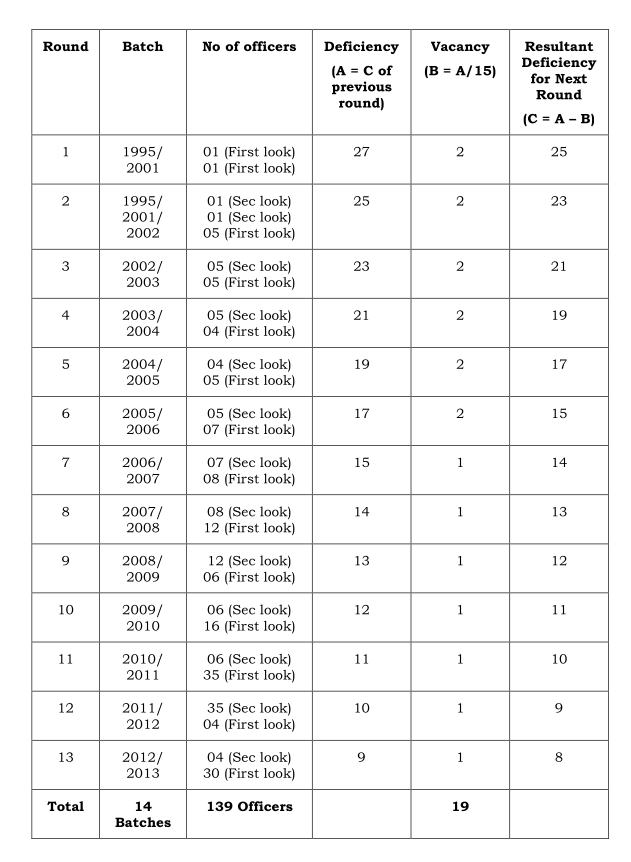
28. As may be seen from the above illustration, the deficiency diminishes with each successive round as vacancies are allotted. At the same time, this method does not result in the exhaustion of the entire deficiency. In the Executive–Logistics cadre, for instance, out of an initial deficiency of 27, only 19 vacancies were ultimately allocated across 13 batches.
29. The above table also demonstrates that each batch was afforded both a First Look and a Second Look. Owing to the peculiar circumstances of this case, however, both Looks were conducted within the same Selection Board and the same calendar year. Nevertheless, each batch was assessed alongside a senior batch in the First Look and a junior batch in the Second Look, save for the earliest batch.
D.2.2 Grievances of the Appellants-SSCOs
30. Having outlined the mechanics of the Dynamic Vacancy Model, we now turn to the three principal objections raised by the Appellants to its adoption and implementation.
D.2.2.1 Deficiency wrongly computed as in 2020
31. The Appellants have contended that, under Annie Nagaraja (supra), vacancies ought to have been assessed with reference to their 6th and 7th years of service, rather than with reference to the cadre position in 2020. This submission proceeds on the premise that the concept of ‘material time’ must remain fixed, irrespective of the exceptional circumstances in which consideration was eventually undertaken.
32. As discussed previously, this Court, in Annie Nagaraja (supra), directed that the Selection Board consider the officers for the grant of PC as per Regulation 203. This would involve the determination of vacancies at the ‘material time’. We have already observed that for the Appellants, who were considered for the grant of PC by the Selection Board in December 2020, the ‘material time’ arose in 2020.
33. The relevance of ‘material time’ lies in its nexus with the availability of vacancies capable of being filled when officers are actually considered for PC. A historical deficiency that may have existed a decade earlier bears no rational connection to the cadre position prevailing at the time of actual consideration. In the instant case, the Selection Board was convened in December 2020 pursuant to judicial directions, and it was only at that point that vacancies could realistically be filled. The Respondents were therefore justified in treating 2020 as the relevant material time. On this count, thus, we find no infirmity with the actions of the Respondents.
34. Before moving to the next grievance, we may also allude to another argument made by some of the Appellants in relation to the material time being set in 2020. They contended that the framework implemented by the Respondents has unfairly resulted in them being considered on the basis of the same ACRs in their First Look as well as their Second Look. While this is factually correct, it is an inevitable consequence of the extraordinary situation created by delayed consideration across multiple batches. Importantly, the distinction between the two Looks was preserved through comparison with different adjacent batches. In these circumstances, we see no arbitrariness in relying on the most recent ACRs available, nor do we find any violation of fairness warranting interference.
D.2.2.2 Arbitrary division of the deficiency by 15
35. The Appellants have further argued that the division of the deficiency by 15 was arbitrary and engineered to artificially suppress the number of vacancies available for selection. The Respondents have, however, explained the basis of this methodology before the AFT, contending that vacancies for PC are always determined after taking a long-term perspective.
36. This is necessitated due to the fact that, upon being granted PC, the officer would continue to serve the Navy for at least 30 years, as compared to the maximum tenure of 14 years as an SSCO. This additional 15-16 years of service has an impact on the age composition and the overall agility of the forces, especially given the lean sanctioned strength of the Navy. The rationale advanced is that distributing vacancies over a fifteen-year horizon ensures a balanced age and experience profile within the officer cadre and prevents sudden distortions in the pyramidal structure of the Navy. This distribution is reflected in the division of the remaining deficiency by 15, before the vacancy is allotted for a particular round of selection.
37. We find strength in the submission of the Respondents. Taking the long- term requirements of the Navy as a lean military wing into account, a policy of distribution of vacancies across the present and future rounds of selection cannot be termed as an arbitrary exercise per se. That being so, it would not be appropriate for this Court to interfere in the policy
decision when the means adopted bear a reasonable connection to the stated objective.
38. The specific challenge to the choice of the number ‘15’ as the divisor also fails to persuade us. Far from being an arbitrary figure, it corresponds to the approximate years of service that accompany the grant of PC. Thus, in our considered view, the selection of this divisor is anchored in service realities rather than caprice.
D.2.2.3 Non-exhaustion of all vacancies
39. Lastly, the Appellants are also aggrieved by the fact that, notwithstanding the existence of a substantial deficiency in certain cadres, the Respondents failed to create and utilise all available vacancies, thereby denying PC to otherwise eligible officers such as the Appellants.
40. The Respondents have submitted before the AFT that limiting vacancies despite the existence of a larger deficiency is based on a multitude of policy considerations, from maintaining readiness for exigencies to ensuring adequate vacancies for the future batches.
41. In our considered opinion, this issue is no longer res integra. It is well settled, including through a judgement of a Constitution Bench of this Court in Shankarsan Dash v. Union of India,15 that a candidate does not have a right to be selected merely due to the existence of vacancy. It is open for the Competent Authority, for policy reasons, to leave such vacancies unfilled as are required, as long as such action is not plagued with the vice of arbitrariness, does not aim to undermine the merit of the candidates, or is not otherwise illegal.
42. We find that the above-stated principle is squarely applicable in the instant case, given that the Navy has, for well-explained reasons, chosen not to exhaust all the available vacancies instantaneously. Owing to this, we cannot fault the Respondents’ decision to leave certain vacancies empty for future batches.
43. To reiterate, this Court finds that the modalities of conducting the 2020 Selection Board by the Respondents, with respect to the creation and distribution of vacancies, in compliance with Annie Nagaraja (supra), did not suffer from any infirmity of arbitrariness or discrimination. The decisions of the Navy regarding such a one-time exercise were guided by the terms of the said judgement, the extraordinary circumstances of the Selection Board, and demonstrable rationality. As such, there is no case made out for us to interfere with the same.
D.3 Issue No. 3: Non-disclosure of Evaluation Criteria and Available Vacancies Prior to the Conduct of the Selection Board
44. Apart from the issues discussed above, the Appellants have also drawn our attention to a fundamental procedural deficiency that permeated the conduct of the Selection Boards held in December 2020 and September 2022, namely, the absence of any prior disclosure of the evaluation framework governing the process and the number of vacancies available. Unlike the Army and the Air Force, where the governing policies, vacancy computation methodologies, and assessment criteria were formally promulgated, the Navy did not place any document in the public domain outlining the approved method of determining vacancies, the parameters of evaluation, the moderative mechanisms employed (if any), or the manner in which merit lists were to be prepared. According to the Appellants, this opacity left officers aspiring for PC unaware of the standards against which they would be judged, thereby depriving them of a fair opportunity to address potential deficiencies in their service records.
45. The practical consequences of this non-disclosure, it is urged, were far from theoretical. The Appellants contend that they were never informed that their ACRs from the preceding five years would serve as the exclusive basis for evaluation. As a result, they did not seek redressal of adverse remarks or omissions therein within time. Equally, they remained unaware of whether, and if so how, the Respondents had sought to mitigate the structural deficiencies inherent in the ACR regime, which we have already adverted to while examining the first issue. Requiring the officers to participate in the process for the grant of PC without disclosing the material particulars of the selection procedure was akin to asking them to navigate uncharted waters without a compass.
46. This submission of the Appellants has carried force in the previous round of litigation before this Court. In Amit Kumar Sharma (supra), this Court took serious exception to the Respondents’ failure to disclose the material governing the selection process. At that stage, the AFT had adjudicated the matter in Lt. Cdr. Tarun (supra) on the basis of documents furnished to it in a sealed cover, without any corresponding disclosure to the affected SSCOs. The Appellants had neither been supplied the instructions issued to reporting officers and Selection Boards, nor made privy to the rationale underlying the methodology adopted by the Respondents. This Court found such a procedure to be fundamentally flawed and, on that ground, remanded the matter to the AFT for fresh consideration.
47. Upon remand, the AFT, vide the Impugned Judgement, has accorded necessary impetus to this concern raised by the Appellants. It recognised that the absence of such information being disclosed to the assessee officers not only handicapped the Appellants in their attempts to litigate against the validity and results of the Selection Board, but it vitiated the selection process itself. It may be apposite to reproduce the relevant extract thereof below:
“62. An analysis of the cases adjudicated by the AFT (PB) as given at Para 55 above, indicate that consequent to the judicial orders and consideration of the affected SSCOs, all three Services obtained requisite Govt. Sanction for implementing the judicial orders. In the case of the IAF, they issued a HRP defining the criteria and details of consideration. In the case of the IA, they obtained sanction for additional vacancies and issued the General Instruction for the conduct of the Special No 5 SB in which the criteria and the details of all the 615 eligible SSCOs was promulgated…
63. In the case of IN after obtaining the requisite Govt. sanction, they obtained the approval of the competent authority of an ‘Approach Paper’ on the modalities for the conduct of the Special Board and the environment was intimated only of the batches that were being considered. However, while they had the criteria, method for calculating vacancies, apportionment of
vacancies to various Branches/Cadres on record duly approved, the details were not known to the SSCOs being considered, as these details were not promulgated…”
[Sic] [Emphasis supplied]
48. There is, patently, a dissonance on the promulgation of policy documents on the conduct of the Selection Boards between the Navy and the other two wings of the Armed Forces. While the Army and the Air Force ensured that the affected officers were informed, in advance, of the criteria and modalities governing selection, the Navy confined such material to internal approval processes. This asymmetry in disclosure, as correctly noted by the AFT, undermined the transparency of the selection exercise. This dichotomy led the AFT to direct the Respondents to hold a renewed Special Board, after the public dissemination of the relevant material and policy considerations.
49. It would not be out of place to record that the Appellants, on this issue, are not necessarily aggrieved by the findings forwarded by the AFT. In line with the Appellants’ arguments, the AFT has held that the selection process in the 2020 Selection Board, as well as the 2022 Selection Board, suffered from the infirmity of opaqueness in procedure and criteria.
50. Significantly, the learned Additional Solicitor General, appearing on behalf of the Respondents, has also fairly conceded that the Navy does not propose to challenge the Impugned Judgement or its findings on this aspect, and that the Respondents are prepared to abide by the AFT’s directions for conducting a fresh Selection Board with full prior disclosure, subject to the outcome of the instant appeals.
51. In these circumstances, the failure to disclose the evaluation criteria, vacancy computation methodology, and allied policy considerations prior to the conduct of the Selection Boards in 2020 and 2022 must be held to have violated basic norms of fairness and transparency. We, therefore, find no reason to differ from the view taken by the AFT in this regard. The conclusion that the Navy was obligated to place the relevant policy material in the public domain, in a timely manner and before the commencement of the selection process, merits affirmation.
E. Conclusion and Directions
52. Before concluding the judgement and passing consequential directions to the parties before us, it is necessary to recapitulate our findings on the various issues raised before us. They are summarised as follows:
(i) The ACRs of the Appellants, who were ineligible for PC consideration by virtue of their terms of entry and/or the prevailing policies at the time, were written keeping in mind their ineligibility for PC and with the assumption that they would never undergo any substantive career progression. This presumption undermined the assessment of their ‘suitability’ for such progression once it became available and thus, adversely affected their overall merit in the consideration for PC;
(ii) The Dynamic Vacancy Model adopted by the Respondents to create and distribute vacancies amongst the officers considered by the Selection Board held in December 2020 was rational, non-
arbitrary, and implemented as a one-time measure owing to the directions issued by this Court in Annie Nagaraja (supra); and
(iii) The failure of the Respondents to disclose the evaluation criteria, vacancy computation methodology, and allied policy considerations prior to the conduct of the Selection Boards has adversely impacted the officers considered in those Boards.
53. We may hasten to observe at this stage that in ordinary circumstances, having recorded our approval for the reasoning adopted by the AFT in respect of the non-disclosure of the selection procedure and criteria and without taking into consideration our analysis in the first issue, we would have upheld the decision of the AFT directing another Selection Board to consider the Appellants cases for grant of PC. There are, however, other factors which weigh on our conscience and prevent us from approving the said directions forthwith.
54. The first being that the instant appeals constitute the third round of litigation regarding the Appellants’ claim for PC before this Court. After securing their entitlement to be considered for the grant of PC initially in 2015 and 2016, and affirmed by this Court in 2020, the Appellants were forced to approach the Courts afresh for a fair assessment. After their claim was initially rejected by the AFT in 2022, the Appellants again approached this Court, which remanded the matter to the AFT for fresh adjudication. Regardless of this, the AFT has considered it wise to direct a fresh consideration of the Appellants by a new Special Board. This
ordeal being faced by the aggrieved SSCOs, in our opinion, ought not to be allowed to continue to a fourth round.
55. This is more so because of the second factor that the Appellants cannot be expected to obtain a fair assessment in the renewed Special Board due to the inherently skewed ACRs suffered by them, arising from being considered ineligible for the grant of PC for almost the entirety of their careers. Given the extensive non-consideration of any career progression at the time of filling of ACRs of the Appellants, the result of another consideration by a Selection Board would still not yield any equitable or non-discriminatory result. The third factor which persuades us to finally conclude these proceedings is that it is not in the overall interest of the Navy and its officers to continue to indulge in a protracted litigation.
56. For the above-stated reasons, we consider it appropriate to allow these appeals and consequently, modify the directions issued by the AFT by way of the Impugned Judgement dated 27.09.2024, and the subsequent Impugned Orders dated 13.02.2025 and 06.03.2025, in the following terms:
(i) The grant of PC to the SSCOs who have already been granted PC by the Selection Boards convened in December 2020 and September 2022 as well as those granted relief by virtue of this Court’s judgement in Lt. Cdr. Manish Kumar Singh (supra), shall not be disturbed;
(ii) As a one-time measure, instead of convening a fresh Special Board for reconsideration of the SSCOs’ cases for the grant of PC, the
following categories of officers, who were considered for the grant of PC by the Selection Board convened in December 2020 and are presently still in service, shall be entitled to the grant of PC, subject to their meeting the prescribed medical criteria and on receiving disciplinary and vigilance clearance:
a. SSCWOs who were inducted into the Navy prior to January 2009;
b. SSCWOs who were inducted into the Navy after January 2009 in branches/cadres excluding Law, Education, and Naval Architecture; and
c. Male SSCOs who were barred from consideration for PC as per their initial terms of service/entry.
(iii) The Appellants and Intervenors before us, who have been released from service during the pendency of these proceedings, whether before the AFT, before the High Court, before this Court, or in the interregnum, but would otherwise fall within the categories of officers identified in sub-paragraph (ii) shall be deemed to have completed substantive qualifying service of 20 years and shall be entitled to pension and all consequential benefits, except arrears of pay, on the basis that they have completed such minimum service;
(iv) The pension shall be fixed on the basis of the date of completion of the deemed service of 20 years, but arrears thereof, if any, shall be paid to the SSCOs only with effect from 01.01.2025;
(v) For all future Selection Boards, the Respondents shall issue appropriate General Instructions, prior to the conduct of such Board, laying down: the vacancies available in each branch/cadre for each batch; the detailed criteria for evaluation along with the apportionment of marks for each criterion; and any other information that may be necessary to supply to the officers under consideration for that purpose, in line with the direction contained in Paragraph 66(b) of the Impugned Judgement dated 27.09.2024; and
(vi) The Respondents shall undertake the policy examination directed by the AFT in Paragraph 66(e) of the Impugned Judgement dated 27.09.2024 forthwith.
57. Ordered accordingly.
58. Pending applications, if any, also stand disposed of in the above terms.
- 2010 SCC OnLine Del 1116. [↩] [↩] [↩]
- 2011 SCCOnLine AFT 191. [↩]
- (2021) 15 SCC 125. [↩] [↩] [↩]
- Civil Appeal No. 14681/2024. [↩]
- (2020) 7 SCC 469. [↩]
- (2025) 9 SCC 722. [↩]
- 2015 SCC OnLine Del 11804. [↩]
- 2016 SCC OnLine AFT 798. [↩]
- (2020) 13 SCC 1. [↩]
- 5 2021 SCC OnLine SC 3396. [↩]
- 2022 SCC OnLine AFT 5345. [↩]
- (2023) 20 SCC 486. [↩]
- Writ Petition (Civil) No. 425/2023. [↩]
- Civil Appeal No(s). 9747 – 9757/2024. [↩]
- (1991) 3 SCC 47. [↩]