


Legislative Functions of Constitutional Courts
Ashwini Kumar Upadhyay v Union of India
Case Summary
The Supreme Court held that a constitutional court cannot create or expand criminal offences if there is no legislative sanction.
Thirteen writ petitions, two special leave petitions, and eight contempt matters had accumulated since 2020 alleging rise in hate speech instances after the Covid -19 pandemic. Petitioners sought directions along...
Case Details
Judgement Date: 29 April 2026
Citations: 2026 INSC 432 | 2026 SCO.LR 5(1)[5]
Bench: Vikram Nath J, Sandeep Mehta J
Keyphrases: Hate Speech—267th Law Commission Report—Suo moto registration of FIRs—Doctrine of Separation of Powers—Courts cannot expand criminal offences without legislative action—Writ petition dismissed
Mind Map: View Mind Map
Judgement
1. The jurisdiction of this Court has been invoked under Article 32 of the Constitution of India1 by way of the present writ petitions seeking, inter alia, appropriate directions to the respondent-Union of India to examine the existing legal framework governing ‘hate speech’ and ‘rumour-mongering’, and to take such steps as may be necessary to effectively address and regulate the same by way of a legislation.
2. The proceedings have been occasioned primarily by two developments. First, reliance has been placed upon the 267th Report dated 23rd March, 2017, of the Law Commission of India which recommended certain amendments to the criminal law, including the introduction of specific provisions dealing with ‘incitement to hatred’. Secondly, the petitioners have referred to the emergence of public speeches during the COVID-19 pandemic allegedly targeting particular religious minorities, wherein it was insinuated that members of those communities were responsible for spreading the virus by engaging in communal conduct rather than adhering to public health protocols such as social distancing.
A. Overview of the reliefs sought in the present proceedings
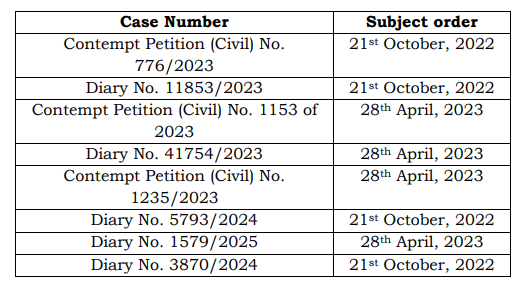
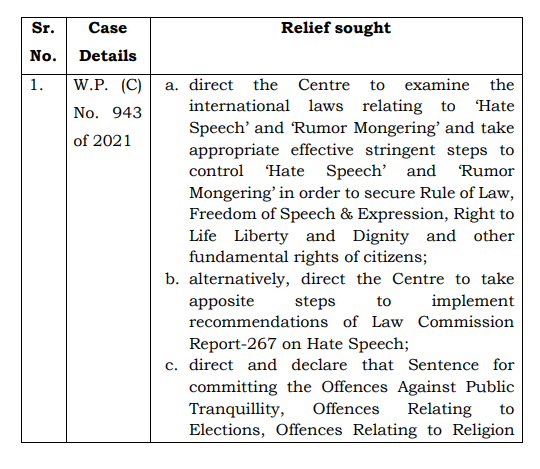
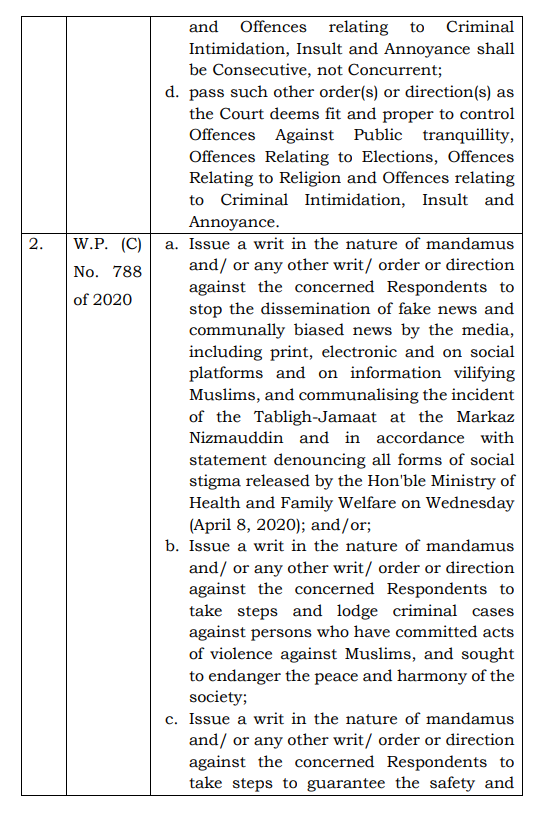
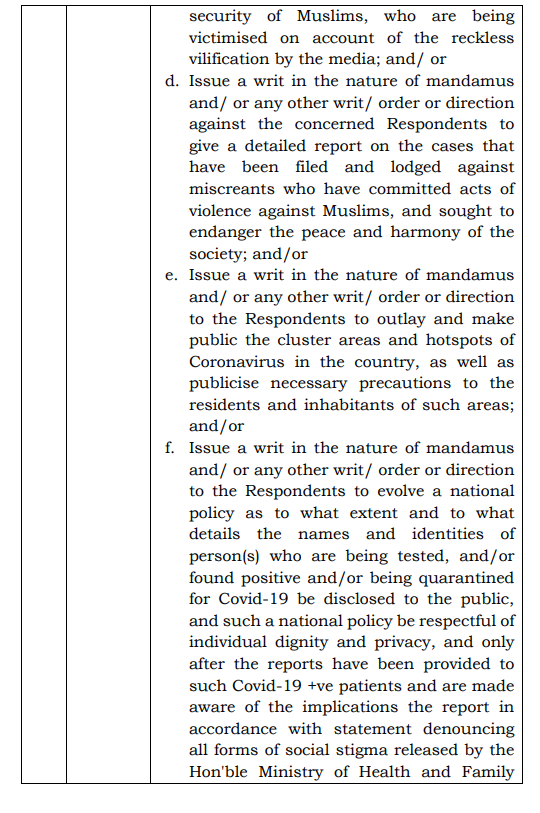
3. These proceedings arise from 13 writ petitions filed by petitioners from various part of the country. The reliefs sought in each of these petitions are captured in the table below, for ease of reference: –
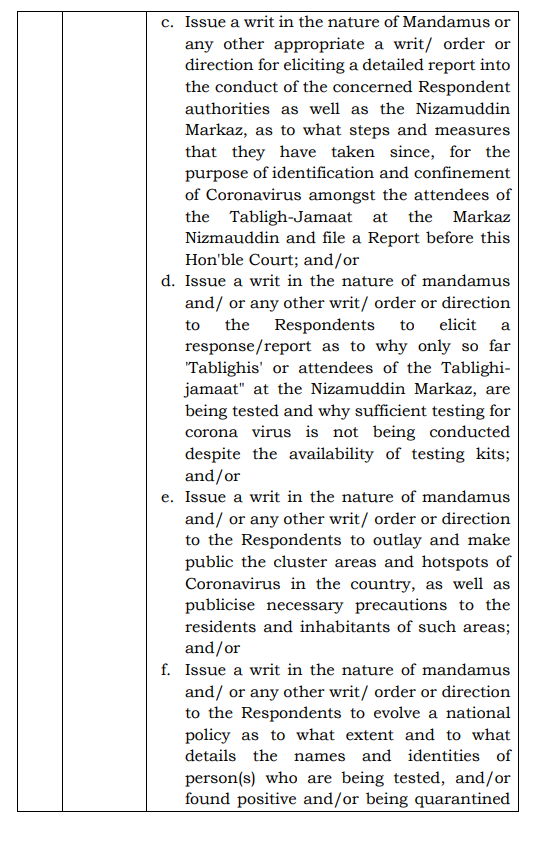
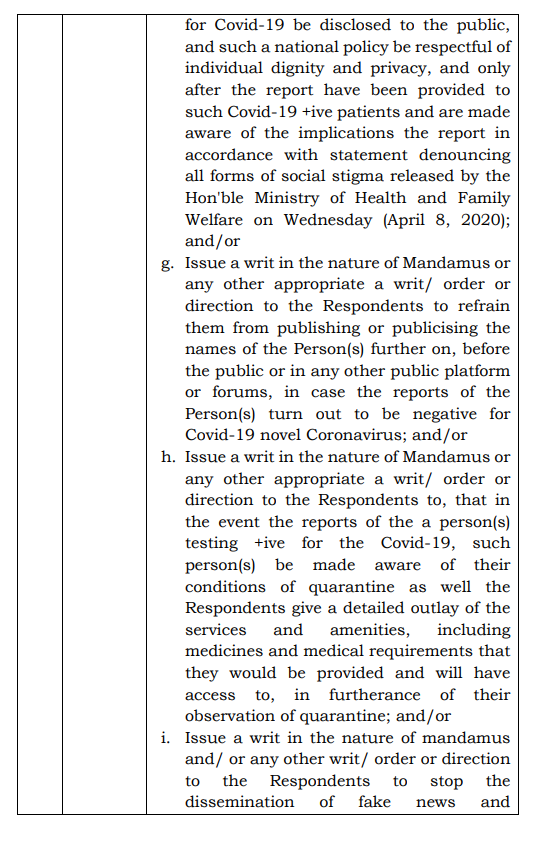
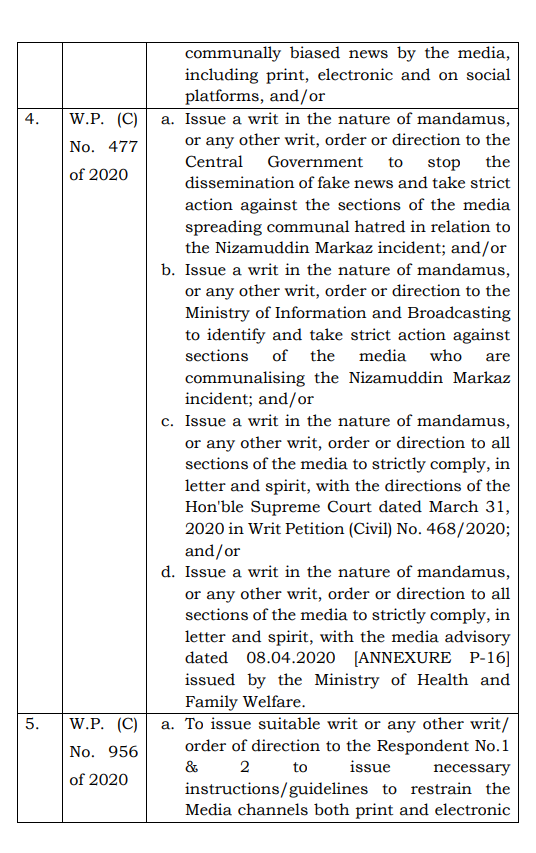
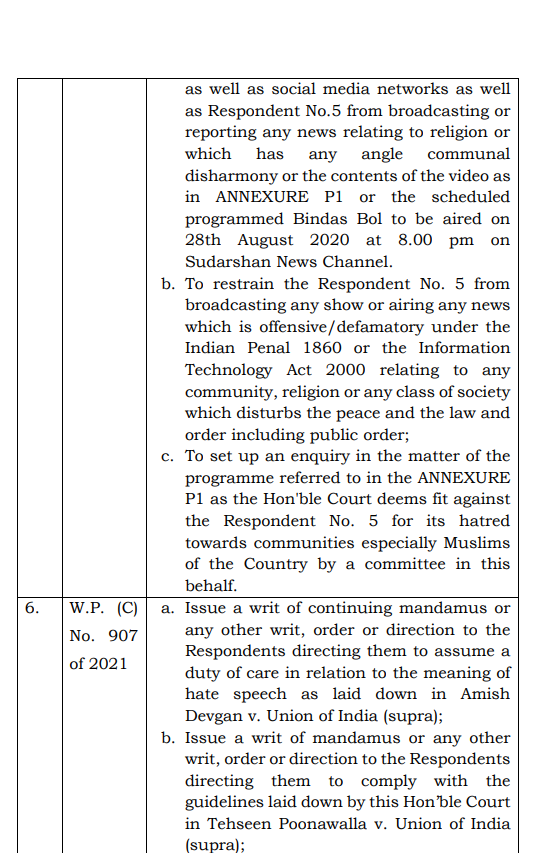
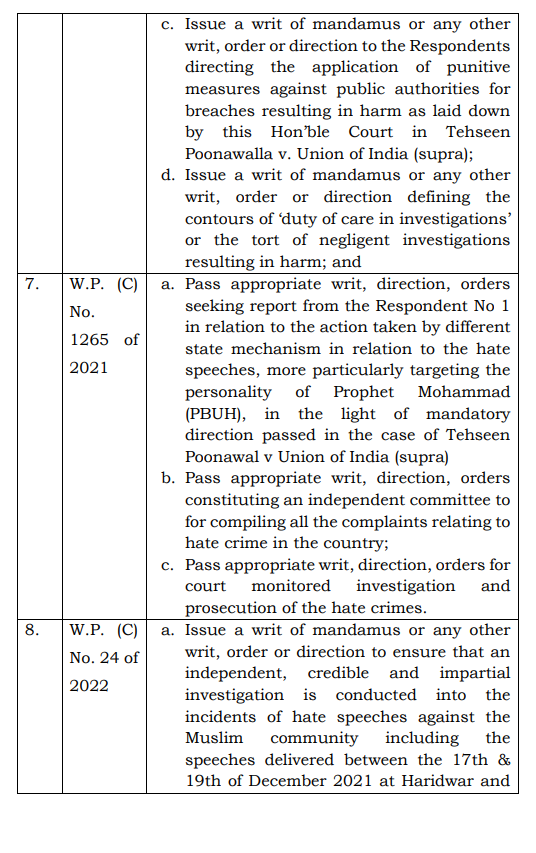
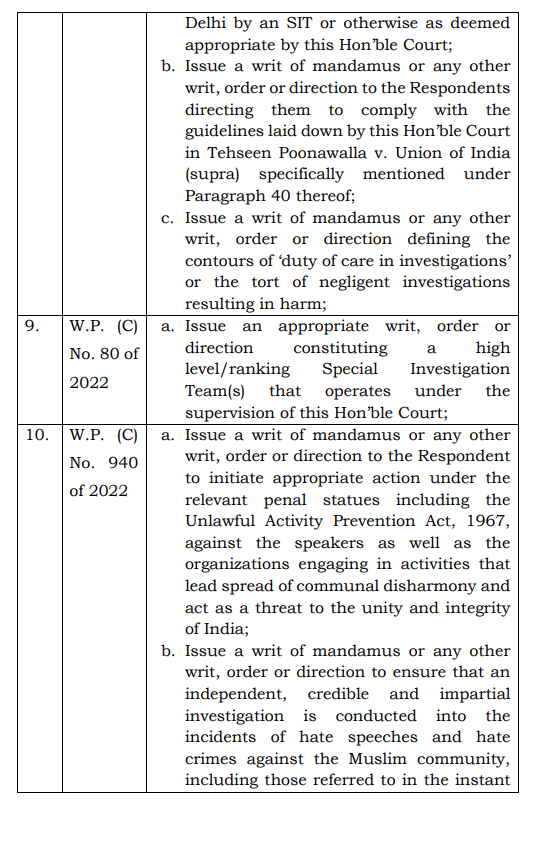
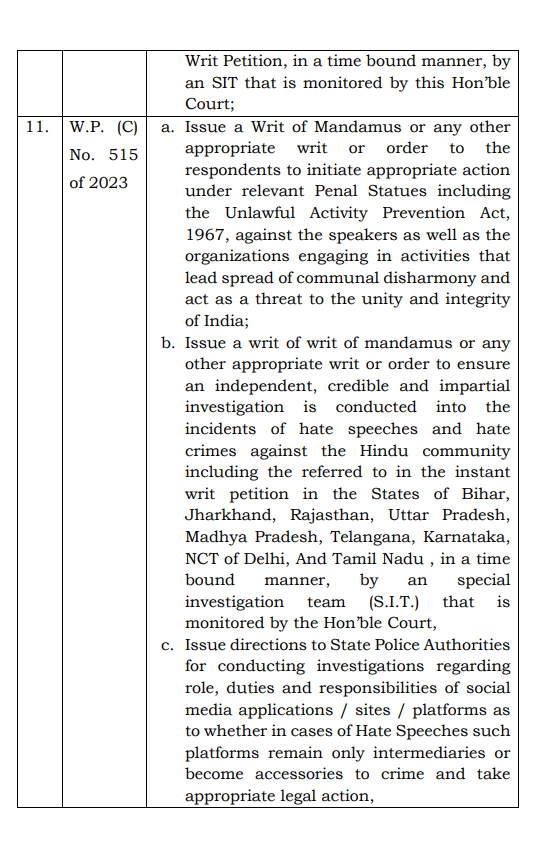
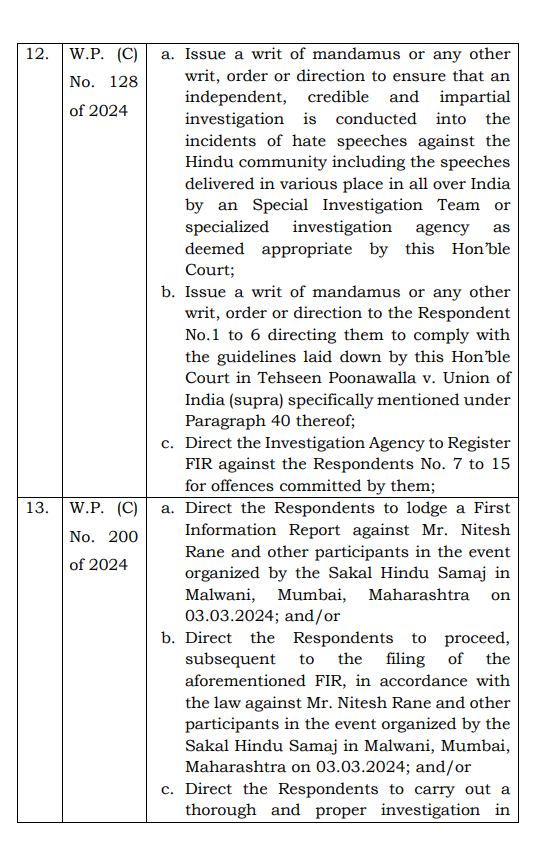
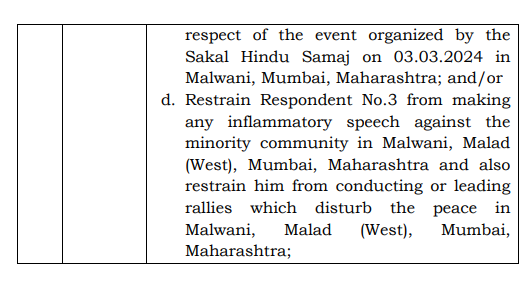
B. Issues before this Court
4. Upon glancing the prayers made, we find that qua some of the prayers, the matter has become infructuous as they pertained to the pandemic and directions to the respondent-Union to that effect. Therefore, largely the present batch of petitions give rise to the following issues: –
I. Whether this Court can create or expand criminal offences in the absence of legislative action?
II. Whether the existing field of substantive criminal law adequately deals with offences relating to hate speech, or the field is legislatively unoccupied?
III. Whether the existing framework of criminal procedural law provides adequate and efficacious remedies to address the grievances raised by the petitioners, particularly in cases of non- registration of a First Information Report?
IV. Whether continuing mandamus should be issued in the present case?
C. Submissions on behalf of the parties
5. Shri Sanjay R. Hegde, learned Amicus Curiae, made the following submissions:
i. That the State is not merely a neutral observer in the contest of ideas but bears the responsibility of preserving the constitutional atmosphere. According to the learned Amicus, the failure of the State to respond to foreseeable and systemic hate speech may amount to a violation of the right to life with dignity guaranteed under Article 21 of the Constitution.
ii. That the statutory framework appears comprehensive on paper, it was submitted that structural deficiencies remain. The existing provisions are largely reactive rather than preventive and are designed to address isolated acts rather than systemic or corporate dissemination of hate speech.
iii. That the penalties prescribed under the existing law may not operate as a sufficient deterrent, particularly in the context of media corporations that may derive commercial benefit from sensational or inflammatory content. Additionally, overlapping regulatory jurisdictions may create uncertainty in enforcement.
iv. Reference was made to evolving international regulatory standards which impose a “duty of care” upon digital platforms and broadcasters. By way of illustration, reliance was placed upon the German regulatory model which requires large social media platforms to remove manifestly unlawful content within a prescribed time frame, failing which substantial financial penalties may be imposed.
6. Shri Ashwini Kumar Upadhyay, petitioner-in-person, made the following submissions:
i. That hate speech is not merely offensive expression but constitutes a targeted misuse of the right to freedom of speech and expression. According to the petitioner, the existing legal framework has proved inadequate to effectively address the phenomenon, and legislative inaction has allowed the problem to persist.
ii. That Indian substantive criminal law has historically recognised that speech which incites hatred, hostility or discrimination against identifiable groups is not merely the expression of opinion but a serious public wrong capable of disturbing social harmony and constitutional order. While the Bharatiya Nyaya Sanhita, 2023 continues to retain offences earlier contained in the Indian Penal Code, 18602 criminalising acts that promote enmity, make imputations prejudicial to national integration, or outrage religious feelings, it was contended that the statute does not provide a comprehensive definition of “hate speech”. Consequently, the legal regime continues to suffer from interpretative ambiguities and enforcement vulnerabilities similar to those which existed under the earlier law.
iii. That the substantive limitations in the law are compounded by procedural deficiencies. Although offences relating to hate speech are cognizable, thereby casting a mandatory obligation upon the police to register a First Information Report and initiate investigation, it was contended that in practice there is frequent refusal, delay or dilution of charges. Such institutional inertia, according to the petitioner, undermines the preventive purpose of the law and permits inflammatory narratives to circulate unchecked until they manifest in overt violence.
iv. That the 267th Report of the Law Commission of India, recommended the creation of specific offences dealing with incitement to hatred. It was submitted that the failure to implement these recommendations has resulted in a legislative vacuum, compelling reliance upon provisions that are inadequate to address contemporary manifestations of hate speech.
7. Shri M.R. Shamshad, learned senior counsel appearing for the petitioner in W.P. (Civil) No. 1265 of 2021, submitted that there is no complete vacuum in the legal framework governing hate speech. However, the principal concern lies in the manner of enforcement. According to learned senior counsel, the failure to take action in appropriate cases should not be permitted to translate into a discretionary or selective approach by law enforcement authorities, particularly where victims belong to vulnerable or minority communities.
8. Shri Nizamuddin Pasha, learned counsel appearing for the petitioners in some of the aforesaid writ petitions, made the following submissions:
i. That the petitions do not seek the enactment of additional legislation but rather address the reluctance of State authorities to take action against hate speech in accordance with existing law, particularly where the alleged perpetrators occupy positions of authority.
ii. That hate speech assumes a particularly dangerous character when it emanates from persons in positions of power. Reference was made to instances where speeches delivered at public events allegedly included explicit calls for violence or economic boycott against particular communities.
iii. That when such speech emanates from constitutional functionaries or public representatives, it acquires a semblance of legitimacy and may contribute to its wider dissemination and normalisation in public discourse.
iv. That when such speeches occur in the presence of law enforcement authorities without any immediate action, it creates a chilling effect and undermines public confidence in the neutrality and effectiveness of the State’s enforcement machinery.
v. That in this backdrop, learned counsel urged that continued judicial oversight through a continuing mandamus may be necessary to ensure that State authorities take prompt action in accordance with law.
vi. That effective compliance with the directions of this Court may require the imposition of institutional consequences, including contempt proceedings or disciplinary action against erring officials, as contemplated in the order dated 21st October, 2022.
8A. Shri Sanjay Parikh, learned senior counsel appearing for the applicant-PUCL, made the following submissions:
i. That hate speech strikes at the foundational values of the Constitution of India. The Preamble envisages India as a secular republic and seeks to secure fraternity, dignity of the individual, and the unity and integrity of the Nation. Fraternity, it was contended, can exist only in an environment where persons belonging to different religions, castes and communities are able to live in mutual respect and harmony. Hate speech undermines these constitutional guarantees and threatens collective social harmony.
ii. That this Court has on several occasions held that where the existing statutory framework fails to adequately address a particular issue, this Court may issue appropriate guidelines to fill the vacuum until suitable legislation is enacted.
iii. That the directions issued by this Court in Tehseen S. Poonawalla v. Union of India3, which dealt with mob lynching, may be suitably adapted and extended to cases of hate speech. It was contended that hate speech often precedes or precipitates acts of mob violence, physical assault, or lynching, and therefore the preventive and remedial measures indicated in the said judgment would be equally relevant.
9. On behalf of the petitioner in W.P. (Civil) No. 907 of 2021, it was submitted that apart from punitive measures, this Court may consider issuing directions for systemic and periodic efforts by the State to counter the social impact of hate speech. It was suggested that such measures may include periodic public service messages aimed at promoting constitutional values and discouraging exclusionary narratives.
10. By order dated 20th January, 2026, this Court, while reserving judgment in the present matter, granted two weeks’ time to the parties to file their written submissions. However, no such submissions have been filed on behalf of the respondent-Union of India. In the absence thereof, we proceed to delineate the stand of the respondent-Union of India on the basis of the affidavits filed during the course of proceedings. The said stand may be summarised as follows: –
i. That the practice of invoking the extraordinary jurisdiction of this Court under Article 32 of the Constitution, without first availing available statutory remedies, ought to be discouraged, as it has the potential to open the floodgates of litigation before this Court.
ii. That the writ petitioners ought to have first approached the competent authorities and exhausted the remedies available under the statutory framework. It is contended that, in the present case, the petitioners have approached this Court without even initiating proceedings before the police or other law enforcement agencies.
iii. That the reliefs sought by the writ petitioners fall within the domain of legislative policy and are, therefore, within the exclusive province of the legislature. It is submitted that the role of the judiciary is confined to interpretation of existing law, and while the Court may, in appropriate cases, fill in interstitial gaps, it ought not to trench upon the legislative domain.
iv. That legislation is a constitutionally assigned function of a higher order, vested in the competent legislature under the scheme of the Constitution, particularly with reference to the distribution of legislative powers under the Seventh Schedule. Any judicial interference in this domain, except within permissible constitutional limits, would be inconsistent with the doctrine of separation of powers.
11. On the other hand, Shri Dama Seshadri Naidu, learned senior counsel appearing for the respondent- Election Commission of India, submitted as follows:
i. That the existing statutory framework adequately addresses the concerns raised by the petitioner. Reference was made to Sections 153A, 153B, 295A, 298 and 505 of IPC (now corresponding provisions under the Bharatiya Nyaya Sanhita), as well as Sections 8, 123(3A) and 125 of the Representation of the People Act, 1951. Preventive powers under Sections 95, 107 and 144 of the Code of Criminal Procedure, 1973 were also relied upon. According to the respondent, these provisions sufficiently empower the authorities to curb hate speech and rumour-mongering.
ii. That this Court in Pravasi Bhalai Sangathan v. Union of India4, has observed that the implementation of existing law would solve the problem of hate speech to a great extent as the root- cause of the problem is not the absence of laws rather lack of the effective execution.
iii. That the Election Commission ensures that elections are conducted in accordance with the Model Code of Conduct. In cases where hate speech is alleged during the electoral process, the Commission takes note of such instances and issues show-cause notices to the concerned candidates. Upon consideration of their responses, appropriate action may be taken, including advisories, censure, temporary prohibition from campaigning, or the initiation of criminal complaints.
iv. That the Commission has also issued guidelines in the nature of “Do’s and Don’ts” to be followed by political parties and candidates after the announcement of elections and until the completion of the electoral process, which specifically prohibit appeals based on caste or communal sentiments.
12. Ms. Nisha Bhambhani, learned counsel appearing for respondent No. 4- News Broadcasters and Digital Association, submitted that there exists no statutory or regulatory vacuum in the legal framework governing hate speech. However, it was suggested that this Court may direct strict compliance with the punitive and remedial measures laid down in Tehseen S. Poonawalla (supra), including monitoring of provocative content and ensuring timely investigation and prosecution where offences are disclosed.
D. Analysis and Discussion
13. We have heard the learned counsel appearing in support of the writ petitions as well as those opposing the same, and have perused the material placed on record. Since the issues raised in the present proceedings traverse multiple facets of constitutional and legal significance, we propose to deal with them under separate heads.
Nature and Essential Attributes of Crime in Criminal Jurisprudence
14. Crime, in its broadest sense, refers to the commission of an act prohibited by law or the omission of an act which the law mandates, resulting in a violation of public law and causing harm to society, for which the State prescribes punishment. Conduct which a sufficiently powerful section of a community perceives as destructive of its collective interests, or as endangering its safety, stability or public order, is ordinarily treated as criminal and is sought to be repressed through the coercive authority of the State.
15. Historically, the idea of crime has evolved alongside the development of organised society. The existence of social norms and the consequences attached to their violation form an intrinsic part of social organisation. Discourse on crime, deviance and wrongdoing, whether described as sin, villainy, or misconduct, can be traced through the literature and social thought of different eras. Early accounts found in criminal biographies, pamphlets and literary works of the early modern period reflect rudimentary attempts to explain deviant conduct. In contemporary times, however, the identification of crime is largely a matter of legislative determination, reflecting the policy choices of the State as to which forms of conduct should be prohibited in the larger public interest.
16. This Court in P. Rathinam v. Union of India5, while considering the constitutional validity of Section 309 of the IPC relating to ‘attempt to commit suicide’, noted with approval the formulation of the characteristics of crime as set out in Kenny’s Outlines of Criminal Law (19th Edn.). It was observed that a crime ordinarily exhibits three essential attributes: –
i. it involves harm brought about by human conduct which the sovereign power in the State seeks to prevent;
ii. the measures adopted for such prevention include the threat or imposition of punishment; and
iii. legal proceedings of a special character are employed to determine whether the person accused has in fact caused such harm and is legally punishable for the same.
17. It therefore follows that, for conduct to constitute a crime in the eye of law, the act or omission in question must be expressly prohibited by the sovereign authority of the State through legislation governing the field.
ISSUE I: Whether this Court can create or expand criminal offences in the absence of legislative action?
18. In the mid-eighteenth century, during the intellectual movement of reform which awakened human rationality and later came to be known as the age of enlightenment, the idea of liberty began to assume a wider meaning in political thought. It was in this backdrop that the French political philosopher Montesquieu, in his seminal work The Spirit of Laws, articulated the theory concerning the distribution of governmental powers.
19. Montesquieu postulated that in every system of government there exist three distinct kinds of power: the legislative power; the executive power relating to matters dependent upon the law of nations; and the executive power concerning matters governed by civil law, which in substance corresponds to the judicial power. While the first pertains to the authority to enact laws, the second concerns the execution of laws, and the third relates to the adjudication of disputes arising under them.
20. He emphasised that liberty would be imperilled if the legislative, executive and judicial powers were concentrated in the same person or body. It was therefore essential that these powers remain distinct and independent so that each organ of the State could operate as a check upon the others. This conception later came to be known as the Doctrine of Separation of Powers.
21. One of the earliest constitutional incorporations of this doctrine may be found in the Federal Constitution of the United States of America, 1787, where separate Articles are devoted to the Legislature, the Executive and the Judiciary, delineating their respective powers, functions and limitations.
(i) Separation of Power under the Indian Constitution
22. The question whether the Constitution of India embodies the Doctrine of Separation of Powers has engaged the attention of this Court on several occasions. In Rai Sahib Ram Jawaya Kapur v. The State of Punjab6, this Court observed that while the Constitution of India does not recognise the doctrine of separation of powers in its absolute rigidity, the functions of the different organs of the State have nevertheless been sufficiently demarcated and differentiated.
23. In Kesavananda Bharati v. State of Kerala7, this Court observed that the Constitution itself furnishes ample indication of a system of checks and balances, whereby powers are distributed in such a manner that none of the three organs of the State can assume such predominance as to disable the others from exercising the functions entrusted to them. The Court further held that although the Constitution of India does not incorporate the doctrine of separation of powers in its strict or absolute form, as is the case under the Constitution of the United States, it nonetheless envisages a functional separation of powers to a significant degree.
24. In a similar vein, while examining the contours of the doctrine of separation of powers, the Constitution Bench of this Court in Supreme Court Advocates- on-Record Association v. Union of India8, adverted to the deliberations of the Constituent Assembly, particularly the acceptance of the proposal moved by Dr. B.R. Ambedkar to incorporate Article 39A of the Draft Constitution (which now finds place as Article 50 of the Constitution of India). The said provision casts an express obligation upon the State to take steps to separate the judiciary from the executive in the public services of the State.
25. The constitutional scheme thus makes it evident that while the Constitution recognises the doctrine of separation of powers, it does not adopt it in its rigid or absolute form. Nonetheless, the functional demarcation between the three organs of the State remains fundamental. One organ cannot usurp the essential functions assigned to another. Just as the Legislature cannot assume the function of interpreting laws, which lies within the domain of the Judiciary, the Judiciary likewise cannot assume the role of the Legislature by enacting laws.
(ii) Limits of Judicial Power in the Creation of Criminal Offences
26. The question whether this Court can create or recognise a criminal offence must, therefore, be examined in the light of the constitutional framework and the precedents of this Court.
27. Another three-Judge Bench of this Court in Asif Hameed v. State of J&K9, was concerned with the question whether the High Court was justified in issuing a writ of mandamus directing the State Government to constitute a “statutory independent body” for the purpose of making selections for admission to medical colleges. This Court strongly disapproved of the directions issued by the High Court, holding them to be patently erroneous, and observed that such a direction would effectively compel the State Legislature to enact a law in that regard, an exercise beyond the permissible limits of judicial review. For the sake of convenience, the relevant extract is reproduced hereunder: –
“17. Before adverting to the controversy directly involved in these appeals we may have a fresh look on the inter se functioning of the three organs of democracy under our Constitution. Although the doctrine of separation of powers has not been recognised under the Constitution in its absolute rigidity but the Constitution makers have meticulously defined the functions of various organs of the State. legislature, executive and judiciary have to function within their own spheres demarcated under the Constitution. No organ can usurp the functions assigned to another. The Constitution trusts to the judgment of these organs to function and exercise their discretion by strictly following the procedure prescribed therein. The functioning of democracy depends upon the strength and independence of each of its organs. legislature and executive, the two facets of people’s will, they have all the powers including that of finance. Judiciary has no power over sword or the purse nonetheless it has power to ensure that the aforesaid two main organs of State function within the constitutional limits. It is the sentinel of democracy. Judicial review is a powerful weapon to restrain unconstitutional exercise of power by the legislature and executive. The expanding horizon of judicial review has taken in its fold the concept of social and economic justice. While exercise of powers by the legislature and executive is subject to judicial restraint, the only check on our own exercise of power is the self-imposed discipline of judicial restraint.
. . .
19. When a State action is challenged, the function of the court is to examine the action in accordance with law and to determine whether the legislature or the executive has acted within the powers and functions assigned under the Constitution and if not, the court must strike down the action. While doing so the court must remain within its self-imposed limits. The court sits in judgment on the action of a coordinate branch of the Government. While exercising power of judicial review of administrative action, the court is not an Appellate Authority. The Constitution does not permit the court to direct or advise the executive in matters of policy or to sermonize qua any matter which under the Constitution lies within the sphere of legislature or executive, provided these authorities do not transgress their constitutional limits or statutory powers.
. . .
21. The High Court’s directions for constituting “Statutory Independent Body” obviously mean that the State Legislature must enact a law in this respect. The Constitution has laid down elaborate procedure for the legislature to act thereunder. The legislature is supreme in its own sphere under the Constitution. It is solely for the legislature to consider as to when and in respect of what subject- matter, the laws are to be enacted. No directions in this regard can be issued to the legislature by the courts. The High Court was, therefore, patently in error in issuing directions in Jyotshana Sharma case and reiterating the same in the judgment under appeal.”
(emphasis supplied)
28. While reiterating that the Legislature is supreme within its constitutionally assigned sphere of law- making, this Court has simultaneously cautioned that the power of judicial review, though a potent constitutional instrument to restrain unconstitutional exercise of power by the Legislature or the Executive, must be exercised with due restraint. The only limitation upon the exercise of this power is the self-imposed discipline of judicial restraint. The constitutional position, therefore, remains clear that the Legislature, being supreme in its own domain under the Constitution, is the sole authority to determine when and in respect of what subject matter laws ought to be enacted.
29. This Court in SCWLA v. Union of India10, was seized of a writ petition under Article 32 of the Constitution of India seeking a direction to the Union of India to introduce “chemical castration” as an additional punishment for offences involving sexual abuse of children. The petitioners therein contended that certain perpetrators had repeatedly engaged in acts of physical and sexual abuse of minor girls, some as young as two to five years of age, and in certain instances had even murdered the victims thereafter.
30. While considering the said plea, this Court observed that the statutory framework already provided for the relevant offences as well as the punishment prescribed therefor. The Court further held that the question whether a higher or additional punishment ought to be introduced falls within the legislative domain. In that context, the Court observed as follows: –
5. At the very outset, we must make it clear that the courts neither create offences nor do they introduce or legislate punishments. It is the duty of the legislature. The principle laid down in Vishaka case [Vishaka v. State of Rajasthan, (1997) 6 SCC 241: 1997 SCC (Cri) 932] is quite different, for in the said case, the Court relied on the International Convention, namely, “Convention on the Elimination of All Forms of Discrimination against Women” especially articles pertaining to violence and equality in employment and further referred to the concept of gender equality including protection from sexual harassment and right to work with dignity and on that basis came to hold that in the absence of enacted law to provide for effective enforcement of the basic human right of gender equality and guarantee against the sexual harassment and abuse, more particularly against sexual harassment at work places, guidelines and norms can be laid down in exercise of the power under Article 32 of the Constitution, and such guidelines should be treated as law declared under Article 141 of the Constitution.
. . .
6. We have referred to the said passage from Vishaka case [Vishaka v. State of Rajasthan, (1997) 6 SCC 241 : 1997 SCC (Cri) 932] as it is clear that the Court has clearly taken note of the constitutional silence or constitutional abeyance and dealt with the constitutional obligation to protect the right of women at the workplace.
. . .
7. In the case at hand, the legislature has enacted the law and provided the punishment and, therefore, we cannot take recourse to the Vishaka [Vishaka v. State of Rajasthan, (1997) 6 SCC 241 : 1997 SCC (Cri) 932] principle.
There is no constitutional silence or abeyance.
. . .
14. This Court cannot provide a higher punishment. It can only suggest to the legislature.
…”
(emphasis supplied)
It thus becomes evident that, in the absence of constitutional silence or a legislative vacuum, the Judiciary cannot assume the role of the Legislature by determining what ought to constitute an offence or by prescribing the appropriate punishment for a particular criminal act. Where the Legislature has already enacted a law governing the field and has provided for the corresponding punishment, the Court cannot, in exercise of its jurisdiction, supplant the legislative scheme.
31. In such circumstances, this Court has held that recourse cannot be taken to the principles laid down in Vishaka v. State of Rajasthan11, for the purpose of framing rules or guidelines to occupy the field. The power exercised in Vishaka (supra) was premised upon the existence of a legislative vacuum. Where the law already occupies the field, the formulation of norms in the nature of legislation would fall beyond the permissible contours of judicial power.
32. In another decision of a three-Judge Bench in Dr. Ashwini Kumar v. Union of India,12 this Court was called upon to consider a prayer seeking a direction to the Union of India to enact a comprehensive standalone legislation to address custodial torture. While dealing with the said request, the Court acknowledged that in the course of interpreting statutes and constitutional provisions, the judiciary inevitably contributes to the development of the law by laying down binding precedents.
33. The Court observed that such interpretative exercise, often described as “judge-made law”, arises as a natural consequence of adjudication. However, it clarified that this process of judicial interpretation cannot be equated with legislation, which lies within the exclusive domain of the Legislature. The relevant extract of the aforesaid decision is reproduced hereinbelow: –
“22. Seven Judges of this Court in P. Ramachandra Rao v. State of Karnataka [P. Ramachandra Rao v. State of Karnataka, (2002) 4 SCC 578 : 2002 SCC (Cri) 830] had, while
interpreting Articles 21, 32, 141 and 142 of the Constitution, held that prescribing period at which criminal trial would terminate resulting in acquittal or discharge of the accused, or making such directions applicable to all cases in present or in future, would amount to judicial law-making and cannot be done by judicial directives. It was observed that the courts can declare the law, interpret the law, remove obvious lacuna and fill up the gaps, but they cannot entrench upon the field of legislation. The courts can issue appropriate and binding directions for enforcing the laws, lay down time-limits or chalk out a calendar for the proceeding to follow to redeem the injustice and for taking care of the rights violated in the given case or set of cases depending on the facts brought to the notice of the court, but cannot lay down and enact the provisions akin to or on the lines of Chapter XXXVI of the Code of Criminal Procedure, 1973.
. . .
24. . . . This requires a Judge to interpret the provisions to decide the case and, in this process, he may take recourse and rely upon fundamental rights, including the right to life, but even then he does not legislate a law while interpreting such provisions. Such interpretation is called “Judge- made law” but not legislation.
. . .
25. Legislating or law-making involves a choice to prioritise certain political, moral and social values over the others from a wide range of choices that exist before the legislature. It is a balancing and integrating exercise to give expression/meaning to diverse and alternative values and blend it in a manner that it is representative of several viewpoints so that it garners support from other elected representatives to pass institutional muster and acceptance. Legislation, in the form of an enactment or laws, lays down broad and general principles. It is the source of law which the Judges are called upon to apply. Judges, when they apply the law, are constrained by the rules of language and by well-identified background presumptions as to the manner in which the legislature intended the law to be read. Application of law by the Judges is not synonymous with the enactment of law by the legislature. . . .
26. Legislature, as an institution and a wing of the Government, is a microcosm of the bigger social community possessing qualities of a democratic institution in terms of composition, diversity and accountability. Legislature uses in-built procedures carefully designed and adopted to bring a plenitude of representations and resources as they have access to information, skills, expertise and knowledge of the people working within the institution and outside in the form of executive. . .
The Constitution states that legislature is supreme and has a final say in matters of legislation when it reflects on alternatives and choices with inputs from different quarters, with a check in the form of democratic accountability and a further check by the courts which exercise the power of judicial review. It is not for the Judges to seek to develop new all-embracing principles of law in a way that reflects the stance and opinion of the individual Judges when the society/legislators as a whole are unclear and substantially divided on the relevant issues [ Lord Browne-Wilkinson in Airedale N.H.S. Trust v. Bland, 1993 AC 789, pp. 879-880 : (1993) 2 WLR 316 (HL)] . In Bhim Singh v. Union of India [Bhim Singh v. Union of India, (2010) 5 SCC 538] , while observing that the Constitution does not strictly prohibit overlapping of functions as this is inevitable in the modern parliamentary democracy, the Constitution prohibits exercise of functions of another branch which results in wresting away of the regime of constitutional accountability. . . .
. . .
29. It can be argued that there have been occasions when this Court has “legislated” beyond what can be strictly construed as pure interpretation or judicial review but this has been in cases where the constitutional courts, on the legitimate path of interpreting fundamental rights, have acted benevolently with an object to infuse and ardently guard the rights of individuals so that no person or citizen is wronged, as has been observed in para 46 of the judgment of Dipak Misra, C.J. in Kalpana Mehta case [Kalpana Mehta v. Union of India, (2018) 7 SCC 1] . Secondly, these directions were given subject to the legislature enacting the law and merely to fill the vacuum until the legislature takes upon it to legislate. These judgments were based upon gross violations of fundamental rights which were noticed and in view of the vacuum or absence of law/guidelines. The directions were interim in nature and had to be applied till Parliament or the State Legislature would enact and were a mere stop-gap arrangement. These guidelines and directions in some cases as in Vishaka [Vishaka v. State of Rajasthan, (1997) 6 SCC 241 : 1997 SCC (Cri) 932] had continued for long till the enactment of “The Sexual Harassment of Women at Workplace (Prevention, Prohibition and Redressal) Act, 2013” because the legislature (it would also include the executive) impliedly and tacitly had accepted the need for the said legislation even if made by the judiciary without enacting the law. Such law when enacted by Parliament or the State Legislature, even if assumably contrary to the directions or guidelines issued by the Court, cannot be struck down by reason of the directions/guidelines; it can be struck down only if it violates the fundamental rights or the right to equality under Article 14 of the Constitution ”
(emphasis supplied)
From the foregoing discussion, it emerges that the constitutional role of the judiciary is primarily to interpret and apply the law, and not to legislate. In appropriate cases, particularly where a legislative vacuum exists, this Court may issue directions or evolve principles while interpreting statutory provisions or enforcing fundamental rights. Such directions, however, are inherently interim in nature and are intended to operate only until the Legislature enacts an appropriate law governing the field.
34. The authority to enact binding and general norms of conduct, which necessarily involve broader political, social and moral considerations, lies exclusively within the legislative domain. Any attempt by Courts to prescribe detailed statutory schemes or to frame provisions akin to legislation would amount to judicial law-making and would impermissibly trench upon the functions assigned to the Legislature. Thus, while Courts may fill interstitial gaps in order to safeguard constitutional rights, they cannot supplant the legislative function or create enduring legal frameworks that properly fall within the province of Parliament or the State Legislatures.
35. Very recently, this Court in Union of India v. K. Pushpavanam13, was called upon to consider the correctness of directions issued by the High Court requiring the Union Government to introduce a Bill in relation to liability in tort. This Court expressed its disapproval of the directions so issued, observing that the High Court had transgressed the permissible limits of judicial review by effectively directing the introduction of legislation. The Court observed as follows: –
“7. As far as the law of torts and liability thereunder of the State is concerned, the law regarding the liability of the State and individuals has been gradually evolved by courts. Some aspects of it find place in statutes already in force. It is a debatable issue whether the law of torts and especially liabilities under the law of torts should be codified by a legislation. A writ court cannot direct the Government to consider introducing a particular bill before the House of Legislature within a time frame. Therefore, the first direction issued under the impugned judgment [K. Pushpavanam v. Union of India, 2021 SCC OnLine Mad 17062] was unwarranted.
. . .
13. The law regarding power of the writ court to issue a mandate to the legislature to legislate is well settled. No constitutional court can issue a writ of mandamus to a legislature to enact a law on a particular subject in a particular manner. The Court may, at the highest, record its opinion or recommendation on the necessity of either amending the existing law or coming out with a new law The only exception is where the Court finds that unless a rule-making power is exercised, the legislation cannot be effectively implemented.”
(emphasis supplied)
36. It is thus well settled that while exercising its writ jurisdiction, this Court may interpret and develop the law and may also indicate the necessity for legislative reform where the circumstances so warrant. However, the Court cannot issue a writ of mandamus directing the Legislature or the Government to enact a particular law or to introduce a Bill before the Legislature within a stipulated time frame. While the Court may draw attention to the need for legislative action, it cannot compel the Legislature to undertake the law-making function.
ISSUE II: Whether the existing field of substantive criminal law adequately deals with offences relating to hate speech, or the field is legislatively unoccupied?
37. The submission that there exists a legislative or constitutional vacuum in addressing hate speech and allied offences is misconceived. The field is not unoccupied. The criminal law, as shall be presently demonstrated, already contains several provisions which penalise acts that promote enmity between different groups, outrage religious sentiments, or disturb public tranquillity. These provisions represent a conscious legislative effort to regulate speech which threatens communal harmony and public order.
38. The mere occurrence of incidents of hate speech cannot lead to the conclusion that the law is silent on the subject. More often than not, the difficulty lies in the effective enforcement and application of the existing statutory framework. At best, such instances may reveal deficiencies in implementation in particular cases. That, however, cannot furnish a ground for the Court to assume the legislative function or to supplant the statutory scheme enacted by the Legislature.
Law Commission Report No. 267 on ‘Hate Speech’
39. This Court in Pravasi Bhalai Sangathan (supra), observed that the issue of hate speech warranted a deeper and more comprehensive examination by the Law Commission of India. Accordingly, this Court requested the Law Commission to consider the issues highlighted in the judgment, examine the desirability of defining the expression “hate speech”, and make appropriate recommendations to Parliament, including suggestions for strengthening the powers of the Election Commission to effectively curb the menace of hate speech.
40. Pursuant to the aforesaid observations, the Law Commission of India, under the Chairmanship of Dr. Justice (Retd.) B.S. Chauhan, submitted its 267th Report dated 23rd March, 2017, titled “Hate Speech”, to the Union Minister for Law and Justice, Government of India. The Report undertook a comprehensive examination of the legal framework governing hate speech and analysed the issue from constitutional, comparative and statutory perspectives.
41. In Chapter II of the Report, titled “Legal Provisions on Hate Speech in India”, the Law Commission surveyed the existing legislative provisions addressing hate speech under Indian law. For the sake of convenience, the relevant extract is reproduced hereinbelow: –
“2.3 Hate speech has not been defined in any law in India. However, legal provisions in certain legislations prohibit select forms of speech as an exception to freedom of speech.
Legislations Around Hate speech:
2.4 Presently, in our country the following legislations have bearing on hate speech, namely:
(i) the Indian Penal Code, 1860 (hereinafter IPC)
◦ Section 124A IPC penalises sedition
◦ Section 153A IPC penalises ‘promotion of enmity between different groups on grounds of religion, race, place of birth, residence, language, etc., and doing acts prejudicial to maintenance of harmony’.
◦ Section 153B IPC penalises ‘imputations, assertions prejudicial to national-integration’.
◦ Section 295A IPC penalises ‘deliberate and malicious acts, intended to outrage religious feelings of any class by insulting its religion or religious beliefs’.
◦ Section 298 IPC penalises ‘uttering, words, etc., with deliberate intent to wound the religious feelings of any person’.
◦ Section 505(1) and (2) IPC penalises publication or circulation of any statement, rumour or report causing public mischief and enmity, hatred or ill- will between classes.
(ii) the Representation of The People Act, 1951
◦ Section 8 disqualifies a person from contesting election if he is convicted for indulging in acts amounting to illegitimate use of freedom of speech and expression.
◦ Section 123(3A) and section 125 prohibits promotion of enmity on grounds of religion, race, caste, community or language in connection with election as a corrupt electoral practice and prohibits it.
(iii) the Protection of Civil Rights Act, 1955
◦ Section 7 penalises incitement to, and encouragement of untouchability through words, either spoken or written, or by signs or by visible representations or otherwise
(iv) the Religious Institutions (Prevention of Misuse) Act, 1988
◦ Section 3(g) prohibits religious institution or its manager to allow the use of any premises belonging to, or under the control of, the institution for promoting or attempting to promote disharmony, feelings of enmity, hatred, ill-will between different religious, racial, language or regional groups or castes or communities.
(v) the Cable Television Network Regulation Act, 1995
◦ Sections 5 and 6 of the Act prohibits transmission or retransmission of a programme through cable network in contravention to the prescribed programme code or advertisement code. These codes have been defined in rule 6 and 7 respectively of the Cable Television Network Rules, 1994.
(vi) the Cinematograph Act, 1952
◦ Sections 4, 5B and 7 empower the Board of Film Certification to prohibit and regulate the screening of a film.
(vii) the Code of Criminal Procedure, 1973
◦ Section 95 empowers the State Government, to forfeit publications that are punishable under sections 124A, 153A, 153B, 292, 293 or 295A IPC.
◦ Section 107 empowers the Executive Magistrate to prevent a person from committing a breach of the peace or disturb the public tranquillity or to do any wrongful act that may probably cause breach of the peace or disturb the public tranquillity.
◦ Section 144 empowers the District Magistrate, a Sub-divisional Magistrate or any other Executive Magistrate specially empowered by the State Government in this behalf to issue order in urgent cases of nuisance or apprehended danger. The above offences are cognizable. Thus, have serious repercussions on liberties of citizens and empower a police officer to arrest without orders from a magistrate and without a warrant as in section 155 CrPC.”
42. It is thus evident that there is no complete legislative vacuum in the substantive criminal law insofar as addressing hate speech is concerned. The Law Commission, towards the conclusion of its Report, emphasised that while the right to freedom of speech and expression is a fundamental democratic guarantee, it is not absolute and may be reasonably restricted in the interests of public order, dignity and equality. The Report observed that although several existing statutory provisions address facets of hate speech, certain gaps remain in effectively dealing with incitement to hatred and discrimination. In this backdrop, the Commission recommended strengthening the legal framework by introducing specific penal provisions, namely proposed Sections 153C (prohibiting incitement to hatred) and 505A (causing fear, alarm or provocation of violence), in the IPC, along with measures aimed at promoting responsible speech and ensuring more effective enforcement.
43. Once the Court arrives at the conclusion that no legislative vacuum exists, the principle of judicial restraint assumes considerable significance while addressing the manner in which a particular social concern ought to be regulated through policy measures. It is well settled that the formulation of policy and the choice of legislative response fall squarely within the domain of the Legislature. At best, the Court may draw the attention of the Legislature to an emerging concern and recommend that appropriate measures be considered. Whether, and in what manner, the Legislature chooses to act upon such observations remains entirely within its legislative discretion.
44. The issues and instances brought to the notice of this Court in the present petitions indicate that the difficulty does not arise from the absence of substantive law governing the field. On the contrary, the existing legal framework contains provisions capable of addressing the conduct in question. The concern, rather, appears to stem from selective, delayed, or inconsistent application of the procedural mechanisms entrusted with enforcing these provisions. The problem, therefore, is not one of legislative vacuum but of inadequate or uneven invocation of the legal processes designed to give effect to the law.
ISSUE III: Whether the existing framework of criminal procedural law provides adequate and efficacious remedies to address the grievances raised by the petitioners, particularly in cases of non-registration of a First Information Report?
45. Before addressing the specific grievances raised by the petitioners, it is necessary to examine the statutory framework governing the initiation of criminal proceedings. The question whether the existing legal regime is inadequate must be assessed in the context of the scheme of the Code of Criminal Procedure, 197314 (now replaced by Bharatiya Nagarik Suraksha Sanhita, 202315), and the remedies it provides.
(i) Statutory Framework governing Registration of Offences under CrPC/BNSS
46. The CrPC provides a comprehensive statutory framework governing the recording of information relating to cognizable offences, the consequent investigation by police authorities, and the supervisory jurisdiction of the Magistrate over the process. Importantly, CrPC also envisages specific remedies to address situations where the police fail or decline to register a First Information Report16 despite disclosure of a cognizable offence. It is, therefore, necessary to briefly examine the scheme of the Code, the duty cast upon the police to register an FIR upon disclosure of a cognizable offence, and the remedies available to an aggrieved person in cases of non- registration.
47. While emphasising the significance of FIR, the Constitution Bench of this Court in Lalita Kumari v. Government of Uttar Pradesh & Ors.17, recognised it as a foundational document in the criminal law process, the primary object of which is to set the criminal law in motion. Section 154 of CrPC (Section 173 of BNSS) lays down the procedural architecture for this purpose. The use of the expression “shall” in the provision makes it abundantly clear that every information relating to the commission of a cognizable offence, if given orally to an officer in charge of a police station, must be reduced to writing and entered in the prescribed register. The provision, thus, casts a mandatory duty upon the police officer, leaving no discretion in the matter. The underlying object is to ensure that the earliest information regarding the commission of a cognizable offence is formally recorded, thereby enabling the investigative machinery to act promptly, trace the offence, and bring the offender to justice.
48. The scheme of the CrPC makes a clear and conscious distinction between cognizable and non-cognizable offences. In respect of cognizable offences, the police are vested with the power to register the case, arrest without warrant, and proceed with investigation without prior judicial sanction. On the other hand, in cases of non-cognizable offences, Section 155 of CrPC (Section 174 of BNSS) requires prior authorization of the Magistrate before any investigation can be undertaken. This distinction reflects the legislative intent to ensure immediacy of action in serious offences affecting public order and safety.
49. However, even under Section 155 of CrPC (Section 174 of BNSS), the use of mandatory language obligates the officer in charge of a police station to record the substance of information relating to a non- cognizable offence in the prescribed register. Though investigation in such cases requires prior authorization of the Magistrate, the recording of information itself is not left to discretion.
(ii) Mandatory Registration of FIR upon Disclosure of Cognizable Offence
50. The issue whether registration of an FIR is mandatory upon disclosure of a cognizable offence is no longer res integra. This Court in Lalita Kumari (supra) has conclusively held that the statutory scheme of CrPC leaves no discretion with the police in such cases and mandates registration of an FIR. This Court further clarified that no preliminary enquiry is permissible to test the veracity or credibility of the information before registration.
51. The principle underlying the said judgment is that the registration of an FIR is only the first step in the criminal investigative process. Questions relating to the truthfulness, reliability or sufficiency of the allegations fall squarely within the domain of investigation and cannot be made a ground to refuse registration of the FIR at the threshold.
(iii) Statutory Mechanism to address Non-registration of FIR
52. Equally significant is the fact that the CrPC itself provides a comprehensive set of remedies in cases where the police fail or refuse to register an FIR despite disclosure of a cognizable offence.
53. In the first instance, Section 154(3) of CrPC (Section 173 of BNSS) enables an aggrieved person to approach the Superintendent of Police by submitting the substance of such information. Upon being satisfied that the information discloses the commission of a cognizable offence, the Superintendent of Police may either undertake the investigation himself or direct an investigation to be conducted by a subordinate officer.
54. In addition, the remedy under Section 156(3) of CrPC (Section 175 of BNSS) confers supervisory powers upon the Magistrate. Section 156(3) of CrPC empowers the Magistrate to direct registration of an FIR and investigation by the police. This Court in Madhu Bala v. Suresh Kumar,18 clarified that the power to order investigation under Section 156(3) implicitly includes the power to direct registration of a case. The relevant extract is reproduced hereunder:-
“7. On completion of investigation undertaken under Section 156(1) the officer in charge of the police station is required under Section 173(2) to forward to a Magistrate empowered to take cognizance of the offence on a police report, a report in the form prescribed by the State Government containing all the particulars mentioned therein. Chapter XIV of the Code lays down the conditions requisite for initiation of proceedings by the Magistrate. Under sub-section (1) of Section 190 appearing in that Chapter any Magistrate of the First Class and any Magistrate of the Second Class specially empowered may take cognizance of any offence (a) upon receiving a “complaint” of facts which constitutes such offence; (b) upon a “police report” of such facts; or (c) upon information received from any person other than a police officer, or upon his own knowledge that such offence has been committed. Chapter XV prescribes the procedure the Magistrate has to initially follow if it takes cognizance of an offence on a complaint under Section 190(1)(a).
8. From a combined reading of the above provisions it is abundantly clear that when a written complaint disclosing a cognizable offence is made before a Magistrate, he may take cognizance upon the same under Section 190(1)(a) of the Code and proceed with the same in accordance with the provisions of Chapter XV. The other option available to the Magistrate in such a case is to send the complaint to the appropriate police station under Section 156(3) for investigation. Once such a direction is given under sub-section (3) of Section 156 the police is required to investigate into that complaint under sub-section (1) thereof and on completion of investigation to submit a “police report” in accordance with Section 173(2) on which a Magistrate may take cognizance under Section 190(1)(b) — but not under 190(1)(a). Since a complaint filed before a Magistrate cannot be a “police report” in view of the definition of “complaint” referred to earlier and since the investigation of a “cognizable case” by the police under Section 156(1) has to culminate in a “police report” the “complaint” — as soon as an order under Section 156(3) is passed thereon — transforms itself to a report given in writing within the meaning of Section 154 of the Code, which is known as the first information report (FIR). As under Section 156(1), the police can only investigate a cognizable “case”, it has to formally register a case on that report.”
(emphasis supplied)
It is, therefore, clear that once a Magistrate directs investigation under Section 156(3) of CrPC, the police is duty-bound to first register an FIR and thereafter proceed with the investigation into the complaint, which, upon such direction, attains the character of a duly registered case disclosing a cognizable offence.
55. This Court in Sakiri Vasu v. State of U.P.19 had occasion to consider the scope and ambit of Section 156(3) of CrPC. While examining the scheme of the provision and the supervisory role of the Magistrate, the Court observed as follows: –
“15. Section 156(3) provides for a check by the Magistrate on the police performing its duties under Chapter XII CrPC. In cases where the Magistrate finds that the police has not done its duty of investigating the case at all, or has not done it satisfactorily, he can issue a direction to the police to do the investigation properly, and can monitor the same.
. . .
17. In our opinion Section 156(3) CrPC is wide enough to include all such powers in a Magistrate which are necessary for ensuring a proper investigation, and it includes the power to order registration of an FIR and of ordering a proper investigation if the Magistrate is satisfied that a proper investigation has not been done, or is not being done by the police. Section 156(3) CrPC, though briefly worded, in our opinion, is very wide and it will include all such incidental powers as are necessary for ensuring a proper investigation.
. . .
24. In view of the abovementioned legal position, we are of the view that although Section 156(3) is very briefly worded, there is an implied power in the Magistrate under Section 156(3) CrPC to order registration of a criminal offence and/or to direct the officer in charge of the police station concerned to hold a proper investigation and take all such necessary steps that may be necessary for ensuring a proper investigation including monitoring the same. Even though these powers have not been expressly mentioned in Section 156(3) CrPC, we are of the opinion that they are implied in the above provision.”
(emphasis supplied)
The position of law, therefore, stands clarified that Section 156(3) of CrPC impliedly empowers the Magistrate to direct registration of a criminal case.
56. In Sakiri Vasu (supra), this Court also deprecated the practice of directly invoking the jurisdiction of constitutional Courts in matters relating to non- registration of FIRs. While delineating the statutory mechanism available to an aggrieved informant, the Court observed as follows: –
“25. We have elaborated on the above matter because we often find that when someone has a grievance that his FIR has not been registered at the police station and/or a proper investigation is not being done by the police, he rushes to the High Court to file a writ petition or a petition under Section 482 CrPC. We are of the opinion that the High Court should not encourage this practice and should ordinarily refuse to interfere in such matters and relegate the petitioner to his alternating remedy, first under Section 154(3) and Section 36 CrPC before the police officers concerned, and if that is of no avail, by approaching the Magistrate concerned under Section 156(3).
26. If a person has a grievance that his FIR has not been registered by the police station his first remedy is to approach the Superintendent of Police under Section 154(3) CrPC or other police officer referred to in Section 36 CrPC. If despite approaching the Superintendent of Police or the officer referred to in Section 36 his grievance still persists, then he can approach a Magistrate under Section 156(3) CrPC instead of rushing to the High Court by way of a writ petition or a petition under Section 482 CrPC. Moreover, he has a further remedy of filing a criminal complaint under Section 200 CrPC. Why then should writ petitions or Section 482 petitions be entertained when there are so many alternative remedies?
27. As we have already observed above, the Magistrate has very wide powers to direct registration of an FIR and to ensure a proper investigation and for this purpose he can monitor the investigation to ensure that the investigation is done properly (though he cannot investigate himself). The High Court should discourage the practice of filing a writ petition or petition under Section 482 CrPC simply because a person has a grievance that his FIR has not been registered by the police, or after being registered, proper investigation has not been done by the police. For this grievance, the remedy lies under Sections 36 and 154(3) before the police officers concerned, and if that is of no avail, under Section 156(3) CrPC before the Magistrate or by filing a criminal complaint under Section 200 CrPC and not by filing a writ petition or a petition under Section 482 CrPC.”
(emphasis supplied)
Thus, where an informant is aggrieved by non- registration of an FIR, the first remedy available is to approach the Superintendent of Police under Section 154(3) of CrPC (Section 173 of BNSS). If the grievance persists, the informant may thereafter invoke the jurisdiction of the Magistrate under Section 156(3) of CrPC (Section 175 of BNSS), who is empowered to direct registration of the FIR and consequent investigation.
57. The supervisory jurisdiction of the Magistrate under Section 156(3) of CrPC (Section 175 of BNSS) is of a wide amplitude, encompassing judicial oversight over the investigative process at various stages. Such jurisdiction is not confined merely to the pre- cognizance stage, but extends, in appropriate cases, even after the submission of the police report under Section 173 of CrPC (Section 193 of BNSS).
58. The object of vesting such power in the Magistrate is to ensure that the investigating agency acts strictly in accordance with law and conducts the investigation in a fair, impartial, and effective manner. The provision serves as a vital safeguard against arbitrariness or inaction on the part of the police, enabling the Magistrate to intervene where the material on record discloses that the investigation is either deficient, tainted, or not being carried out in accordance with established legal principles.
59. The underlying rationale is to keep the Magistrate informed and engaged in the process, so that, where necessary, appropriate directions may be issued to secure a proper and lawful investigation.
(iv) Constitutional Remedies in cases of Continuing Non-redressal
60. However, where the grievance of the complainant persists even after exhaustion of the statutory remedies, the constitutional framework provides an additional safeguard. Articles 32 and 226 of the Constitution of India confer wide powers upon this Court and the High Courts, respectively, to ensure that the rule of law is upheld and that public authorities act within the bounds of their legal obligations. The power of judicial review, having been recognised as part of the basic structure of the Constitution of India, remains ever available to ensure that authorities entrusted with statutory duties do not fail in their performance.
61. In an appropriate case, therefore, the constitutional Courts may exercise their jurisdiction to ensure that the statutory duty of registering and investigating cognizable offences is not defeated by inaction or arbitrary refusal on the part of the authorities. At the same time, it must be emphasised that such jurisdiction is extraordinary in nature and is to be exercised with circumspection, ordinarily after exhaustion of the remedies available under the statutory scheme. The existence of this layered framework, both statutory and constitutional, clearly demonstrates that the legal system provides adequate and effective mechanisms to redress the grievances highlighted by the petitioners.
62. In view of the layered statutory and constitutional remedies available within the existing legal framework, it cannot be contended that the law is either silent or deficient in addressing grievances arising from conduct that disturbs public order or fosters inter-group hostility. Any deficiency lies not in the absence of law, but in its application and enforcement in specific cases. The function of this Court is not to create new offences or construct parallel regulatory regimes, but to ensure faithful implementation of the remedies already envisaged under law. Where the field stands fully occupied by legislation, supported by adequate procedural safeguards, the exercise of judicial power must necessarily be guided by the discipline of constitutional restraint.
ISSUE IV: Whether a continuing mandamus is warranted in the present case?
63. In the present case, it was contended by learned counsel, Shri Nizamuddin Pasha, that a continuing mandamus may be warranted to ensure sustained judicial oversight so that the State authorities act promptly in accordance with law, particularly with respect to registration of FIRs and initiation of action by the State machinery.
64. The writ of mandamus is a prerogative remedy vested in constitutional courts under Articles 32 and 226 of the Constitution of India. In Union of India v. S.B. Vohra20, this Court explained that mandamus lies where a legal right is established and a corresponding public duty, arising either from statute or otherwise, remains unperformed. The object of mandamus is to prevent a failure of justice, and it may be invoked in cases where no equally efficacious remedy exists and the ends of justice so demand.
65. A recent three-Judge Bench decision of this Court in Lok Prahari v. Union of India21, while dealing with Article 224-A of the Constitution of India pertaining to the appointment of retired Judges to High Courts, recognised that the concept of “continuing mandamus” is a judicial innovation evolved through interpretative exercise and does not constitute a substantive writ remedy in itself.
66. This Court further observed that the device of continuing mandamus enables the Court to ensure that the fruits of its judgments are not rendered illusory on account of administrative or institutional inertia. It provides an effective mechanism to secure compliance and to ensure that the rights declared by this Court are translated into tangible outcomes, rather than remaining merely on paper.
67. We are therefore, unable to accept the submission that issuing continuing mandamus in the present case is called for, for more than one reason. In the first place, issuance of a continuing mandamus in the manner suggested would, in effect, require this Court to keep the matter pending in anticipation of future contingencies, including possible commission of offences. Such an approach is neither contemplated by law nor consistent with the settled principles governing the exercise of writ jurisdiction. It would not only undermine the confidence of authorities entrusted with statutory functions but also disturb the balance inherent in the statutory framework of CrPC.
68. The scheme of the law already incorporates adequate checks and balances to ensure that statutory duties are duly performed, and in cases of failure, provides for corrective mechanisms through supervisory and judicial intervention. However, such intervention is warranted only upon a demonstrated failure in the discharge of duty and not on a mere apprehension thereof. To assume failure in advance and to exercise continuous oversight on that basis would be contrary to the principle of institutional comity and the discipline of judicial restraint.
69. Secondly, the issuance of a continuing mandamus in anticipation of a possible failure in discharge of statutory duty would result in this Court assuming functions that are not constitutionally vested in it. Such an approach would trench upon the domain of other constitutional authorities and disturb the carefully calibrated scheme of distribution of powers under the Constitution of India.
70. In Tirupati Balaji Developers (P) Ltd. v. State of Bihar22, this Court has categorically held that, within the constitutional framework, both this Court and the High Courts are courts of record, and the High Courts are not subordinate to the Supreme Court. It was further emphasised that the power of superintendence over subordinate courts and tribunals under Article 227 of the Constitution of India is vested exclusively in the High Courts and not in this Court.
71. In such a backdrop, to assume a role of continuous supervisory oversight over executive or investigative functions, particularly in anticipation of possible default, would not only blur constitutional boundaries but also amount to an impermissible expansion of judicial power beyond its legitimate limits.
72. Therefore, in our considered opinion, this Court must exercise due circumspection while invoking its constitutional powers and employing judicially evolved mechanisms. Such tools cannot be deployed in anticipation of a possible failure or omission in the discharge of statutory duties, much less in relation to contingencies that have not yet arisen.
73. Where the statute itself provides a complete and efficacious remedial framework, it would be inappropriate for this Court to transgress the limits imposed by the doctrine of separation of powers by assuming functions that are primarily vested in the Executive. It is only upon a demonstrated failure in the discharge of statutory obligations that constitutional Courts may justifiably step in, in exercise of their power of judicial review. As observed in S.B. Vohra (supra), a writ of mandamus is ordinarily issued in situations where the law provides no specific remedy and where justice, despite being sought, has not been rendered.
74. More recently, this Court in National Federation of Indian Women v. Union of India23, was approached under Article 32 of the Constitution seeking enforcement and compliance of the directions issued in Tehseen Poonawalla (supra) concerning incidents of lynching and mob violence. While examining the maintainability and feasibility of such a course, this Court observed that it would not be appropriate for this Court, sitting at the national level, to monitor incidents occurring across various States.
75. This Court cautioned that such an exercise would amount to “micro-management” of matters falling within the domain of the executive authorities and would be neither feasible nor consistent with the constitutional scheme. It was thus emphasised that mechanisms for enforcement must operate within the existing institutional framework rather than through continuous monitoring by this Court.
76. In view of the foregoing, we find no justification to issue a continuing mandamus. Such a course would result in an unwarranted assumption of functions vested in statutory authorities and governed by settled principles of law.
E. Epilogue: An ode to ‘Fraternity’ in the Preamble vis- à-vis the idea of ‘vasudhaiva kutumbakam’
77. The question as to whether the Preamble forms part of the Constitution is no longer res integra. In Kesavananda Bharati (supra), although this Court delivered eleven separate opinions and there was divergence on certain aspects of the constitutional scheme, the majority unequivocally held that the Preamble is an integral part of the Constitution of India.
78. This position was reaffirmed by a nine-Judge Bench of this Court in K.S. Puttaswamy v. Union of India24, wherein the majority opinion, while approving the view of Sikri, C.J., in Kesavananda Bharati (supra) observed that the Preamble embodies the foundational values of the Constitution, i.e. justice, liberty, equality and fraternity, which together constitute the guiding faith and normative framework of the constitutional order, imbued with a sense of permanence.
(i) Fraternity in the Constitutional Ethos of Indian Society
79. While elucidating the concept of “fraternity”, this Court in K.S. Puttaswamy (supra) underscored that it is essential to promote fraternity in order to secure the dignity of the individual. The expression “fraternity”, however, is not merely aspirational rather it carries substantive constitutional meaning and relevance.
80. In this regard, a recent Constitution Bench of this Court in Citizenship Act, 1955, Section 6-A, In Re25, had occasion to examine the content and scope of the principle of fraternity. This Court, referring to Dr. B.R. Ambedkar’s address in the Constituent Assembly Debates26, observed that fraternity signifies “a sense of common brotherhood of all Indians”. It was further held that neither the debates in the Constituent Assembly nor Dr. Ambedkar’s conceptualisation of fraternity indicate any limitation of this principle to a particular community or segment of citizens; rather, it is a unifying constitutional value that transcends all forms of social, religious, or cultural divisions.
81. This Court in Kaushal Kishor v. State of U.P.27, (per the minority opinion) observed that the concept of fraternity is founded upon the principle that citizens bear reciprocal obligations towards one another. Speech that fosters division or animosity, particularly in the nature of “hate speech”, strikes at the very root of fraternity, which is the sine qua non of a cohesive society founded upon plurality and multiculturalism, as is the case in India.
82. The historical experience of our nation underscores the importance of this value. Indian society has, at various points in time, witnessed deep fissures arising out of caste-based discrimination, as well as communal divisions exacerbated during the colonial period and the eventual partition of the subcontinent. It was in this backdrop that the framers of our Constitution consciously envisioned a modern Indian State founded upon secularism, inclusivity, and unity in diversity. They emphatically rejected the notion that people professing different faiths and beliefs cannot coexist.
83. It is in furtherance of this constitutional vision that the Preamble incorporates the principle of fraternity, mandating a sense of common brotherhood among all citizens. The idea of belonging to one nation cannot be made contingent upon selective inclusion or exclusion; rather, it requires a collective commitment to shared constitutional values. Fraternity, therefore, demands that every citizen recognise and respect the equal dignity of others, irrespective of differences, and consciously eschew conduct that undermines social harmony.
84. Once this constitutional ideal is internalised by citizens, both individuals and those in positions of influence, the very impulse to engage in “hate speech” would stand diminished. Hate speech, at its core, stems from a perception of difference that breeds exclusion, where the “other” is viewed as alien, inferior, or undeserving of equal regard. So long as this binary of “us” and “them” persists, the promise of fraternity remains unrealised, and true constitutional belonging becomes elusive.
85. Hate speech is thus not merely a deviation from acceptable discourse; it is fundamentally antithetical to the constitutional value of fraternity and strikes at the moral fabric of our Republic. It also runs counter to the deeper civilisational ethos of India. The land historically known as Bharata has, across centuries, been a refuge for diverse communities fleeing persecution, offering not merely shelter but acceptance and assimilation. This tradition of inclusivity is not episodic, but deeply embedded in the cultural consciousness of the nation.
86. The philosophical underpinning of this ethos finds expression in the ancient maxim of “vasudhaiva kutumbakam”, the idea that the entire world is one family. Rooted in the Yajur Veda, the expression signifies a worldview that transcends narrow identities and affirms universal kinship. In constitutional terms, it resonates with the principle of fraternity, which calls upon every citizen to recognise the shared humanity and equal dignity of all others.
87. For a nation that has historically embraced the idea of the world as one family, the modern construct of “citizenship” cannot be reduced to a basis for exclusion or division. It is, therefore, inconceivable that citizens be classified or discriminated against on grounds such as caste, colour, creed, gender, or any other marker rooted in an “us versus them” mindset. Such an approach would be wholly inconsistent with the constitutional vision of unity, dignity, and equality.
88. It is in furtherance of this constitutional ethos that Part IVA, incorporating the Fundamental Duties, was introduced into the Constitution of India. Article 51A, inter alia, mandates as follows: –
“51A. Fundamental duties.– It shall be the duty of every citizen of India–
…
(e) to promote harmony and the spirit of common brotherhood amongst all the people of India transcending religious, linguistic and regional or sectional diversities; to renounce practices derogatory to the dignity of women;
…
(j) to strive towards excellence in all spheres of individual and collective activity so that the nation constantly rises to higher levels of endeavour and achievement
89. The constitutional mandate is, therefore, unequivocal. A fundamental duty is cast upon every citizen to promote harmony and the spirit of common brotherhood among all the people of India, transcending religious, linguistic, regional and sectional diversities. It also enjoins upon citizens the obligation to renounce practices that are derogatory to the dignity of women.
90. The Constitution of India, thus, does not envisage classification as a means to foster division or discrimination among its citizens. On the contrary, it seeks to promote the welfare of the nation through collective coexistence, grounded in mutual respect, harmony, and a shared sense of fraternity.
(ii) Vision of the Constituent Assembly and the Duties of Constitutional Citizenship
91. Dr. B.R. Ambedkar, while addressing the Constituent Assembly on 25th November, 194928 sounded a note of enduring caution in relation to the working of the Constitution. He observed, “… however good a Constitution may be, it is sure to turn out bad because those who are called to work it happen to be a bad lot. However bad a Constitution may be, it may turn out to be good if those who are called to work it happen to be a good lot…” These words continue to resonate with undiminished relevance, reminding us that the vitality of our constitutional framework ultimately depends upon the conduct of those entrusted with its operation.
92. The caution sounded by Dr. Ambedkar is a reminder that every constitutional actor, be it a citizen, a public official, a legislator, or a judge, bears a corresponding responsibility to preserve and uphold the foundational values embodied in the Constitution. The liberties secured by the Constitution cannot be sustained unless they are matched by a collective commitment to its ethos. In particular, the value of fraternity demands conscious restraint in both speech and conduct, ensuring that no expression degenerates into hatred, ridicule, or exclusion of others.
93. The liberty secured to us under the Constitution is not an abstract inheritance, but the result of a collective struggle waged by countless men and women across regions, faiths, and walks of life against the formidable might of a colonial regime. This shared sacrifice underscores that the freedoms we enjoy today are neither incidental nor expendable. They must not be diminished by a failure to appreciate the responsibilities that accompany them. If citizens are unable to uphold the values of mutual respect and solidarity, the caution expressed by Dr. B.R. Ambedkar that, even the finest Constitution may falter in the hands of those who fail to work it in its true spirit, may well stand vindicated.
94. Before parting, it is necessary to reiterate that the guarantee of Freedom of speech and expression under Article 19(1)(a) occupies a central position in our constitutional democracy. The marketplace of ideas, the freedom to question authority, and the right to dissent are indispensable to a vibrant and open society. At the same time, this freedom is not absolute. The Constitution itself contemplates reasonable restrictions in the interest of public order, dignity, and harmony. Speech that is designed to inflame passions, promote hatred between communities, or disturb public tranquillity does not strengthen democracy; it corrodes the foundational values of fraternity, dignity, and equality.
95. Hate speech, in this sense, is not merely an exercise of free expression but a distortion of it, one that undermines the constitutional promise of an inclusive and cohesive society by fostering hostility and discrimination against identifiable groups.
96. It must, therefore, be borne in mind that the preservation of constitutional order is not the responsibility of the State alone. In a constitutional democracy, public discourse carries with it a corresponding duty of restraint and responsibility. Individuals, public figures, and institutions alike must remain mindful that words have consequences, particularly in a society as diverse as ours.
97. While the law provides mechanisms to address conduct that threatens public order or communal harmony, the more enduring safeguard against the menace of hate speech lies in the collective constitutional conscience of society. Ultimately, the Constitution does not survive merely through institutions or legal frameworks, but through the sustained fidelity of its citizens to the values it embodies.
F. Conclusion of Part I:
98. Having bestowed our thoughtful consideration upon the issues arising in the present batch of matters, we are of the considered view that the reliefs sought by the petitioners do not warrant exercise of our jurisdiction under Article 32 of the Constitution.
98.1. On the first issue, we hold that this Court, in exercise of its constitutional jurisdiction, cannot create or expand criminal offences or prescribe punishments in the absence of legislative sanction. Any such exercise would transgress the settled doctrine of separation of powers and encroach upon the legislative domain.
98.2. On the second issue, we find that the field of substantive criminal law governing hate speech is not unoccupied. The existing statutory framework contains adequate provisions to address acts that promote enmity, hatred, or disturb public order. The grievance projected before us pertains not to any legislative vacuum, but to issues of enforcement.
98.3. On the third issue, we hold that the procedural framework under the CrPC (now Bharatiya Nagarik Suraksha Sanhita, 2023) provides a comprehensive and multi-tiered mechanism to address grievances arising from non-registration of FIRs. The remedies available under Sections 154(3), 156(3) and 200 of the CrPC, coupled with the supervisory jurisdiction of the Magistrate, constitute an efficacious statutory scheme.
98.4. We further clarify that while constitutional remedies under Articles 32 and 226 remain available as a safeguard against failure of statutory authorities, such jurisdiction is extraordinary in nature and ought not to be invoked in a routine manner so as to bypass the remedies provided under the statutory framework.
98.5. On the fourth issue, we are not inclined to issue a writ of continuing mandamus. In the absence of any legislative vacuum or systemic failure of such magnitude as would warrant continuous judicial monitoring, such a course would be neither justified nor consistent with the principle of judicial restraint.
Part II29
99. Leave granted in SLP (Civil) No. 6913 of 2021 and SLP (Criminal) No. 5107 of 2023.
Criminal Appeal @ SLP (Crl.) No. 5107 of 2023
100. The present Criminal Appeal, arising out of SLP (Crl.) No. 5107 of 2023, assails the judgment dated 13th June, 2022, passed by the High Court of Delhi at New Delhi30 in Writ Petition (Crl.) No. 1624 of 2020, whereby the High Court dismissed the writ petition preferred by the appellant and affirmed the order dated 26th August, 2020, passed by the learned Additional Chief Metropolitan Magistrate (I), Rouse Avenue Courts, Delhi31 in Complaint Case No. 4 of 2020. By the said order, the learned Magistrate had declined the prayer made under Section 156(3) of CrPC seeking a direction for registration of an FIR under Sections 153A, 153B, 295A, 504, 505 and 506 of the IPC against certain public functionaries.
101. The principal question of law which arises for our consideration in the present appeal is whether the existence of prior sanction is a precondition for directing registration of an FIR under offences committed in the IPC and commencement of investigation under Section 156(3) of CrPC.
102. The facts relevant for adjudication of the present controversy are as follows: –
102.1. Certain speeches delivered on 27th January, 2020 by the then Union Minister and on 28th January, 2020 by a Member of Parliament were alleged by the appellants to disclose commission of cognizable offences, including promotion of communal enmity, issuance of threats, and acts prejudicial to national integration. In this regard, the appellants submitted a complaint dated 29th January, 2020, to the Commissioner of Police, Delhi, seeking registration of an FIR against the persons concerned.
102.2. Upon failure of the authorities to take any action, the appellants, by a subsequent communication dated 2nd February, 2020, approached the Station House Officer, Parliament Street Police Station, New Delhi, reiterating their request for immediate registration of an FIR.
102.3. As no action ensued, the appellants were constrained to file a complaint under Section 156(3) of CrPC before the Trial Court, being Complaint Case No. 4 of 2020, on 5th February, 2020. In response, a status report was submitted by the investigating agency stating that no cognizable offence was made out on the basis of the material placed on record.
102.4. By order dated 26th August, 2020, the Trial Court dismissed the complaint filed by the appellants, holding that the same was not maintainable in law in the absence of prior sanction from the competent authority to prosecute the named accused.
102.5. Aggrieved thereby, the appellants invoked the writ jurisdiction of the High Court under Articles 226 and 227 of the Constitution of India, read with Sections 482 and 483 of CrPC.
102.6. The High Court, vide judgment dated 13th June, 2022, dismissed the writ petition, holding that in respect of offences falling within the ambit of Section 196 of CrPC, the power under Section 156(3) of CrPC to direct registration of an FIR and investigation could not be exercised in the absence of prior sanction. The High Court accordingly affirmed the order of the Trial Court.
103. Aggrieved by the aforesaid judgment, the appellants are before this Court.
Analysis and Discussion
104. This Court, vide order dated 17th April, 2023, issued notice to the respondents. Pursuant thereto, learned counsel appearing on behalf of the respondent- authorities entered appearance and sought time to file a counter-affidavit, as recorded in the order dated 15th May, 2023.
105. However, as per the latest office report dated 12th January, 2026, no counter-affidavit has been filed on behalf of either of the respondents till date. In these circumstances, we proceed to determine the issues arising in the present appeal on the basis of the material available on record.
106. At the outset, we are unable to subscribe to the view taken by the High Court in the impugned judgment. It is pertinent to note that the Trial Court did not adjudicate upon the merits of the complaint. The dismissal of the complaint was founded solely on the ground of lack of jurisdiction, premised on the absence of prior sanction.
107. In order to properly appreciate the controversy in issue, it would be apposite to first advert to the reasoning adopted by the High Court in arriving at the conclusion that prior sanction is a sine qua non for directing registration of an FIR and investigation. The High Court, while dismissing the writ petition, has, inter alia, recorded the following conclusions: –
i. That Section 196 of CrPC expressly bars any Court from taking cognizance of offences punishable under Chapter VI and Sections 153A, 295A and 505 of the IPC without previous sanction of the Central or the State Government, as the case may be.
ii. That Section 197 of CrPC similarly prohibits a Court from taking cognizance of offences alleged to have been committed by Judges or certain categories of public servants in the discharge of their official duties, except with prior sanction of the competent authority.
iii. That in the present case, the allegations pertain, inter alia, to offences under Sections 153A, 295A and 505 IPC, which, according to the High Court, attract the bar contained in Section 196 of CrPC.
iv. That the expression “taking cognizance” occurring in Sections 196 and 197 of CrPC ought not to be construed narrowly, but must be given a wider connotation so as to include within its fold the exercise of powers under Section 156(3) of CrPC, which necessarily involves application of judicial mind.
v. That the legislative intent underlying the requirement of prior sanction is to prevent frivolous or motivated prosecution, particularly in matters involving public figures, and to ensure that the criminal process is not set in motion in a routine or vindictive manner.
vi. That reliance was placed on the decisions of this Court in Anil Kumar v. M.K. Aiyappa32, and L. Narayana Swamy v. State of Karnataka33, to hold that in cases where prior sanction is required, a Magistrate cannot direct registration of an FIR or investigation under Section 156(3) of CrPC in the absence of such sanction.
108. The scheme of CrPC in relation to registration of an FIR upon receipt of information disclosing a cognizable offence, stands authoritatively settled by the Constitution Bench of this Court in Lalita Kumari (supra). This Court unequivocally held that registration of an FIR under Section 154 of CrPC is mandatory where the information discloses the commission of a cognizable offence.
109. This Court expressly rejected the contention that a preliminary inquiry could be conducted, as a matter of course, prior to registration of an FIR, and clarified that such inquiry is permissible only in limited categories of cases and not as a general rule so as to dilute the statutory mandate contained in Section 154 of CrPC. The relevant conclusions recorded by the Constitution Bench are reproduced hereinbelow:
–
“120. In view of the aforesaid discussion, we hold:
120.1. The registration of FIR is mandatory under Section 154 of the Code, if the information discloses commission of a cognizable offence and no preliminary inquiry is permissible in such a situation.
120.2. If the information received does not disclose a cognizable offence but indicates the necessity for an inquiry, a preliminary inquiry may be conducted only to ascertain whether cognizable offence is disclosed or not.
120.3. If the inquiry discloses the commission of a cognizable offence, the FIR must be registered. In cases where preliminary inquiry ends in closing the complaint, a copy of the entry of such closure must be supplied to the first informant forthwith and not later than one week. It must disclose reasons in brief for closing the complaint and not proceeding further.
120.4. The police officer cannot avoid his duty of registering offence if cognizable offence is disclosed. Action must be taken against erring officers who do not register the FIR if information received by him discloses a cognizable offence.
120.5. The scope of preliminary inquiry is not to verify the veracity or otherwise of the information received but only to ascertain whether the information reveals any cognizable offence.
120.6. As to what type and in which cases preliminary inquiry is to be conducted will depend on the facts and circumstances of each case. The category of cases in which preliminary inquiry may be made are as under:
(a) Matrimonial disputes/family disputes
(b) Commercial offences
(c) Medical negligence cases
(d) Corruption cases
(e) Cases where there is abnormal delay/laches in initiating criminal prosecution, for example, over 3 months’ delay in reporting the matter without satisfactorily explaining the reasons for delay. The aforesaid are only illustrations and not exhaustive of all conditions which may warrant preliminary inquiry’
110. The position of law, as crystallised by this Court, is unequivocal. Where information discloses the commission of a cognizable offence, registration of an FIR is mandatory. The police, in such circumstances, have no discretion in the matter, either under the statutory scheme or by way of interpretative latitude.
111. In Madhu Bala (supra) a co-ordinate Bench of this Court authoritatively delineated the courses open to a Magistrate upon receipt of a complaint disclosing commission of an offence. It was held that the Magistrate may, in the first instance, take cognizance under Section 190(1)(a) of CrPC and proceed in accordance with Chapter XV thereof, which governs complaints to Magistrates.
112. Alternatively, the Magistrate may, in exercise of powers under Section 156(3) of CrPC, direct the complaint to be forwarded to the jurisdictional police station for investigation. Upon such direction being issued, the police are obliged to register an FIR and undertake investigation in terms of Section 156(1) of CrPC. The investigation, upon completion, culminates in a police report under Section 173(2) of CrPC, on which the Magistrate may thereafter take cognizance under Section 190(1)(b) of CrPC.
113. This Court, in Mohd. Yousuf v. Afaq Jahan,34 examined in extenso the distinction between “taking cognizance” and “ordering investigation” under the CrPC. The Court clarified the conceptual and procedural interplay between these two stages and delineated the scope of the Magistrate’s powers under Section 156(3) vis-à-vis Section 190 of CrPC. The relevant observations of the judgment are reproduced hereinunder: –
“8. The various steps to be adopted for investigation under Section 156 of the Code have been elaborated in Chapter XII of the Code. Such investigation would start with making the entry in a book to be kept by the officer in charge of a police station, of the substance of the information relating to the commission of a cognizable offence. The investigation started thereafter can end up only with the report filed by the police as indicated in Section 173 of the Code. The investigation contemplated in that chapter can be commenced by the police even without the order of a Magistrate. But that does not mean that when a Magistrate orders an investigation under Section 156(3) it would be a different kind of investigation. Such investigation must also end up only with the report contemplated in Section 173 of the Code. But the significant point to be noticed is, when a Magistrate orders investigation under Chapter XII he does so before he takes cognizance of the offence.
9. But a Magistrate need not order any such investigation if he proposes to take cognizance of the offence. Once he takes cognizance of the offence he has to follow the procedure envisaged in Chapter XV of the Code. A reading of Section 202(1) of the Code makes the position clear that the investigation referred to therein is of a limited nature. The Magistrate can direct such an investigation to be made either by a police officer or by any other person. Such investigation is only for helping the Magistrate to decide whether or not there is sufficient ground for him to proceed further. …
…
11. The clear position therefore is that any Judicial Magistrate, before taking cognizance of the offence, can order investigation under Section 156(3) of the Code. If he does so, he is not to examine the complainant on oath because he was not taking cognizance of any offence therein. For the purpose of enabling the police to start investigation it is open to the Magistrate to direct the police to register an FIR. There is nothing illegal in doing so. After all registration of an FIR involves only the process of entering the substance of the information relating to the commission of the cognizable offence in a book kept by the officer in charge of the police station as indicated in Section 154 of the Code. Even if a Magistrate does not say in so many words while directing investigation under Section 156(3) of the Code that an FIR should be registered, it is the duty of the officer in charge of the police station to register the FIR regarding the cognizable offence disclosed by the complainant because that police officer could take further steps contemplated in Chapter XII of the Code only thereafter.”
(emphasis supplied)
Thus, upon a comprehensive examination of the scheme of CrPC, this Court has consistently held that the power exercised by a Magistrate under Section 156(3) of CrPC falls at the pre-cognizance stage. An order directing investigation under the said provision does not amount to taking cognizance of the offence.
114. In Sakiri Vasu (supra), this Court recognised the structured statutory mechanism available to an aggrieved complainant and held that where the Police fail to register an FIR under Sections 154(1) and 154(3) of CrPC, the appropriate course is to approach the Magistrate under Section 156(3) of CrPC, rather than invoking the writ jurisdiction of the High Court or its inherent powers under Section 482 of CrPC in the first instance.
115. Further, in Mohd. Yousuf (supra), this Court clarified that even where the Magistrate, while exercising jurisdiction under Section 156(3) of CrPC, does not expressly direct registration of an FIR, such a direction is implicit. It is the bounden duty of the officer in charge of the police station to register an FIR upon disclosure of a cognizable offence and to proceed with the investigation in accordance with Chapter XII of CrPC.
116. The interpretative exercise undertaken by this Court has consistently been guided by the need to render the statutory framework workable and to ensure accountability of the authorities entrusted with its implementation. Any construction which renders the statutory mandate otiose or defeats the legislative intent cannot be countenanced.
117. The registration of an FIR under Section 154 of CrPC is the foundational step to set the criminal law in motion. The provision does not admit of any distinction based on the status or identity of the person against whom the allegations are made.
118. In Lalita Kumari (supra), while affirming the mandatory nature of registration of an FIR upon disclosure of a cognizable offence, this Court carved out limited categories where a preliminary inquiry may be conducted prior to registration, namely matrimonial or family disputes, commercial offences, medical negligence cases, corruption cases, and cases involving abnormal delay or laches in initiating prosecution.
119. Even within these limited categories, the scope of preliminary inquiry is circumscribed. Such inquiry is only to ascertain whether a cognizable offence is disclosed and cannot be employed as a device to avoid or indefinitely defer registration of an FIR.
120. In the present case, the High Court has declined to direct registration of an FIR on the ground that prior sanction under Sections 196 and 197 of CrPC had not been obtained. The High Court has further proceeded on the premise that while exercising jurisdiction under Section 156(3) of CrPC, the Magistrate is deemed to have taken cognizance, and therefore, the requirement of prior sanction becomes a condition precedent.
121. A coordinate Bench of this Court in State of Karnataka v. Pastor P. Raju35, had occasion to consider the stage at which prior sanction becomes necessary under CrPC. The Court categorically held that there is no embargo on the registration of a criminal case, the conduct of investigation by the police, or the submission of a report under Section 173 of CrPC in the absence of prior sanction.
122. The requirement of sanction, this Court clarified, operates at the stage of taking cognizance by the Court and not at the anterior stage of investigation. In this context, after surveying the earlier precedents on the subject, this Court observed as follows: –
“12. In Narayandas Bhagwandas Madhavdas v. State of W.B. [(1960) 1 SCR 93 : AIR 1959 SC 1118 : 1959 Cri LJ 1368] it was held that before it can be said that any Magistrate has taken cognizance of any offence under Section 190(1)(a) of the Criminal Procedure Code, he must not only have applied his mind to the contents of the petition but must have done so for the purpose of proceeding in a particular way as indicated in the subsequent provisions of the Chapter—proceeding under Section 200 and thereafter sending it for inquiry and report under Section 202. It was observed that there is no special charm or any magical formula in the expression “taking cognizance” which merely means judicial application of the mind of the Magistrate to the facts mentioned in the complaint with a view to taking further action. It was also observed that what Section 190 contemplates is that the Magistrate takes cognizance once he makes himself fully conscious and aware of the allegations made in the complaint and decides to examine or test the validity of the said allegations. The Court then referred to the three situations enumerated in sub-section (1) of Section 190 upon which a Magistrate could take cognizance. Similar view was expressed in Kishun Singh v. State of Bihar [(1993) 2 SCC 16 : 1993 SCC (Cri) 470] that when the Magistrate takes notice of the accusations and applies his mind to the allegations made in the complaint or police report or information and on being satisfied that the allegations, if proved, would constitute an offence, decides to initiate judicial proceedings against the alleged offender, he is said to have taken cognizance of the offence. …”
(emphasis supplied)
Thus, defining attribute of “taking cognizance” of an offence lies in the application of judicial mind by the Magistrate to the contents of the complaint or police report with a view to proceed in accordance with law, including under Sections 200 or 204 of CrPC. Until such stage is reached, any action undertaken by the Magistrate cannot be construed as taking cognizance of the offence.
123. In Pastor P. Raju (supra), the FIR therein had been registered under Section 153B of IPC, and the respondent was arrested and produced before the Magistrate. At the stage of remand under Section 167 of CrPC, the respondent sought quashing of the proceedings on the ground of absence of prior sanction under Section 196(1-A) of CrPC. While delineating the distinction between “taking cognizance” and subsequent procedural stages, including issuance of process, this Court held as follows: –
“13. It is necessary to mention here that taking cognizance of an offence is not the same thing as issuance of process. Cognizance is taken at the initial stage when the Magistrate applies his judicial mind to the facts mentioned in a complaint or to a police report or upon information received from any other person that an offence has been committed. The issuance of process is at a subsequent stage when after considering the material placed before it the court decides to proceed against the offenders against whom a prima facie case is made out.
14. In the present case neither any complaint had been filed nor any police report had been submitted nor any information had been given by any person other than the police officer before the Magistrate competent to take cognizance of the offence. After the FIR had been lodged and a case had been registered under Section 153-B IPC, the respondent was arrested by the police and thereafter he had been produced before the Magistrate. The Magistrate had merely passed an order remanding him to judicial custody. Section 167 CrPC finds place in Chapter XII which deals with information to the police and their powers to investigate. This section gives the procedure which has to be followed when investigation cannot be completed within twenty-four hours and requires that whenever any person is arrested and detained in custody and it appears that the investigation cannot be completed within the period of twenty-four hours fixed by Section 57 and there are grounds for believing that the accusation or information is well founded, he shall be forthwith transmitted to the nearest Judicial Magistrate along with a copy of the entries in the diary. Sub-section (2) of Section 167 will show that even a Magistrate who has no jurisdiction to try the case can authorise the detention of the accused. A limited role has to be performed by the Judicial Magistrate to whom the accused has been forwarded viz. to authorise his detention. This is anterior to Section 190 CrPC which confers power upon a Magistrate to take cognizance of an offence. Therefore, an order remanding an accused to judicial custody does not amount to taking cognizance of an offence. In such circumstances Section 196(1-A) CrPC can have no application at all and the High Court clearly erred in quashing the proceedings on the ground that previous sanction of the Central Government or of the State Government or of the District Magistrate had not been obtained. It is important to note that on the view taken by the High Court, no person accused of an offence, which is of the nature which requires previous sanction of a specified authority before taking of cognizance by the court, can ever be arrested nor such an offence can be investigated by the police. The specified authority empowered to grant sanction does so after applying his mind to the material collected during the course of investigation. There is no occasion for grant of sanction soon after the FIR is lodged nor such a power can be exercised before completion of investigation and collection of evidence. Therefore, the whole premise on the basis of which the proceedings have been quashed by the High Court is wholly erroneous in law and is liable to be set aside.”
(emphasis supplied)
124. A cumulative reading of the principles laid down in Pastor P. Raju (supra) and Sakiri Vasu (supra) makes the legal position abundantly clear that an order passed by a Magistrate under Section 156(3) of CrPC does not amount to “taking cognizance” of an offence within the meaning of Section 190 of CrPC.
125. In the present case, the appellants, being aggrieved by the inaction of the police authorities in registering an FIR, approached the Magistrate by way of an application under Section 156(3) of CrPC. The bar contained in Sections 196 and 197 of CrPC operates only at the stage of taking cognizance. In other words, it restrains the Magistrate from proceeding under Section 190 and thereafter invoking the procedure under Sections 200 or 204 of CrPC in the absence of prior sanction.
126. The scheme of CrPC does not contemplate any embargo on the direction for registration of an FIR or the conduct of investigation at the pre-cognizance stage. To hold otherwise would amount to introducing a restriction not envisaged by the legislature. The process of criminal law is sequential: information of a cognizable offence must first be received; an FIR must then be registered; investigation must follow; a report under Section 173 of CrPC must thereafter be submitted; and it is only at that stage that the question of taking cognizance arises.
127. The requirement of sanction is, therefore, a condition precedent only for taking cognizance and not for the registration of an FIR or for the conduct of investigation. Any interpretation that makes the registration of an FIR contingent upon prior sanction would invert this statutory scheme and render the provisions relating to investigation unworkable.
128. In the facts of the present case, the prayer before the Trial Court was limited to seeking a direction to the Station House Officer, Parliament Street Police Station, to register an FIR on the basis of the complaint dated 29th January, 2020. In law, the Magistrate had two options: either to direct investigation under Section 156(3), or to take cognizance under Section 190(1)(a) and proceed in accordance with Chapter XV.
129. The bar under Sections 196 and 197 of CrPC would operate only in respect of the latter course. It could not have been invoked to deny the former. The Trial Court, therefore, fell in error in declining to exercise jurisdiction under Section 156(3) of CrPC on the ground of absence of prior sanction, and the High Court, in affirming such view, has adopted an interpretation which cannot be sustained in law.
130. In the present case, the relief sought before the Trial Court was confined to a direction to the Station House Officer, Parliament Street Police Station, to register an FIR on the basis of the complaint submitted by the appellants. At this stage, the Magistrate was not required to take cognizance of the offence. The limited enquiry before the Magistrate was whether the complaint disclosed the commission of a cognizable offence, in which event a direction under Section 156(3) of CrPC for registration of an FIR was warranted.
131. Investigating agencies, being creatures of statute, are bound by the duties and obligations cast upon them under the law. They cannot evade or dilute these statutory obligations by resorting to provisions which are inapplicable at the stage of investigation. Any such approach undermines the rule of law and erodes public confidence in the administration of criminal justice.
132. The criminal process is designed to protect both the rights of the accused and the interests of society. While the requirement of sanction serves as a safeguard against frivolous or vexatious prosecution at the stage of cognizance, it cannot be permitted to operate as a shield to prevent the very initiation of the investigative process where a cognizable offence is disclosed.
133. Failure on the part of the authorities to perform their statutory duties at the threshold stage not only defeats the legislative intent but also places the ordinary citizen in a position of vulnerability against institutional inaction. The rule of law mandates that the machinery of investigation be set in motion in accordance with law, uninfluenced by extraneous considerations.
134. A three-Judge Bench of this Court in R.R. Chari v. State of U.P.36, while approving the decision of the Calcutta High Court in Supt. And Remembrancer of Legal Affairs v. Abani Kumar Banerjee,37 authoritatively explained the concept of “taking cognizance”. It was held that a Magistrate can be said to have taken cognizance of an offence only when he applies his mind to the contents of the complaint for the purpose of proceeding under Chapter XV of CrPC, such as under Sections 200 and 202. Conversely, where the Magistrate applies his mind for a different purpose, such as ordering investigation under Section 156(3) of CrPC or issuing a search warrant in aid of investigation, it would not amount to taking cognizance of the offence.
135. In this backdrop, the reliance placed by the High Court on the decisions of this Court in Anil Kumar (supra) and L. Narayana Swamy (supra) is misconceived. Those decisions arose in the context of sanction under Section 19 of the Prevention of Corruption Act, 1988. Moreover, the correctness of the view expressed therein, insofar as it relates to the stage at which sanction is required while exercising powers under Section 156(3) of CrPC, this Court vide judgment dated 27th March, 2018, in Manju Surana v. Sunil Arora38, has already referred to a larger Bench in view of the divergence of judicial opinion.
136. Having clarified the legal position, we now turn to the merits of the case. The High Court has, on an independent assessment, held that the speeches in question do not disclose the commission of any cognizable offence, observing that the statements were not directed against any specific community nor did they incite violence or public disorder.
137. Upon a careful consideration of the material placed on record, including the alleged speeches, the status report dated 26th February, 2020 submitted before the Trial Court, and the reasons recorded by the courts below, we are in agreement with the conclusion that no cognizable offence is made out.
138. Accordingly, while we disapprove the reasoning adopted by the High Court on the issue of prior sanction, we find no ground to interfere with the ultimate conclusion. The appeal against the impugned judgment dated 13th June, 2022, therefore, stands partly-allowed to the aforesaid extent.
Civil Appeal @ SLP (Civil) No. 6913 of 2021
139. The Civil Appeal arising out of SLP (Civil) No. 6913 of 2021 is directed against the final order dated 22nd April, 2021, passed by the High Court for the State of Telangana at Hyderabad in Writ Petition (PIL) No. 134 of 2020, whereby the High Court closed the writ petition without granting any substantive relief. For the sake of convenience, the relevant observations of the High Court are reproduced hereinbelow: –
“1. The present petition has been filed with three prayers. Learned for the petitioner concedes that the first prayer, which is to direct the respondents No.1 to 4 to stop the illegal trending on the social network of the respondent No.5 under the name of Islamiccoronavirusjihad, Tablighijamat etc., does not survive any longer as it has worked itself out.
2. The second relief prayed for by the petitioner is for issuing directions to the respondents No.1 and 2/Central Government to restrain all online social media networks operating in India and not to carry out any Islamophobic posts or messages hurting or insulting the feelings of a particular community. Having regard to the manner in which the second prayer is couched, this court being a State High Court cannot grant such a relief. It is for the petitioner to approach the Supreme Court for appropriate orders.
3. In so far as the third relief is concerned, which is for issuing directions to the respondent No.1/Government of India, to register criminal complaint against the respondent No.5/Twitter and its users, who are spreading hatred messages, it is directed that the respondent No.2 shall consider the averments made in the present petition and take appropriate steps, if considered expedient, as contemplated in law.
4. The present petition is, accordingly, closed along with the pending applications, if any.”
140. In our considered view, the grievance raised by the appellant stands adequately addressed by the High Court. Even assuming that certain concerns may still subsist, in light of the discussion and conclusions recorded in Part I of this judgment, no further adjudication is warranted.
Part III39
141. The present batch of contempt petitions has been filed alleging, inter alia, violation of the directions issued by this Court. In order to properly appreciate the controversy, it is necessary to briefly advert to the relevant orders passed by this Court.
142. This Court was earlier seized of Writ Petition (Civil) No. 940 of 2022, wherein concerns relating to the growing instances of hate speech were brought to its notice. In that context, this Court deemed it appropriate to issue an interim direction. Accordingly, by order dated 21st October, 2022, it was clarified that the concerned authorities shall not hesitate to act in accordance with their statutory duties and in compliance with the earlier directions issued by this Court. For the sake of convenience, the relevant portion of the said order is reproduced hereunder: –
“…
The Constitution of India envisages Bharat as a secular nation and fraternity assuring the dignity of the individual and unity and the integrity of the country is the guiding principle enshrined in the Preamble. There cannot be fraternity unless members of community drawn from different religions or castes of the country are able to live in harmony. The petitioners points out that there are appropriate provisions such as Sections 153A, 153B, 505, and 295A of the Indian Penal Code. He voices his concern that no action has been taken even after this Court has been approached in the matter and the transgressions have only increased. We feel that this Court is charged with the duty to protect the fundamental rights and also preserve the constitutional values and the secular democratic character of the nation and in particular, the rule of law.
The matter needs examination, and some form of interim directions.
Issue notice.
Respondent No.2-Commissioner of Police, New Delhi, Respondent No.3-Director General of Police Uttarakhand and Respondent No.4- Director General of Police, Uttar Pradesh will file a report as to what action has been taken in regard to such acts as are the subject matter of this writ petition within their jurisdiction.
Respondent Nos. 2 to 4 shall ensure that immediately as and when any speech or any action takes place which attracts offences such as Sections 153A, 153B and 295A and 505 of the IPC etc., suo motu (sic) action will be taken to register cases even if no complaint is forthcoming and proceed against the offenders in accordance with law. Respondent Nos.2 to 4 will therefore issue direction(s) to their subordinates so that appropriate action in law will be taken at the earliest.
We make it clear that any hesitation to act in accordance with this direction will be viewed as contempt of this Court and appropriate action will be taken against the erring officers.
…”
(emphasis supplied)
143. The order passed by this Court contained, inter alia, three directions addressed to respondent No. 2- Commissioner of Police, New Delhi; respondent No. 3- Director General of Police, Uttarakhand; and respondent No. 4-Director General of Police, Uttar Pradesh.
144. Firstly, the said authorities were directed to file status reports indicating the action taken by them in respect of the incidents forming the subject matter of the writ petition.
145. Secondly, they were directed to ensure that whenever any speech or action, irrespective of the identity or religion of the speaker, attracts offences under Sections 153A, 153B, 295A or 505 of IPC, suo motu action is taken for registration of cases, even in the absence of a formal complaint, and that such cases are proceeded with in accordance with law. In furtherance thereof, the authorities were required to issue appropriate directions to their subordinate officers to ensure prompt and effective compliance.
146. Lastly, this Court clarified that any failure or hesitation on the part of the authorities in complying with the aforesaid directions would be viewed seriously and may attract proceedings for contempt of court.
147. Subsequently, noting the persistence of incidents of hate speech and the apparent inadequacy of response by the authorities across the country, this Court, by order dated 28th April, 2023, passed in Writ Petition (Civil) No. 943 of 2021 and connected matters, reiterated and expanded the earlier directions by extending them to officials of all State Governments. For the sake of completeness, the relevant extract of the said order is reproduced hereunder: –
“…
Respondent Nos. 9 to 36 shall ensure that immediately as and when any speech or any action takes place which attracts offences such as Sections 153A, 153B and 295A and 505 of the IPC etc., suo motu action will be taken to register cases even if no complaint is forthcoming and proceed against the offenders in accordance with law.
Respondent Nos.9 to 36 will therefore issue direction(s) to their subordinates so that appropriate action in law will be taken at the earliest. We make it clear that any hesitation to act in accordance with this direction will be viewed as contempt of this Court and appropriate action will be taken against the erring officers.
We further make it clear that such action will be taken irrespective of the religion that the maker of the speech or the person who commits such act may profess, so that the secular character of India, that is, Bharat as is envisaged by the Preamble, is preserved and protected.
…”
(emphasis supplied)
148. The subsequent order was thus issued to extend pan-India applicability to the directions earlier confined to the police authorities of the States of Uttar Pradesh, Uttarakhand and the National Capital Territory of Delhi, by reiterating and reinforcing the obligations already cast upon them.
149. It is in the backdrop of the aforesaid orders dated 21st October, 2022 and 28th April, 2023, passed in Writ Petition (Civil) Nos. 940 of 2022 and 943 of 2021, respectively, that the present contempt petitions have been instituted alleging wilful disobedience on the part of the respondent-authorities. For the sake of clarity, the following table summarises the subject orders forming the basis of each contempt petition: –
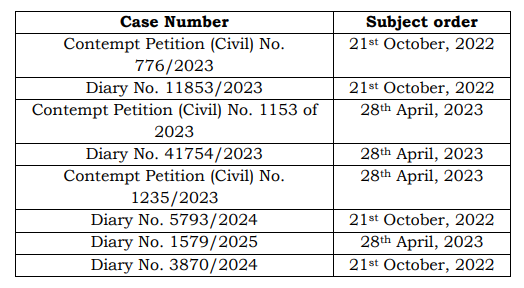
150. The contempt petitions allege that the respondent- authorities, who were bound by the directions contained in the aforesaid orders, failed to register criminal cases despite the occurrence of incidents allegedly constituting hate speech. It is contended that certain political figures, including sitting members of State Legislatures, have made statements targeting different religious communities, namely Hinduism, Islam and Christianity, which, according to the petitioners, attract penal provisions.
151. In Contempt Petition (Civil) No. 776 of 2023, the respondent, in their counter-affidavit dated 26th April, 2023, has specifically stated that action was taken in compliance with the directions of this Court and that an FIR has been duly registered. This position stands admitted by the contempt petitioner in the rejoinder- affidavit dated 26th February, 2025.
152. Similarly, in Diary No. 11853 of 2023, the respondent, in their counter-affidavit dated 10th May, 2023, has stated that suo motu FIR Nos. 151 of 2023 and 258 of 2023 have already been registered at Mira Road Police Station, District Thane, and Shrirampur Police Station, District Ahmednagar, respectively.
153. In Contempt Petition (Civil) No. 1153 of 2023, the contempt-petitioner alleges that certain public functionaries, including the Speaker of a State Legislative Assembly, a Minister of the State of Tamil Nadu, a Member of Parliament, and another State Minister, have made statements amounting to hate speech directed against the religion professed by the petitioner. The respondent-authorities have not yet had the opportunity to file their response.
154. In Diary No. 41754 of 2023, the grievance pertains to an alleged instance of hate speech dated 11th September, 2023, by one Kavati Manohar Naidu, then Mayor of the Guntur Municipal Corporation, directed against the petitioner, being a political party and its President. The respondent-authorities have not yet had the opportunity to file their response.
155. In Contempt Petition (Civil) No. 1235 of 2023, it is alleged that a sitting Minister has made statements against followers of a particular religion. The petitioner asserts that despite lodging a complaint, no FIR has been registered, thereby amounting to disobedience of the order dated 28th April, 2023. The respondent-authorities have not yet had the opportunity to file their response.
156. In Diary No. 5793 of 2024, the allegation pertains to instances of hate speech by a political leader across three States. However, there is no averment to indicate that the petitioner approached the concerned authorities with a complaint. The petitioner instead proceeds on the assumption that non-registration of an FIR suo motu would ipso facto amount to contempt.
157. In Diary No. 1579 of 2025, the petitioner alleges that certain remarks were made against Ajmer Sharif Dargah. It is stated that the petitioner approached the Nanded Rural Police Station and, upon inaction, made representations to the Superintendent of Police as well as the Director General of Police. The respondent-authorities have not yet had the opportunity to file their response.
158. In Diary No. 3470 of 2024, the petitioner has enumerated as many as 55 alleged instances of hate speech across different States. However, there is nothing on record to indicate that these incidents were brought to the notice of the concerned authorities by way of any complaint or representation.
159. A common contention raised in some of the contempt petitions is that the respondent-authorities were under an obligation to register FIRs suo motu, and failure to do so would automatically amount to contempt of the orders dated 21st October, 2022 and 28th April, 2023. We find this submission to be overly broad and untenable. The aforesaid directions were issued to remind the authorities of their statutory obligations and to ensure prompt action in appropriate cases. The element of “hesitation” or failure to act despite knowledge of a cognizable offence is a sine qua non for invoking the contempt jurisdiction of this Court.
160. In cases where the petitioner has not even approached the authorities or placed the relevant material before them, it would be wholly inappropriate to infer disobedience or “hesitation” on the part of the authorities. In the absence of such foundational facts, the contempt jurisdiction cannot be invoked.
161. Accordingly, in Diary No. 5793 of 2024 and Diary No. 3470 of 2024, where no complaint has been made to the authorities, we are unable to hold that there has been any wilful disobedience of the directions of this Court. No case of contempt is made out in these matters.
162. In Contempt Petition (Civil) No. 776 of 2023 and Diary No. 11853 of 2023, it is evident from the affidavits on record that FIRs have already been registered in compliance with the directions of this Court. These petitions, therefore, stand closed.
163. However, in Contempt Petition (Civil) No. 1153 of 2023, Diary No. 41754 of 2023, Contempt Petition (Civil) No. 1235 of 2023 and Diary No. 1579 of 2025, there are specific averments that the respondent- authorities have failed to act despite complaints having been made. In these matters, we deem it appropriate to grant opportunity to respondent- authorities therein to file their response.
Part IV
Our Conclusions
164. For the foregoing reasons and discussion, our conclusions are summarised as follows: –
I. The creation of criminal offences and the prescription of punishments lie squarely within the legislative domain. The constitutional scheme, founded upon the Doctrine of Separation of Powers, does not permit the judiciary to create new offences or expand the contours of criminal liability through judicial directions.
II. The precedents of this Court consistently affirm that while constitutional Courts may interpret the law and issue directions to secure the enforcement of fundamental rights, they cannot legislate or compel legislation. At the highest, the Court may draw attention to the need for reform; the decision whether, and in what manner, to legislate remains within the exclusive domain of the Parliament and the State Legislatures.
III. The contention that the field of hate speech remains legislatively unoccupied is misconceived. The existing framework of substantive criminal law, including the provisions of the IPC and allied legislations, adequately addresses acts that promote enmity, outrage religious sentiments, or disturb public tranquillity. The field is, therefore, not unoccupied.
IV. The material placed before this Court indicates that a greater extent of the concerns highlighted by the petitioners arise not from the absence of law, but from deficits in its consistent and effective enforcement. Such concerns, however significant, cannot justify the judicial assumption of legislative functions.
V. The statutory framework under the CrPC (now the Bharatiya Nagarik Suraksha Sanhita, 2023), provides a comprehensive and layered mechanism to set the criminal law in motion. The duty of the police to register an FIR upon disclosure of a cognizable offence is mandatory, as settled in Lalita Kumari (supra).
VI. In cases of non-registration of FIR, the CrPC/BNSS provide efficacious remedies. An aggrieved person may approach the Superintendent of Police under Section 154(3) of CrPC or corresponding Section 173(4) of BNSS and thereafter invoke the jurisdiction of the Magistrate under Section 156(3) of CrPC (corresponding Section 175 of BNSS) or proceed by way of a complaint under Section 200 of CrPC (corresponding Section 223 of BNSS). These remedies constitute a complete statutory architecture.
VII. The availability of such remedies, coupled with the supervisory jurisdiction of constitutional Courts under Articles 32 and 226 of the Constitution demonstrates that no legislative vacuum exists warranting the intervention sought. The appropriate course lies in ensuring faithful and even-handed enforcement of existing law.
VIII. The supervisory jurisdiction of the Magistrate under Section 156(3) of CrPC or corresponding Section 175 of BNSS is of wide amplitude and includes supervisory oversight over the investigation at appropriate stages. This power is intended to ensure that the investigation is conducted in a fair, impartial, and lawful manner, and may be exercised simultaneously during the stage of investigation, where the material on record discloses any deficiency, inaction, or taint in the investigative process.
IX. The requirement of prior sanction under Sections 196 and 197 of CrPC (corresponding Sections 217 and 218 of BNSS) operates at the stage of taking cognizance and does not extend to the pre-cognizance stage of registration of FIR or investigation under Section 156(3) of CrPC (corresponding Section 175(3) of BNSS). An order directing investigation under Section 156(3) of CrPC does not amount to taking cognizance within the meaning of Section 190 of CrPC (corresponding Section 210 of BNSS).
X. While we decline to issue directions of the nature sought, we deem it appropriate to observe that issues relating to ‘hate speech’ and ‘rumour mongering’ bear directly upon the preservation of fraternity, dignity, and constitutional order. It would be open to the Union of India and competent legislative authorities to consider, in their wisdom, whether any further legislative or policy measures are warranted in light of evolving societal challenges or to bring about suitable amendments as suggested by the Law Commission’s 267th Report dated 23rd March, 2017.
Final Directions
165. In view of the foregoing discussion, all the Writ Petitions and the Civil Appeal arising out of SLP (Civil) No. 6913 of 2021 stand dismissed.
166. The Criminal Appeal arising out of SLP (Criminal) No. 5107 of 2023 is partly allowed in terms of our discussion in Part II of this judgment. The impugned judgment dated 13th June, 2022, passed by the High Court of Delhi at New Delhi in W.P. (Crl.) No. 1624 of 2020 is set aside to the limited extent that it holds that a Magistrate, while exercising powers under Section 156(3) of CrPC, cannot direct registration of an FIR in the absence of prior sanction.
167. Insofar as Contempt Petition (Civil) No. 776 of 2023, Diary No. 11853 of 2023, Diary No. 5793 of 2024, and Diary No. 3470 of 2024 are concerned, in view of the findings recorded in Part III of this judgment, we are satisfied that either compliance has been effected or no case of contempt is made out. Accordingly, the said contempt petitions stand closed.
168. In Contempt Petition (Civil) No. 1153 of 2023, Diary No. 41754 of 2023, Contempt Petition (Civil) No. 1235 of 2023, and Diary No. 1579 of 2025, for the reasons recorded in Part III, the respective respondent- authorities are granted two weeks’ time to file their response. Let these matters be listed separately for consideration on 19th May, 2026.
169. The Registry of this Court is directed to transmit a copy of this judgment to all the High Courts. The High Courts may, in their administrative side, consider examining the feasibility of issuing appropriate practice directions or guidelines, as may be deemed necessary, to give full and effective implementation to the law declared in the present judgment.
170. Pending application(s), if any, shall stand disposed of.
- Hereinafter, referred to as “Constitution”. [↩]
- For short, “IPC”. [↩]
- (2018) 9 SCC 501 [↩]
- AIR 2014 SC 1591 [↩]
- (1994) 3 SCC 394. [↩]
- AIR 1955 SC 549 [↩]
- (1973) 4 SCC 225 [↩]
- (2016) 5 SCC 1 [↩]
- 1989 Supp (2) SCC 364 [↩]
- (2016) 3 SCC 680 [↩]
- (1997) 6 SCC 241 [↩]
- (2020) 13 SCC 585 [↩]
- (2023) 20 SCC 736 [↩]
- For short, “CrPC”. [↩]
- For short, “BNSS”. [↩]
- For short, “FIR”. [↩]
- (2014) 2 SCC 1 [↩]
- (1997) 8 SCC 476 [↩]
- (2008) 2 SCC 409 [↩]
- (2004) 2 SCC 150 [↩]
- (2021) 15 SCC 80 [↩]
- (2004) 5 SCC 1 [↩]
- Writ Petition (Civil) No. 719 of 2023 [↩]
- (2017) 10 SCC 1 [↩]
- (2024) 16 SCC 105 [↩]
- Dr. B.R. Ambedkar, Constituent Assembly Debates, Vol. 11, 25th November, 1949. [↩]
- (2023) 4 SCC 1 [↩]
- Dr. B.R. Ambedkar, Constituent Assembly Debates, Vol. 11, 15th November, 1949. [↩]
- This Part deals with SLP (Civil) No. 6913 of 2021 and SLP (Crl.) No. 5107 of 2023. [↩]
- Hereinafter, in this Part referred to as “High Court”. [↩]
- Hereinafter, in this Part referred to as “Trial Court”. [↩]
- (2013) 10 SCC 705 [↩]
- 2016) 9 SCC 598 [↩]
- (2006) 1 SCC 627 [↩]
- (2006) 6 SCC 728 [↩]
- 1951 SCC OnLine SC 22 [↩]
- 1950 SCC OnLine Cal 49 [↩]
- (2018) 5 SCC 557 [↩]
- Contempt Petitions will be dealt in this Part, being Diary No. 5793 of 2024, Diary No. 3470 of 2024, Contempt Petition (Civil) No. 776 of 2023, Diary No. 11853 of 2023, Contempt Petition (Civil) No. 1153 of 2023, Diary No. 41754 of 2023, Contempt Petition (Civil) No. 1235 of 2023 and Diary No. 1579 of 2025. [↩]