


Analysis
Becoming a democracy
A brief history of how universal adult franchise brought India's marginalised into the electorate
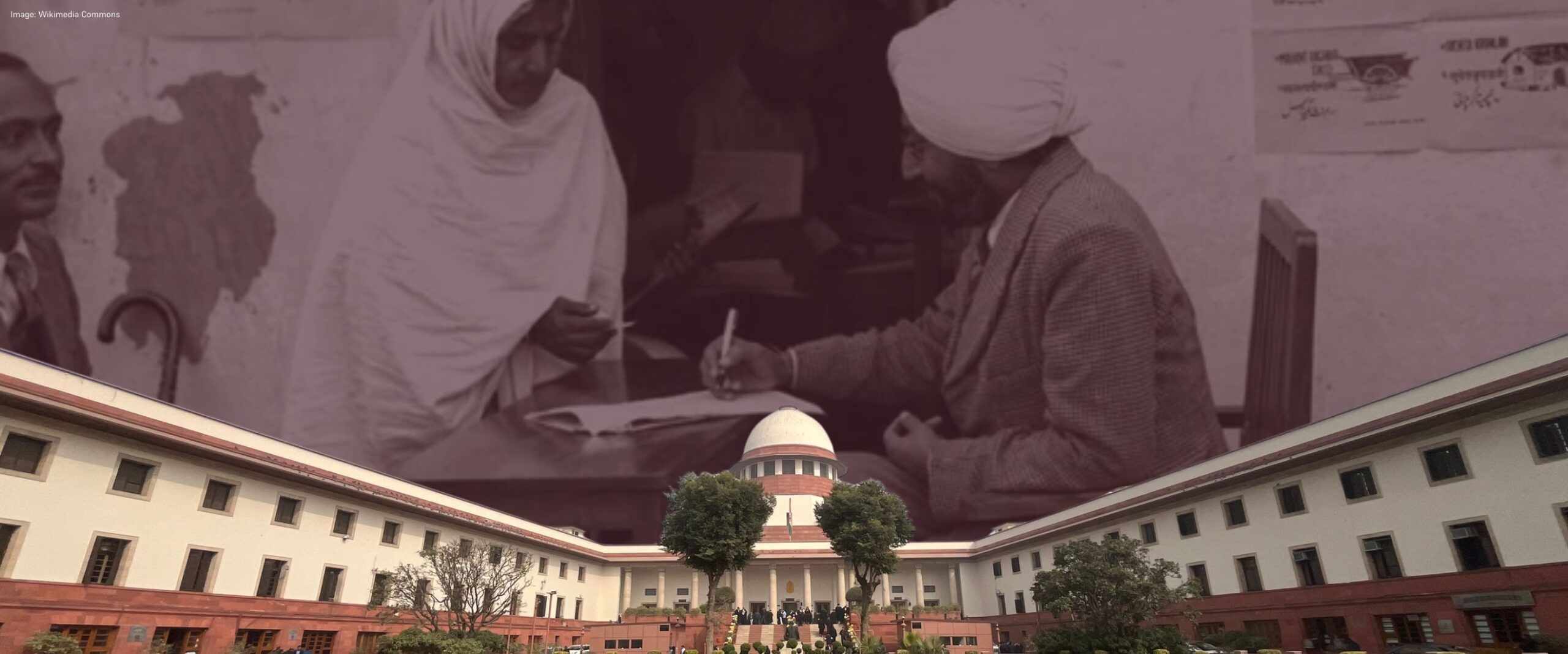
In 1950, the Constitution of India came into force, introducing universal adult franchise for the nation and granting everyone above 21 years of age the right to vote and shape democracy. For decades, this right had depended on property, education and community and the case for extending it to every adult was not without challenge.
In How India Became Democratic, Prof. Ornit Shani draws a vivid picture of India’s awakening to democracy and remarks that enfranchisement through universal adult franchise was “destined to happen”. She refers to Prof. Rajeev Bhargava’s argument that the idea of universal franchise lay securely within the heart of nationalism.
This leads to the question: was universal adult franchise really so woven into the social fabric of our democratic nation? How did India—a society so deeply divided by caste, class and religion—find a shot at equal representation? Interestingly, inclusiveness through universal suffrage has more to do with the demand for separate electorates than one may imagine.
A long drawn struggle
The demand was first captured in the Constitution of India Bill, 1895, or the Swaraj Bill—a document of unknown authorship that spearheaded the movement for independence. For years, the right to elect representatives operated within cascading limits. In 1909, the Indian Councils Act or the Morley-Minto reforms, permitted inclusion of Indians in legislative councils elections. But the right to elect was indirect. It was confined to municipalities, district and local boards, universities, chambers of commerce and trade associations and groups of persons such as land-holders or tea planters. The 1909 Act further introduced separate electorates for Muslims to address the problem of representation.
This limited franchise posed a real problem for India’s vast population of Depressed Classes. While the Government of India Act, 1919 expanded separate electorates to Anglo-Indians, Sikhs and Indian Christians. There was no mention of the Depressed Classes.
This became a site of heightened contestation. In his submission before the Southborough Committee (1918), Dr. B.R. Ambedkar demanded that limited franchise be extended to the Depressed Class as it was to Muslims. Sir Frank Sly, the Deputy Chairman of the Committee remarked, “He [Dr Ambedkar] was opposed to any system under which the representatives of the depressed classes were drawn from other classes.”
Universal adult suffrage, however, still did not capture the imagination of the Indian Nationalists. The Commonwealth of India Bill, drafted by a committee led by Anne Basant, which was presented at the British Parliament in December 1925, continued to prescribe limited franchise. This changed only in 1928, when the Nehru Report, presented at the Lucknow Session of All Parties Conference in 1928, espoused universal suffrage for those above the age of 21.
The demand picked up momentum in the 1930s. At the First Round Table Conference (November 1930–January 1931), Dr. Ambedkar stated, “if you give us adult universal suffrage, the Depressed Classes… will be prepared to accept joint electorates and reserved seats; but if you do not give us adult suffrage, then we must claim representation through separate electorates.”
By March 1931, the Indian National Congress was on board with the idea of adult suffrage. Assembling at Karachi, days after the Gandhi-Irwin Pact, the Congress passed the Karachi Resolution, which in clear terms, stated that “the franchise shall be on the basis of universal adult suffrage” The Karachi Resolution was circulated by Gandhi at the Second Round Table Conference (September 1931—December 1931).
By May 1932, the Indian Franchise Committee Report made a strong case for adult suffrage, noting, “Any form of restricted franchise necessarily infringes the principle of equality between individuals in some degree.” It addressed the need to reconcile wide political divides, shaping the aspirational unification of a nation, in the following words:
“Adult franchise… avoids the necessity for devising special franchises, for example for women, or the depressed classes, [which] may discourage the formation of groups based on sectional, communal, or similar interests, and will facilitate the development of parties based on political ideas and ends, which are the true foundation of sound political life.”
Despite the push, adult suffrage received no formal sanction until it was adopted in anticipation of the new Constitution. Shani notes that by 15 March 1948, a circular letter to all provinces and State instructed the preparation of a draft electoral roll on the basis of adult franchise, legitimised on the basis that adult franchise was considered in the Draft Constitution. Finally, on 16 June 1949, Draft Article 289B was introduced by Dr. Ambedkar, which unequivocally declared that elections to legislatures will be based on adult suffrage. The Article corresponds to Article 326 of the Constitution.
Post Independence
India, as a nascent democracy, took on the colossal task of enfranchising 340 million people (at that time) through the process of registration on the electoral roll. The limitations of ownership of property, residential status and education to becoming a voter was done away with. People became enfranchised as voters even before they could become citizens, on the anticipation that they would, in time, steer towards a democracy that went beyond divisions of class, religion and community status.
In 1988, the 61st Amendment of the Constitution reduced the voting age from 21 to 18, extending franchise to millions of young citizens.
Since the Special Intensive Revision was introduced in July 2025, petitioners have often come before the Supreme Court, raising the issue of disenfranchisement of millions of voters. In the light of the SIR, this history reminds us how India became a nation, and aspired to be a deeply democratic one.
Related articles

Analysis
“Ancient republics” and the Bihar SIR
An anatomy of mass exclusion through swadeshi jurisprudence and the Special Intensive Revision (SIR) of electoral rolls
Analysis
Beyond ‘Special’: How the 2025 Bihar SIR marks a break from the past
As the SC considers its verdict in the roll revision case following 29 hearing days, it must confront the history of electoral safeguards
Analysis
Independence of Election Commissioners | Court in review
A history of developments on the procedure for appointment and removal of Election Commissioners
Analysis
‘Out of Sight, Out of Mind’: Jantar Mantar and Democracy
Does the designation of protests to remote and invisible locations amount to regulation or prohibition?