


Analysis
SC reserves judgement on impeachment proceedings against Justice Varma
Counsel debated whether coequal Houses can take divergent decisions on identical impeachment motions
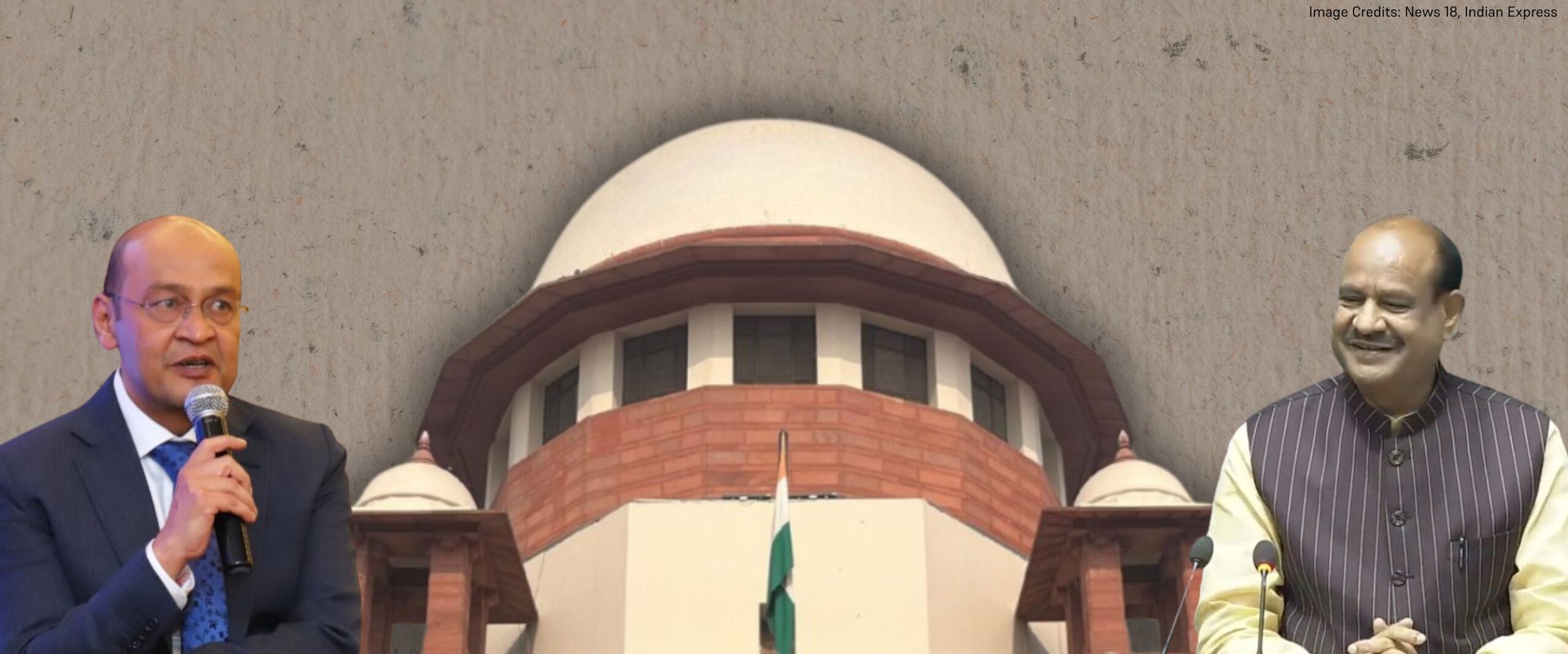
Today, a Bench of Justices Dipankar Datta and S.C. Sharma reserved judgement on the petition filed by Justice Yashwant Varma challenging the impeachment proceedings initiated against him under the Judges (Inquiry) Act, 1968. The proceedings stem from allegations of corruption after burnt currency notes were allegedly found at his official residence in Delhi.
Senior Advocates Mukul Rohatgi, Sidharth Luthra, Jayant Mehta and Siddharth Agarwal appeared for Justice Varma. Solicitor General Tushar Mehta appeared for both the Lok Sabha and the Rajya Sabha.
Yesterday, Rohatgi had questioned the authority of the Deputy Chairman of the Rajya Sabha and contended that the constitution of an Inquiry Committee violated Article 124(5) of the Constitution of India and Section 3 of the Act.
Article 124(5) creates a self-contained constitutional code
Luthra submitted that the Judges Act was passed under Articles 124(4) and 124(5) which govern the removal of judges and together form a closed constitutional regime. According to Luthra, general constitutional provisions governing the conduct of parliamentary business, including Article 91, stand excluded in the context of impeachment.
Justice Datta questioned whether such exclusion could be read into Article 124(5). “If there is some silence in Article 124(5), then what shows that Article 91 is excluded?” he asked, noting that the Court had to grapple with a situation where the Chairman of the Rajya Sabha had resigned.
Luthra responded that impeachment proceedings were not routine parliamentary business and that the seriousness of the process justified waiting for a new Chairman to assume office. He further criticised the manner in which the Deputy Chairman rejected the motion, submitting that there was no application of mind as contemplated under Section 3(1).
Rohatgi contrasted Articles 118 and 119, on conduct of parliamentary business, with Article 124(5), which he described as conferring a rare and sovereign power on Parliament to sit in judgement over a constitutional authority.
Justice Datta asked, “If we accept your contention, then if there are specific duties which are to be performed by the Chairman of the Rajya Sabha himself, no such duty can be performed.”
Rohatgi responded that such vacancies would be brief. Justice Datta refused to proceed on that assumption. “We do not know that. What does history tell us?” he asked, noting that constitutional interpretation could not rest on presumed timelines. He said that “there cannot be a vacuum” in the discharge of constitutional or statutory functions.
Deputy Chairman cannot discharge a role demanding neutrality
Rohatgi then argued that the Chairman occupied a uniquely neutral position under the Constitution. “The Chairman is completely non-partisan. He does not belong to any party. He does not sign any motion,” he said, pointing out that even at the stage of voting on removal, the Chairman exercises only a casting vote.
By contrast, he submitted, the Deputy Chairman remains a member of the House unless called upon to preside in exigency and could even be a signatory to the impeachment motion. Importing Article 91 into the impeachment framework would therefore create an inherent conflict of interest.
Justice Datta observed that the Deputy Chairman was elected. Rohatgi responded that election did not confer neutrality, particularly in a process that demanded the highest institutional impartiality. He further submitted that the same difficulty would arise if a third person appointed by the President were to act, since such a person could also be a signatory to the motion.
Secretary General assumed an adjudicatory role without authority
Rohatgi also assailed the role played by the Secretary General of the Rajya Sabha. He argued that the Secretary General had prepared what amounted to a reasoned judgement on the merits of the allegations while the Act did not contemplate any such adjudicatory role for the Secretariat.
Rohatgi then submitted that there was no documentary evidence to support the allegations of corruption. He argued that the unlawful circulation and publication of the Secretary General’s assessment caused grave reputational damage and irreversible harm.
Justice Datta mentioned that something had entered the public domain which the Court had earlier deprecated. “It does not smell of malice of intention, but it smells of malice in law,” he said, adding that the Court might comment on the issue to provide future guidance.
Coequal Houses but opposite outcomes
Stressing on the constitutional equality of both Houses of Parliament, Luthra argued that identically worded impeachment motions could not be permitted to meet different fates.
Jayant Mehta added that one House cannot override the decision of the other. Building on the argument that Section 3 was a complete and exhaustive code, he submitted that Parliament was conscious of the possibility that motions could be moved on the same day in both Houses and enacted the first proviso to Section 3 to deal precisely with that contingency. According to Mehta, any other interpretation would allow one House to outweigh the other, contrary to the constitutional design.
Justice Datta observed that if the same Speaker or Chairman continued in office, they would likely adhere to their earlier opinions. He warned against interpretations that left room for misuse and referred to an earlier instance involving a judge of the Calcutta High Court where impeachment proceedings were rendered infructuous due to intervening events.
Admission is discretionary, proviso confers no vested right
Tushar Mehta argued that admission of a motion under Section 3(1) was not automatic. He drew a clear distinction between the giving of a notice of motion by Members of Parliament and the presentation of an address to the President under Article 124(4).
He relied on the decision in Justice P.D. Dinakaran v Judges Inquiry Committee (2011) to submit that the Speaker or Chairman must apply their mind and either admit or refuse admission of the motion. He argued that the first proviso to Section 3 did not confer any vested right on the judge concerned and merely prevented the constitution of multiple inquiry committees.
Justice Datta repeatedly asked whether any demonstrable prejudice had been caused to Justice Varma by the absence of a joint committee. Tushar Mehta submitted that there was no allegation of bias against the Deputy Chairman, or the members of the Inquiry Committee. In the absence of prejudice, he argued, the Court should not exercise its equity jurisdiction under Article 32.
Directing parties to file their written submission, the Court reserved judgement.
Related articles
Analysis
SC examines feasibility of Inquiry Committee against Justice Varma
Counsel argued that admission by both Houses is mandatory and questioned powers of the Deputy Chairman
Analysis
Justice Varma had ‘covert or active control’ of store room, finds committee
The in-house committee set up by CJI Khanna also found evidence of cash being removed from the store room in the early hours of 15 March
Analysis
Justice Varma cash inquiry: The story so far
Following a fire, a large amount of unaccounted cash was found in Justice Varma’s official residence on 14 March