


Analysis
Legislating India’s Tribunals: A Timeline
Our timeline covers the key Supreme Court judgements on legislations concerning Tribunals in India
1986
S.P. Sampath Kumar v Union Of India | 5-J
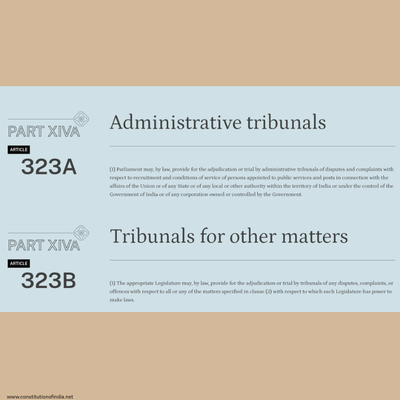
The 42nd Amendment Act, 1976 introduced Article 323A to the Constitution which empowered Parliament to establish administrative tribunals. Article 323B enabled the legislature to constitute tribunals for other subjects. The Administrative Tribunals Act, 1985 was enacted pursuant to Article 323A. Its constitutional validity was challenged for being ultra vires the Constitution and for violating its Basic Structure. Several provisions of the Act permitted executive functionaries to be appointed as members of the Tribunal while excluding the jurisdiction of High Courts under Articles 226 and 227. The Supreme Court upheld the validity of the Act. It held that tribunals should be a real substitute of High Courts, noting that only persons with legal and/or judicial experience must be appointed as members of the Tribunal. The Court, however, directed Parliament to revisit the provisions determining a fixed term for members of the Tribunals stating that a limited term was not conducive to the effective functioning of the tribunals system.
1987
S.P. Sampath Kumar v Union Of India | Review Petition | 5-J
The Supreme Court, in a review petition seeking reconsideration of S.P. Sampath Kumar (1986), clarified that appointments to the Central Administrative Tribunal should be made through a High-Powered Selection Committee headed by a sitting judge of the Supreme Court nominated by the Chief Justice of India. For State Administrative Tribunals, a committee should be chaired by a sitting judge of the High Court nominated by its Chief Justice. The Bench reiterated that the Basic Structure of the Constitution was not violated as the power of judicial review of administrative tribunals was vested with the Supreme Court.
1997
L. Chandra Kumar v Union of India | 7-J
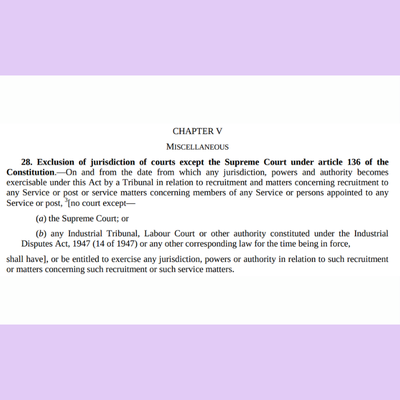
The Supreme Court heard a reference seeking reconsideration of S.P. Sampath Kumar and struck down Article 323A(2)(d), Article 323B(3)(d) and Section 28 of the Administrative Tribunals Act, 1985, holding that Tribunals cannot substitute the jurisdiction of the High Courts. The Court held that the power of judicial review by High Courts forms part of the basic structure of the Constitution. The Court stated that Tribunals shall continue to act as the Court of first instance and it is not open for litigants to directly approach the High Court. Further, the Court pressed for an independent nodal body that would help safeguard the autonomy and independence of the Tribunals.
2010
Union of India v R. Gandhi | Madras Bar Association - I | 5-J
The petitioner—the President of the Madras Bar Association (MBA)—challenged the constitutional validity of Parts 1B and 1C of the Companies Act, 1956, inserted by the Companies Amendment Act, 2002, which set up the National Company Law Tribunal (NCLT) and National Company Law Appellate Tribunal (NCLAT). The petitioner argued that Parliament does not have the competence to vest judicial functions performed by High Court, on matters like insolvency, revival and restructuring of the companies, in any Tribunal. It was argued that the transfer of the entire company jurisdiction to the Tribunals violated the separation of powers doctrine, which is a part of the basic structure of the Constitution. The Supreme Court held that Indian tribunals will be quasi-executive rather than quasi-judicial if comprehensive reforms ensuring independence in appointments, funding and administration are not made. It declared Parts 1B and 1C of the 1956 Act unconstitutional for diluting the qualifications for appointment of tribunal members, noting that Tribunals must appoint members with judicial knowledge and cannot become a “sinecure” to members of civil services. It directed corrections to Parts 1B and 1C which include the appointment of judges and advocates as judicial members of the tribunal, members should have the same position and status as High Court judges, increasing the fixed term from three years to five or seven years. The Court upheld the constitution of the NCLT and the NCLAT.
2014
Madras Bar Association v Union of India | Madras Bar Association - II | 4-J
The Madras Bar Association moved the Supreme Court for the second time, challenging the constitutional validity of the National Tax Tribunal Act, 2005. The petitioners alleged that the Act divested the jurisdiction of High Courts over substantial questions of law, granted Union Government the power to appoint non-judicial members and allowed for executive-dominance in the Selection Committee as well as in the Tribunal. The Supreme Court struck down the National Tax Tribunal Act, 2005 in its entirety, noting that it was the “ultimate encroachment on the exclusive domain of the superior Courts of Record in India.” The Court further added that allowing Union control would compromise judicial independence as it would be a litigant in all cases before the Tribunal.
2015
Madras Bar Association v Union of India | Madras Bar Association - III | 5-J
The Third Madras Bar case challenged the constitutionality of provisions under Chapter 27 of the Companies Act 2013, claiming that the Act brought back various provisions from the previously struck down Parts 1B and 1C of the Companies Act, 1956. The said chapter brought back the criteria for appointment of non-judicial persons to be members of the Tribunal, outnumbered executive members to judicial members in the Selection Committee for Members of Tribunals and Appellate Tribunals and prescribed re-appointment of members of the tribunal after serving a tenure of five years. The Supreme Court, while upholding the constitutional validity of NCLT and NCLAT, struck down provisions which brought back the qualifications for appointment of non-judicial persons. The Court further struck down provisions concerning the composition of the Selection Committee for violating the mandate of the 2010 judgement.
2019
Rojer Mathew v South Indian Bank | 5-J
Parliament enacted the Finance Act, 2017 which included provisions relating to the appointment and administration of tribunals. Part XIV of the 2017 Act, consisting of Sections 158 to 182 amended 25 Central Acts and introduced changes in the governance of Tribunals. The petitioner contended that the introduction of the 2017 as a money bill is a colourable exercise that bypassed the Rajya Sabha. Further, it was argued that provisions under Part XIV rendered certain tribunals defunct and terminated the services of presiding officers and members of Tribunals. Section 184 was challenged for empowering the Union Government to enact the 2017 Rules, providing for qualifications and procedure of appointment, conditions of service, terms and salaries of members of the Tribunal. The Supreme Court struck down the 2017 Rules notified under Section 184 of the Act for compromising judicial independence. Further, the question of whether Part XIV of the Act could be validly passed as a money bill was referred to a larger bench.
2020
Madras Bar Association v Union of India | Madras Bar Association - IV | 3-J
The petitioner challenged the Tribunal, Appellate Tribunal and other Authorities Rules, 2020, notified by the Union Government under Section 184 of the Finance Act, 2017 after the 2017 Rules were struck down. The Supreme Court upheld the 2020 Rules provided that they are modified to align them with principles of judicial independence and separation of powers. The Court suggested the reconstitution of Search-cum-Selection Committees to reflect judicial dominance, extension of tenure and age limits of Chairpersons and members of the Tribunal and extended eligibility of appointment as a member of the Tribunal to advocates with at least 10 years of practice at the bar.
2021
Madras Bar Association v Union of India | Madras Bar Association - V | 3-J
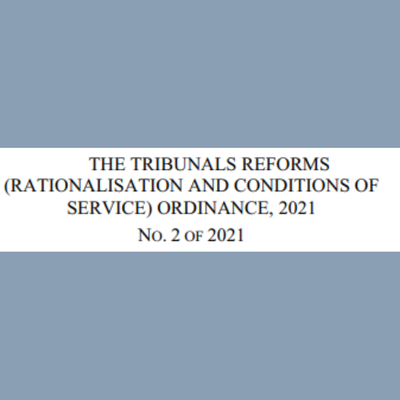
The Tribunal Reforms (Rationalisation and Conditions of Service) Ordinance, 2021 was promulgated after the decision in Madras Bar Association-IV. It introduced amendments to the Finance Act, 2021. The Madras Bar Association challenged Sections 12 and 13 of the Ordinance as well as Sections 184 and 186(2) of the Finance Act, 2017 which prescribed qualifications for appointment, terms of service, salary and allowances to members of the Tribunal. The Supreme Court, by 2:1 majority, struck down provisions of the 2021 Ordinance pertaining to a minimum qualifying age for appointment, four-year tenure limit and timelines for recommendation and selection of members by the Search-cum-selection Committee for directly violating the mandate in Madras Bar Association – IV.
2025
Madras Bar Association v Union of India| Madras Bar Association - VI | 2-J
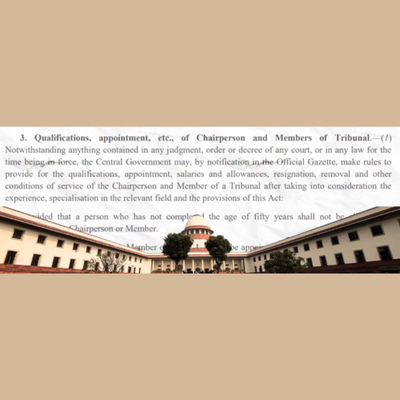
In August 2021, Parliament enacted the Tribunal Reforms Act, 2021. The Madras Bar Association challenged it by arguing that the Act re-enacted provisions that were previously struck down in Madras Bar Association – V, concerning a minimum qualifying age for appointment, four-year tenure limit and recommendation of names by Search-cum-Selection Committee. The Supreme Court held that the re-enactment of previously invalidated provisions without removing the defect directly violates constitutional supremacy. The decision noted that the directions issued in Madras Bar Association IV and V shall continue to govern the appointment, qualifications, tenure, service conditions, and allied aspects concerning tribunal members and chairpersons until relevant laws are enacted by the Parliament.
Related articles
Analysis
New tribunal law raises more questions than answers
The Tribunals Reforms Act, 2026 paves the way for yet another round of litigation
Analysis
Supreme Court holds the line against executive-legislative attempts to control tribunals
A brief history of the Union’s repeated attempts to change the tribunals law—and how the Court has addressed this executive creep
Analysis
Tribunal tribulations
The Bench asked the Union pointed questions during the hearings but does it suggest that the judiciary will win this round of the turf war?
Analysis
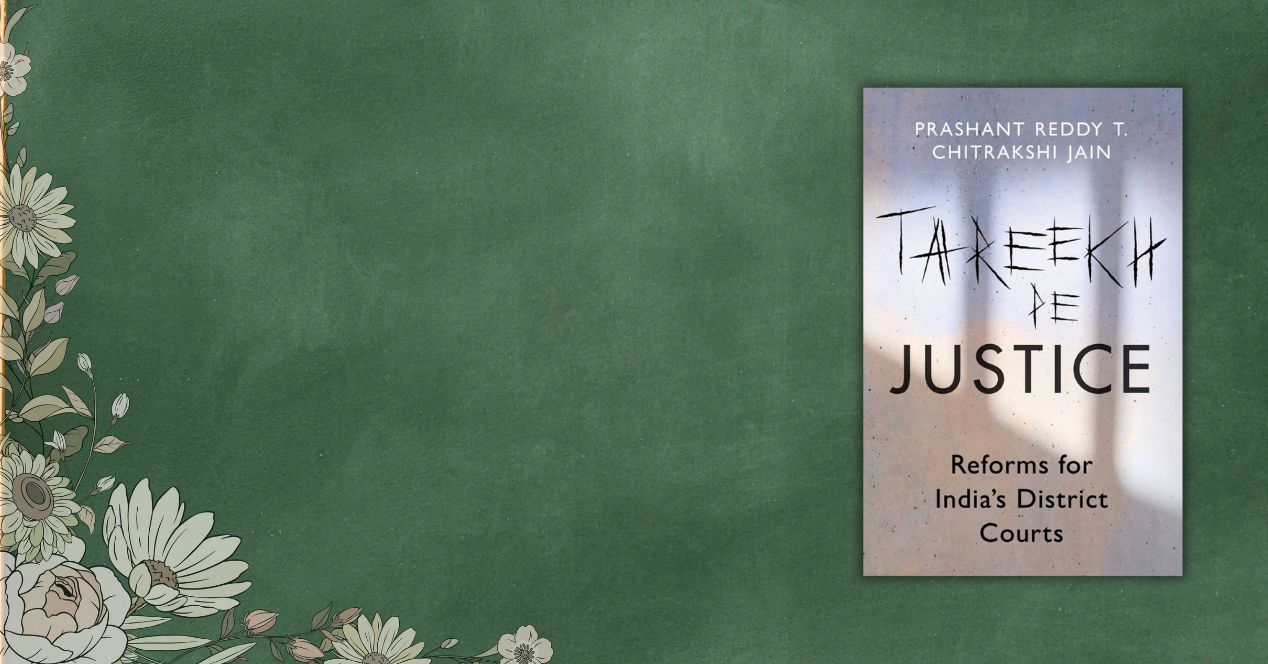
‘SC orders to increase funding for district judiciary read like royal firmans’
In a new book on the district judiciary, the authors argue that SC orders on lower courts often fail to articulate constitutional basis