


Analysis
SC says allegations of police excess warrant independent probe
The Court directed preservation of CCTV footage and protesters’ data, and the release of detained minors.
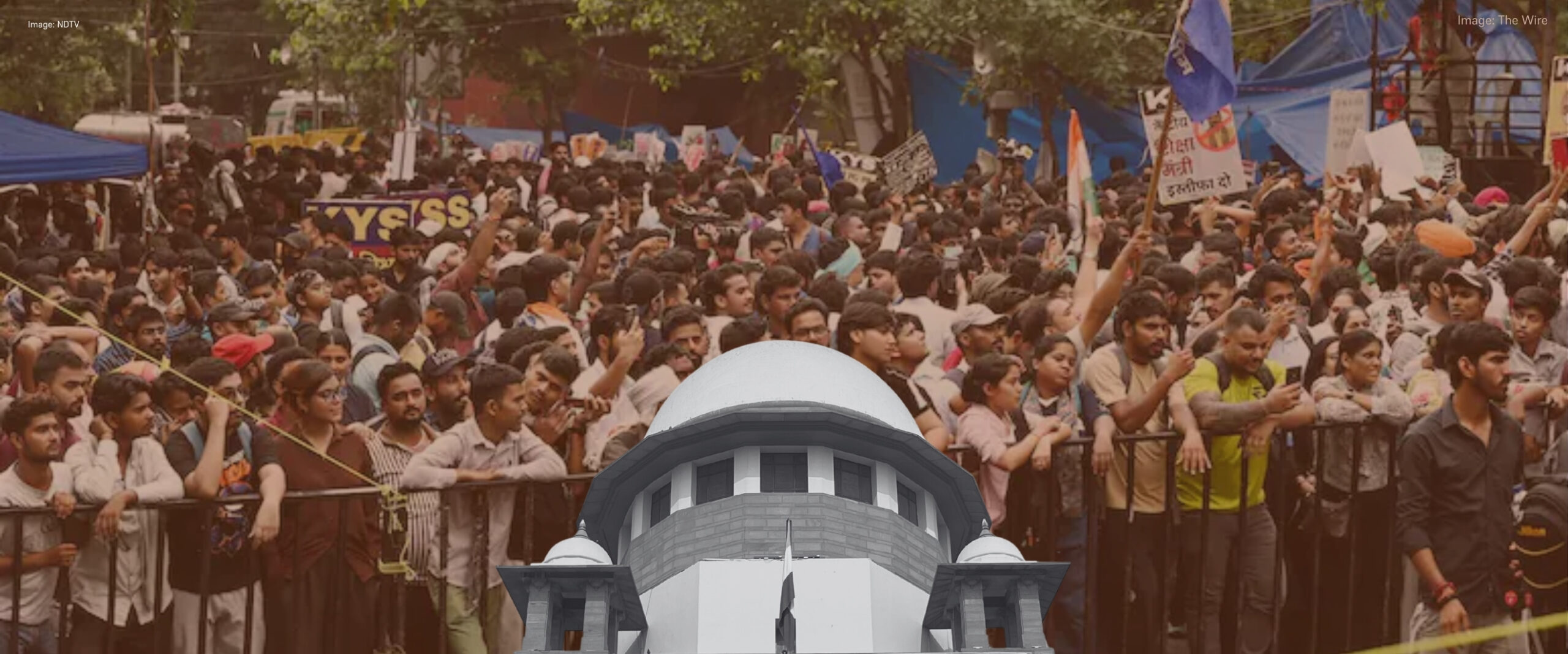
Today, the Supreme Court restrained authorities from taking coercive action against students who participated in the recent protests over the NEET paper leak. The Court held that the allegations of police brutality across several states disclosed a prima facie case for an independent inquiry. The Bench of Chief Justice Surya Kant and Justices Joymalya Bagchi and V. Mohana observed that evolving methods of crowd control required a fresh constitutional framework.
The batch of petitions, which was heard together after being mentioned before the Court on yesterday, concerns allegations of excessive force used against students protesting examination irregularities, including the NEET paper leak. While several petitions seek action against police personnel for the alleged use of pellet guns, electric batons and lathi charges, others have been filed by the families of police officers who claim they were assaulted during the demonstrations. The Court made it clear that both sets of allegations would have to be examined through the same independent process.
A nationwide challenge to police action
CJI Surya Kant noted that one of the petitions allege that the use of pellet guns had caused a 19-year-old boy to lose his eyesight. Other petitions claimed that electric batons had caused life threatening injuries to a young protester, lathis were embedded with nails, assaults on journalists, police personnel operating in civilian clothes, a woman protester being slapped without provocation and allegations of molestation at the hands of police personnel. He noted that the protests had begun as peaceful demonstrations by students asserting constitutionally protected rights.
Appearing for one of the petitioners, Senior Advocate Gopal Sankaranarayanan submitted that the incidents were not confined to Delhi but extended to Bihar, Madhya Pradesh, Uttar Pradesh, West Bengal, Maharashtra and elsewhere. He argued that the police had failed to follow the graded protocol evolved by the Supreme Court after earlier protests, which required announcements through loudspeakers, the use of water cannons before force and carefully regulated deployment of tear gas away from the crowds and lathis. Sankaranarayanan further contended that several officers operated without identification badges and that responsibility could not stop with individual constables. Referring to a video from Delhi, Sankaranarayanan claimed that an Assistant Sub-Inspector had himself broken the windows of a vehicle before attributing the damage to protesters.
“They behaved with a licence,” he submitted. “We want responsibility to be placed up the ladder. Unless this Court does that, the police think they can get away.” He suggested that a Special Investigation Team (SIT) be constituted headed by a former CJI.
Bench: Probe is meaningless if no responsibility is fixed
The Court said the allegations could not be examined solely by the police and would require a “completely independent probe”. CJI Surya Kant added that an inquiry would serve little purpose unless accountability was fixed.
Senior Advocate Shyam Divan referred to reports alleging that there were attempts to deter participation by threatening students with fabricated criminal cases. Referring to a widely circulated video, he submitted that a police officer in Maharashtra was seen warning young protesters that drugs would be planted on them if they returned to the protest site. Divan also relied on reports alleging violence against women demonstrators, including the incident in which a senior police officer was seen slapping a woman protester. CJI Surya Kant reiterated that any inquiry must be “independent, fair and transparent”.
Questions over arrests, surveillance and accountability
Senior Advocate Shadan Farasat drew the Court’s attention to the situation in Bihar,stating that 150 persons continued to remain in custody. This was despite the state government’s announcement that cases against protesters would be withdrawn. Many, he said, were children, including a 13-year-old boy, while most of the others were around 16 years of age. According to him, several had been produced before a Magistrate only after nearly 40 hours, well beyond the statutory requirement of production within 24 hours.
CJI Surya Kant responded that the Court will constitute a high-powered committee which would examine these issues from an all-India perspective. Farasat also submitted that in Delhi, police continued to chase and assault protesters even after the gathering at Jantar Mantar had dispersed. Students and young lawyers walking back through Connaught Place, he alleged, were beaten despite the situation having already been brought under control.
Sankaranarayanan submitted that police and Central Armed Police Force (CAPF) personnel had deployed vans equipped with facial recognition systems, following which several protesters had begun receiving notices asking them to explain their presence at the demonstrations. Farasat added that photographs of several participants, including minors, had appeared in newspapers. Sankaranarayanan argued that such profiling could have a chilling effect on the exercise of the right to protest.
The hearing saw brief interventions from other counsel. Advocate Vrinda Grover questioned the police version regarding a truck allegedly carrying stones to the protest site, asking how such a vehicle could have crossed multiple police barricades if the area had been under heavy security. Senior Advocate Abhishek Manu Singhvi handed over two compilations to the Court, one arranged state-wise and another dealing with the alleged use of pellet guns.
Advocate Prashant Bhushan, appearing for Mohammad Junaid Malik, submitted that his client had merely been distributing food to protesters when he was allegedly blindfolded and taken to Mussoorie by the police. Towards the close of the hearing, another lawyer informed the Bench that he too had been assaulted by police while providing legal assistance to protesters who were detained.
Union backs students’ right to protest
Mehta said the government did not take allegations of police excess lightly and accepted that students had a constitutional right to protest peacefully. At the same time, he submitted that more than 250 police personnel had sustained injuries during the demonstrations and suggested that criminal elements had infiltrated otherwise peaceful protests.
“I stand with the students,” Mehta told the Court, adding that he did not believe the students themselves had perpetrated violence. If students had indeed suffered at the hands of the police, those responsible must be brought to book, he said. However, before any committee was constituted, the Union sought a short opportunity to place its version on record. Mehta also informed the Court that all relevant electronic records were already being preserved.
Justice Bagchi observed “When the situation turns out of control, defensive gear is more important than offensive gear,” he remarked, suggesting that adequate protection could give officers additional time to defuse tense situations before resorting to tear gas or force. Recording that the material disclosed a prima facie case for an independent and fair probe, the Bench issued notice to Delhi, Maharashtra, Bihar, Kerala, Madhya Pradesh, Uttar Pradesh, Assam and West Bengal.
Court’s Directions
The Court passed the following directions:
- All CCTV footage, drone recordings, body worn camera footage, wireless communication records and PCR call records relating to the student protests shall be preserved.
- The police authorities shall preserve all digital data collected from protesters and ensure that it is not placed in the public domain until further orders.
- The respondents shall not publish the personal details or other identifying information of student protesters.
- No coercive action shall be taken against students who participated in the protests. The protection, however, shall not extend to persons with criminal antecedents.
- All States shall release children below the age of 18 years who were arrested during the student protests, provided they have no criminal antecedents.
The matter has been listed for further hearing next Monday, while the petition filed on behalf of Mohammad Junaid Malik has been directed to be listed separately on Wednesday.
Related articles
Analysis
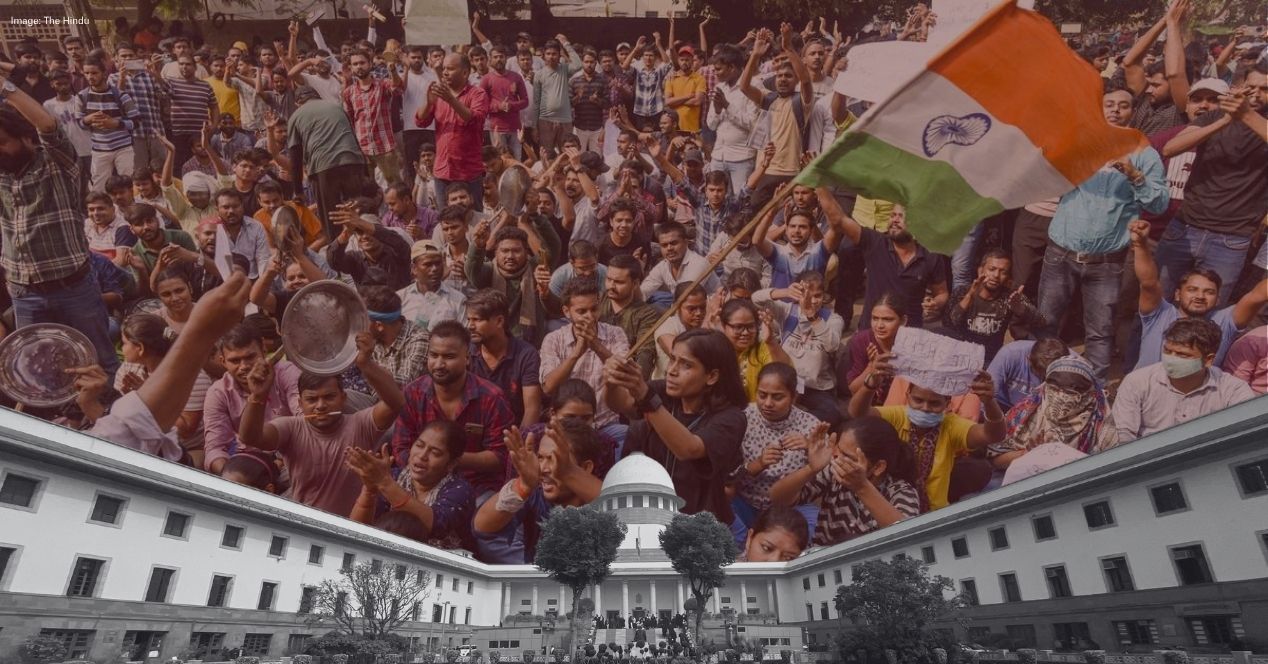
“Agitation cannot justify police excess”: SC on student protest crackdown
The Court said allegations of police excess must be independently examined and suggested a uniform protocol for handling public protests.