


Analysis
Belated scrutiny
As the Supreme Court scrutinises the Special Intensive Revision, the question is whether justice delayed can still protect the franchise
Earlier this week, the Supreme Court heard challenges on the legality of the Special Intensive Revision (SIR) of electoral rolls in Bihar. As the Bench of Chief Justice Surya Kant and Justice Joymalya Bagchi weighs in on its validity, the irony has grown too glaring to ignore: Bihar has already voted on the rolls prepared under the SIR, while the ECI’s second phase has begun in nine states and three union territories. Yet, by the 17th day of hearings, the Court was still considering the threshold question: can this exercise be justified in law at all? Is it compatible with the ECI’s powers under Article 324? The Bench kept demanding data and explanations, as it examined a structure whose foundations were laid, tested and used.
The first picture that reached the Court was not of cleaned-up rolls but of exhausted workers. The Bench was informed that 35-40 Booth Level Officers (BLOs) had died during the SIR, either by suicide or brain haemorrhage. Many more faced notices for breach of duty under Section 32 of the Representation of the People Act, 1950 (RP Act) which carries a punishment of imprisonment for failing to perform revision duties. FIRs have been filed against BLOs in Uttar Pradesh. On the ground, this translated into specific tragedies: a BLO in Moradabad recorded that he could not cope before he died, a headmaster in Meerut collapsed from cardiac arrest while handling SIR work. For their families, the revision is not a technical exercise but the alleged cause of an avoidable loss.
The Bench responded by asking states to post more staff, grant exemptions where needed and replace workers under severe pressure. Yet the Chief Justice of India’s remark cut to the core: if the SIR is lawful, he said, it must be carried out.
Inside the courtroom, the challenge to the SIR has turned on design and implementation rather than grand theory. Counsel warned that even voters already on the rolls could be excluded if they failed to file fresh forms, and underlined how poor and marginalised voters struggle to produce the documents now demanded by the Commission. They told the Court that the ECI deleted lakhs of names in Bihar without disclosing the underlying lists. They argued that refusing to accept Aadhaar and ration cards exceeded the Commission’s authority under the RP Act, and that a revision premised on doubt about whole classes of voters resembled a citizenship test in disguise. Citing Lal Babu Hussein v Electoral Registration Officer (1995), they reminded the Bench that electoral registration cannot begin from a presumption of ineligibility. By the end of the 8th day of arguments, the Court intervened to settle the ambiguity, directing that Aadhaar be treated as a document for establishing “identity, subject to verification.”
The mechanics of deletion have drawn particular fire. Petitioners said the main deletion list in Bihar surfaced only after the Court insisted, and that the ECI has still not fully disclosed deletions based on objections. Voters were shown as removed without effective notice or explanation, they argued, leaving no realistic chance to appeal. The Bench, in turn, reminded the Commission that deletions must comply with Rule 21 of the Registration of Electors Rules, 1960, and recorded its concern that the final roll itself seemed to generate confusion about who had been struck off and who had been added.
The gap between timing and scrutiny is now the real issue. The SIR hearings have become a test of how constitutional adjudication responds to time-sensitive administrative action. Judicial review usually assumes that the Court’s word will meaningfully shape what happens next. Here, the SIR has already determined who could vote in at least one state election and is likely to influence upcoming polls elsewhere. A judgement delivered after ballots have been cast risks operating entirely in the past tense. If the wait stretches much longer, the SIR challenge risks slipping into the territory where the case may become “academic.”
This article was first featured in SCO’s Weekly newsletter. Sign up now!
Related articles
Analysis
Trusting the Election Commission
In a hearing on electoral roll revision, the SC reiterated its inclination to trust the ECI, but not before offering friendly advice
Analysis
From Swamy to ADR: Nine VVPAT related cases decided by the Supreme Court
SCO lists key cases filed before the top court in the past decade seeking more transparency in the EVM-VVPAT system in India
Analysis
The making and unmaking of the Electoral Bond Scheme: Part 1
The Supreme Court’s judgement has validated the concerns expressed by various stakeholders during the planning stage of the Scheme.
Analysis
The making and unmaking of the Electoral Bond Scheme: Part 2
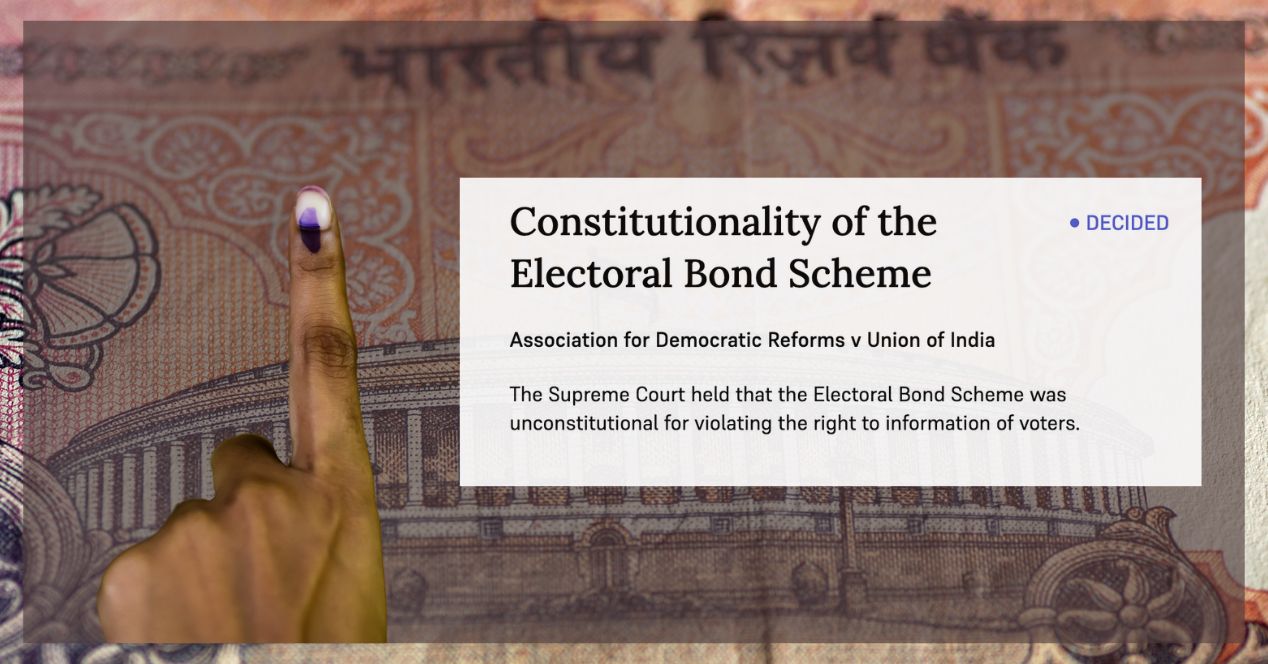
Several elections came and went before the top Court heard the case on merits. Yet, petitioners believe their eventual victory is not hollow