


Analysis
Eight years later, Sabarimala is back in the Supreme Court
The Court will start hearing the review petition on 7 April. Here are the key aspects of the 2018 verdict that will be under scrutiny
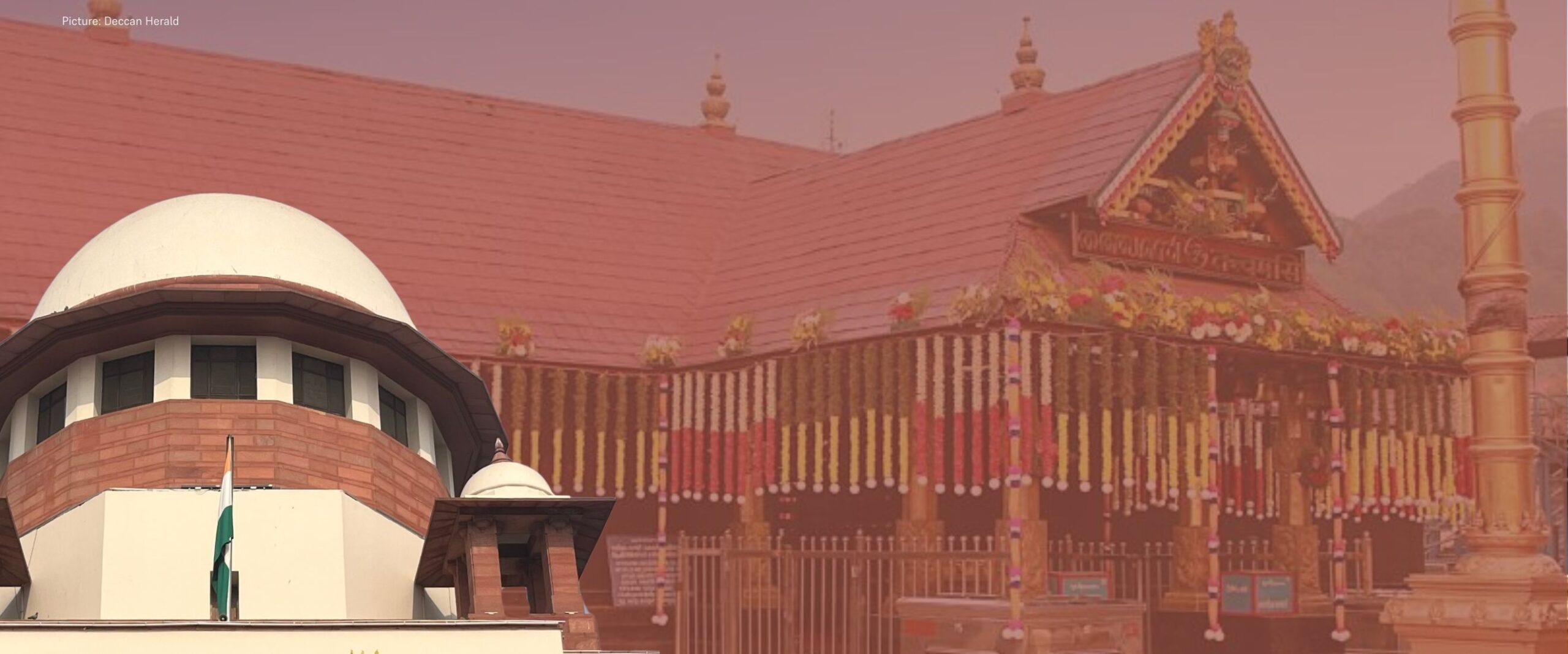
On 7 April, a nine-judge Bench will begin hearing the review of a five-judge Bench’s verdict in the Sabarimala case. The listing arrives nearly eight years after the Bench led by then CJI Dipak Misra held—in a 4:1 split—that prohibiting women between the ages of 10 and 50 years from entering the Sabarimala Temple violated Article 25(1) of the Constitution and Section 3 of the Kerala Hindu Places of Worship (Authorisation of Entry) Rules, 1965.
The majority and concurring opinions reflected a similar constitutional vision. But the Bench stopped short of settling the larger legal questions—how to balance competing fundamental rights and whether the Court has the authority to determine what counts as an ‘essential religious practice’. These issues were left to a nine-judge Constitution Bench.
The verdict, however, triggered a wave of review petitions. Though the maintainability of review petitions was briefly contested, a nine-judge Bench led by then CJI S.A. Bobde allowed the review in February 2020. The matter then lay in cold storage until it was finally listed in February 2026. Before the nine-judge bench assembles, here is a brief summary of why the Court ruled how it did in 2018.
Gender, morality and dignity
Writing for himself and Justice A.M. Khanwilkar, CJI Misra opened with the assertion that women “of any age group have as much right as men to visit and enter a temple.” They noted that excluding women devotees of a particular age from entering the temple violates their right of worship.
Justice R.F. Nariman presented a strongly worded view against biological determinism, remarking that “biological or physiological phenomenon of menstruation” must not result in ritualistic impurity.
Justice D.Y. Chandrachud’s opinion contained the statement: “Individual dignity cannot be allowed to be subordinate to the morality of the mob.” Further, he held that “morality” under Article 26, cannot be interpreted as the “morality of the majority”. Declaring the “position of the individual” central to constitutional morality, Justice Chandrachud concluded that the right of religious denominations to manage their affairs under Article 26 cannot function in opposition to constitutional morality, which considered the “position of the individual”.
Taken together, the Bench’s observations take the Judgement beyond the determination of rights and limitations, articulating broader ideas about the kind of society the Constitution envisions.
Faith, rights, and who decides
Central to the verdict are competing arguments on “public order”, “morality” and the fundamental right to religion under Articles 25 and 26.
The Constitution lists “public order” and “morality” as grounds on which both the individual’s right to freedom under Article 25(1) and the right of religious denominations under Article 26 may be restricted. In the present case, both parties drew on the shared language to make opposing arguments. While the petitioners argued that the right of denominations under Article 26 is subject to “public order” and “morality”, the respondents flipped the argument to contend that allowing the entry of women of menstruating ages to the temple would violate “public order” under Article 25(1).
The respondents argued that the exclusion of women is an “essential religious practice” under Article 26, necessary to preserve the character of the deity as a ‘Naisthik Bramchari’, a celibate god. They contended that allowing women of menstruating ages into the temple would violate the deity’s sacred vow of penance.
Pushing back on the argument, the petitioners invoked Article 25(2)(b). The provision reflects the Constitution’s commitment of social reform by throwing open Hindu religious institutions of a public character to all classes and sections of Hindus.
The majority rejected the respondents’ claims on two grounds. First, it held that the followers of Lord Ayyappa do not constitute a separate religious denomination. Second, it held that even if Sabarimala were treated as a religious denomination, the rights under Article 26 could not override the constitutional vision embodied in Article 25(2)(b). Declining to recognise the temple as one, the majority noted that it neither maintains a separate administration nor is it independently financed. Instead, the temple is administered by a statutory body and financed by the Kerala state government, falling short of the threshold required for recognition as a religious denomination.
Additionally, the Bench held that the Ayyappa devotees did not satisfy the three conditions required to qualify as a religious denomination under S.P. Mittal v Union of India (1983).
Further, since the Sabarimala temple is a public institution administered by the State, the Bench held that any custom or usage barring women from entry could be set aside under Article 25(2)(b), even if it were claimed as part of an essential religious practice.
The majority judges also rejected the respondent’s invocation to “public order” and “morality” under Article 26, holding that narrow and individualistic definitions of public morality cannot be used to encourage discrimination: instead, public morality must yield to constitutional morality.
Similarly, the Court held that Article 26 cannot be interpreted so as to defeat the vision of Article 25(2)(b). Where the two provisions conflict, the Court favoured a harmonious construction of the competing fundamental rights. The freedom of religious denominations to manage their own affairs must therefore yield to the individual’s right to worship under Article 25(2)(b).
Untouchability and wider interpretation of Article 17
The decision of the majority did not just interpret the rights of women devotees, it gave effect to the constitutional vision of equality. In a departure from convention, the five-judge Bench adopted an expansive reading of untouchability under Article 17, holding that the provision bars untouchability in all forms, not merely those rooted in caste.
Their reasoning borrowed heavily from the deliberations around Article 17 in the Constituent Assembly, which favoured an interpretive definition of “untouchability” as opposed to meaning contained by caste or religion. The majority anchored their reasoning in the language of Article 17, which prohibited untouchability “in any form”.
Justice Indu Malhotra’s dissent
The 2018 judgement contains an irony: Justice Indu Malhotra, the only woman on the bench, dissented. She held that the prohibition of temple entry for women of menstruating ages doesn’t violate any core constitutional principle of equality or the right of worship.
Her opinion noted that the worshippers of Lord Ayyappa are entitled to freedom of conscience and the right to practice, profess and propagate their religion under Article 25(1). She argued that this right can only be meaningfully guaranteed if the character of the deity as “naishtik bramhachari” was preserved: permitting women of menstruating ages to enter the temple would fundamentally alter the character of the deity.
Further, Justice Malhotra ruled out the overriding of Article 26 by Article 25(2)(b), stating that the latter cannot be interpreted to override customs and usage, forming an essential part of the religion. In her view, the respondents made a “plausible case” to satisfy the requirements of being a religious denomination. The dissent argues the converse of the majority—in her view, Article 25(2)(b) is not absolute; it is subject to the right of religious denominations to “manage its own affairs”.
Justice Malhotra equally resisted the majority’s expansive reading of “untouchability” under Article 17. To her, drawing a parallel between the exclusion of women worshippers and the exclusion of Dalits from temples was a false equivalence. Justice Malhotra observed that the rights asserted by Dalits arose from a history of systematic social exclusion. This, in her view, bore no resemblance to the exclusion of women from the temple.
Finally, Justice Malhotra expressed her overarching concerns on the power of the courts to determine ‘essential religious practices’. Rather than the Supreme Court, she deemed a competent court of civil jurisdiction an appropriate forum to adjudicate the matter. In her words of caution, Justice Malhotra suggested that in pluralistic societies, Public Interest Litigations challenging practices followed by specific sects or groups could cause serious damage to the country’s secular fabric.
The Sabarimala temple entry issue raises a range of questions about the limits of judicial intervention in matters of faith. The upcoming hearings before the nine-judge Bench will reveal how the Court navigates these difficult questions of faith and rights, of the individual and the collective.