

Court Data
If no new cases are filed, SC will still need 1.4 years to clear its docket
We look at the Court’s congestion and clearance rates over a period of a year starting from February 2025
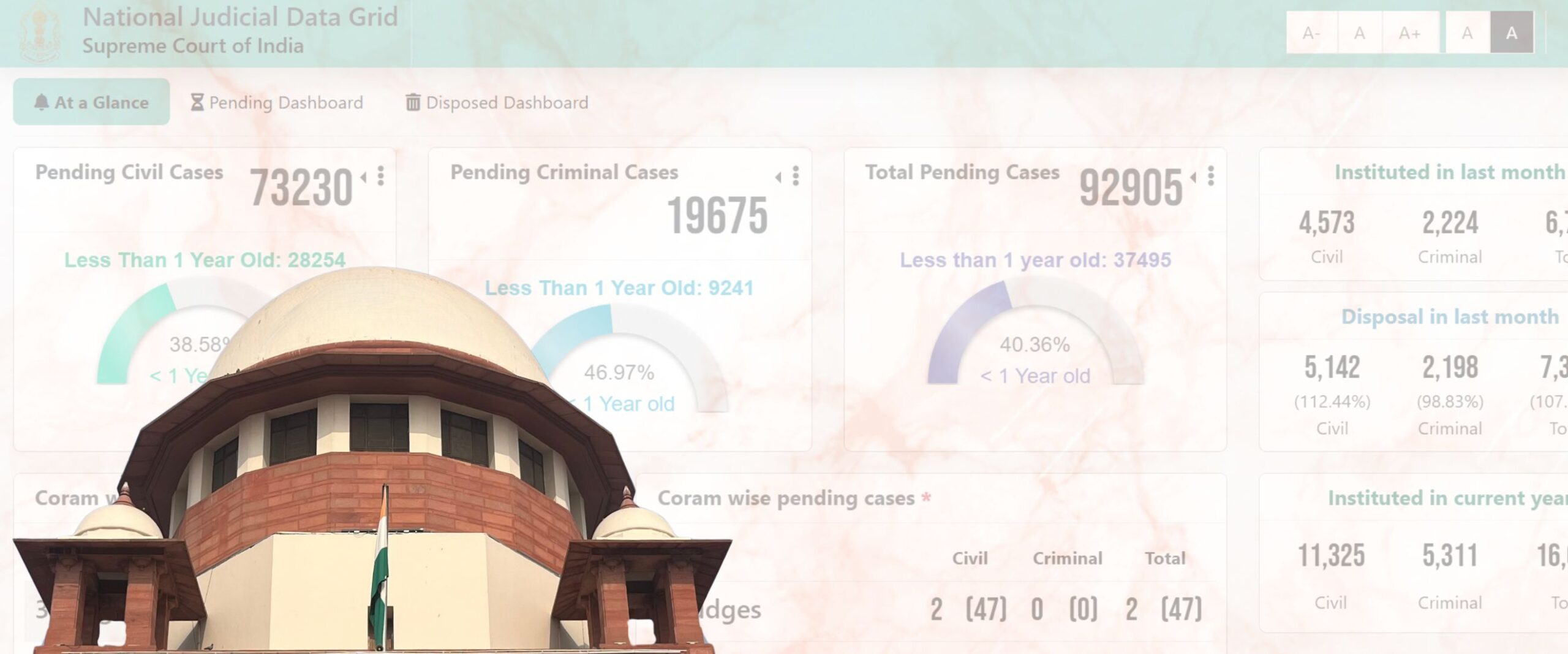
In February 2026, pendency in the Supreme Court was reduced for the first time in 12 months. The docket had reached an all-time high in January 2026, with over 92,000 pending cases. As of 18 March, 92,905 cases are pending as per the National Judicial Data Grid (NJDG). In this article, we will determine the congestion rate and the clearance rate for the year starting from February 2025.
What is the congestion rate?
The congestion rate indicates how long a court will take to clear its pending backlog if no new cases are instituted. The congestion rate for a given year is calculated by dividing the total number of pending cases by the total number of cases disposed of in that year. A congestion rate of 1.5 means the Court will take 1.5 years to dispose of pending cases at its current rate, provided no new cases are instituted.
In February 2025, pendency stood at 80,982 cases. This increased to 92,002 cases at the end of February in 2026—a net increase of 11,020. Between February 2025 and February 2026, the Supreme Court disposed of 65,752 cases.
Applying our formula, the congestion rate is 1.4—which means the Supreme Court will take 1.4 years to clear its docket, if no new cases are instituted. In fact, 80,471 cases were instituted in the period we are looking at.
What is the clearance rate?
The clearance rate for a given year is calculated by dividing the total number of cases disposed of in that year by the total number of cases instituted in the same year.
A clearance rate above 1 indicates that the relevant court is disposing of (or clearing) more cases than are being instituted. This leads to a drop in pendency—it indicates that cases from the court’s backlog are also being disposed of.
Applying the formula to the figures from a year starting February 2025, the Supreme Court currently has a clearance rate of 0.817. This means that more cases are being instituted in the Supreme Court than disposed of.
Why does this matter?
Maintaining favourable congestion and clearance rates will be pivotal in bringing down the overall pendency of cases.
In February 2026, the Court had a clearance rate of more than 1 for the first time in a year. Maintaining a similar tempo of steady disposals could help improve the clearance rate and bring down the congestion rate.
Related articles
Court Data
January 2026: Pendency increases by 510 cases
Pendency continued to increase in January 2026, in line with a trend that began in July 2025
Court Data
February 2026: Pendency dips by 826 as disposals soar
In February, disposal numbers surpassed institutions for the first time in 12 months
Court Data
December 2025: Pendency increases by 1600 cases
The Supreme Court saw an increase of 9000 cases in 2025 as December closed with over 92,000 cases
Court Data
November 2025: Pendency steadily increases by 400 cases
In November 2025, the Court pendency inched closer to 91000, as institutions soared and disposals failed to keep up