


Analysis
Judgement un-reserved: SC Judge K.V. Viswanathan recuses after arguments conclude
A post-reservation recusal raises questions about disclosure protocols for former advocates directly elevated to the bench
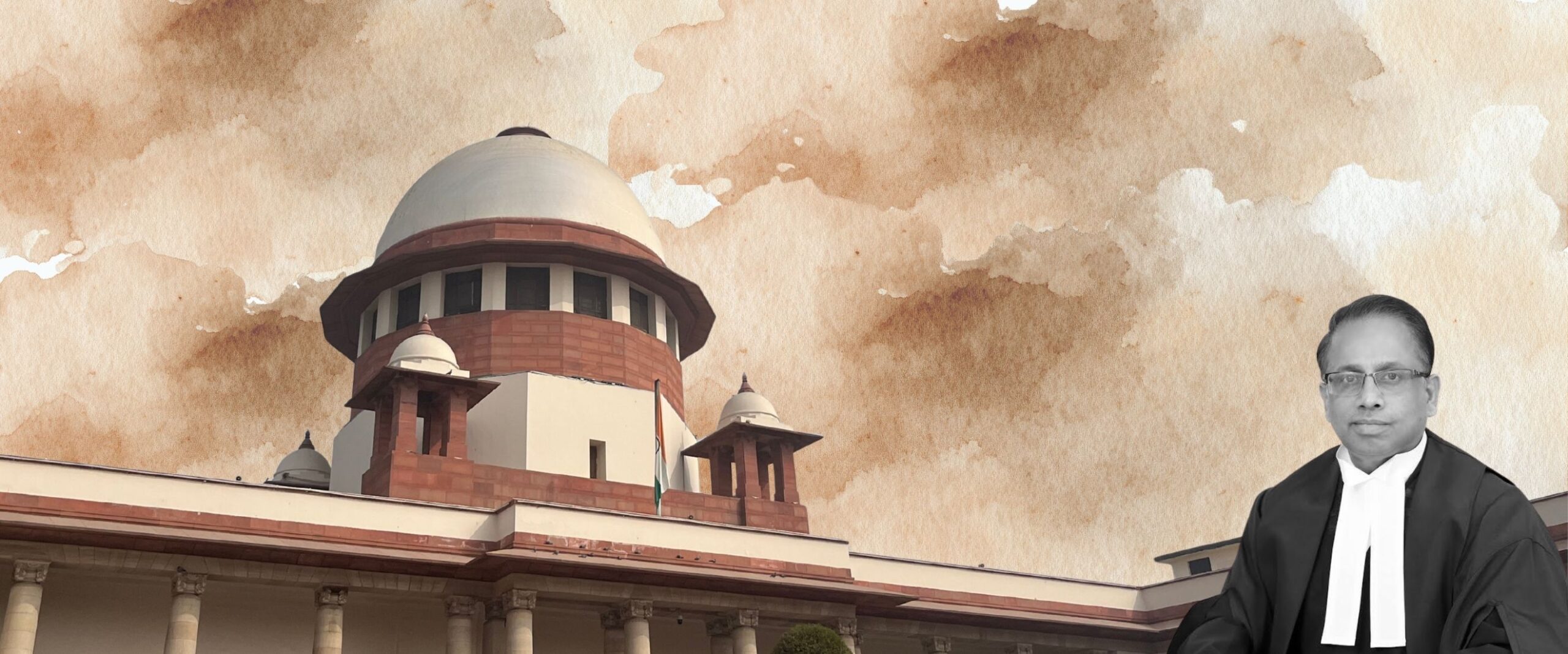
On 1 April, Justice K.V. Viswanathan recused from Alchemist Asset Reconstruction Company Private Limited v Raju Chappakal Pappu. The timing of the recusal makes it one of the most unusual in the Supreme Court’s recent history. A Bench of Justices J.B. Pardiwala and Viswanathan had already completed arguments and reserved judgement in the case on 17 March 2026 (the order reserving it is yet to be uploaded).
Only after the judgement was reserved did it come to Justice Viswanathan’s notice that he had, as a senior advocate, appeared for Alchemist Asset Reconstruction—the appellant. The appearance was in the Corporate Insolvency Resolution Process (CIRP) against the principal borrower (corporate debtor).
The terse Order, running two pages and four paragraphs, uses the passive formulation “it has come to the notice” without disclosing how the conflict surfaced. It does not say whether the judge recalled the connection himself, whether a law clerk flagged it or whether a party raised it informally.
In consequence, the Bench recalled the reservation order of 17 March, effectively nullifying the entire hearing. The matter will now be listed before a different bench. The Order records no objection from either side.
A proceeding without precedent
Typically the overwhelming majority of recusals occur before hearings begin. At worst, they occur at an early stage of proceedings. A judge notices a conflict, or a party draws attention to one, and the matter is quietly transferred.
A post-reservation recusal is qualitatively different. It means that substantial judicial time and resources of all parties have already been expended. Arguments have been heard. The bench has deliberated. A draft judgement may well be in preparation. Recalling a reservation order unravels all of this.
Such recusals are so rare that there is no established procedural template for handling them. The Order simply recalls the reservation and remits the case to the Chief Justice of India (CJI) for re-allocation. It does not address whether the fresh bench may draw on any part of the existing record. The logic of the recusal, however, would seem to require a de novo hearing. The parties must now re-argue the matter from scratch before a fresh bench.
The disclosure gap
Justice Viswanathan was elevated to the Supreme Court directly from the Bar on 19 May 2023. Prior to this, he had practised for 35 years as an advocate. He was designated a senior advocate in 2009 and served as Additional Solicitor General from 2013 to 2014. He appeared in landmark matters including the right to privacy case, the challenge to the Aadhaar Act and the marriage equality proceedings. His practice, as the Collegium noted, ranged across constitutional, criminal, commercial, insolvency and arbitration law.
This breadth of practice is precisely what makes the disclosure problem acute. A senior advocate of Justice Viswanathan’s standing would have appeared in hundreds of matters across decades. The insolvency and corporate litigation space generates a particularly dense web of connected proceedings. A single corporate debtor may spawn disputes involving multiple financial creditors, operational creditors, resolution professionals and asset reconstruction companies. Each of these may generate its own chain of appeals.
The CIRP in which Justice Viswanathan appeared as counsel for Alchemist ARC may have been legally distinct from the civil appeal before his bench. A formalist argument could be made that appearing in one proceeding does not automatically disqualify a judge from hearing another. But the identity of the party for whom he appeared was the same. It is this identity of interest, rather than any identity of subject-matter, that makes the conflict unanswerable.
This is not the first time Justice Viswanathan has recused on grounds of prior professional involvement. In January 2025, he withdrew from a bench hearing coal scam-related matters. He disclosed that he had appeared in the petition filed by Common Cause that initiated those proceedings. On that occasion, the recusal came at the start of the hearing, before any substantial judicial time had been invested.
The structural deficit
India has no codified rules governing judicial recusal. The Restatement of Values of Judicial Life, adopted by the Supreme Court on 7 May 1997, addresses pecuniary interest—a judge should not hear a matter in which he holds a financial stake. But it offers no granular guidance on the position of former advocates who now sit on the bench. The test laid down in Ranjit Thakur v Union of India (1987) asks whether a reasonable person would apprehend bias. Where a judge has previously appeared for one of the parties, the answer would seem self-evident.
Yet the Supreme Court has declined to frame binding recusal guidelines. In May 2025, a bench of Justices A.S. Oka and Ujjal Bhuyan dismissed such a petition. In Chandraprabha v Union of India, the Bench held that recusal is a matter of individual judicial discretion. It added that Article 142 could not be invoked to lay down guidelines on the subject. Further, the decision on whether to disclose reasons, the Bench held, must remain with the judge concerned.
The Alchemist ARC episode exposes the limits of this discretion-based approach. Justice Viswanathan acted with evident probity. His decision to recuse, once the conflict came to his notice, was plainly correct and the only course open to him. The difficulty is systemic. Judges elevated from the bar carry with them decades of professional associations. Justice Viswanathan himself is in line to become Chief Justice of India in 2030, as are other former practitioners on the bench.
The Supreme Court’s listing system does not systematically cross-reference sitting judges’ prior briefs against the parties in cases allocated to them. Some foreign jurisdictions have addressed this gap through institutional mechanisms. The Code of Conduct for United States Judges requires recusal where the judge served as a lawyer in the matter in controversy. Some federal courts also use conflict-screening systems to flag potential disqualifications at the listing stage. The Supreme Court of India has no comparable mechanism.
The insolvency context
Alchemist Asset Reconstruction Company is a Reserve Bank of India-registered securitisation and reconstruction company. It operates in the stressed-asset and insolvency ecosystem and should be distinguished from other entities in the wider Alchemist Group. In February 2026, the NCLT recalled the CIRP against Alchemist Limited, a separate group company. The Tribunal found that those insolvency proceedings had been vitiated by fraud, collusion and malicious intent. This followed an Enforcement Directorate investigation into alleged fund diversion of approximately Rs 1,840 crore.
The civil appeal before Justices Pardiwala and Viswanathan concerned Alchemist ARC, the asset reconstruction arm, and its claims in relation to a principal borrower. The 1 April order does not disclose whether the CIRP in which Justice Viswanathan appeared as counsel for Alchemist ARC involved this same principal borrower.
The case will now be heard afresh by a bench yet to be constituted. For the parties, this means further delay in a matter pending since 2022. For the institution, it is a reminder. The transition from bar to bench demands a more robust infrastructure of disclosure and conflict-screening than the Supreme Court currently possesses.