


Analysis
Supreme Court holds the line against executive-legislative attempts to control tribunals
A brief history of the Union’s repeated attempts to change the tribunals law—and how the Court has addressed this executive creep
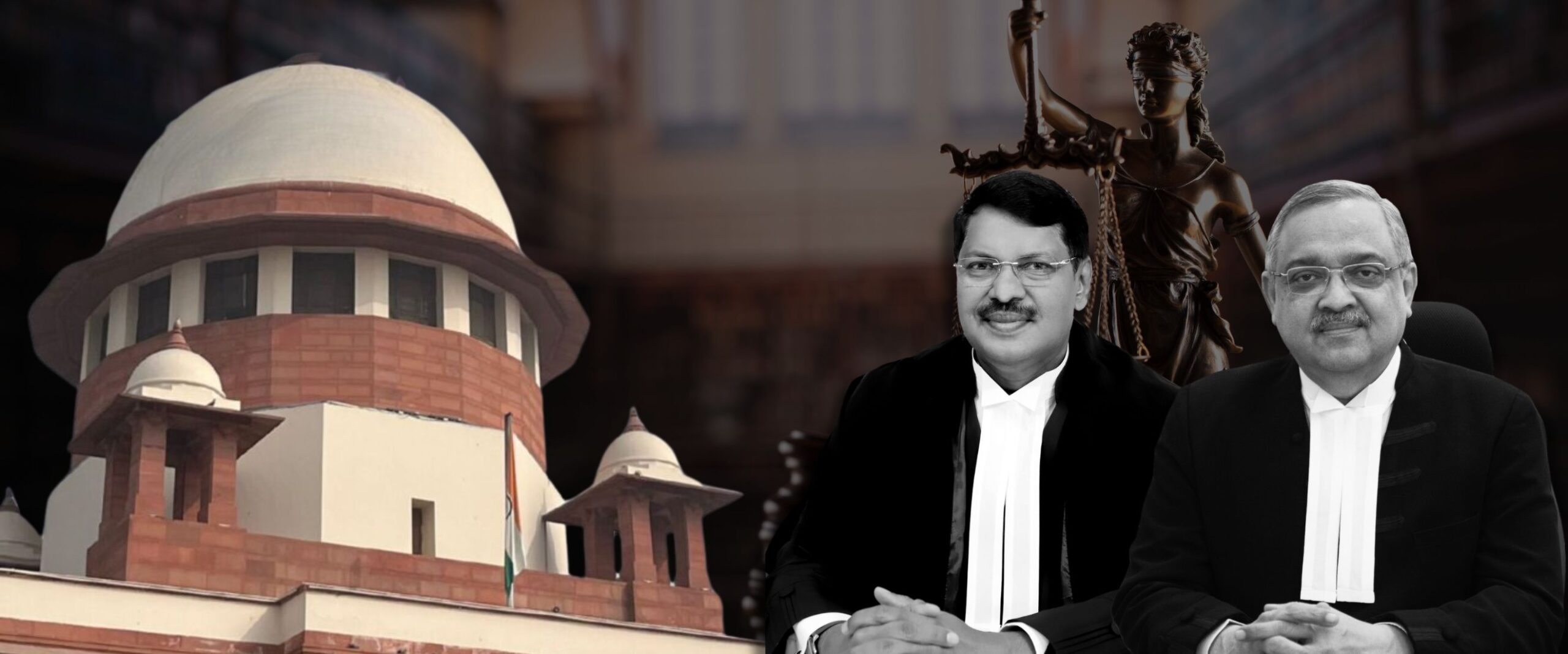
On 19 November 2025, in Madras Bar Association v Union of India (MBA 2025), a two-judge Bench of the Supreme Court held that the Tribunals Reform Act 2021 was unconstitutional and inconsistent with the basic structure of the Indian Constitution. The judgement was delivered by Chief Justice Gavai, with Justice K Vinod Chandran delivering a pithy concurrence.
The challenge to the Act was the latest instalment—in the words of Chief Justice B.R. Gavai—in “a continuing constitutional dialogue on the structure, independence, and functioning of tribunals.” In particular, this case was the latest skirmish in a years-long back-and-forth between Parliament and the Supreme Court about who can choose the leaders and members of India’s tribunals, and what is required to maintain their institutional independence.
In this article, we explain the background to this struggle and the Court’s reasoning in striking down the Act before discussing the judgement’s broader significance for how appointments to tribunals are to be made, and the terms and conditions of members’ service. We argue that the Court has not ousted Parliament’s role in this area entirely; it has simply identified the basic requirements for a tribunal to be independent from the executive and the legislature. Parliament can add to these standards, but it cannot go below this minimum.
Background
The nature and independence of India’s tribunals have been contested for decades. The roots of this inter-branch tension can be traced back to the 1960s, when the Supreme Court sought to reverse some of Indira Gandhi’s key policy decisions, early in her time as Prime Minister.
Articles 323A and 323B of the Constitution, inserted as part of the 42nd Amendment in 1976 during the Emergency, permitted Parliament to grant tribunals powers and jurisdiction once exercised solely by the High Courts. The Swaran Singh Committee’s recommendations for tribunals of this kind were widely perceived as an effort to muzzle the High Courts and the Supreme Court—shifting key areas of their jurisdiction, including in constitutional cases, to bodies without the independence and protections enjoyed by the courts.
The courts have been conscious of these threats, particularly for tribunals which exercise jurisdiction akin to that of the High Courts. In L Chandra Kumar v Union of India (1997), the Supreme Court reasoned that the role of tribunals is supplemental to the High Courts, not a substitute. This was because “[t]he constitutional safeguards which ensure the independence of the Judges of the superior judiciary are not available to the Judges of the subordinate judiciary or to those who man tribunals created by ordinary legislation.” Extending this principle, the Court in Union of India v R Gandhi (2010) emphasised that ‘‘[i]f Tribunals are to be vested with judicial power hitherto vested in or exercised by courts, such Tribunals should possess the independence, security and capacity associated with courts.”
This requirement for ‘equivalence’ does not require courts and tribunals to be identical. But it provides context for these ongoing disputes. How far can tribunals differ from courts in how they are appointed and in their conditions of service, and still enjoy the same “independence, security and capacity”?
The Finance Act 2017 and associated regulations created a uniform scheme of qualifications, appointment, tenure and service conditions for most of India’s Central tribunals. Section 184 of the Finance Act authorised the Union Government to create rules addressing these questions for the Chairpersons, Vice-Chairpersons and members (and their equivalents) of specified tribunals. This led to the notification of the Tribunal, Appellate Tribunal and Other Authorities (Qualifications, Experience and Other Conditions of Service of Members) Rules, 2017 (2017 Rules).
The 2017 Rules created a new system of appointments based on recommendations by Search-cum-Selection Committees. Of the five members of these committees tasked with selecting Chairpersons or Judicial Members of tribunals, only the Chief Justice of India or their nominee was necessarily a judge. Moreover, when selecting Administrative Members of Tribunals, none of the four members of these committees were necessarily judges. Under this system, tribunal members would serve three-year terms.
Each of these measures posed threats to the requirement that tribunals have the same “independence, security and capacity” as India’s High Courts and Supreme Court because they would allow members of the executive—rather than judges—to have a majority vote in deciding who should be appointed. Additionally, members would serve for only brief terms before needing to seek reappointment.
Section 184 of the Finance Act 2017 and the 2017 Rules were challenged in Rojer Mathew v South Indian Bank (2019). Chief Justice Ranjan Gogoi, writing for a five-judge Constitution Bench, struck down the appointment mechanisms established by the 2017 Rules, describing “the lack of judicial dominance in the Search-cum-Selection Committee” as being “in direct contravention of the doctrine of separation of powers.”
In doing so, CJI Gogoi relied on and extended the Court’s earlier Judgement in the Fourth Judges Case (as to the need for “judicial primacy” in appointing judges), identifying the “compulsory need for exclusion of control of the Executive over quasi-judicial bodies of tribunals discharging responsibilities akin to Courts.” The 2017 Rules’ three-year terms for tribunal members were also found to be inconsistent with tribunal independence. Significantly, three future CJIs (N.V. Ramana, D.Y. Chandrachud and Sanjiv Khanna) concurred with CJI Gogoi, signalling both the importance of the issues involved and a clear statement that the future leadership of the judiciary was of one voice on this critical issue.
In response, the Union Government notified the Tribunal, Appellate Tribunal and Other Authorities (Qualification, Experience and Other Conditions of Service of Members) Rules 2020 (2020 Rules). The 2020 Rules addressed some of the defects of the 2017 Rules identified in Rojer Mathew—for example, reducing the Search-cum-Selection Committee’s membership from five to four, and hence reducing the underrepresentation of judges.
Nonetheless, when these rules were challenged in Madras Bar Association v Union of India, 2020 (MBA 2020), Justice Nageswara Rao, speaking for a three-judge Bench, found that the Rules continued to permit the executive to “exercise their discretion in the matter of appointments to the Tribunals” by requiring committees to recommend two names, not one, to the executive for appointment. He further held that the Rules infringed judicial independence by continuing to impose an impermissibly short term of four years for members.
In place of the scheme notified by the 2020 Rules, the Court in MBA 2020 prescribed its own stipulations for how tribunal members should be appointed, and the terms for which they should serve. These directions listed the qualifications for membership of the Search-cum-Selection Committees for each of the tribunals under the new uniform regime—four voting members, of whom two would be judges or judicial members—in a way designed to ensure “judicial dominance” in the appointments process. These directions also prescribed that Chairpersons, Vice-Chairpersons and members would serve terms of five years.The Union Government then notified the Tribunal Reforms (Rationalisation and Conditions of Service) Ordinance, 2021 (2021 Ordinance). Unlike the regime directed by the Supreme Court in MBA 2020, the 2021 Ordinance provided that Search-cum-Selection Committees would propose two names to the Centre for appointment, not one; that tribunal members would serve four-year terms; and that tribunal members must be aged 50 or above.
The 2021 Ordinance was challenged in Madras Bar Association v Union of India (2021) (MBA 2021). The Court struck down those provisions of the 2021 Ordinance which did not conform to the requirements of the directions given in MBA 2020, with Justice Nageswara Rao describing these departures from the MBA 2020 regime as an “impermissible legislative override.”
MBA 2021 was delivered on 14 July 2021. A month later, Parliament enacted the Tribunals Reform Act, 2021. This Act, quite audaciously and provocatively, simply relegislated many of the provisions of the Ordinance that had been struck down in MBA 2021.
The MBA 2025 judgement
In MBA 2025, CJI Gavai’s articulation of the first issue presumes its outcome: “whether Parliament possesses the authority to disregard a judicial pronouncement and to enact a statute in any matter it deems appropriate.” He asserted that Parliament “must enact laws within the contours of its legislative competence and in conformity with constitutional rights, values, and structural principles.”
He further held that when the Supreme Court “has struck down a provision or issued binding directions after identifying a constitutional defect,” Parliament “cannot simply override or contradict that judicial decision by reenacting the very same measure in a different form.” Parliament may “cure” defects identified by the Court but cannot simply “restate or repackage” what has been struck down.
While acknowledging that the Court cannot “dictate the contents of a statute,” the opinion confirmed that the Court can “issue mandatory directions to ensure compliance with constitutional principles, such as those concerning the independence, composition, or tenure of adjudicatory bodies.”
The Court rejected the proposition that MBA 2021 considered the constitutionality of laws and regulations on tribunal independence on “abstract” or “structural” principles. Instead, as CJI Gavai observed, where a law offends the constitutional requirements of “independence, impartiality, and effective adjudication”, it strikes “at the core of the constitutional arrangement.” This is not simply an abstract proposition. It derives from the need to construe Articles 323A and 323B in a way which “firmly anchors the principles of separation of powers and judicial independence”, given that tribunals “perform functions that were traditionally within the domain of courts.”
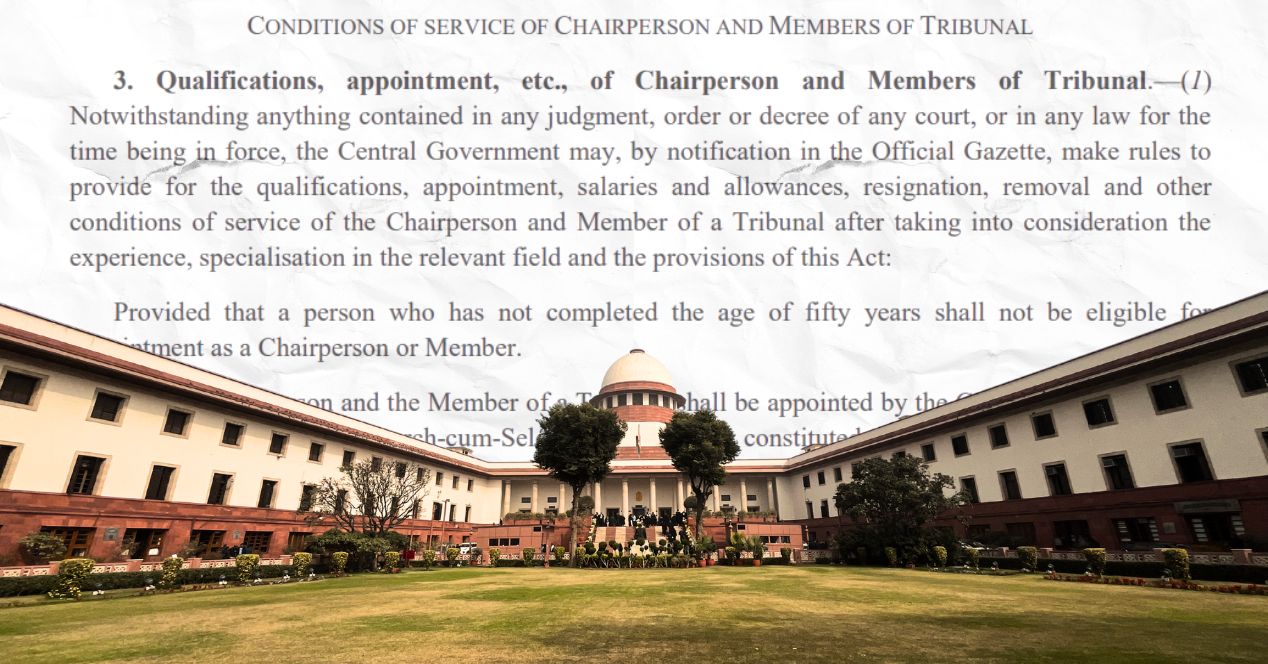
CJI Gavai then addressed the constitutionality of the Tribunals Reform Act. He noted that several provisions of the 2021 Ordinance are “verbatim repeated” or “substantially identical” to those in the Act, or “retained in full”. These provisions include—the minimum age bar of 50 for all appointments; the truncated four-year tenure with upper age caps of 70/67; the requirement that the Search-cum-Selection Committee propose two names for each vacancy; and the fixing of allowances and benefits to those of equivalent civil servants.
CJI Gavai struck down these offending provisions and declared that the principles and directions issued in MBA 2020 and MBA 2021 should “continue to govern all matters relating to the appointment, qualifications, tenure, service conditions” until the Court’s “constitutional concerns” were addressed and cured. (In an extremely brief, pointed concurrence, Justice K. Vinod Chandran observed that the Act “is a replica of the struck down Ordinance; old wine in a new bottle, the wine whets not the judicial palette, but the bottle merely dazzle.”)
In concluding, the Court expressed its “disapproval of the manner in which the Union of India has repeatedly chosen to not accept the directions of this Court on the very issues that have already been conclusively settled through a series of judgments.” The Court also reiterated earlier calls for a National Tribunals Commission to ensure transparency and uniformity, and directed that this be established by the Centre within four months. (The Court had previously directed that such a Commission be created in MBA 2020; this was not acted upon.)
Discussion
In defending the Act before the Supreme Court, Attorney General R. Venkataramani argued that “courts cannot compel the legislature to enact a particular law or structure a statutory framework in a particular manner”, and that questions of qualifications and service conditions belong exclusively to the legislature.
As noted above, the Court responded by drawing a distinction between dictating the terms of a law and merely providing directions for compliance with the Constitution. There are obvious difficulties in identifying how this distinction applies in practice, particularly in circumstances where, as here, the Court’s directions are extensive and detailed. But the critical feature of the MBA 2020 regime is that it provided a floor—and not a ceiling—for tribunals’ independent exercise of judicial power.
Parliament was not bound to replicate the regime proposed by the Court in MBA 2020 in every respect. As CJI Gavai observed, that regime will only apply until the Court’s “constitutional concerns” are addressed and cured. Parliament could, for example, provide greater guarantees of independence and tenure to members than what had been prescribed in that regime. Alternatively, it could provide equivalent or substitute measures to cure these defects without adopting exactly the same solutions as the Court had proposed.
But it was not open to Parliament to ignore MBA 2020 or MBA 2021. The Court had made it clear that only a term of five years (or more) and only judicial dominance in the appointments process would ensure independence to the extent required by the Constitution.
During the hearing, the Attorney General also sought to refer the petition to a larger bench. The Court refused, finding that the case “does not present any new or unresolved constitutional question” that would require it to reconsider or depart from the principles of tribunal independence recognised in a long line of cases, particularly in circumstances where many people have been appointed to tribunals under the impugned regime and whose appointments were left in a prolonged “state of uncertainty”.
We believe that the Court was correct to proceed in this way. The question of whether the Act was inconsistent with MBA 2020 and MBA 2021 was not a subtle or nuanced one. Four years had passed between the Act and the eventual hearing and determination of the present case. If the Union wished to challenge any of the preceding authorities—going all the way back to Sampath Kumar (1987)—it had many years to raise such a challenge and to ensure that it could be heard without inconvenience to the petitioners or to tribunal members.
The result in MBA 2025 may seem obvious—that an obviously unconstitutional law was declared unconstitutional. But it is significant that the Tribunals Reform Act was enacted at all in those circumstances; that it remained in force for four years; and that the Attorney General, in oral argument, sought to justify a blatant departure from earlier judgements. The Court invoked the words of Dr. B.R. Ambedkar to remind the government of the need to maintain fundamental principles of the rule of law. We believe this was justified as the facts reveal an attitude of impunity on the part of the government, and provide evidence of a growing trend visible in other aspects of constitutional governance in India.
The present government, like earlier governments of all partisan stripes in the last four decades, has continued to insist that the executive can play a significant role in the appointments and service conditions of tribunals. By this latest judgement, the Supreme Court continues to strongly disagree. This disagreement is more than an insistence on the prerogatives of tribunals; it reflects the Court’s belief that only judicial primacy in tribunal appointments can guarantee their independence.
Douglas McDonald-Norman is a Lecturer at the University of Technology Sydney Faculty of Law. Arun K. Thiruvengadam is a Professor at the National Law School of India University.
Related articles
Analysis
Tribunal tribulations
The Bench asked the Union pointed questions during the hearings but does it suggest that the judiciary will win this round of the turf war?
Analysis
Tribunals Reforms Act: 4 Must Reads
The Tribunals Reforms Act, 2021 is currently being challenged in the Supreme Court. Here are some related must reads.