


Analysis
Are there limits to the Speaker’s discretion in deciding an impeachment motion?
The Justice Varma case spotlights the Speaker’s power in impeachment procedure, which will be tested again in the Justice Swaminathan matter
On 16 December, a two-judge Bench of the Supreme Court comprising Justices Dipankar Datta and A.G. Masih, while hearing Justice Yashwant Varma’s case, questioned how the Speaker constituted an inquiry committee without consulting the Chairperson of the Rajya Sabha, as required by the first proviso to Section 3(2) of the Judges (Inquiry) Act, 1968. The proviso applies when notices for motions for removal of a judge are submitted on the same day in both Houses of Parliament. Motions for the removal of Justice Varma were submitted to both Houses of Parliament on 21 July 2025.
The MPs had submitted motions for removal of Justice Varma based on the Supreme Court’s in-house committee report. The Supreme Court subsequently dismissed Justice Varma’s challenge to the report. In Paragraph 68 of its Judgement, it noted that Justice Varma would be free to “exercise his rights as are available in law” if the in-house report was relied on as part of the parliamentary inquiry—its justification for this finding was that the in-house report was meant to be “preliminary in nature, ad hoc and not final.”
Significantly, the Bench also queried whether the Speaker received legal advice before proceeding to set up the committee. The Bench’s suggestion that the Speaker could have sought legal advice about his powers stems from a lack of clarity in the law regarding his options when there is a temporary vacancy in the office of the Chairperson of the Rajya Sabha. The Bench has since issued notice to the office of the Speaker of the Lok Sabha, returnable on 7 January 2026.
Jagdeep Dhankhar, the then Chairperson of the Rajya Sabha, had resigned suddenly, on the very day he received notice of the motion. Justice Varma has argued that the Speaker’s decision to admit the motion and constitute the inquiry committee without consulting Dhankhar’s successor was therefore illegal.
If this line of questioning is seen from a wider lens, it strikes at the heart of the constitutional design governing judicial accountability—one that places decisive power in the hands of the Speaker at the threshold stage, while offering few standards to guide or constrain its exercise.
The motion against Justice Swaminathan
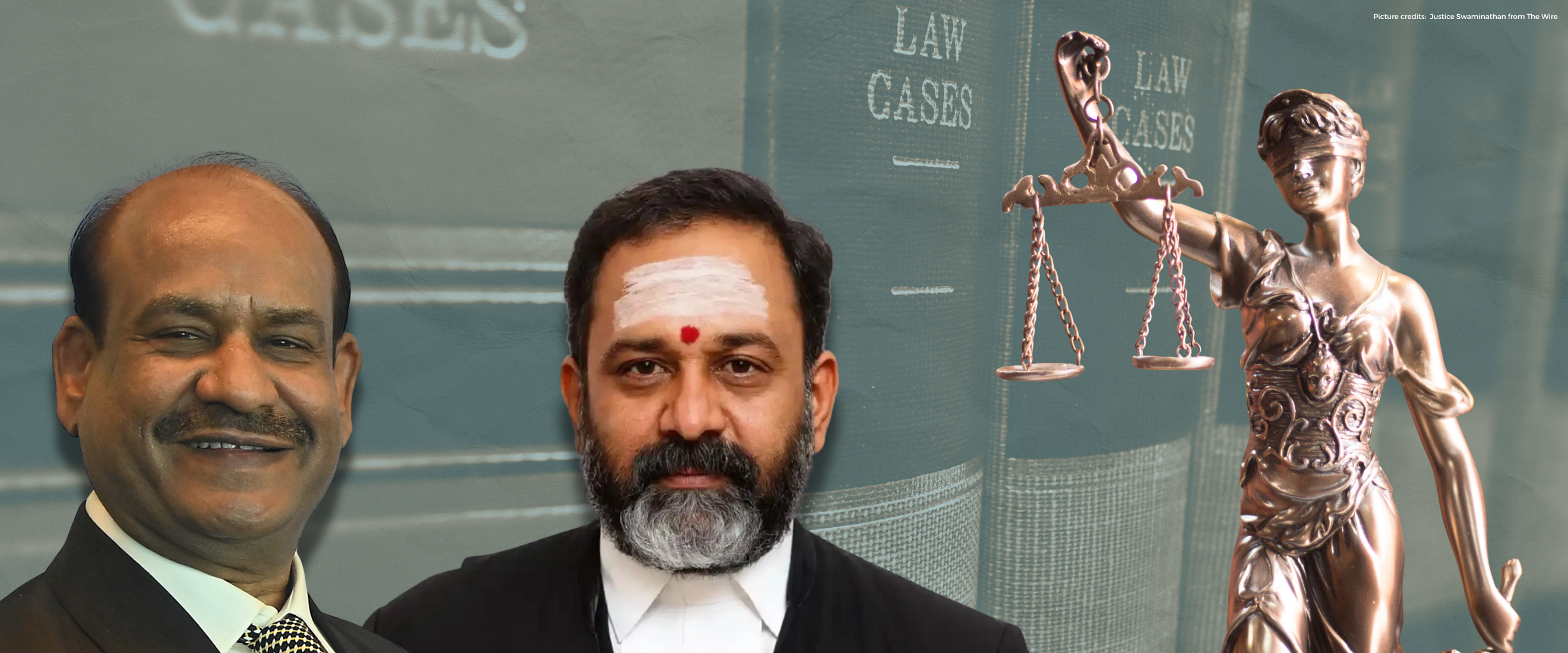
The recent motion against Justice G.R. Swaminathan will bring this structural imbalance into focus again. Under the Constitution and the Judges (Inquiry) Act, 1968, impeachment is conceived as an exceptional remedy, reserved for “proven misbehaviour or incapacity”. The process appears robust: a high numerical threshold to initiate proceedings, an inquiry by a judicial committee and a supermajority vote in both Houses of Parliament.
However, the most consequential decision in the entire process is taken before any inquiry begins—when the presiding officer of the House decides whether a motion is admissible at all. This was evident in 2018, when a motion against then Chief Justice Dipak Misra was rejected at the threshold by the then Chairperson of the Rajya Sabha, M. Venkaiah Naidu.
The Speaker is not constitutionally bound to admit a motion merely because formal requirements are satisfied. Nor is there any statutory obligation to record reasons for rejecting it. In a Lok Sabha where the Opposition lacks numerical strength, this discretion becomes determinative. Therefore, a motion may be rejected without any assessment of the substance of the allegations.
The design produces a constitutional paradox. Impeachment is formally a parliamentary process, but its gatekeeping function is concentrated in a single office-holder, who may operate without transparent standards or legal advice while rejecting a motion or setting up an inquiry committee. Naidu, for instance, pronounced a 10-page order rejecting the motion for impeachment against CJI Misra. Still, he faced criticism for his failure to give “clear and cogent reasons” for rejecting the motion.
Of course, there is an additional concern in the matter of Justice Swaminathan, where the allegations do not relate to corruption, financial impropriety or incapacity. They arise from disagreement with judicial orders allegedly promoting Hindu religious practices, or suggesting favouritism to counsel belonging to a particular caste or espousing rightwing ideology. Whether those orders were correct or flawed is ordinarily a matter for appellate scrutiny.
But the problem does not lie only in the possibility of misuse of the impeachment provisions. It lies equally in the ease with which a motion for impeachment may be neutralised without explanation. The Speaker’s discretion allows impeachment to operate as a symbolic threat and as a process that can be easily smothered. In both cases, the judge concerned may suffer reputational harm, without the procedural protections of a formal inquiry.
Justice Yashwant Varma’s case
Justice Varma’s challenge raises a fundamental question: whether the Speaker, when exercising functions that directly affect judicial independence, is bound by constitutional norms of fairness, reason-giving and informed decision-making.
The Supreme Court’s questioning during the 16 December hearing suggests an acknowledgement that the Speaker’s role is quasi-judicial in its consequences. If impeachment motions can be admitted or rejected without clear and cogent reasoning, the process becomes unpredictable and vulnerable to political calibration.
A holding that the Speaker’s discretion in impeachment matters must require legal advice, intelligible standards and recorded reasons would not diminish parliamentary privilege. Instead, it will strengthen the legitimacy of impeachment as a constitutional mechanism rather than a political gesture.
Related articles
Analysis
Judge inquiry: The opacity of the in-house process
The CJI’s power to recommend removal of a judge on the basis of an in-house committee’s report may be diluting the separation of powers
Analysis
Speaker admits motion for Justice Varma’s removal: What lies ahead?
The Speaker constituted a three-member committee under the Judges Inquiry Act. We explain the steps involved in the parliamentary process
Analysis
Justice Varma had ‘covert or active control’ of store room, finds committee
The in-house committee set up by CJI Khanna also found evidence of cash being removed from the store room in the early hours of 15 March
Analysis
Justice Varma cash inquiry: The story so far
Following a fire, a large amount of unaccounted cash was found in Justice Varma’s official residence on 14 March