


Analysis
Five cracks in finality: What CJI Gavai’s tenure meant for the Court’s understanding of a final judgement
From the Supreme Court’s past six months emerges a troubling trajectory marked by quiet procedural departures and an erosion of finality
Earlier this year, we wrote about a series of unusual manoeuvres by the Supreme Court in three significant cases: the recall in the Bhushan Steel insolvency, the modification in the Allahabad judge’s matter and the larger bench reference in the Delhi stray dogs matter. At the time, the apparent randomness of those decisions felt like the story.
The last week of Chief Justice B.R. Gavai’s tenure makes the earlier chaos appear less random and more like a new judicial playbook, one in which the finality of a signed judgement seems increasingly negotiable and the question of relief depends on who is asking. We write again not to offer a full reckoning of his tenure, but because it is striking, and perhaps telling, that these final-week retreats come under his leadership. It cemented what had already begun to emerge: a legacy of judicial undoing.
The Vanashakti reversal
On 16 May 2025, a Division Bench of Justices A.S. Oka and Ujjal Bhuyan struck down a 2017 notification and a 2021 office memorandum that enabled post-facto environmental clearances. In a succinct 41-page judgement, Justices Oka and Bhuyan spoke in one voice and held that post-facto clearances are fundamentally incompatible with environmental law as they regularise projects which had illegally commenced without meeting the mandate for prior clearance under the Environment Impact Assessment Notification, 2006 (2006 Notification).
The Judgement started with the long legislative history of the Environment (Protection) Act, 1986, which was enacted fourteen years after the 1972 United Nations Conference on Human Environment. It then stated that it took two subsequent decades to mandate prior environmental clearances under the 2006 Notification. The 2017 Notification and the 2021 Memorandum sought to dilute these strides.
Towards the end, Justice Oka underscored the life threatening impacts of environmental harm that are faced today, including how the residents of the national capital suffocate in life-threatening AQI levels. The judgment was delivered on 16 May 2025. Justice Oka retired eight days later on 24 May 2025.
Shortly after, on 11 June, two miscellaneous applications were filed by the Sail Refractory Company Ltd., a subsidiary of Steel Authority of India; and the Karnataka State Industrial Infrastructure Development Corporation. They sought protection for those who were already granted clearances based on the 2017 notification. These applications were listed before a Bench of three-judges: CJI Gavai, and Justices K.V. Chandran and N.V. Anjaria. Miscellaneous applications are filed within a main matter—that is to say, there is no existence of a miscellaneous application without the case in which it is being filed. That being so, the application is typically listed before the same judge(s) who had passed the judgment for which clarification is sought. However, the applications were not listed before Justice Bhuyan, a sitting member of the original bench.
On 28 July, the new CJI Gavai-led Bench passed an Order and issued a notice in the case. Two days later, the Confederation of Real Estate Developers of India (CREDAI) filed a review petition seeking a reconsideration of the Vanshakti judgement. As per course, the review was filed before a bench comprising the sitting member of the original bench. The final composition consisted of CJI Gavai and Justice Bhuyan. The Bench issued notice and permitted an open court hearing (often review petitions are dismissed or heard in-chambers). The Miscellaneous Applications were tagged with the review petition.
We must pause here to talk about the distinction between a miscellaneous application and a review petition. Miscellaneous applications are limited in scope to seek clarifications and cannot, by design, operate as a substitute for review petitions.
Bizarrely, the arguments to review the entire judgement were substantively heard from parties that filed the application as well. This is a practice that has been frowned upon by the Court in the past. Former CJI D.Y. Chandrachud had commented that the “disturbing trend” of miscellaneous applications should be “strongly discouraged”, reminding that the “hallmark of a judicial pronouncement is its stability and finality.” He goes on to strongly deprecate the practice of litigants seeking review of a judgement in the form of a miscellaneous application.
In clubbing the miscellaneous applications and the review petition in the Vanshakti case, the Court has appeared to have undergone quite a transformation from holding litigants to strict procedural standards to revisiting judgements at the drop of a hat.
The Vanshakti Bench strength
Procedure dictates that a review petition is listed before a Bench consisting of the sitting member of the original bench. The final composition in the Vanshakti case had CJI Gavai, and Justices Bhuyan and Chandran. Any review of a judgement ought to be before the same bench or the same bench strength—in this instance, two judges. Ultimately, the matter was heard by three judges since the miscellaneous applications were listed before a three-judge bench. This formed the backdrop for the judgements that came on 18 November.
Just five days before retirement, CJI Gavai, writing in first person, held that the 16 May Judgement was to be recalled. The decision came at a time when the same national capital was actually in the grips of the deadly pollution that Justice Oka had written about.
The Chief noted that several Central and state governments worth thousands of crores would be impacted by the 16 May decision. In doing so, it validated illegal projects that began without the right clearances. Justice Bhuyan dissented and unequivocally described the recall “a step in regression”. The tie breaker was a short 19-page judgment by Justice Chandran expressing agreement with the Chief Justice and effectively erasing a sweeping environmental jurisprudence overnight.
A truly “special” reference
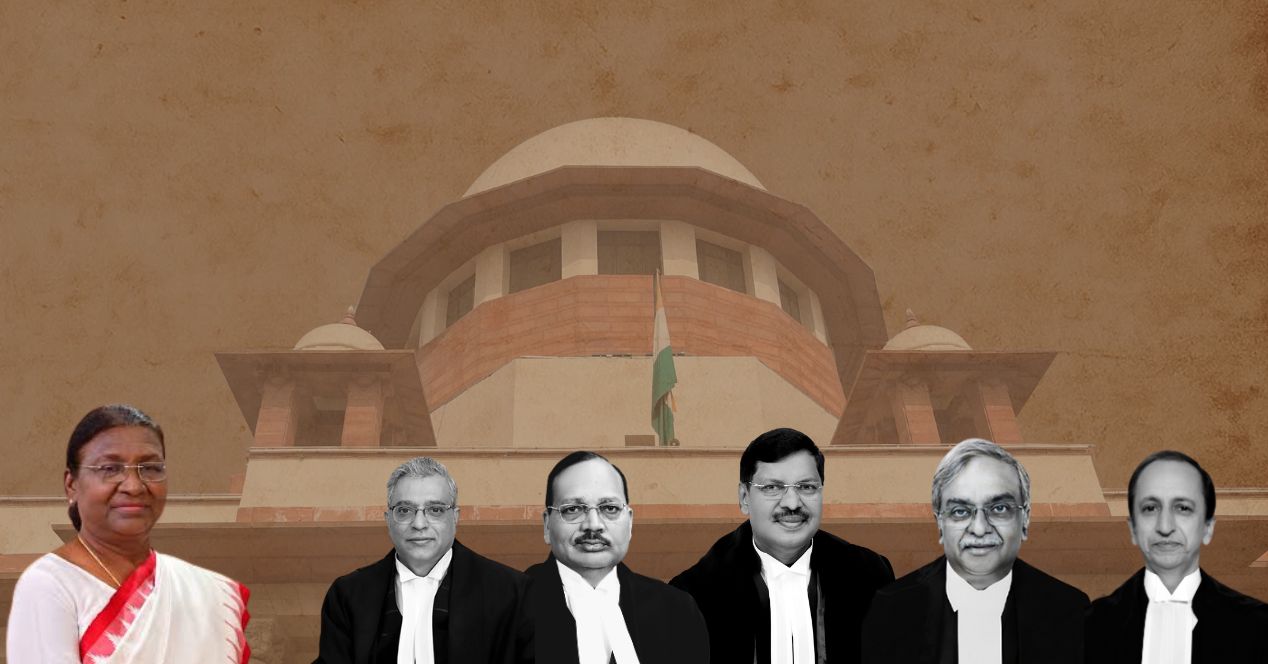
Two days after the Vanashakti recall, on 20 November, a Constitution Bench led by CJI Gavai delivered its advisory opinion on the Presidential Reference concerning gubernatorial assent to state bills. The President had invoked the Court’s advisory jurisdiction under Article 143 and referred 14 questions relating to Articles 200 and 201. The Reference came a little over a month after the Supreme Court delivered its judgement in State of Tamil Nadu v Governor of Tamil Nadu, where a Bench of Justices J.B. Pardiwala and R. Mahadevan had held that Governor R.N. Ravi had illegally withheld 10 bills passed by the Tamil Nadu legislature. The Court had laid down timelines for the Governor and the President for communicating their decisions on bills and deemed assent to the 10 pending bills using its discretionary powers under Article 142. No review was filed by the Tamil Nadu Governor.
Then came the Special Reference of the President conspicuously on the very same questions that were decided by the Bench in TN Governor. If any readers are wondering if this is the equivalent of going to one Bench of the Supreme Court to ask whether another Bench could do what it did, that is what it amounts to be.
The advisory jurisdiction of the Supreme Court under Article 143 is meant to assist the President by providing an opinion when “a question of law or fact arises or is likely to arise of such public importance that it is expedient to obtain the opinion of the Supreme Court on it.” Over the years, in the fifteen references made to it, the Supreme Court has fleshed out the contours of Article 143—from the manner in which the questions must be framed (specific not vague), to whether courts can decline to answer a reference (they can), to whether such opinions will be binding (they can be, if it overrules a previous judgment).
Within these contours, however, what goes to the core of such a reference is what it seeks to achieve, and crucially, what it must not do: serve as an appeal in disguise against a final judgment of the Supreme Court.
From the fifteen references, this question came up perhaps most starkly in the Natural Resources Allocation reference. The preliminary objection to the maintainability of the reference was that it was an indirect endeavour to upend the verdict in the 2G case. The Court held that the only recourse available after a final judgment of the Supreme Court is a review under Article 137 or a curative petition (a remedy carved out by the Supreme Court itself), and that a Presidential Reference under Article 143 could not be used to overturn a concluded adjudication inter-se parties.
So, how did the 2025 reference get around this?
In its opinion on the 2025 reference, which incidentally does not mention its author, the Court took an entirely new route. First, it reasoned that, unlike the previous references, the questions pertained to the “day to day functioning of constitutional functionaries” and described it as a “functional reference”. The Bench then stated that the novel nature of the Reference required the Court to “answer some, if not all questions so referred.”
Thereafter, as it addressed the elephant in the room—the Tamil Nadu case—it made a further distinction between reconsidering a case under Article 143 and the Court’s authority to answer general questions of law of constitutional importance referred to it. Most glaringly, the Court said that it accepted the Attorney General’s submissions that the clarification on these constitutional principles is for future governance, and not to set aside an already answered decree.
Having accepted the Attorney General’s assurance as a condition for entertaining the Reference, the Court did something extraordinary—it set aside an already answered decree. It overturned the Tamil Nadu Governor judgement to the extent of holding that the discharge of functions by the Governor or the President under Articles 200 and 201 are non-justicable, that timelines cannot be imposed and that deemed assent under Article 142 was unconstitutional.
What the Court has taken great pains to say in the 2025 reference is that while a reference under Article 143 cannot be an appeal in disguise, if an already decided judgment comes up for consideration in the process of answering larger constitutional questions, then that is merely collateral. What follows then is a brand new rule that the only recourse after a final judgment of the Supreme Court of India remains a review and then a curative petition – unless the one seeking such recourse is the Union executive through the President of India.
The fuss about finality
With a new chief justice in May this year came an altogether new style of adjudication, of a court that no longer speaks in final judgments. Vanashakti and the Special Reference have followed a playbook developed steadily through Bhushan Steel, the Delhi stray dogs case and the Allahabad judge’s case. First, a judgment is delivered. Then, a significant stakeholder is unhappy. Suddenly, a novel procedural mechanism appears and finally the original judicial outcome is replaced (either softened, reversed, recalled or reinterpreted). Most concerningly perhaps, in four of these five cases, the case was either directly pulled away from the bench authoring the original judgement or reconstituted in such a manner as to facilitate a different result.
Article 141 codifies the principle of stare decisis and states that a judgement of the Supreme Court is final and binding. There are only two constitutionally and judicially sanctioned routes for the Court to revisit a judgement: review petitions (rare, and for patent errors)and curative petitions (even rarer, and for grave miscarriages of justice).
Finality thus is not a formality, it is a constitutional value.
When a final judgement can be reopened within hours, days or weeks of public anger, government discomfort, or headline pressure, several dangers emerge. First, predictability collapses. Law relies on stability. When judgements become provisional, everyone operates in uncertainty.
Second, precedent loses authority. If a later bench can quietly modify an earlier one without the formal structure of a review, then how does the legal system know which ruling binds?
Third, government and corporate actors learn that pushback works. If the Court repeatedly alters course after blowback, incentives shift. Instead of respecting judgements, powerful actors may simply pressure the Court, directly or through second-order routes, to reconsider.
And fourth, the CJI’s “master of the roster” power becomes a stealth mechanism for outcome engineering. When finality is weak, the roster becomes the most potent judicial instrument. A fresh bench can yield a fresh outcome, without formally overruling anything.
The six months of the Supreme Court under the chiefship of Justice Gavai have seen a significant shift. What must concern us is that this is not a doctrinal shift debated deeply and announced openly but rather a behavioural shift manifested through easy-to-miss maneuvers, case by case. Case strategy used to be the domain of lawyers, advising clients on the right maneuvers through the available options and it was the Courts that would watch over to ensure nothing is done indirectly which cannot be done directly. These five cases cumulatively show a Court ready to perform unprecedented gymnastics to mould the right relief for the right party.
What does this mean for the average citizen? The Court’s authority rests on faith that its opinion is final and binding. Public trust is tested against adherence to and respect for written rules by institutions; these subtle erosions threaten to take away the very metric by which such trust can even be assessed.
“Each decision, even if unpopular, must reflect fairness and moral courage,” Justice Gavai said, stressing the need for justice to be done without fear or favour. But institutional legacies of chief justices are not built on symbolism or rhetoric about moral courage. They are built on the independence of courts and legitimacy of final judgments, especially if they are unpopular or inconvenient.
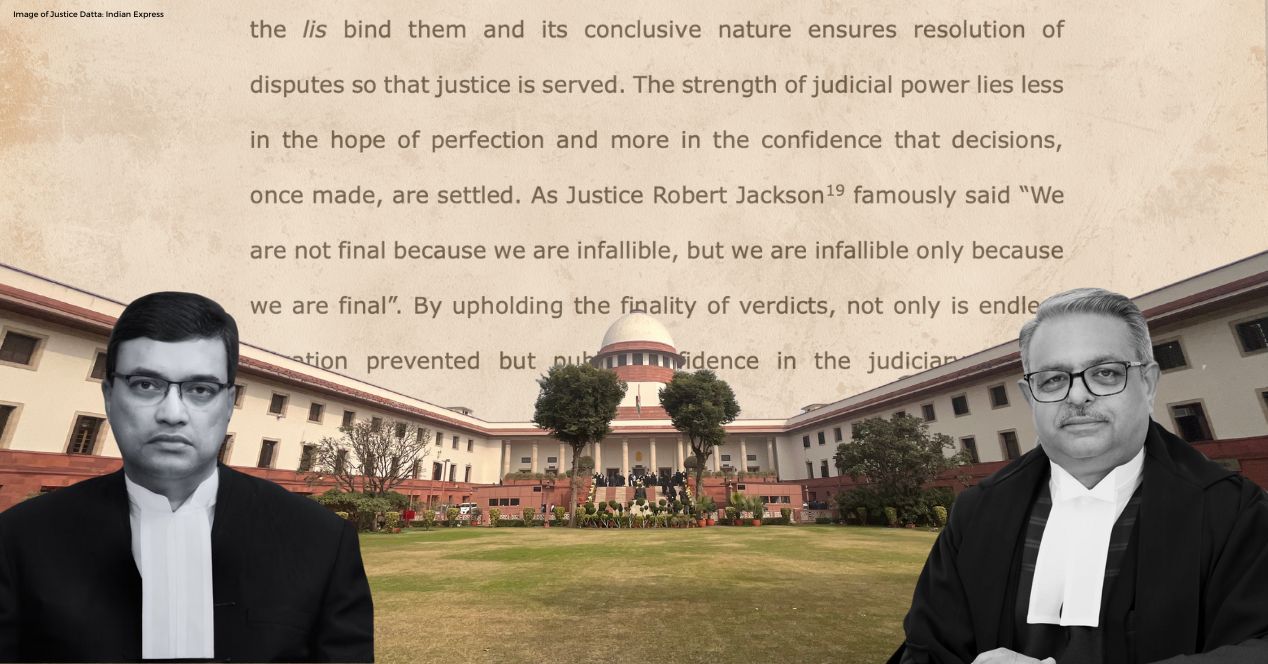
In the days following CJI Gavai’s retirement, several sitting judges of the Court appeared to signal their disquiet about this evolving pattern. In a judgement delivered on 26 November, Justices Dipankar Datta and A.G. Masih warned of a “growing trend… of verdicts pronounced by Judges… being overturned by succeeding benches,” cautioning that allowing litigants to hope for a different outcome after a change in bench composition “would undermine this Court’s authority and the value of its pronouncements.” They stressed that the very purpose of Article 141 “would stand defeated” if final judgments could be revisited simply because “a later different view appears to be better.” Separately, Justice B.V. Nagarathna stated publicly that Supreme Court verdicts cannot be tossed out merely because the judges who authored them have changed, and that the independence of the judiciary demands an assurance that “a judgment once rendered by a judge will hold its anchor in time for it is written in ink and not in sand”. These interventions make clear that concerns over the Court’s shifting relationship with finality now come from within the institution itself.
Aparna Mehrotra is a lawyer practising in the Supreme Court. Rishiraj Bhagawati is a former journalist and public health researcher based in Bengaluru.
Related articles
Analysis
Final until it’s not: The Supreme Court’s beating retreat
The Court’s quick reversals in three recent cases raise questions about procedure, legitimacy, and finality
Analysis
When benches start undoing benches
A two-judge Bench expresses its unease at the Supreme Court reversing its own verdicts outside review and curative jurisdictions
Analysis
The Supreme Court’s retreat from holding Governors accountable
In its advisory opinion on Governors’ assent to state bills, a five-judge Bench of the SC has erased the gains made in TN Governor

Analysis
Supreme Court’s latest order keeps stray dog issue on a short leash
The ‘institutional area’ carve-out shields campuses and transport hubs from returning stray dogs, reviving concerns about harshness