

Sabarimala Reference | Day 8: Bench seeks standard to test religious practices
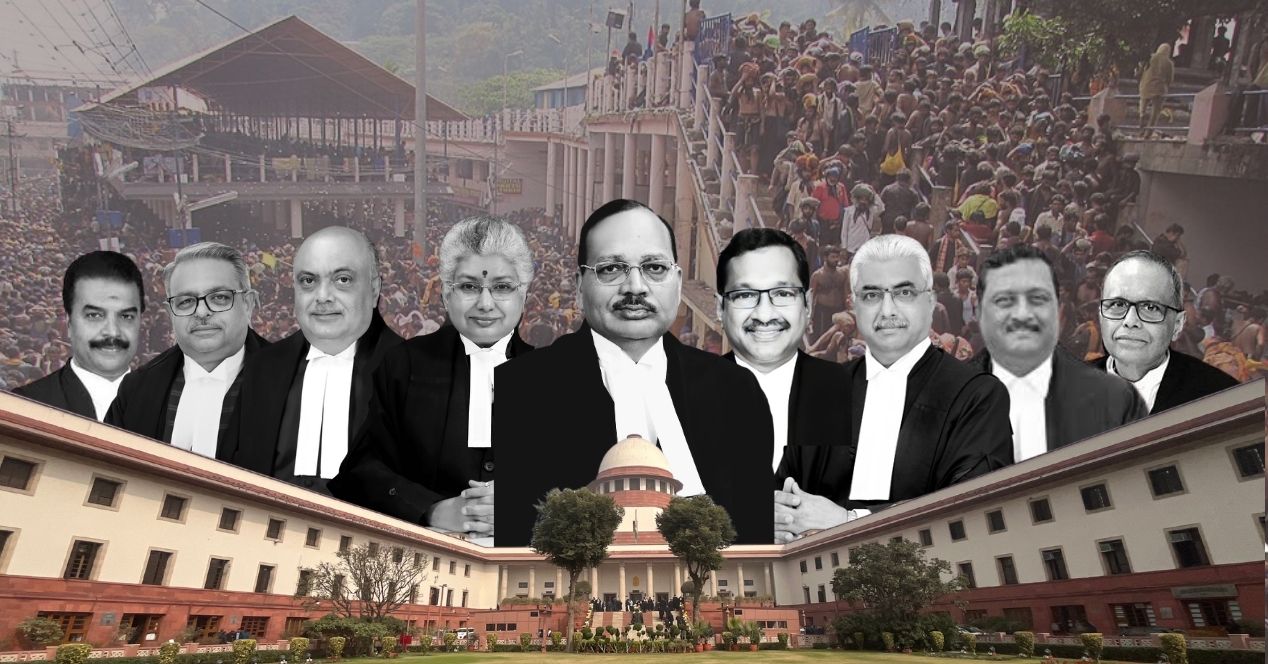
Sabarimala ReviewJudges: Surya Kant CJI, B.V. Nagarathna J, M.M. Sundresh J, Ahsanuddin Amanullah J, Aravind Kumar J, A.G. Masih J, P.B. Varale J, R. Mahadevan J, Joymalya Bagchi J
Today, the nine-judge Bench led by Chief Justice Surya Kant continued hearing the Sabarimala reference, with the Court repeatedly engaging with the limits of judicial review in matters of religion.
During the hearing, the Bench asked, “How do we test whether a practice is religious or not? Against what standard do we test it?” Senior counsel for the review petitioners responded with competing positions on whether such questions can be examined by courts at all, with arguments ranging from stopping inquiry once a practice is found to be religious, to applying constitutional standards such as proportionality and public order, morality and health.
Background
On 28 September 2018, in Indian Young Lawyers Association v State of Kerala, a Constitution Bench of Chief Justice Dipak Misra, Justices R. F. Nariman, A. M. Khanwilkar, D. Y. Chandrachud and Indu Malhotra, in a 4:1 majority, held that the Sabarimala Temple’s exclusionary custom prohibiting the entry of women is unconstitutional. The custom barred women between the ages of 10 and 50 years old from entering the temple. The Judgment held that the said custom, and Rule 3(b) of the Kerala Hindu Places of Public Worship (Authorisation of Entry) Rules, 1965 — which allowed religious denominations to exclude women from public places of worship based on custom, violated the fundamental right to freedom of religion of female worshippers under Article 25 of the Constitution. The Bench held that the devotees of Lord Ayyappa were not a separate religious denomination and that the custom was not an essential religious practice (ERP).
More than 50 review petitions were subsequently filed by various individuals and organisations including Kantaru Rajeevaru, the Chief Priest of the Sabarimala Ayyappa Temple, the National Ayyappa Devotees (Women’s) Association, the Nair Service Society and the All Kerala Brahmin’s Association.
After CJI Misra retired, the review petition was heard on 13 November 2018 by a Bench of CJI Ranjan Gogoi, and Justices Khanwilkar, Nariman, Chandrachud and Malhotra. On 14 November 2019, the review bench by a narrow 3:2 majority decided to keep the review petitions pending and referred certain overarching constitutional questions to a larger bench. The review will be decided after the questions are clarified. The majority found that the Sabarimala judgement will have a bearing on other freedom of religion cases. Justices Nariman and Chandrachud dissented, holding that this speculation went beyond the narrow scope of a review petition. They dismissed challenges against the review.
On 13 January 2020, a nine-judge Bench led by CJI S.A. Bobde and Justices, R. Banumathi, Ashok Bhushan, Nageswara Rao, Mohan M. Shantanagoudar, S. Abdul Nazeer, R. Subhash Reddy, B.R. Gavai and Surya Kant began hearing the reference. Parties raised concerns that a review bench cannot refer questions of law to a larger bench.
On 10 February 2020, the nine-judge Bench upheld the referral order issued in the November 14 judgement. It held that the Court had the power to refer a point of law to a larger bench in a review petition, however, it did not publish any reasons for this finding at the time. On 11 May 2020, the Supreme Court published a detailed judgement substantiating the maintainability of the reference.
On 16 February 2026, a Bench of CJI Surya Kant with Justices Joymalya Bagchi and Vipul Pancholi listed the case for arguments on 7 April 2026.
Key Issues
- What is the scope and extent of judicial review with regard to a religious practice as referred to in Article 25 of the Constitution of India?
- What is the scope and extent of the word ‘morality’ under Articles 25 and 26 of the Constitution of India and whether it is meant to include Constitutional morality?
- What is the scope and ambit of right to freedom of religion under Article 25 of the Constitution of India?
- Whether the rights of a religious denomination under Article 26 of the Constitution of India are subject to other provisions of Part III of the Constitution of India apart from public order, morality and health?
- What is the meaning of expression “Sections of Hindus” occurring in Article 25 (2) (b) of the Constitution of India?
- What is the inter-play between the rights of persons under Article 25 of the Constitution of India and rights of religious denomination under Article 26 of the Constitution of India?
Kaul: Limited override, not the rule
Continuing submissions from yesterday, Senior Advocate Neeraj Kishan Kaul submitted that Sri Venkataramana Devaru v State of Mysore (1957) recognises that the fundamental right to religion and rights of religious denominations are co-equal and of equal strength. It does not lay down any general principle that the right to manage religious affairs under Article 26(b) is subject to the restrictions under Article 25(2)(b) which empowers the State to make social welfare legislations to throw open Hindu institutions. Kaul argued the decision proceeds on harmonious construction and not subordination and that ordinarily Article 26(b) would operate fully in matters of religion, except in the limited situation of temple entry. He added that in all other religious matters, Article 26(b) should be given full play.
Justice B.V. Nagarathna observed that when legislation is enacted under Article 25(2)(b) and tested on public order, morality and health, she said, “It cannot be said that the right of a religious denomination will always prevail,” since those rights are themselves subject to these limitations and can form the basis of social reform. Kaul responded, “I cannot put it better. I agree.”
Kaul: Morality cannot be stretched
Justice Ahsanuddin Amanullah asked whether the word “morality” in Articles 25 and 26 could include “constitutional morality,” observing that constitutional morality may be a fluid concept, while morality per se may be more stable. Kaul responded that constitutional morality, in the Constituent Assembly Debates, was discussed in the context of governance. He submitted, “It was never intended as a limiting principle for interpreting religion under Articles 25 and 26.” He said there is a danger in importing it, since constitutional morality would bring within its fold all fundamental rights, the Preamble and the entire constitutional scheme.
He pointed out that Article 25 is subject to other provisions of Part III, whereas Article 26 is subject only to public order, health and morality. Referring to the drafting history, he said the framers consciously chose not to include a broader limitation and questioned whether the Court should introduce these words when the framers did not. Justice M.M. Sundresh observed that this would mean there is no independent concept of constitutional morality under Articles 25 and 26 and that at best it is the “spirit of the Constitution.”
Addressing what “morality” means, Kaul stated that it should not be understood as societal morality but from the standpoint of the community. He said he had attempted to define what we think morality means and drew an analogy with Article 19(2), explaining that in questions of obscenity, courts look at viewership, readership and audience into whose hand it goes and not from the perspective of “hypersensitive sensibilities.” He added that constitutional morality is aimed at harmonising fundamental rights and cannot at the same time serve as a tool to import an additional restriction into Articles 25 and 26. Referring to Justice Indu Malhotra’s dissent in the Sabarimala judgement he said, “It lays down the correct law.”
Radhakrishnan: Can non-believers challenge faith?
Senior Advocate K. Radhakrishnan submitted that the writ petitioners in the 2018 judgement are “practically non-believers.” He referred to the Makarajyothi proceedings in the Kerala High Court which considered whether the Makarajyothi light in the Sabarimala temple was a divine phenomenon or man-made. There, he argued, the state had refused to conduct an inquiry stating that it was a question of “religious faith and worship.”
He further submitted that the limitations under Article 25(1) are meant for securing peaceful coexistence in the nation. He contended that Articles 25(1) and 26 must be read together, with a bridging between them and that restrictions under Article 25(2)(a) and (b) cannot control denominational rights under Article 26. He added that when morality is considered under these provisions, there is also an element of public policy, in that the practice should not operate against society at large.
Muthuraj: Once religious, inquiry ends
Senior Advocate Jayanth Muthuraj reiterated that the conflict is between individual rights under Article 25(1) and denominational rights under Article 26(b). He argued that Article 25(1) begins with conscience and that a group of believers acting on shared conscience may themselves form a denomination, requiring a broader and more inclusive understanding of the term. He submitted that Article 26 is an expansion of Article 25(1) and that faith “may take many forms”. Justice Bagchi intervened, stating, “What troubles the Court is how is one to define a denomination?” He pointed out that when the Court delivers a judgement, it must apply a clear test, and asked, “How do we test whether a practice is religious or not? Second, against what standard do we test it?” He also noted that while other religions may rely on texts like the Bible or Quran, he asked, “How does one test practices within Hinduism?” Responding, Muthuraj submitted that the test cannot be confined to Vedic sources, pointing to other traditions and materials, and said that the test must be from the perspective of the believer or the guru, not from an abstract conception of religion as a whole. He said that if a practice is found to be religious, then the inquiry should stop there and should not extend into whether it is essential or integral. Justice Sundresh observed that wider import will have to be given to the word denomination to include different sects and groups, and noted that even private denominations may acquire a public character.
Venugopal: Essential practices test has no basis
Senior Advocate Krishnan Venugopal, appearing for the Jain community, Githarth Ganga, submitted that the Constitution does not contemplate absolute freedom of religion and that “most legitimate State objectives for intervention in matters of religion can be addressed within the three heads of public order, morality and health” under Articles 25(1) and 26. He argued that Article 25(1) protects individual conscience and is subject to wider limitations, while Article 26 secures institutional autonomy and is subject only to three restrictions without being made subject to the rest of the fundamental rights under Part III. He submitted that there is no need to rely on Article 25(2)(b) to justify State action on religious denominations, and said, “Morality and health can serve as substitutes for social reform.” On a fallback, he argued that even if Article 25(2) were applied, the essential religious practices doctrine has no textual foundation whatsoever, pointing out that the provision permits regulation of economic, financial, political or other secular activities associated with religious practice.
He also addressed the scope of State control over religious institutions, arguing that reforms should come from within the religion rather than State intervention. Justice Nagarathna asked whether, in a situation of public order between two denominations, the State could intervene, to which he responded that it can.
Kumar: Denomination, not an extension of Article 25
Senior Advocate Guru Krishna Kumar submitted that the Constitution draws a clear distinction between “religion” in Article 25 and “religious denomination or a section thereof” in Article 26, arguing that even groups which may not fit a narrow definition of denomination could still qualify as a “section thereof.” He argued that Article 25(2)(b) is an enabling provision for legislation and cannot be read as controlling Article 26. He submitted that if the framers intended both provisions to operate identically, there would have been no occasion to provide for Articles 25 and 26 separately, and that Article 26 is not merely an extension of Article 25.
He further argued that what are often described as “restrictions” imposed by denominations require a different lens of scrutiny and should be viewed as prescriptions flowing from the tenets of that faith. Justice Sundresh observed that Articles 25 and 26were separately placed to deal with different aspects such as administration and management, remarking that “they never expected arguments like these.” Kumar maintained that the correct approach is to trace such practices to denominational tenets and not treat them as external restrictions.
Kumar: Scope of review, denomination prevails
On the scope of judicial review, Kumar submitted that the rights of the religious denomination would prevail over individual claims in cases where an individual believer comes into conflict with the practices of a denomination.The Court’s role is limited in determining whether the practice under scrutiny exists within the denomination. He explained that where challenges are brought by non-believers, such proceedings may fail for lack of locus, describing Sabarimala as an example of such a situation. Further, he argued that courts should refrain from entering into the religious thicket when claims are brought by non-believers.
Divan: Reading rights together
Senior Advocate Shyam Divan, referring to the nine-judge Bench decision in I.R. Coelho v. State of Tamil Nadu (2007), submitted that fundamental rights cannot be read “in isolation” and “draw strength from each other.” He clarified that this does not mean that textual distinctions are ignored or that one provision is simply imported into another. He referred to the “golden triangle” of Articles 14, 19 and 21, and suggested that the Court may consider whether the time has come to expand this triangle so that the right to freedom of religion is also seen as part of that core constitutional structure.
He argued that where State action is justified on grounds of public order, morality or health, the doctrine of proportionality must be applied to assess its validity. He added that the Court is ultimately concerned with protecting liberty across different fields and that any interpretation adopted must be logically consistent, particularly in a case that will have wide constitutional implications.
Datar: “Morality” must stay consistent
Senior Advocate Arvind Datar submitted that “morality” in Articles 25 and 26 cannot be read as “constitutional morality,” pointing out that the phrase was “never contemplated” as a limiting principle for religious freedom. He argued that Article 25(1) operates with a legislative interface, and that restrictions based on public order, morality and health are legislative in nature and “cannot be elevated into a free-standing constitutional doctrine.”
Datar submitted that “morality” must be interpreted consistently across provisions such as Articles 19(2) and 19(4), where it has been understood as social morality, and cannot carry a different meaning under Article 25. He also raised the issue whether the term “person” in Part III includes juristic persons, submitting that it may not be correct to assume that idols cannot have fundamental rights and that the question must be examined contextually.
Shamshad: “Equally entitled to” cannot be majoritarian
Senior Advocate M.R. Shamshad, appearing for the All India Muslim Personal Law Board, submitted that the petition is framed as a PIL alleging violation of Articles 14, 19 and 21, with no reference to Article 26. He said it proceeds on the footing that women are not allowed to enter mosques. He clarified. “There is no quarrel across the religious denominations in Muslims that women cannot enter into mosque and that too for prayer,” adding that women can be part of the congregation, though “certain discipline has to be followed.” When Chief Justice Surya Kant asked, “For factual clarity, are women allowed to enter mosque?”, he answered in the affirmative.
Justice Amanullah asked him to “elaborate that right from the beginning,” noting that the position flows from the time of the Prophet and that the Hadith tradition has continued for the last 1200 years. Shamshad agreed. He said, “While it is preferable that a woman stays at home and gets the same religious reward as the man,” if she wishes to attend, “she can come.” Justice Nagarathna observed that it is not mandated for them to attend a congregation. On being asked to explain the reason, Shamshad said, “if everyone from the house goes then who will take care of the children?”
He submitted that comparisons with temple structures are misplaced, since a sanctum sanctorum has no place in the mosque and therefore no one can claim a right to stand at a particular place or position during prayer. He criticized M. Ismail Faruqui v Union of India (1994), stating that the observation that a mosque is not essential because namaz can be offered elsewhere is completely wrong and has led to difficulties in applying Article 25, since the masjid is the core of the belief of Muslims. Justice Nagarathna remarked, “It is as good as saying temple is not essential. Who is the court to decide that?” to which he responded, “Exactly.” He submitted that Article 25 operates as a “conditional fundamental right.” He relied on S.R. Bommai v Union of India (1994) to argue that religious freedom forms part of the country’s social fabric. He warned that the guarantee of being “equally entitled to” practice religion should not become “a victim to the majoritarian concept of law making.”
The Court will continue hearing arguments on 28 April.