


Analysis
Sequel Season
Recent challenges to the ECI’s exercise of plenary powers has left onlookers anticipating a legal sequel
When the Supreme Court upheld the Election Commission of India’s power to conduct a Special Intensive Revision (SIR) of electoral rolls, the constitutionality of the exercise appeared settled. Recent developments illustrate that this is not quite the case.
Concerns resurfaced with the deletion of 47 lakh voters in Delhi during phase III of the SIR. At first, this drew the Court’s attention to the mechanical issuance of notices to voters under the “unmapped” and “logical discrepancy” categories. The issue then escalated into a legal challenge when, on 22 September, the Court issued notice on a petition filed by RTI-activist Anjali Bhardwaj contesting the use of Form 6 for re-entry of deleted voters as well as modifications made to the form in July.
The petitioner’s argument is two-fold: First, Form 6 is a statutory document under the Registration of Electors Rules 1960 and can only be modified through a legislative process. Second, it is meant to be used by first-time voters and carries a declaration that the applicant has never been a registered voter before. Since Form 6 is the only way for a voter marked Absent, Shifted, Dead or Duplicate (ASDD) to make their way back to the electoral roll, they must falsely declare themselves as fresh voters. A false declaration is punishable under the Representation of People Act, 1951 with imprisonment up to one year.
In Phase I of the SIR, the ECI added Annexure D to the form, requiring voters to submit a list of documents if they were unable to map themselves to the previous SIR of 2002-3. In Phase II, the declaration was modified to mandate mapping of voters, their parents or grandparents to the earlier electoral roll. The change drew attention for hindering online Form 6 applications on the ECINet portal as applicants could not complete submissions without filing the declaration.
The ECI has maintained that annexing declarations to Form 6 does not constitute a change to the form. Observers disagree. Days after the Indian Express reported disagreements between Election Commissioners Dr. Sukhbir Sandhu and Dr. Vivek Joshi with Chief Election Commissioner Gyanesh Kumar, the ECI issued a press release contending that the Form 6 declaration has been upheld by the Supreme Court. On 12 October, a Bench of Chief Justice Surya Kant and Justice Joymalya Bagchi clarified that the new Form 6 was “neither approved nor disapproved” in its 27 May judgement.
The May decision could not have ruled on the new Form 6 as it was only introduced in July, but the question was not left untouched. The Court held that there is no absolute embargo on the ECI exercising its authority under Article 324 read with Section 21(3) of the RP Act even when the Parliament occupies the field. It affirmed the Commission’s residual authority to formulate an appropriate documentation framework suited to the SIR process and most importantly, noted that Form 6 can be tailored through the revision process under Section 21(2). The Court was equally clear about the limit: the ECI’s plenary powers cannot override an express statutory mandate or prohibition (See Page 42; Para 25 of the Judgement).
The ECI’s exercise of plenary powers has boomeranged and is now before the Court again, prompting the question of whether its discretion with Form 6 has overridden an express statutory mandate. A more significant question follows: must the Court test every exercise of the Commission’s plenary powers against the statute applicable in each instance? Or will it instead define a common legal boundary beyond which ECI’s discretionary actions become unconstitutional? Given the stakes for future electoral exercises, clarity from the Court on this point would be welcome.
Over the past few weeks, multiple petitions have been filed to challenge the legality of the ECI’s actions and one seeks a review of the May Judgement. With 13.6 crore deletions recorded across India so far, and the final rolls of Karnataka and Maharashtra yet to be public, the full impact of the SIR is unclear. Together, the new challenge appears like a legal sequel to the Court’s verdict and like most sequels, this one inherits the cast and unresolved plotlines of the original.
This article was first featured in SCO’s Weekly newsletter. Sign up now!
Related articles
Analysis
SC puts ECI on notice, asks petitioners to explain conduct
The Bench sought the ECI’s response to the INDIA bloc’s SIR challenge and asked a Petitioner to explain their conduct during Monday’s march.
Analysis
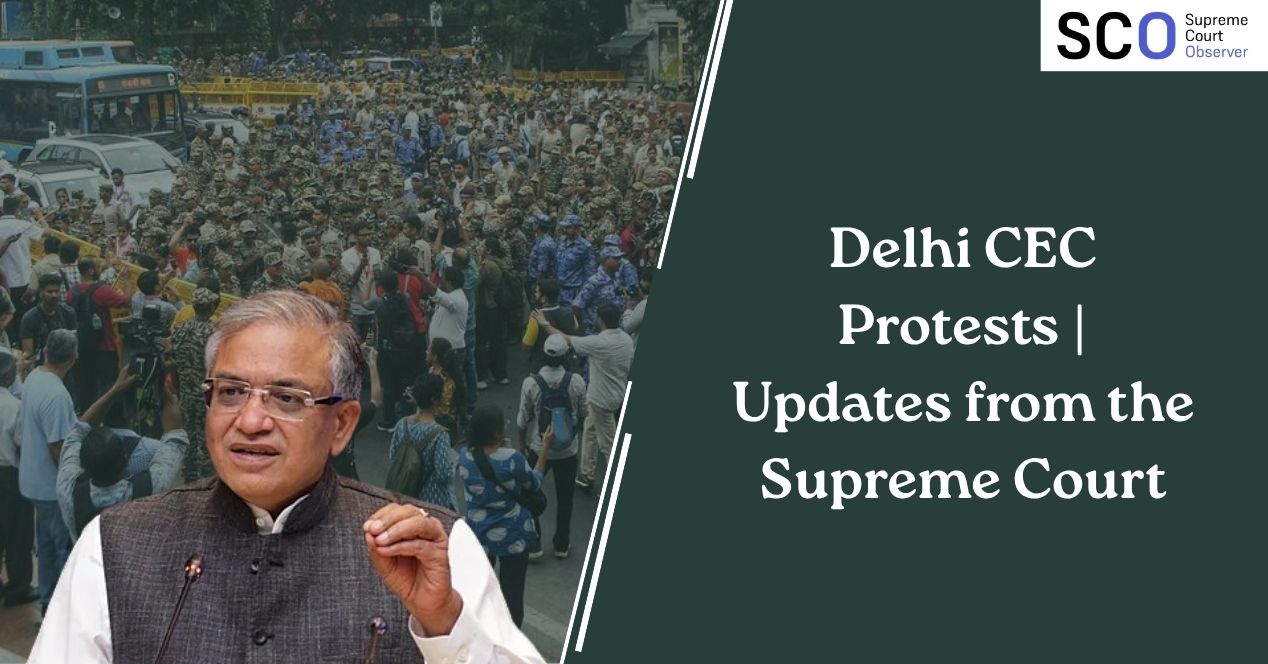
Delhi CEC protests | SC seeks police orders, considers plea for women-led committee
The Bench declined immediate restoration of Jantar Mantar as a protest site and sought State responses on 46 related petitions
Channel
What is Form 6 and why is it central to 13.36 Cr voter deletions?
The ECI has left only one path open for deleted voters to re-enter the list and it requires a false declaration that can land them in prison
Channel
Protests against the Chief Election Commissioner
In the recent weeks, protests have swept India on the demand for resignation of the Chief Election Commissioner Gyanesh Kumar