


Analysis
Justice J.K. Maheshwari: Notable judgements
As precise as his prose, Justice Maheshwari’s rulings were marked by clarity on rules of interpretation
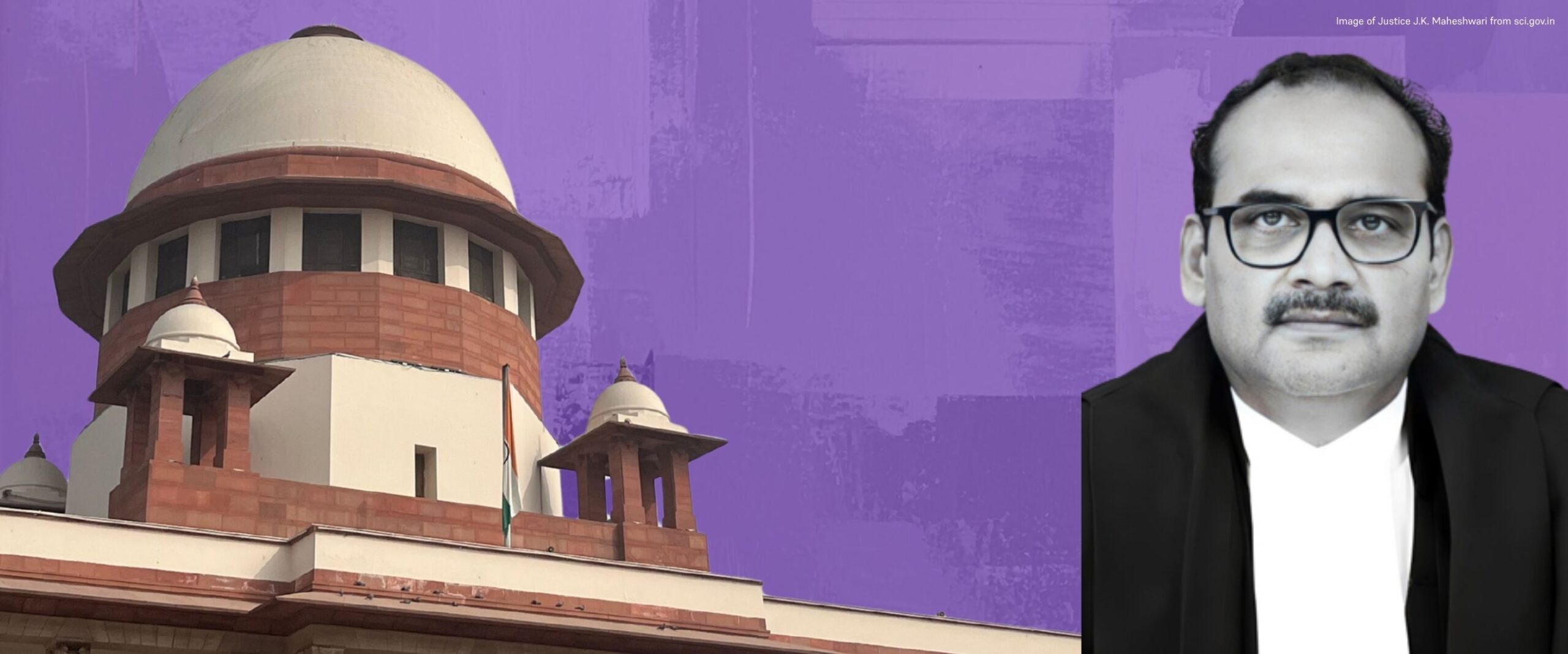
28 June 2026 marks Justice J.K. Maheshwari’s retirement from the Supreme Court after a tenure of four years and 10 months. Elevated in August 2021 from his position as Chief Justice of the Sikkim High Court, he has authored 171 decisions and participated in 307 benches.
In commemoration of his tenure, we revisit the significant judgements that form part of his legacy. Drafted in a precise and direct manner with little room for rhetoric, Justice Maheshwari’s writing is known for its brevity. His is the third retirement of the year, leaving the Court with 35 sitting judges and three vacancies.
Constitution Benches
In 2023, Justice Maheshwari participated in multiple notable five-judge Constitution benches. On 10 February, two Constitution Bench decisions were passed in Central Board of Dawoodi Bohra Community v State of Maharashtra and Bar Council of India v Bonnie Foi Law College. While the former referred the question of excommunication within the Bohra community to the nine-judge Sabarimala Review bench, the latter upheld the BCI’s power to conduct the All India Bar Examination.
On 14 March, Justice Maheshwari was on the Bench that dismissed a curative petition seeking enhanced compensation for victims of the Bhopal gas tragedy. The Court upheld the 1989 settlement as sufficient and asserted that curative petitions can only be filed in the case of fraud, which was not claimed by the Union.
On 1 May, in Shilpa Sailesh v Varun Sreenivasan, a Bench led by Chief Justice Sanjiv Khanna upheld the Court’s powers under Article 142 to grant divorce to parties without being bound by the procedural requirements of personal law.
Justice Maheshwari was also part of the bench in CBI v R.R. Kishore, which refused immunity to public officials arrested for offences committed before the immunity-granting provision was struck down as unconstitutional.
Environmental matters
In May 2026, Justice Maheshwari authored two significant decisions on environmental law on behalf of himself and Justice A.S. Chandurkar. First, in Neetu Solvents v Vineet Nagar, the Bench held that ex-post facto environmental clearance must be granted in strict conformity with applicable rules, particularly when closure causes greater adverse effects than regularization. Setting aside the National Green Tribunal’s order for closure of formaldehyde units in Rajasthan and Haryana, it allowed the units to operate despite procedural lapse as the regulating authority was unaware of prior clearance requirements.
A week later, in State of Uttar Pradesh v Reliance Industries, Justice Maheshwari clarified that the doctrine of public trust is rooted in environmental jurisprudence aimed at natural resource management and not determination of taxation or fiscal claims. The Bench was firm that the doctrine cannot be utilised to enable multiple taxation on a single inter-State transaction.
Statutory interpretation
On 10 April, in Milind v State of Maharashtra, Justices Maheshwari and Chandurkar iterated that the Probation of Offenders Act, 1958 is a beneficial legislation to be interpreted in a purposive manner. Observing that the Act aims to rehabilitate accused persons as reformed citizens, the Bench held that the term “release” extended to exemption from payment of fine and is not confined to imprisonment alone. It directed that the fines be paid not as penalty but as compensation to the victim(s).
On 10 December 2025, a Bench of Justices Maheshwari and Vijay Bishnoi adopted a similarly wide interpretation of “workplace” under the POSH Act, 2013 due to its intent as a social welfare legislation. Pronouncing the verdict in Dr Sohail Malik v Union of India, it held that complainants can approach the Internal Complaints Committee in their own workplace even if the accused is an employee in a different workplace visited by the complainant.
In August 2025, Justice Maheshwari authored the decision in a Presidential reference on behalf of himself and Justice Aravind Kumar. Called upon to settle conflicting high court opinions on Article 317 which provides for removal or suspension of Public Service Commission members, the Bench clarified that the provision requires proof of specific individual acts. It upheld a plain reading to reject the argument that members of the Commission were ‘collectively responsible’ for the Arunachal Pradesh Public Service Commission (APPSC) examination paper leak.
Jurisdiction
In October 2025, in Legislative Council U.P., Lucknow v Sushil Kumar, a Bench of Justices Maheshwari and Bishnoi held that constitutional courts may direct investigations by the Central Bureau of Investigation (CBI) only as a measure of last resort. Setting aside the Allahabad High Court’s order for a CBI probe into alleged State favouritism towards an external examination-conducting agency, the Bench cautioned that courts must exercise judicial discretion before burdening specialised bodies.
Just a few months prior, Justice Maheshwari authored another decision in Partha Das v State of Tripura which held that executive instructions can only supplement, and not override, statutory rules in a recruitment process. Partly setting aside the Tripura High Court’s decision, it clarified that application of the State’s New Recruitment Policy midway through the process amounted to an illegal change of rules.
Related articles
Analysis
Justice Pankaj Mithal’s Notable Judgements
From Waqf to Sub-classification of Scheduled Caste Persons, Justice Mithal has been a part of it all
Analysis
Justice Rajesh Bindal’s Notable Judgements
Highly regarded by the Bar for his calm disposition, Justice Bindal did it all. We list his notable judgements
Analysis
10 notable judgements by CJI Gavai
Two recalls, a Presidential reference, and a stay order in a highly contentious issue of our times—a list of the outgoing CJI’s key verdicts

Analysis
Justice Sudhanshu Dhulia’s notable judgements
Highlights include a dissent in a long-pending case, a stirring verdict on language recognition and a reiteration of evidence law principles